
You’re probably in the same spot many Alberta buyers reach right before they make an offer. You’ve looked at homes in Calgary, maybe compared a newer place in Airdrie with something a bit larger in Red Deer, and your monthly payment estimate feels manageable. Then someone mentions broker fees, lender fees, closing costs, and suddenly the mortgage side feels harder to read than the property side.
One of the most common questions we hear is: “How much does a mortgage broker cost?”
The good news is that for most residential mortgages, working with a mortgage broker does not cost you anything directly. In many cases, the lender pays the broker after your mortgage funds, allowing you to receive professional advice and access to multiple lenders at no additional cost.
However, there are situations where broker fees may apply, such as:
✔ Private mortgages
✔ Alternative lending solutions
✔ Self-employed mortgage applications
✔ Credit-challenged borrowers
✔ Commercial financing
✔ Construction mortgages
When fees are required, they must be clearly disclosed before you commit to any mortgage solution.
A mortgage broker does more than find a competitive rate. We help compare lenders, structure financing, negotiate terms, navigate underwriting challenges, and guide you through the entire mortgage process from application to funding.
Whether you’re purchasing your first home, refinancing, renewing your mortgage, or investing in real estate, understanding mortgage costs is an important part of making informed financial decisions.
Many first time home buyers searching for mortgage get confused about mortgage broker fees. That confusion is normal. Most buyers don’t mind paying for value. What they dislike is not knowing who gets paid, when they get paid, and whether a “no-fee” mortgage is cheaper.
In Alberta, especially in active markets like Calgary, Cochrane, Chestermere, Okotoks, and Airdrie, the practical question extends beyond “Does a mortgage broker charge a fee?” Instead, the better question is, “What is the total cost of this mortgage once rate, lender compensation, and closing structure are all considered?” If you understand that, you’re far less likely to choose a mortgage that looks good on the surface but costs more over time.
If you also want a broader view of buyer expenses, this guide to closing costs for a Calgary home purchase is worth reviewing alongside your mortgage comparison.
Table of Contents
- The Hidden Costs Every Alberta Homebuyer Asks About
- What Exactly Is a Mortgage Broker Fee?
- How Mortgage Broker Fees Are Calculated in Alberta
- Lender-Paid vs Borrower-Paid Fees A Detailed Comparison
- Sample Fee Calculations for Alberta Homebuyers
- Broker Disclosures and Potential Red Flags
- Your Path to a Clear and Affordable Mortgage
- Frequently Asked Questions
The Hidden Costs Every Alberta Homebuyer Asks About
A first-time buyer in Calgary often starts with the payment. That makes sense. You check the mortgage amount, test a few rates, and decide what feels comfortable each month. The trouble starts when the conversation shifts from payment to transaction cost.

In practice, this comes up all the time. A buyer in Cochrane may think the only real question is whether one lender is offering a slightly better rate than another. A buyer in Red Deer may hear that working with a broker is “free.” Someone shopping in Chestermere or Okotoks may assume a broker fee is a separate bill they need to budget for in cash. All three ideas can be incomplete.
Why this feels confusing
Mortgage costs are layered. Some charges show up clearly. Others are built into the deal structure. Broker compensation sits right in the middle of that.
Here’s what usually makes buyers uneasy:
- The language is inconsistent. One person says broker fee. Another says commission. A third says lender-paid compensation.
- The cost visibility changes. You may not see a separate line item even when compensation exists.
- The cheapest-looking option isn’t always the lowest-cost option. A lower upfront fee can come with a tradeoff elsewhere in the mortgage.
The safest way to compare mortgages is to compare the full structure, not just the headline rate and not just whether a fee appears on page one.
What buyers in Alberta actually need to know
If you’re buying in Calgary or Airdrie, the key issue isn’t whether mortgage broker fees exist. They do. The useful question is how they’re paid and what value you’re getting for them.
A clear mortgage comparison should answer four things:
- Who is paying the broker (Most A side deals are being paid to the broker by the lender)
- Whether any fee is due directly from you (Often happen if a private mortgage is arranged)
- How that affects the mortgage rate or total borrowing cost
- What happens if your file is more complex than a standard salaried application
Once those answers are on the table, the stress level usually drops fast. Buyers stop guessing and start comparing properly.
What Exactly Is a Mortgage Broker Fee?
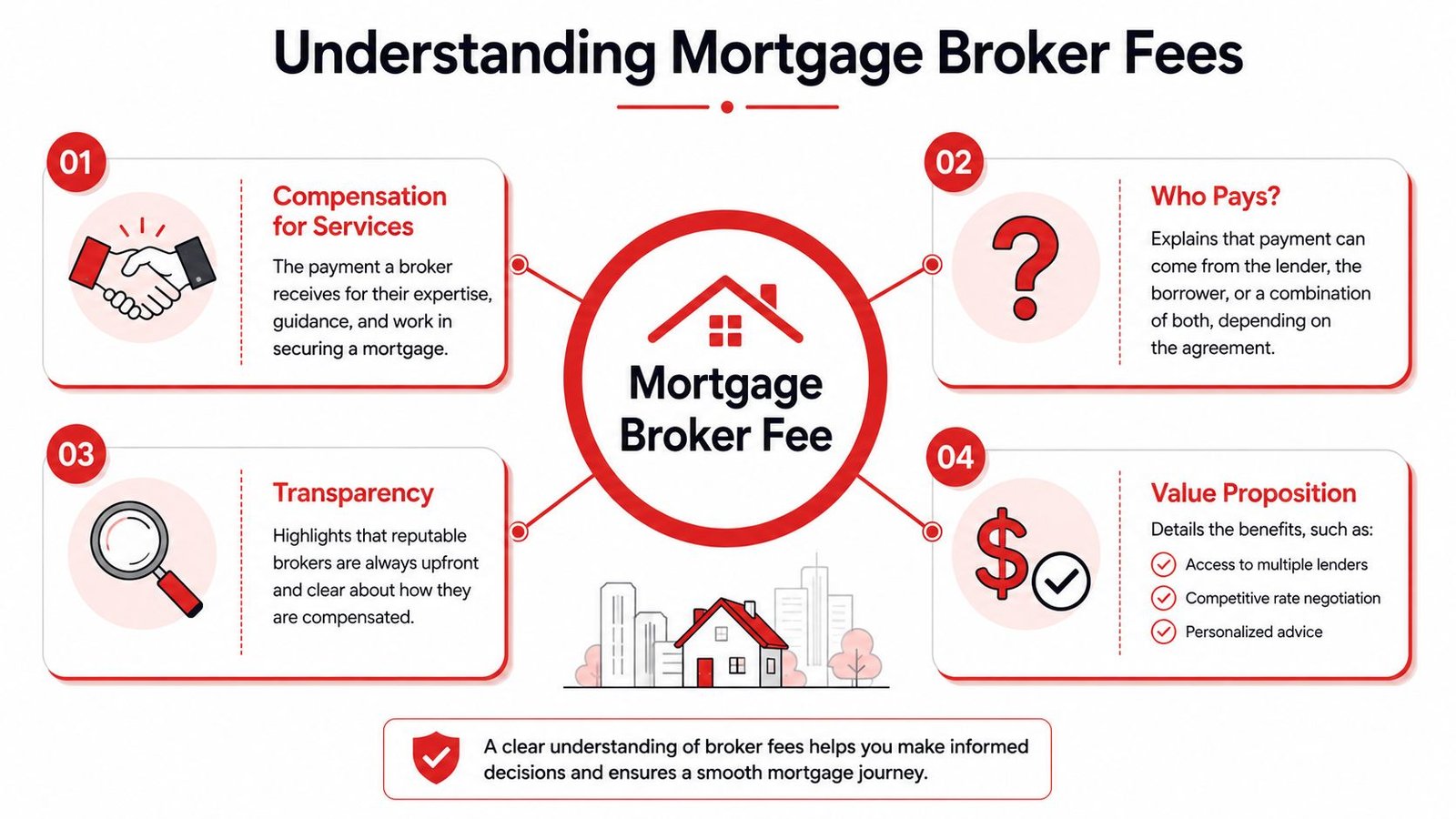
A mortgage broker fee is the compensation paid for the work involved in arranging your mortgage. This usually happens when the mortgage broker secures a private lender mortgage for the buyer. That work can include reviewing your application, matching your file to a suitable lender, packaging the documents, explaining conditions, solving qualification issues, and staying involved until the mortgage funds.
A simple way to think about it is this. A broker is a bit like a travel agent for mortgage products, except the decision is larger and the paperwork is far stricter. Instead of checking one lender’s shelf, a broker checks multiple lender options and helps you weigh rate, penalty structure, prepayment flexibility, and approval fit.
What the fee is paying for
The fee is not just for “finding a rate.” A good broker’s value usually shows up in the less visible parts of the process. The mortgage broker fees usually come into picture for hard to finance deals funded through private lenders.
- Lender matching: A file for a salaried buyer in Calgary may fit one lender easily, while a self-employed buyer in Okotoks may need a completely different lender policy.
- Document handling: Income, down payment, liabilities, and property details all need to be packaged properly.
- Term review: Two mortgages can look similar on rate and behave very differently if you break them early or need flexibility later.
- Problem solving: Newcomers, contract workers, and commission-based earners often need more than a standard application path.
The most misunderstood part
For borrowers in Canada, the payment source changes the cost’s visibility, not its existence. When a lender pays the broker, the borrower may not see a line item, but the commission is part of the transaction. This is why a “no fee” message can be misleading unless you compare the total loan structure, not just the upfront charge, as explained in NerdWallet’s guidance on working with a mortgage broker in Canada.
Practical rule: If someone says the broker is free, ask one more question. “Free upfront for me, or lower cost overall?”
Where the value is real and where it isn’t
Broker fees make sense when the broker is giving you access, clarity, and better decision-making during private lending and B side lending. They don’t make sense if the advice is vague, the lender range is narrow, or the compensation discussion is avoided.
The fee should feel tied to actual work. You should be able to understand what the broker is doing for you, how they’re being paid, and why the recommendation fits your file.
How Mortgage Broker Fees Are Calculated in Alberta
In the Canadian market, mortgage broker compensation is typically tied to the loan amount. A side deals are usually compensensated by the lenders. The private deals are usually not compensated by the lenders. Industry guidance cited in broker-education material places compensation at roughly 0.5% to 2.75% of the loan amount, with a common 1% to 2% range, and minimum fees often reported at $1,000 to $3,000. On a $400,000 mortgage, that works out to roughly $2,000 to $11,000 in commission, which shows how strongly compensation scales with mortgage size, as outlined in Cedar Home Loans’ explanation of mortgage broker fees in Canada.
That doesn’t mean every Alberta borrower is paying that amount directly out of pocket. It means that compensation on the mortgage file is commonly calculated as a percentage of the mortgage balance.
The basic formula
For a percentage-based structure, the math is simple:
| Mortgage amount | Compensation rate agreed | Approximate fee |
|---|---|---|
| $400,000 | 0.5% | $2,000 |
| $400,000 | 1% | $4,000 |
| $400,000 | 2% | $8,000 |
| $400,000 | 2.75% | $11,000 |
This is why buyers in Calgary and surrounding communities should pay attention to loan size. A small difference in compensation percentage creates a much bigger dollar effect as the mortgage gets larger.
What this means in Alberta practice
For many standard files, especially with prime lending, the compensation is often handled through the lender side of the transaction. For more difficult files, the compensation structure can change.
Here are the practical points that matter:
- Prime files often follow a lender-paid model. The broker is compensated from the lender side rather than collecting a separate invoice from the client.
- Complex files can trigger direct fees. This can happen when extra underwriting work, lender placement difficulty, or non-standard financing is involved.
- Minimum fees matter more on smaller mortgages. A floor of $1,000 to $3,000 can represent a larger percentage burden on a smaller loan than on a larger one.
Why small mortgages can feel disproportionately expensive
A percentage-based fee scales naturally. Minimum fees do not. That’s the part many buyers miss.
If you’re purchasing a lower-priced property in Red Deer or a condo in Calgary with a smaller mortgage amount, a minimum fee can have a heavier impact on the economics of the deal than it would on a larger detached purchase in Airdrie or Chestermere.
When a file is small, unusual, or harder to place, don’t focus only on whether there’s a fee. Focus on whether the mortgage itself still solves the financing problem at a reasonable overall cost.
Lender-Paid vs Borrower-Paid Fees A Detailed Comparison
The cleanest way to understand mortgage broker fees is to separate them into two models. One is lender-paid compensation. The other is a borrower-paid fee.
They are not the same thing, and they are not used in the same situations.
Side by side comparison
| Feature | Lender-Paid Commission | Borrower-Paid Fee |
|---|---|---|
| Who pays the broker | The lender pays compensation within the transaction structure | The borrower pays directly, usually through closing arrangements |
| What the borrower sees | Often no separate broker invoice | Usually disclosed as a direct fee |
| Common use case | More typical on standard mortgage files | More common on difficult, non-standard, or alternative files |
| Main risk for the borrower | Assuming “no fee” means no cost | Focusing on upfront fee without weighing the mortgage solution |
| Best comparison method | Compare total loan cost and mortgage terms | Compare both the fee and the mortgage outcome |
For many Alberta buyers, the mistake is assuming the first column means the broker has no cost attached. That isn’t the right way to read it.
Consumer guidance notes that when the lender pays the broker, the cost can be built into the mortgage pricing. That’s why a “free broker” pitch can be misleading unless you compare the all-in cost, not just the absence of an upfront fee, as Bankrate explains in its article on how mortgage broker compensation works.
When lender-paid works well
If you’re a typical salaried homebuyer in Calgary or Cochrane with solid credit, stable income, and a straightforward purchase, lender-paid compensation often works smoothly. It keeps the transaction simpler from a cash-flow perspective because you’re not usually writing a separate cheque to the broker.
That said, “simpler” doesn’t automatically mean “cheaper.” You still need to compare the total structure carefully. For this, a proper mortgage broker vs bank comparison in Calgary and Alberta becomes useful.
When borrower-paid can still make sense
Borrower-paid fees are more common when the broker is doing extra work to place a file with limited options. Think of situations involving bruised credit, unusual income, short timelines, or private lending.
That doesn’t make the fee bad. It just means the value test changes. You ask:
- Does this mortgage solve a financing problem I can’t solve elsewhere?
- Is the broker being clear about the fee in writing?
- Am I comparing the full cost, not reacting only to the word “fee”?
If the answer to those questions is yes, a borrower-paid structure can still be a rational choice.
Sample Fee Calculations for Alberta Homebuyers
Numbers make this easier to grasp. The examples below use the common 1% to 2% band cited in Canadian guidance. These examples show how mortgage broker fees can scale with mortgage size. They do not mean every borrower will pay these amounts directly.
A Red Deer example using the verified benchmark
On a $400,000 mortgage, a 1% compensation level equals $4,000. A 2% level equals $8,000.
Math:
- $400,000 × 1% = $4,000
- $400,000 × 2% = $8,000
This fits neatly within the broader Canadian compensation range cited earlier.
A Calgary example with a larger mortgage
On a $600,000 mortgage, using the same common band:
- $600,000 × 1% = $6,000
- $600,000 × 2% = $12,000
For a Calgary buyer, that’s why loan size matters so much. Once the mortgage gets larger, even a normal percentage-based compensation model becomes a meaningful dollar figure.
An Airdrie purchase with straightforward math
A buyer in Airdrie with a $400,000 mortgage is often surprised that the same compensation formula used elsewhere can translate into thousands of dollars in the background of the file, even if the borrower doesn’t see a separate bill.
That’s the practical lesson. Mortgage broker fees are usually easier to understand when you stop thinking of them as a flat service charge and start thinking of them as loan-size-based compensation.
A borrower-paid scenario on a smaller or harder file
Now consider a file where a direct fee applies instead of standard lender-paid compensation. Canadian guidance notes that minimum fees often start around $1,000 to $3,000.
For a tougher file in Cochrane or Okotoks, a direct fee within that range may be disclosed and settled at closing. On a smaller mortgage, that minimum can feel expensive fast. The fee may still be worth it if the broker is solving a problem that a mainstream lender won’t handle, but it needs to be weighed against the entire mortgage result.
The right comparison isn’t “fee versus no fee.” It’s “total borrowing outcome versus total borrowing outcome.”
Broker Disclosures and Potential Red Flags
A professional mortgage process should feel clear, not slippery. If you’re dealing with mortgage broker fees and you still can’t tell who is paying whom, that’s not a small issue. That’s a trust issue.
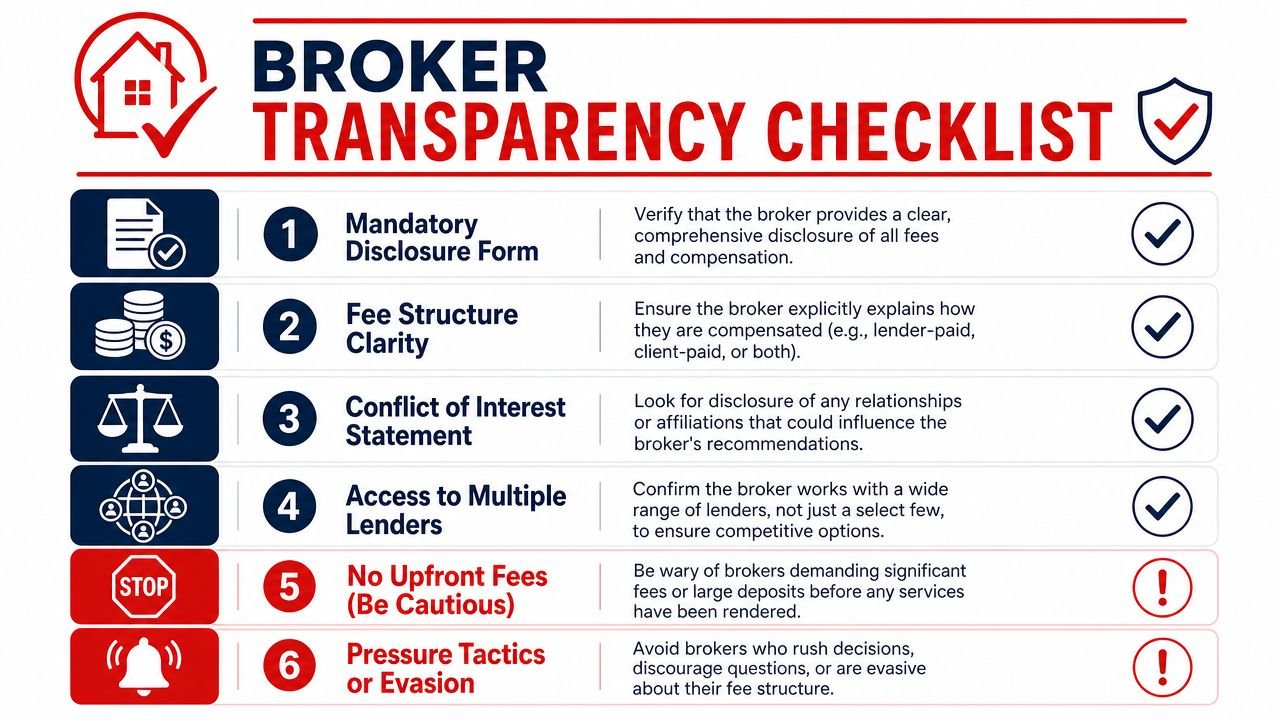
The practical standard in Alberta is simple. You should expect written disclosure, direct answers, and a recommendation that can be explained in plain language.
What clear disclosure should look like
A transparent broker should be able to tell you:
- How they’re compensated: lender-paid, borrower-paid, or a specific alternative arrangement
- When a direct fee applies: especially if your file is outside standard lending
- What tradeoffs come with the recommended mortgage: not only the rate, but also restrictions and penalties
- Why the product fits your file: not just that it was “approved”
Red flags buyers should take seriously
Not every problem starts with a bad rate. Sometimes it starts with weak communication.
Watch for these warning signs:
- Evasive compensation answers: If the broker avoids a straight answer on fees, pause.
- Pressure to move quickly without explanation: Speed matters in mortgages, but pressure without clarity is different.
- No written breakdown: Important terms should not live only in a phone call.
- One-option advice presented as market advice: A broker should be clear about whether they evaluated multiple lenders or recommended a single path.
A short video can also help buyers understand how transparency should sound in a real conversation.
Why this matters even when the rate looks good
A lower rate can still come with a more expensive overall deal if other costs rise around it. That concern isn’t theoretical. Independent research from J.P. Morgan Chase Institute found broker-intermediated loans were, on average, $739 more expensive in closing costs for some borrowers, highlighting why cost transparency matters so much. You can review that finding in J.P. Morgan Chase Institute’s research on hidden closing costs and lender differences.
That doesn’t mean brokers are a bad option. It means the right broker must be transparent enough that a competitive rate isn’t undermined by other charges.
Your Path to a Clear and Affordable Mortgage
The smartest Alberta buyers don’t judge a mortgage by one label. They don’t assume “no broker fee” means lower cost, and they don’t assume a direct fee automatically means bad value. They compare the full deal.
That’s the habit that protects you whether you’re buying in Calgary, Cochrane, Red Deer, Chestermere, Airdrie, or Okotoks. Look at who is paying the broker, whether compensation is built into the mortgage structure, and whether the product still makes sense once all the moving pieces are on the table.
If you want help comparing options properly, this overview on why many Alberta buyers use a mortgage broker is a useful next read.
When the process is handled well, mortgage broker fees stop feeling mysterious. They become just one part of a mortgage decision that you understand clearly.
Contact Guriqbal Chahal, MBA, PMP
Mortgage Broker | Dreamhouse Mortgage
📞 403-966-6072
Frequently Asked Questions
As a first-time homebuyer, should I avoid brokers who charge a fee?
Not automatically. The better question is whether the fee is appropriate for the file and clearly disclosed. For many first-time buyers with straightforward income and good credit, the broker is often compensated through the lender side of the transaction rather than by a direct upfront charge from the buyer.
If a fee is being charged directly, ask why. The explanation should be specific. If the broker can show that your file requires a non-standard lending route, extra underwriting work, or access to a product you likely wouldn’t secure on your own, then a fee may be justified. If the explanation is vague, keep asking questions.
I’m a newcomer to Canada. Will I have to pay mortgage broker fees directly?
Sometimes, but not always. New-to-Canada files can be placed with mainstream lenders in many cases, especially when the rest of the application is strong. In those situations, the compensation may still come from the lender side.
Direct borrower-paid fees become more likely when the file needs alternative lending, extra exception work, or a lender with more flexible qualification rules. What matters most is that the broker tells you this early and explains all available options in plain language.
I’m self-employed. How do broker fees usually work for me?
Self-employed borrowers often need more careful lender matching because income presentation matters a lot. If your file fits a lender’s standard policy, the compensation may still follow a lender-paid model. If the file needs an alternative route, a direct fee can come into the conversation.
The important part isn’t just the fee itself. It’s whether the mortgage solves the income-document issue properly and whether the broker has experience placing self-employed files without steering you into a more expensive option than necessary.
Is a no-fee broker quote actually cheaper?
Not always. A no-fee quote may mean you do not see a direct broker invoice. It does not automatically mean the total mortgage cost is lower.
To judge properly, compare:
- The mortgage rate
- The term and restrictions
- Prepayment flexibility
- Penalty structure
- Any direct borrower-paid fees
- Any signs that compensation is built into the mortgage pricing
That full comparison matters much more than the phrase “no fee.”
What should I ask a broker before I apply?
Keep it simple and direct. Ask these questions:
- How are you being paid on my file?
- Will I owe any direct fee, and if so, when?
- How many lender options fit my situation?
- What tradeoffs come with the mortgage you’re recommending?
- If I break this mortgage early, what should I expect?
If the answers are clear, specific, and written down when needed, you’re usually dealing with a much stronger process.
If you want straight answers about mortgage broker fees, rate structure, and total borrowing cost, talk to DreamHouse Mortgage. Buyers across Calgary, Cochrane, Red Deer, Chestermere, Airdrie, and Okotoks can get clear guidance without the guesswork.
Drafted with Outrank tool