
Business Financials Mortgage Qualification in Alberta
Business financials mortgage qualification is the process lenders use to evaluate the financial performance and stability of self-employed individuals and business owners before approving a mortgage loan. For Alberta business owners in Calgary, Airdrie, Cochrane, Chestermere, and Edmonton, this process is more complex than a standard salaried application. Lenders examine income consistency, credit scores, debt-to-income ratios, and business structure to assess repayment risk. Understanding what lenders look for, and how to prepare your financial records, is the difference between a fast approval and a frustrating decline. This guide covers every factor that drives mortgage approval for self-employed borrowers in Alberta.
What financial documents do lenders require from Alberta business owners?
Lenders require specific financial documentation to verify that your self-employment income is real, consistent, and sustainable. The standard requirement is 2 years of self-employment income documentation for conventional mortgage qualification. Businesses operating for more than 5 years may qualify with only 1 year of tax returns, but this is an exception rather than the rule.
Core documents lenders request
The documentation list for self-employed borrowers in Alberta is longer than most people expect. Here is what you need to prepare:
- T1 General tax returns: Two years of personal tax returns, including all schedules and the Notice of Assessment from the Canada Revenue Agency.
- Business financial statements: Profit and loss statements and balance sheets, typically prepared by a chartered professional accountant (CPA).
- Business bank statements: 12–24 months of business account statements showing actual cash deposits and operating activity.
- Business license or registration: Proof that your business is legally registered in Alberta, whether as a sole proprietorship, corporation, or partnership.
- Articles of incorporation: Required for incorporated businesses to confirm ownership percentage and business structure.
- GST/HST returns: Canada Revenue Agency filings that confirm business revenue and activity levels.
Lenders do not simply accept the bottom line on your tax return. They analyze cash flow to distinguish between taxable income and the actual cash available to you as the owner. A business generating strong revenue but reporting low net income due to legitimate deductions will face extra scrutiny. The lender wants to confirm that distributions from the business do not threaten its ongoing viability.
Alberta-specific considerations also apply. If you operate through a corporation registered in Alberta, lenders will request T2 corporate tax returns in addition to your personal T1 returns. Sole proprietors filing a T2125 business income statement face a simpler documentation path, but the 2-year income history requirement still applies. For a complete checklist of required documents, the Alberta mortgage documents guide from Dreamhouse Mortgage outlines exactly what to gather before you apply.
Pro Tip: File your taxes on time every year. Lenders in Alberta will request your Notice of Assessment from the Canada Revenue Agency to confirm your returns are filed and accepted. A missing or late NOA can stall your mortgage approval by weeks.
The most common mistake self-employed borrowers make is assuming their gross revenue is what lenders use to calculate qualifying income. Lenders use net income after expenses, averaged over 2 years. If your net income dropped significantly in year 2, lenders may use the lower figure or average both years, whichever is less favorable to you.
How do credit scores and debt-to-income ratio affect mortgage approval?
Your credit score and debt-to-income ratio are the two fastest filters lenders apply to any mortgage application. For self-employed borrowers in Alberta, both metrics carry extra weight because income is harder to verify than a T4 employment slip.

Credit score thresholds for self-employed borrowers
Credit score minimums for conventional mortgages start at 620, but scores above 740 secure the best interest rates and mortgage terms. Alternative loan programs accept scores in the 620–640 range, but they require higher down payments of 10%–30%. A score below 620 effectively closes the door on most institutional lenders in Canada and pushes borrowers toward private mortgage solutions.
For Alberta business owners, credit scores are affected by several factors specific to running a business:
- Business credit cards reported personally: If you carry personal guarantees on business credit accounts, those balances appear on your personal credit report.
- Missed business loan payments: Any personally guaranteed business loan that falls behind will damage your personal credit score directly.
- High credit utilization: Using more than 30% of your available personal credit limit lowers your score, even if your business cash flow is strong.
- Multiple credit inquiries: Shopping for business financing aggressively can trigger hard inquiries that temporarily reduce your score.
Debt-to-income ratio limits and business debt
Debt-to-income ratio limits for self-employed borrowers typically range from 43% to 50%, with some lenders permitting higher ratios when compensating factors like strong credit or significant cash reserves are present. Your DTI is calculated by dividing your total monthly debt obligations by your gross monthly income.
The trap for business owners is personal guarantees. Business debts personally guaranteed by the borrower are included in the DTI calculation, even if the business makes every payment on time. A $3,000 monthly business loan payment that you personally guaranteed counts against your DTI the same as a personal car loan. This is one of the most overlooked factors in business financials mortgage qualification.
Tax-deductible business expenses reduce net income on tax returns, which lowers your qualifying income and the mortgage amount you can access. The more aggressively you write off expenses, the lower your reported income, and the smaller the mortgage a lender will approve. This is the core tension every self-employed borrower in Calgary, Red Deer, and Edmonton faces.
Pro Tip: If you plan to apply for a mortgage in the next 12–18 months, talk to your accountant about moderating your write-offs for that period. Reporting slightly higher net income will increase your qualifying income and may unlock a significantly larger mortgage.
Conventional vs. alternative mortgage products for business owners
Not every self-employed borrower in Alberta will qualify for a conventional mortgage. The right product depends on how your income is reported and how long your business has been operating.
Conventional mortgages
Conventional mortgages rely on T1 personal tax returns and the net income reported after all business deductions. Lenders average 2 years of net income to calculate your qualifying amount. This product offers the lowest interest rates and the most favorable terms, but it requires clean, consistent income documentation. If your net income is low due to write-offs, a conventional mortgage may approve you for far less than your actual cash flow supports.
Bank statement mortgages
Bank statement loans use 12–24 months of business bank deposits rather than tax returns to calculate qualifying income. This product is designed for borrowers whose tax returns understate their true earnings. The lender reviews actual cash flowing into your accounts and uses a percentage of those deposits as qualifying income. The trade-off is a higher interest rate and a larger required down payment compared to conventional products.
P&L statement mortgages
P&L mortgage loans use a 12-month CPA-prepared profit and loss statement to qualify borrowers instead of personal tax returns. The P&L statement must typically be dated within 90 days of the application and may need to be supported by recent bank statements. This product suits borrowers with strong recent profitability who cannot show 2 full years of consistent tax-return income.
Comparison of mortgage products for Alberta self-employed borrowers
| Feature | Conventional mortgage | Bank statement mortgage | P&L statement mortgage |
|---|---|---|---|
| Income verification | T1 tax returns, 2 years | 12–24 months bank deposits | CPA-prepared P&L, 12 months |
| Credit score minimum | 620 (740+ for best rates) | 620–640 | 620–640 |
| Down payment | Standard (5%–20%) | 10%–30% | 10%–30% |
| Interest rate | Lowest available | Higher than conventional | Higher than conventional |
| Best suited for | Consistent net income | High revenue, high write-offs | Recent profitability growth |
| Documentation burden | Moderate | High | Moderate to high |
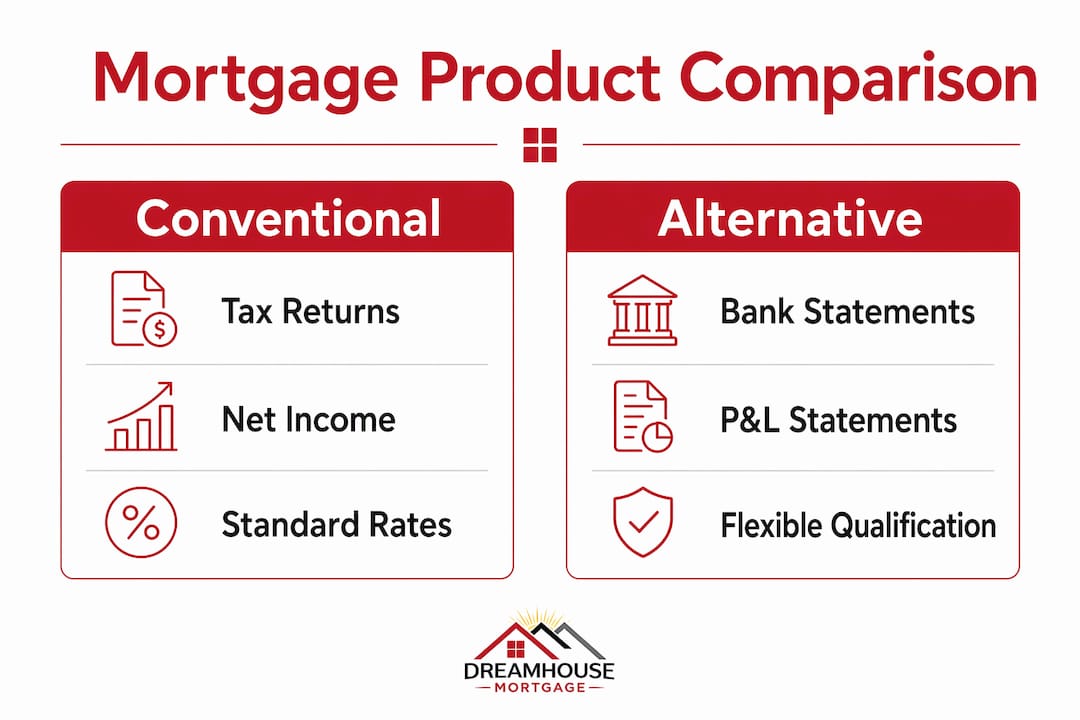
Alternative mortgage products offer viable paths for borrowers whose tax returns do not reflect their true cash flow due to legitimate business expenses. The cost is real: higher rates and fees add up over a 5-year term. Borrowers should calculate the total cost difference before choosing an alternative product over a conventional one.
Pro Tip: Ask your mortgage broker to run both a conventional qualification and a bank statement qualification side by side. The rate difference may be smaller than you expect, and the qualifying income difference may be significant enough to justify the alternative product.
For a deeper look at how lenders in Canada categorize self-employed borrowers, the self-employed mortgage lender types guide from Dreamhouse Mortgage breaks down the full lender spectrum from banks to private lenders.
How does business structure affect business financials mortgage qualification in Alberta?
Business structure is one of the most underestimated factors in qualifying for a mortgage as a self-employed borrower. Business legal structures directly influence lender risk assessment and income calculation methods. How your business is organized determines which income documents lenders request and how they calculate your qualifying income.
Sole proprietorships
Sole proprietors in Alberta report business income on their personal T1 return using the T2125 form. Lenders treat this income as personal income, which simplifies the qualification process. The full net income from the T2125 flows into the qualifying income calculation after averaging 2 years. This is the most straightforward structure for mortgage qualification.
Incorporated businesses
Incorporated business owners face a more complex review. Lenders need to see both the T2 corporate return and the personal T1 return. Your qualifying income is based on what you actually paid yourself, either as salary reported on a T4 or as dividends. Retained earnings sitting inside the corporation do not count as personal income unless they were distributed to you.
Here is where the structure creates real challenges for business financials mortgage qualification:
- Salary income: T4 salary from your own corporation is treated like employment income and is the cleanest path to mortgage qualification.
- Dividend income: Dividends are taxed differently and some lenders discount dividend income or require additional documentation to verify its sustainability.
- Undistributed profits: Cash retained inside the corporation does not count toward your personal qualifying income, even if the business is highly profitable.
- Personal guarantees on corporate debt: Any corporate loan you personally guaranteed counts against your personal DTI ratio, as confirmed by mortgage underwriting guidelines.
Partnerships
Partnership income is reported on a T5013 slip. Lenders require the partnership agreement to confirm your ownership percentage and will calculate your share of net income accordingly. If the partnership carries debt, your proportional share of that debt may also affect your DTI.
Recent business changes and income history
Starting a new business, changing your business structure, or switching from employment to self-employment resets your income history clock with lenders. A Calgary contractor who incorporated their sole proprietorship in 2024 will need to show 2 years of income under the new structure before most conventional lenders will accept it. The add-back income mortgage approach can help borrowers in this situation by allowing certain non-cash expenses to be added back to qualifying income.
Understanding how your specific structure affects your qualifying income is the most practical step you can take before starting the mortgage prequalification process in Alberta.
Dreamhouse Mortgage helps Alberta business owners get approved
Alberta business owners in Calgary, Cochrane, Airdrie, Chestermere, Okotoks, Red Deer, and Edmonton get expert mortgage guidance from Dreamhouse Mortgage. Guriqbal Chahal, MBA, PMP, Broker of Record, specializes in self-employed mortgage solutions and works with banks, credit unions, monoline lenders, and alternative lenders to find the right product for your financial situation.
Dreamhouse Mortgage handles mortgage pre-approvals, rate negotiation, document collection, and lender matching so you can focus on running your business. Whether you qualify through conventional income documentation or need a bank statement or P&L product, the team identifies your strongest path to approval. Learn how a broker can improve your terms through mortgage rate negotiation. For a free consultation, contact Guriqbal Chahal at 403-966-6072 or visit the Google Business Profile to book your appointment today.
Key Takeaways
Business financials mortgage qualification in Alberta requires consistent income documentation, a credit score above 620, a DTI ratio below 50%, and the right mortgage product matched to your business structure.
| Point | Details |
|---|---|
| Two years of income history | Most lenders require 2 years of tax returns; businesses over 5 years may qualify with 1 year. |
| Write-offs reduce qualifying income | Business deductions lower net income on tax returns, which directly reduces the mortgage amount you can access. |
| Personal guarantees inflate DTI | Business debts you personally guaranteed count against your personal debt-to-income ratio. |
| Alternative products fill the gap | Bank statement and P&L mortgages qualify borrowers on cash flow rather than tax-return net income. |
| Business structure determines income type | Sole proprietors, incorporated owners, and partners each have different qualifying income calculations. |
FAQ
What is the minimum credit score to qualify for a mortgage in Alberta as self-employed?
The minimum credit score for a conventional mortgage is 620. Scores above 740 secure the best available rates and terms.
How many years of tax returns do Alberta lenders require from self-employed borrowers?
Most lenders require 2 years of personal tax returns. Businesses with more than 5 years of operating history may qualify with 1 year of documentation.
Do business write-offs hurt my mortgage qualification?
Yes. Tax-deductible expenses reduce your reported net income, which lenders use to calculate qualifying income. Lower net income means a smaller approved mortgage amount.
What is a bank statement mortgage and who is it for?
A bank statement mortgage uses 12–24 months of business bank deposits instead of tax returns to verify income. It suits self-employed borrowers in Alberta whose tax returns understate their actual cash flow due to high business deductions.
Does my incorporated business debt affect my personal mortgage application?
Yes. Any business debt you personally guaranteed is included in your personal debt-to-income ratio calculation, even if the corporation makes all the payments on time.
Recommended
- Power Guide: How to Use Corporate Income Mortgage Alberta (B‑Lender Mortgage Calgary Strategies That Work)
- Ultimate Guide to Mortgage Documents Required Alberta (2026 Checklist That Gets You Approved Faster)
- Stated Income Mortgage Alberta: The Powerful Truth for Business Owners Who Want Approval
- Mortgage Pre-Approval Process Explained for Alberta Buyers
- Pre approved for mortgage? Find Your Dream Home