
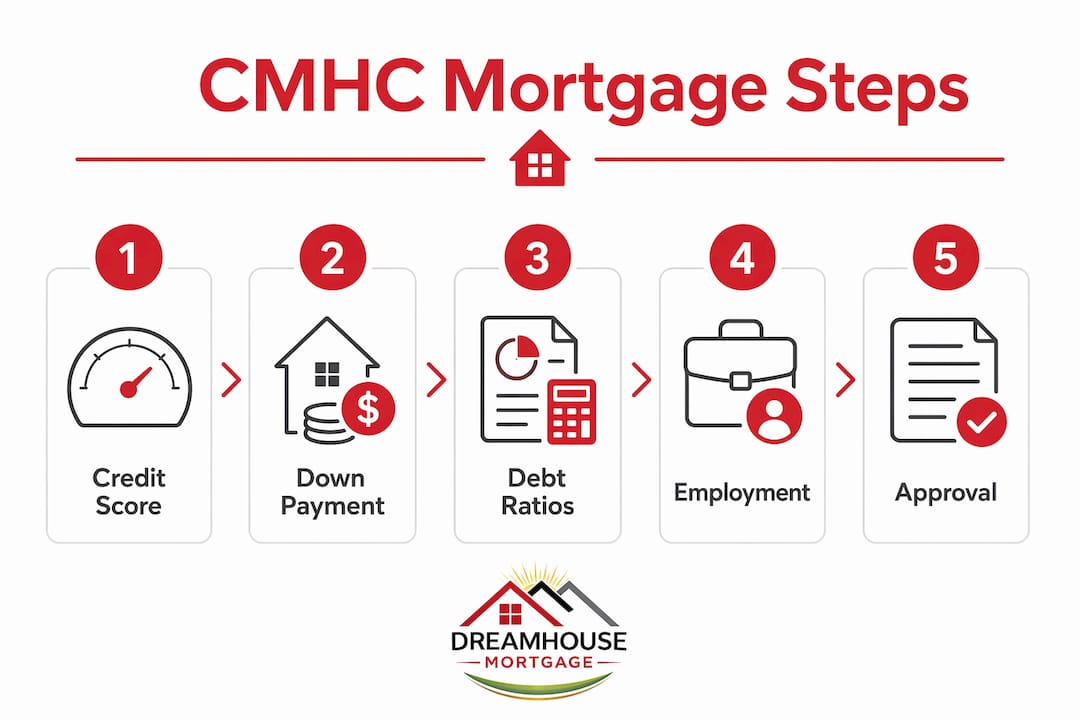
The minimum credit score for a CMHC insured mortgage in Alberta is 600. That number is the federal policy floor set by Canada Mortgage and Housing Corporation for mortgage default insurance on homes purchased with less than 20% down. However, most A-lenders in Alberta require a score of 680 or higher before they will approve a file. Understanding that gap between the CMHC minimum and real lender standards is the single most important thing Alberta homebuyers can know before they apply. Your credit score, down payment, debt ratios, and income all work together to determine whether you qualify.
What is the minimum credit score for CMHC insured mortgages in Alberta?
The CMHC minimum credit score of 600 is a policy floor, not a guarantee of approval. CMHC requires all federally regulated lenders to meet this threshold as a baseline condition for insuring mortgages with less than 20% down. Lenders, however, are free to set higher internal standards on top of that floor.

Most A-lenders, including major banks and credit unions operating in Calgary, Edmonton, Airdrie, and Cochrane, require a 680 minimum for standard mortgage approvals. That 80-point gap between the CMHC floor and the bank standard catches many first-time buyers off guard. A buyer with a 620 score technically meets the CMHC threshold but will be declined by most mainstream lenders.
Scores of 720 and above typically unlock the best available rates. That distinction matters because even a small rate difference on a Calgary or Airdrie home purchase compounds into thousands of dollars over a five-year term. Your credit score is not just a pass-fail gate. It directly affects the rate you pay.
The gap between the CMHC minimum of 600 and the lender standard of 680 is one of the most common misconceptions among first-time buyers in Alberta. Many buyers assume that meeting the government minimum is enough. It is not. Knowing both numbers before you apply saves time and prevents unnecessary hard inquiries on your credit report.
What credit score do lenders actually require for CMHC mortgages in Alberta?
Lenders in Alberta operate in tiers based on credit score ranges. Each tier determines which lenders will look at your file and what rate you will receive.
- 720 and above: A-lenders offer the best rates and fastest approvals. Major banks, credit unions, and monoline lenders compete for this borrower profile.
- 680–719: Standard A-lender approval. Most banks will approve at this range, though rates may be slightly higher than the top tier.
- 600–679: A-lenders auto-decline these files regardless of CMHC backing. Borrowers in this range need specialist lenders or B-lenders, and a mortgage broker becomes essential.
- Below 600: CMHC will not insure the mortgage. Borrowers must either rebuild their credit or explore private lending options, which carry higher rates and fees.
Scores between 600 and 679 require specialist brokers. Mortgage brokers in Alberta can access lenders that mainstream banks cannot. These specialist lenders accept the additional risk associated with lower scores but price that risk into the rate. Borrowers in this range should expect a higher interest rate than the posted market rate.
The practical implication is direct. If your score sits at 650 and you are shopping for a home in Cochrane or Chestermere, a standard bank application will fail. A broker with access to specialist lenders is the path forward. Dreamhouse Mortgage works with banks, credit unions, monoline lenders, and alternative lenders to match borrowers to the right product for their score.
Pro Tip: Pull your credit report from Equifax Canada or TransUnion Canada before you apply. Errors on Canadian credit reports are more common than most buyers expect, and a single disputed account can suppress your score by 20–40 points.
How do other eligibility factors affect CMHC mortgage approval in Alberta?
Credit score is one input in a multi-factor approval process. Debt service ratios, down payment size, property price, and income stability all carry significant weight alongside your score.
Down payment requirements
CMHC insured mortgages follow a tiered down payment structure based on purchase price. The table below summarizes the rules as of 2026.
| Purchase Price | Minimum Down Payment |
|---|---|
| Up to $500,000 | 5% of the full purchase price |
| $500,001 to $1,500,000 | 5% on first $500K, 10% on the remainder |
| Over $1,500,000 | 20% minimum, CMHC insurance not available |
Homes priced above $1.5 million do not qualify for CMHC insurance at all. That threshold is relevant in Calgary’s higher-priced neighborhoods and in some acreage properties in Rocky View County. Buyers targeting those price points need a conventional mortgage with 20% down.
Debt service ratios and the stress test
Debt service ratios are often the decisive approval factor, with credit score alone being insufficient. CMHC and OSFI guidelines cap the Gross Debt Service ratio at 39% and the Total Debt Service ratio at 44%. GDS measures your housing costs as a share of gross income. TDS adds all other debt payments to that calculation.
Even a borrower with a 720 score will be declined if their TDS ratio exceeds 44%. The stress test compounds this. Lenders qualify you at the higher of your contract rate plus 2%, or 5.25%. That test reduces the maximum mortgage amount most buyers can carry, which directly affects how much home you can buy in Edmonton, Red Deer, or Calgary.
Pro Tip: Pay down revolving credit card balances before you apply. Credit card utilization above 30% of your limit suppresses your score and raises your TDS ratio at the same time. Reducing balances addresses both problems in one step.
Income stability and employment verification
Income stability matters as much as income level. Lenders want to see two years of consistent employment history for salaried borrowers. Self-employed buyers in Calgary or Airdrie face additional documentation requirements, including two years of Notice of Assessment from the Canada Revenue Agency. Gaps in employment or recent job changes can trigger additional scrutiny even when the credit score and ratios look clean. For self-employed buyers, business income documentation plays a central role in the approval process.
What steps can Alberta homebuyers take to improve their CMHC mortgage chances?
Preparation before application is the most reliable way to improve your approval odds. The following steps apply directly to buyers in Calgary, Cochrane, Airdrie, Okotoks, and surrounding Alberta communities.
Check your credit report early. Request your free credit report from Equifax Canada and TransUnion Canada at least three to six months before you plan to apply. Dispute any errors immediately. Corrections take time to process and reflect in your score.
Resolve active collections. Active collections on your credit report frequently cause mortgage insurers to deny applications even when the score passes the 600 minimum. Pay off or settle any outstanding collections before you apply. Get written confirmation that the account is closed.
Reduce credit card balances. Keep each card below 30% of its limit. High utilization is one of the fastest ways to suppress a credit score. Paying down balances can raise your score within one to two billing cycles.
Avoid new credit applications. Each hard inquiry from a new credit application reduces your score by a small amount. Multiple inquiries in a short window signal risk to lenders. Stop applying for new credit at least six months before your mortgage application.
Work with a mortgage broker. Mortgage brokers in Alberta can access specialist lenders for borrowers with scores between 600 and 679. A broker submits your file to the right lender the first time, avoiding multiple hard inquiries from direct bank applications. Dreamhouse Mortgage serves buyers across Calgary, Edmonton, Red Deer, and surrounding communities.
Get a mortgage pre-approval. A mortgage pre-approval in Alberta locks in a rate and confirms your borrowing capacity before you make an offer. It also identifies credit or income issues early enough to fix them.
Choose a qualifying property. CMHC insured mortgages apply only to owner-occupied properties priced under $1.5 million. Confirm the property type and price fit CMHC criteria before you make an offer. Certain property types, including some rural acreages and non-standard constructions, may face additional insurer scrutiny.
Understanding mortgage affordability factors before you start shopping gives you a realistic target and prevents wasted time on properties or loan amounts that will not qualify.
How does having a co-borrower affect credit score requirements for CMHC mortgages?
Adding a co-borrower to a mortgage application changes the qualification calculation in ways that surprise many Alberta buyers. The rules are specific and worth understanding before you apply.
Lenders use the lower score. When two borrowers apply together, the lender qualifies the file using the lower of the two credit scores. A couple where one partner has a 740 score and the other has a 620 score will be evaluated as a 620-score application. That single fact can shift the file from an A-lender to a specialist lender.
Applications can be denied after preliminary approval. Co-borrower credit issues discovered during underwriting can reverse a preliminary approval. Lenders pull full credit reports for all borrowers during the underwriting stage. A collection or derogatory mark on the co-borrower’s file that was not disclosed upfront can kill the deal.
Both incomes count toward the TDS ratio. The benefit of a co-borrower is that both incomes are included in the debt service calculation. This increases the maximum mortgage amount the lender will approve. The trade-off is that both borrowers’ debts also count against the TDS ratio.
Guarantors work differently from co-borrowers. A guarantor backs the mortgage but does not appear on title. Lenders treat guarantors differently from co-borrowers, and not all lenders accept guarantor arrangements for CMHC insured mortgages. Confirm the lender’s policy before structuring the application this way.
Separate applications are sometimes the better path. If one partner has a significantly lower score or active collections, applying as a single borrower using only the stronger income may produce a better outcome. A mortgage broker can model both scenarios and recommend the structure that maximizes approval odds.
Buyers with limited credit history, including newcomers to Canada settling in Calgary or Edmonton, have specific options worth exploring. No credit history mortgage options exist for borrowers who have not yet established a Canadian credit profile.
Dreamhouse Mortgage: Expert CMHC Mortgage Guidance in Alberta
Qualifying for a CMHC insured mortgage in Alberta requires more than meeting the 600 minimum credit score. Lender overlays, debt ratios, and property criteria all affect the outcome.

Dreamhouse Mortgage, led by Guriqbal Chahal, MBA, PMP, Mortgage Broker, works with buyers across Calgary, Airdrie, Cochrane, Chestermere, Okotoks, High River, Edmonton, Red Deer, and Rocky View County. The brokerage accesses banks, credit unions, monoline lenders, and specialist lenders to match your credit profile to the right product. Whether your score sits at 620 or 750, Dreamhouse Mortgage structures the application to give you the best approval outcome. Start with a free broker consultation or review key questions to ask your broker before your first meeting. Call Guriqbal Chahal directly at 403-966-6072 or connect via the Dreamhouse Mortgage Google Business Profile.
Key Takeaways
The minimum credit score for a CMHC insured mortgage in Alberta is 600, but most lenders require 680 or higher, making broker guidance and credit preparation the two most critical steps for Alberta homebuyers.
| Point | Details |
|---|---|
| CMHC minimum is 600 | This is the federal floor for mortgage insurance, not a lender approval guarantee. |
| A-lenders require 680+ | Scores below 680 need specialist lenders; scores below 600 cannot access CMHC insurance. |
| Debt ratios are decisive | GDS must stay at or below 39% and TDS at or below 44%, regardless of credit score. |
| Co-borrower scores matter | Lenders use the lower score between co-borrowers, which can shift the lender tier. |
| Broker access is critical | Mortgage brokers connect borrowers with specialist lenders that banks cannot offer directly. |
FAQ
What is the minimum credit score for a CMHC insured mortgage in Alberta?
The minimum credit score for CMHC mortgage insurance is 600. Most A-lenders in Alberta require 680 or higher for actual approval, so meeting the CMHC floor does not guarantee a bank will approve your file.
Can I get a CMHC insured mortgage in Alberta with a 620 credit score?
A score of 620 meets the CMHC minimum but will be declined by most mainstream banks. A mortgage broker can connect you with specialist lenders who work with scores in the 600–679 range, though the rate will be higher than standard A-lender pricing.
Does my co-borrower’s credit score affect my CMHC mortgage application?
Yes. Lenders qualify the file using the lower credit score between co-borrowers. If your partner has a lower score or active collections, it directly affects which lenders will approve the application and at what rate.
What else do I need to qualify for a CMHC insured mortgage in Alberta?
Beyond the credit score, you need a minimum 5% down payment on the first $500,000 of the purchase price, a GDS ratio at or below 39%, a TDS ratio at or below 44%, and a property priced under $1.5 million. Income stability and a clean credit report with no active collections are also required.
How can I improve my credit score before applying for a mortgage in Alberta?
Pay down credit card balances below 30% of each card’s limit, resolve any active collections in writing, avoid new credit applications for at least six months before applying, and check both Equifax Canada and TransUnion Canada reports for errors. Working with a mortgage broker early in the process helps you identify and fix issues before they affect your application.