
Using gifted funds from family or friends abroad as a down payment for a Canadian mortgage is fully permitted when you follow the right documentation and compliance steps. Canadian lenders, CMHC, and FINTRAC each play a role in verifying that international gift funds are legitimate and non-repayable. The process of using a gifted down payment from overseas for a Canadian mortgage requires a signed gift letter, proper seasoning of funds, and certified translations of foreign documents. Buyers in Calgary, Airdrie, Cochrane, Chestermere, Edmonton, and Red Deer who prepare early avoid the most common delays. This guide walks you through every requirement, step, and pitfall so your application moves forward without surprises.
What lenders require when using a gifted down payment from overseas for a Canadian mortgage
Canadian lenders treat international gift funds differently from domestic gifts. The documentation requirements are stricter, and the timeline is longer. Understanding what lenders need before you wire a single dollar saves weeks of back-and-forth.

The 90-day seasoning rule
International gifts require 90 days of seasoning in your Canadian bank account before your mortgage closing date. Domestic gifts sometimes need only 15–30 days, but overseas transfers almost universally require the full 90 days to satisfy anti-money laundering rules under FINTRAC. This rule exists because seasoned funds reduce the lender’s obligation to trace the original foreign source in detail. Missing this window forces your lender to request extensive foreign bank records, which often delays or blocks approval entirely.
Pro Tip: Wire the funds 95–100 days before your target closing date. That five to ten day buffer protects you if the international transfer takes longer than expected.
Required documents
Lenders require a specific set of documents to accept foreign gifted funds. Every item must be consistent with every other item. Names, dates, and dollar amounts must match exactly across all records.
Signed gift letter on the lender’s prescribed template. The letter must confirm the donor’s relationship to you, the exact gift amount in Canadian dollars, and a clear statement that the funds are non-repayable. Gift letter phrasing is scrutinized closely; even slight wording that implies repayment causes automatic mortgage declines.
Donor’s foreign bank statements. Lenders want to see that the funds existed in the donor’s account before the transfer. Statements covering at least 90 days prior to the wire are standard.
SWIFT wire transfer confirmation receipt. This document proves the funds left the donor’s account and traveled to yours. Keep the original receipt from the sending bank.
Your Canadian bank statements. These confirm the funds arrived and have been sitting in your account. The deposit entry must match the wire receipt amount.
Certified translations of foreign documents. Foreign documents require certified translations if they are not in English or French. Notarization may also be required depending on the lender and the country of origin.
Acceptable donor relationships
Accepted donors generally include parents, grandparents, siblings, and spouses. Some lenders extend this to aunts and uncles, but policies vary widely between institutions. Confirm the acceptable donor list with your mortgage broker before the funds are wired. Discovering a lender does not accept a particular donor relationship after the transfer creates a serious problem.
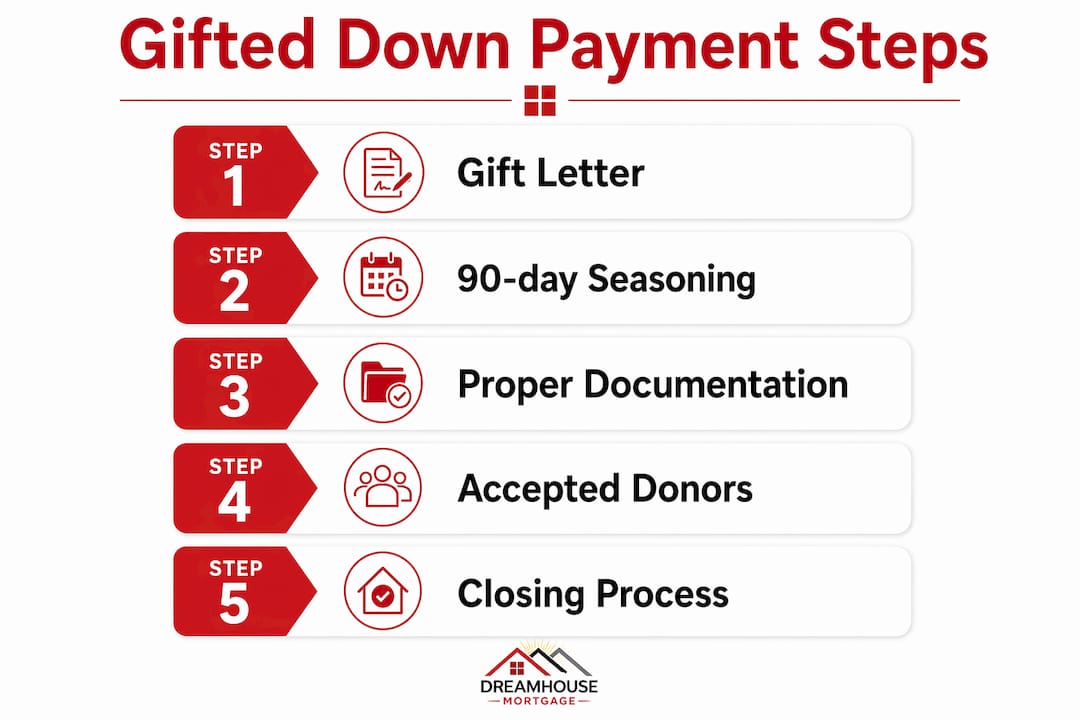
How to use overseas gifted funds step by step for an Alberta home purchase
A clear timeline prevents the most common mistakes. The steps below apply whether you are buying in Calgary, Okotoks, Cochrane, or anywhere else in Alberta.
Set your closing date and calculate backward. Count back at least 90 days from your planned closing date. That date is your latest acceptable wire date. Add a 5–10 day buffer to account for international transfer delays. If you are targeting a closing in october, the funds should land in your Canadian account no later than early july.
Confirm the donor relationship with your mortgage broker. Before anything else, verify that your lender accepts the specific donor. Dreamhouse Mortgage works with banks, credit unions, monoline lenders, and alternative lenders across Alberta. Each has its own policy on donor relationships, and your broker can match you to the right lender before funds move.
Obtain the lender’s gift letter template. Do not draft a gift letter from scratch. Lenders use prescribed templates, and deviations trigger rejections. Your mortgage broker provides the correct template. Have the donor sign it before the wire transfer, not after.
Prepare certified translations of foreign documents. If the donor’s bank statements are in a language other than English or French, arrange certified translations immediately. This step takes time. Budget at least one to two weeks for a professional certified translator. Check the mortgage documents checklist for a full list of what needs translation.
Coordinate the wire transfer and retain all receipts. The donor sends the funds via SWIFT international wire. The donor must retain the sending bank’s wire confirmation, and you must retain the receiving bank’s deposit confirmation. Both documents go into your mortgage file.
Wait for the 90-day seasoning period to complete. Do not spend any of the gifted funds during this period. The balance in your account must reflect the full gift amount consistently across your bank statements.
Submit your complete mortgage application. Provide all documents together: gift letter, donor’s foreign bank statements, wire receipt, your Canadian bank statements, and certified translations. Submitting a complete file on the first attempt is the single most effective way to avoid delays.
Pro Tip: Ask your broker to review every document for exact name and amount matching before submission. A middle name missing from one statement can trigger an AML flag and stall your approval.
The newcomer mortgage guide from Dreamhouse Mortgage covers additional documentation requirements specific to new Canadians, including foreign income verification and credit history alternatives.
Common challenges with overseas gifted down payments and how to fix them
Most problems with international gift funds fall into a small number of categories. Knowing them in advance lets you avoid them entirely.
Late transfers and insufficient seasoning
The most common point of failure is wiring funds too close to the closing date. Early wiring, 95–100 days before closing, is the standard recommendation to avoid complex foreign source tracing. If funds arrive with fewer than 90 days to closing, the lender must trace the original foreign source in detail. That process requires additional foreign bank records, takes weeks, and often results in a delayed or declined application.
Mismatched documentation
Lenders require exact matching of names, dates, and amounts across the gift letter, wire receipt, and bank statements. Inconsistencies trigger increased scrutiny and can threaten your approval timeline. A common example: the donor’s name appears as “Wei Zhang” on the wire receipt but “Zhang Wei” on the foreign bank statement. That single discrepancy creates an AML flag. Resolve all name and amount discrepancies before submitting.
Gifts that look like loans
A gift must be clearly non-repayable. If a lender finds any evidence suggesting the funds carry a repayment obligation, the mortgage application will be declined. Informal agreements, text messages referencing repayment, or any documentation implying interest or a return of funds are enough to cause rejection. Families often misunderstand the difference between a gift and a loan, and that misunderstanding leads directly to rejected applications.
Even informal or interest-free loans disguised as gifts cause automatic mortgage rejection. The gift letter must state clearly and unambiguously that no repayment is expected or required. If your family intends any form of repayment arrangement, disclose it to your broker immediately so the funds can be structured correctly.
Currency exchange risk
Currency exchange rates change between the day a donor commits to a gift amount and the day the funds land in your Canadian account. Donors should wire slightly more than the Canadian dollar target amount to cover exchange rate movement. A forward contract through the donor’s bank can lock in a rate and eliminate this uncertainty entirely.
Key risks to watch for:
- Wiring the exact CAD amount in a foreign currency without accounting for exchange rate fluctuation
- Paying wire fees from the gift amount, leaving the Canadian deposit short of the required down payment
- Failing to document the exchange rate used, which creates an amount discrepancy between the gift letter and the deposit
Tax and regulatory rules for overseas gifted down payments in Canada
Understanding the tax and compliance framework protects both you and your donor from legal problems.
Canadian tax treatment of gift funds
Canada does not impose tax on receiving genuine gift money, including funds from family abroad. The gift is not taxable income to you as the recipient. This applies whether the donor is in India, the Philippines, China, or any other country. The donor’s home country is a separate matter. Many countries have gift tax rules or reporting requirements for large outbound transfers. The donor should consult a local tax professional before sending funds.
FINTRAC compliance and the CAD $10,000 reporting threshold
Regulated Canadian financial institutions automatically report incoming international wire transfers over CAD $10,000 to FINTRAC under the Proceeds of Crime (Money Laundering) and Terrorist Financing Act. This reporting is automatic and routine. It does not mean your funds are flagged as suspicious.
What is illegal is structuring transfers to avoid this threshold. Splitting a $50,000 gift into five transfers of $9,900 each to avoid reporting is a criminal offense under Canadian law. It causes immediate file rejection and can result in legal consequences for both the donor and the recipient.
Compliance points to follow:
- Send the full gift amount in a single wire transfer
- Do not instruct the donor to split transfers to stay under CAD $10,000
- Retain all wire documentation and be prepared to explain the source of funds
- Consult a mortgage broker or legal advisor if the gift amount is large or the source is complex
Proceeds of Crime Act obligations
Canadian lenders operate under the Proceeds of Crime (Money Laundering) and Terrorist Financing Act. This law requires lenders to verify the source of all down payment funds. A properly documented international gift satisfies this requirement. Incomplete documentation does not. The foreign income mortgage guide from Dreamhouse Mortgage outlines how Alberta lenders apply these rules in practice.
Pro Tip: Obtain a letter from the donor’s bank confirming the source of funds. Some lenders request this proactively for large international transfers, and having it ready speeds up the review.
Dreamhouse Mortgage: expert guidance for gifted down payments from abroad
Navigating international gift funds, FINTRAC compliance, and lender documentation requirements is complex. Dreamhouse Mortgage, led by Guriqbal Chahal, MBA, PMP, has helped buyers across Calgary, Airdrie, Cochrane, Chestermere, Okotoks, Edmonton, and Red Deer structure their mortgage applications correctly the first time.

Guriqbal Chahal works directly with buyers to match them to lenders that accept their specific donor relationship, prepare compliant gift letters, and coordinate document timelines. Whether you are a newcomer to Canada or a long-term resident receiving funds from family abroad, Dreamhouse Mortgage provides clear guidance on mortgage broker rate negotiation and full application support. Call Guriqbal Chahal at 403-966-6072 or visit the Dreamhouse Mortgage Google Business Profile to book a consultation and start your application with confidence.
Key Takeaways
Using a gifted down payment from overseas for a Canadian mortgage requires a signed gift letter, 90-day fund seasoning, exact documentation matching, and full FINTRAC compliance to achieve approval.
| Point | Details |
|---|---|
| 90-day seasoning is mandatory | Wire funds 95–100 days before closing to meet the seasoning rule and avoid source-of-funds tracing delays. |
| Gift letter must be non-repayable | Use the lender’s prescribed template and confirm no repayment language appears anywhere in the letter. |
| Documents must match exactly | Names, dates, and amounts must be identical across the gift letter, wire receipt, and bank statements. |
| Canada does not tax gift receipts | The recipient pays no tax on genuine gift funds, but the donor’s home country may have its own rules. |
| Structuring transfers is illegal | Send the full gift amount in one wire; splitting transfers to stay under CAD $10,000 is a criminal offense. |
FAQ
Can I use a gift from my parents overseas as a down payment in Canada?
Yes. Canadian lenders accept gifted down payments from parents abroad when the funds are properly documented with a signed gift letter, donor bank statements, and a wire transfer receipt. The funds must be in your Canadian account for at least 90 days before closing.
How long do overseas gift funds need to be in my Canadian account?
International gift funds require 90 days of seasoning in your Canadian bank account before your mortgage closing date. Wiring funds 95–100 days before closing provides a safe buffer for transfer delays.
Do I need to pay tax on gift money received from abroad in Canada?
Canada does not tax genuine gift money received from family abroad. The recipient owes no income tax on the gift, though the donor’s home country may have its own reporting or tax obligations.
What happens if the gift letter wording implies repayment?
Lenders will decline the mortgage application if any documentation suggests the gift carries a repayment obligation. Use the lender’s prescribed template and remove any language that could be interpreted as a loan arrangement.
Is it legal to split a large overseas gift into smaller transfers to avoid reporting?
No. Structuring transfers to stay below the CAD $10,000 FINTRAC reporting threshold is a criminal offense under the Proceeds of Crime (Money Laundering) and Terrorist Financing Act. Send the full gift amount in a single wire transfer and retain all documentation.