
Yes, you can assume a mortgage in Canada, and in 2026 it’s worth a serious look. Many fixed-rate mortgages are technically transferable to a new buyer, but the lender must approve that buyer through full underwriting first. The upside goes both ways: sellers holding a rate from 2020 or 2021 can market that as a selling point, and buyers can lock into payments below today’s going rate. The catch is liability. Unless the seller gets a formal release of covenant from the lender, they can remain on the hook for that mortgage even after the sale closes.
TL;DR:
- Assumptibility depends on the mortgage’s charge type, with collateral charge mortgages often being non-assumable and requiring lender confirmation.
- Buyers must still pass the same full underwriting process, including the stress test, credit checks, and proof of income, before assuming a mortgage.
- The equity gap, or the difference between the mortgage balance and property value, significantly influences the practicality of assumption, especially if large cash or secondary financing is needed.
- Sellers should insist on a written release of covenant from the lender before closing to avoid ongoing liability, which many lenders delay or deny if not properly secured upfront.
- The cost of assumption includes lender fees, legal fees, and potential appraisal costs, with approval times often taking several weeks, requiring careful planning and coordination.
Table of Contents
- How Mortgage Assumption Actually Works in Canada
- Assumable Mortgage Pros and Cons for Buyers and Sellers
- Eligibility and Lender Requirements for Assuming a Mortgage
- What Assuming a Mortgage Costs and How Long It Takes
- Seller Liability: Why the Release of Covenant Matters
- Assumable Mortgage Checklist for Calgary and Alberta Sellers and Buyers
- Should You Assume a Mortgage or Get a New One?
- Why Broker Guidance Matters for Mortgage Assumptions
- Assumable Mortgage vs. Vendor Take-Back Mortgage: What’s Different
- Tax Implications of Assuming a Mortgage in Canada
- Does an Assumable Mortgage Affect Resale Value?
- Common Pitfalls in the Mortgage Assumption Process
- An Alberta Broker’s Take on Assumable Mortgages in 2026
- Let DreamHouse Mortgage Guide Your Assumption Decision
- Sources
- FAQ
How Mortgage Assumption Actually Works in Canada
An assumption transfers three things from seller to buyer: the interest rate, the remaining balance, and whatever’s left of the original term. What doesn’t transfer is the lender itself, and that’s the part people miss. You’re not choosing a new lender. You’re stepping into the seller’s existing contract with their existing bank, credit union, or monoline provider, and that lender decides whether you qualify.
The process runs in a fairly predictable order:
- Check the mortgage contract. Confirm it actually contains an assumption clause and that it’s a standard charge, not a collateral charge, since collateral-charge mortgages are often non-assumable.
- Call the lender. The seller or their broker confirms assumability and asks what the lender needs from a new borrower.
- Buyer applies. Full application, income documents, credit check, the works.
- Lender underwrites. This mirrors a fresh mortgage application in almost every respect.
- Legal transfer and registration. A lawyer handles the paperwork and registers the change at land titles.
Don’t confuse this with porting, which is a different mechanism entirely. Porting moves your existing mortgage to a new property you’re buying, while assumption moves the mortgage to a new person on the same property. Sellers who are also buying elsewhere sometimes qualify for both, but they’re not interchangeable tools.
Assumable Mortgage Pros and Cons for Buyers and Sellers

The math that makes assumption interesting in 2026 comes down to the gap between old rates and new ones. Someone who locked a five-year fixed rate at 1.5% to 2.5% back in 2020 or 2021 is sitting on a rate roughly three percentage points below current market rates near 4.8%. On a $500,000 balance, that gap can mean thousands of dollars a year in saved interest for whoever takes it over.
What each side gets out of it:
- Sellers get a genuine marketing edge and skip the prepayment penalty they’d otherwise owe for breaking the mortgage early.
- Buyers get a below-market rate locked in, sometimes for years of remaining term.
- Both sides face lender rejection risk if the buyer doesn’t qualify under standard underwriting.
- Sellers face ongoing liability if no formal release is issued.
- Everyone needs to check whether the product is even eligible, since insured mortgages and collateral charges carry their own exceptions.
The equity gap is the real obstacle. If the home is worth $650,000 and the assumable balance is $400,000, the buyer needs $250,000 in cash or secondary financing before the rate advantage means anything.
Eligibility and Lender Requirements for Assuming a Mortgage
Assuming a mortgage does not mean skipping the qualification process. The buyer goes through the same underwriting a fresh applicant would face, including the federal mortgage stress test, which requires qualifying at the higher of 5.25% or the mortgage’s contract rate plus 2%. That rule doesn’t disappear just because the rate itself is attractive.
Lenders will typically look at:
- Credit score, usually expecting something in the mid-600s or better depending on the lender.
- Gross debt service and total debt service ratios within standard limits, generally 39% and 44%.
- Full income documentation: T4s, Notice of Assessment, an employment letter, or two years of financials for self-employed applicants.
- Down payment or equity gap funds, proven and sourced.
- Insurer concurrence when the mortgage is insured, since CMHC and other insurers have their own approval say.
Pro Tip: Get pre-approved before you even find an assumable listing. Knowing your stress-test rate and borrowing power ahead of time means you can move fast when the right property shows up, and a broker can flag whether a specific mortgage is even a standard charge worth assuming.
What Assuming a Mortgage Costs and How Long It Takes
Assumption isn’t free, though the costs are modest next to arranging a brand new mortgage. Expect an assumption fee from the lender, typically $250 to $600, plus legal fees in the $500 to $1,500 range for the transfer and registration.
- Assumption fee: $250–$600, usually paid by the buyer.
- Legal fees: $500–$1,500 for the lawyer handling the transfer and release paperwork.
- Appraisal or title insurance reissue: $300–$500 where the lender or insurer requires a fresh valuation.
- Timeline: lender review and underwriting commonly take several weeks, with legal closing layered on top of that.
Build in more runway than a conventional purchase, especially if the lender is slow to confirm the release of covenant.
Seller Liability: Why the Release of Covenant Matters
Selling your home with an assumable mortgage doesn’t automatically end your obligation to the lender. Unless the lender issues a formal release, you can remain legally responsible for that mortgage if the buyer defaults, even years after you’ve moved out.
- Insist on a written release as a condition of sale. Don’t let this be a verbal promise from the lender or a “we’ll sort it out later” arrangement.
- Get lender confirmation before closing, not after. Some lenders delay the release or attach it to the buyer completing 12 consecutive months of on-time payments before they’ll let the original borrower off the hook.
- Use a real estate lawyer to build safeguards into the purchase agreement. A lawyer can make the sale conditional on receiving that release in writing, which protects you if the lender drags its feet.
This is the single biggest failure point in Canadian mortgage assumptions, and it’s entirely avoidable with the right conditions written into the contract upfront.
Assumable Mortgage Checklist for Calgary and Alberta Sellers and Buyers
If you’re on either side of an assumption in Calgary, Airdrie, or Cochrane, here’s the order of operations that keeps things moving.
For sellers:
- Pull your mortgage documents and confirm the assumption clause and charge type.
- Call your lender directly to ask about their assumption process and release timeline.
- Instruct your real estate agent to market the property’s assumable status explicitly.
- Retain a lawyer early to demand a written release of covenant as a sale condition.
For buyers:
- Contact a mortgage broker for pre-approval so you know your stress-tested borrowing capacity.
- Line up proof of funds for the equity gap between the sale price and the assumable balance.
- Submit a formal application to the seller’s lender as soon as an accepted offer is in place.
Coordination matters just as much as the individual steps. Closing dates need to account for lender review time, bridge financing has to be arranged if the equity gap is large, and your broker and lawyer should be talking to each other, not just to you.
Pro Tip: A broker with access to multiple lenders can often get a faster read on whether a lender will even entertain an assumption before you commit time and legal fees to the process.
Should You Assume a Mortgage or Get a New One?
Run the numbers before you fall in love with a low rate. A rough rule of thumb: if the annual interest savings from assuming clearly outweigh the assumption fees, legal costs, and the interest rate on whatever you’re using to bridge the equity gap, assumption usually wins.
- If the equity gap requires a second mortgage at 8% or 9% interest, that cost can eat into or erase the savings from a 2% assumed rate faster than people expect.
- If you need mortgage portability, a different amortization schedule, or a lender switch for other reasons, a new mortgage or a refinance is often the cleaner path.
- If the remaining term is short, the hassle of an assumption may not be worth it compared to simply arranging fresh financing.
This is exactly the kind of math DreamHouse Mortgage runs for Calgary and Alberta clients before they commit to either route.
Why Broker Guidance Matters for Mortgage Assumptions
Guriqbal Chahal, MBA, PMP, Broker of Record at DreamHouse Mortgage, has guided Calgary, Airdrie, and Cochrane clients through first-time purchases, refinances, renewals, and specialty financing since 2013. Mortgage assumptions sit at the intersection of several of those disciplines: qualification, lender negotiation, and legal coordination.
DreamHouse Mortgage verifies whether a specific mortgage is genuinely assumable, confirms charge type with the lender, and coordinates the buyer’s application so underwriting moves without unnecessary delay. For sellers, that includes connecting clients with legal professionals who know how to secure a release of covenant in writing before the sale closes, not after.
Assumable Mortgage vs. Vendor Take-Back Mortgage: What’s Different
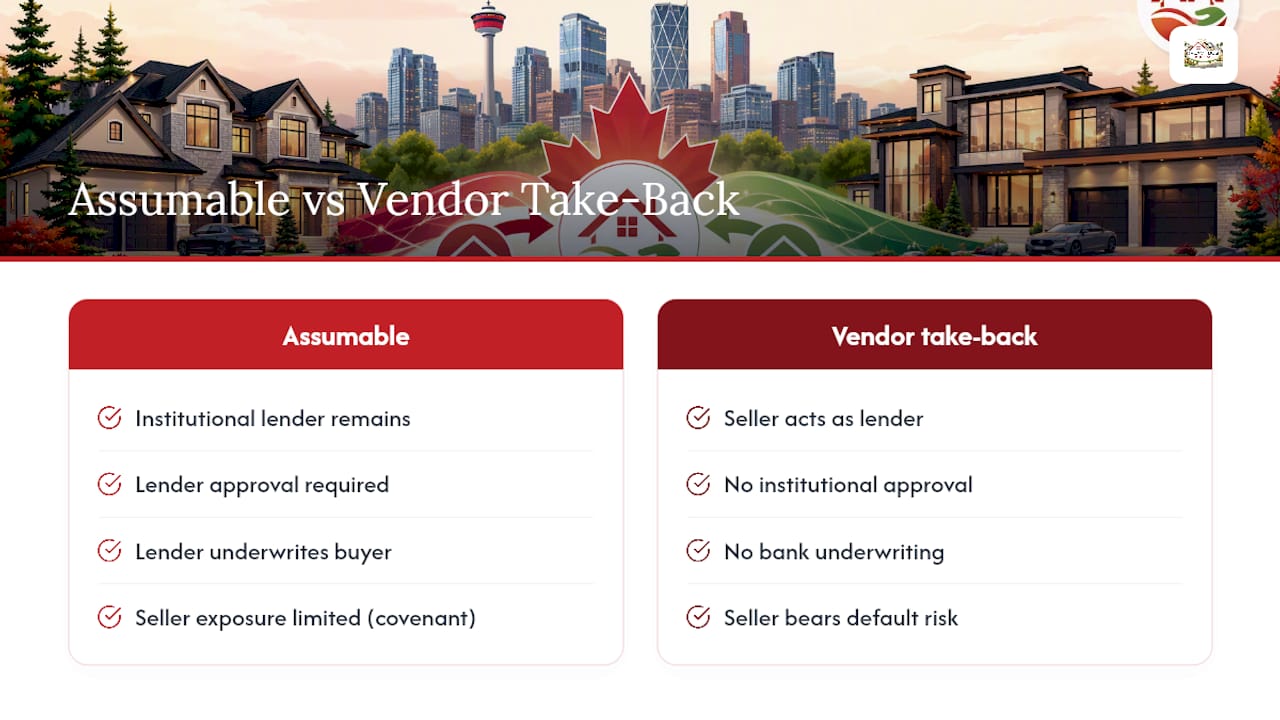
These two structures get confused often, but they solve different problems. An assumable mortgage transfers the seller’s existing lender-held mortgage to the buyer, rate, balance, and term intact, with the original lender’s approval required. A vendor take-back (VTB) mortgage is something else entirely: the seller acts as the lender, financing part of the sale price directly rather than having the buyer borrow it from a bank.
With a VTB, there’s no institutional lender approving the buyer, no stress test in the traditional sense, and the seller carries the risk of the buyer defaulting on payments made directly to them. Terms are negotiated privately between buyer and seller, which offers flexibility but no regulatory backstop.
Assumption keeps an existing institutional lender in the picture the entire time. That lender still underwrites the new borrower, still holds the security on title, and still governs the terms of repayment exactly as before. The seller’s exposure in an assumption is limited to the liability question addressed earlier, tied to whether a release of covenant was secured.
For Calgary-area sellers, the practical difference is this: assumption typically requires a mortgage with favorable, below-market terms to be worth pursuing, while a VTB is often used when a buyer can’t qualify for enough conventional financing and the seller is willing to fill the gap. They’re not competing options so much as tools for different situations, and a broker can help determine which one, if either, actually fits your transaction.
Tax Implications of Assuming a Mortgage in Canada
Assuming a mortgage doesn’t trigger a distinct tax event on its own, but the sale transaction around it does carry the usual tax considerations every Canadian homebuyer and seller should account for.
For sellers, the principal residence exemption still applies the same way it would in any sale, provided the property qualifies and was designated as the principal residence for the years claimed. Sellers holding an investment or rental property with an assumable mortgage face capital gains tax on the sale exactly as they would with any other disposition, and the presence of an assumable mortgage does not change that calculation.
For buyers, land transfer considerations apply based on the province, though Alberta does not levy a provincial land transfer tax the way some other provinces do. Alberta buyers instead pay a title transfer fee and mortgage registration fee through Alberta Land Titles, calculated based on purchase price and mortgage amount. These fees apply whether you’re assuming an existing mortgage or arranging a new one, so an assumption doesn’t reduce this cost.
Where things get genuinely complex is with self-employed buyers or investment property purchases layered on top of an assumption, since income verification and rental income treatment can affect both qualification and reporting. Anyone assuming a mortgage on a rental or investment property in Calgary or the surrounding area should talk to an accountant about their specific tax position before closing, since generic advice rarely fits investment scenarios cleanly.
Does an Assumable Mortgage Affect Resale Value?
A genuinely assumable mortgage with a rate well below current market levels can be a real marketing advantage, and in 2026’s rate environment, that advantage is more visible than it’s been in years. A seller advertising a sub-3% assumable rate on a property is offering something a competing listing with a standard new mortgage simply can’t match.
That said, the effect on marketability depends heavily on how large the equity gap is relative to the buyer pool. A property priced at $700,000 with only $350,000 remaining on an assumable mortgage requires buyers to bring $350,000 in cash or secondary financing just to close. That narrows the pool of qualified buyers considerably, even with the rate advantage factored in. In some cases, the equity gap is simply too large for the assumable status to move the needle on how fast a home sells.
Realistically, assumability tends to help most on properties where the mortgage balance is a large share of the sale price, meaning the equity gap is small and more buyers can realistically bridge it. On higher-priced homes with substantial built-up equity, the assumable rate becomes a secondary selling point rather than the headline feature, since most buyers in that price range are financing the bulk of the purchase anyway regardless of the existing mortgage terms.
Agents marketing an assumable property in Calgary or Airdrie should be upfront about the actual equity gap early in listing conversations, since burying that number until an offer is on the table wastes everyone’s time.
Common Pitfalls in the Mortgage Assumption Process

Most assumption transactions that fall apart do so for a handful of predictable reasons, and nearly all of them are avoidable with the right groundwork.
The most common mistake is assuming a mortgage is assumable without confirming the charge type. Collateral charge mortgages, which many lenders now register by default, frequently cannot be assumed at all, and buyers or sellers sometimes don’t discover this until they’re well into a deal. Always confirm the exact registered charge with the lender before marketing a property as assumable or making an offer contingent on assumption.
A second frequent issue is underestimating how long lender review takes. Buyers and sellers sometimes assume assumption is faster than a new mortgage since the rate and term are already set. In practice, the underwriting is just as thorough, and lender response times can stretch the closing timeline if it isn’t planned for from the start.
Sellers who skip securing a written release before closing create the most serious long-term risk. Once the sale closes without that release, negotiating leverage with the lender largely disappears, and the seller may be stuck waiting out a payment history period or pursuing the release through other means.
Finally, buyers sometimes underestimate the true cost of bridging the equity gap. Secondary financing at higher rates can quietly erase the savings from an attractive assumed rate, which is exactly why running the full math with a broker before committing matters more than the headline interest rate itself.
An Alberta Broker’s Take on Assumable Mortgages in 2026
The conventional advice treats assumption like a simple hack: find a low rate, take it over, save money. That undersells how much the equity gap and the release of covenant actually decide whether a deal makes sense. I’ve seen the math on assumption look fantastic on the rate alone and fall apart the moment someone prices out bridge financing at today’s secondary rates.
My honest read for Calgary, Airdrie, and Cochrane clients in 2026: assumption is a real tool, not a shortcut. It rewards buyers who can genuinely cover the equity gap with cash or a well-structured second mortgage, and it protects sellers only when the release of covenant is nailed down in writing before closing, not promised verbally by a loan officer. Skip that step and you’re carrying risk on a home you no longer own.
What most people should prioritize first isn’t the rate. It’s confirming the charge type is assumable and getting a lender on the phone before an offer goes in. Everything else, including the savings math, only matters once that foundation is solid.
— Guriqbal Chahal, MBA, PMP
Let DreamHouse Mortgage Guide Your Assumption Decision
DreamHouse Mortgage gives Calgary, Airdrie, and Cochrane buyers and sellers something a rate comparison site can’t: a broker who calls the lender directly to confirm assumability before you commit legal fees or waive conditions. That single step saves clients from the most common assumption pitfall, discovering a collateral charge blocks the deal after the offer’s already in.

Whether you need pre-approval to cover an equity gap, help coordinating with the seller’s lender, a bridging strategy for secondary financing, or a referral to a real estate lawyer who knows how to secure a release of covenant, DreamHouse Mortgage handles the pieces that go wrong when handled alone. Explore affordable mortgage payment strategies or review common questions to ask a mortgage broker before your first conversation.
Call Guriqbal Chahal, MBA, PMP, Mortgage Broker, at 403-966-6072 to find out whether an assumable mortgage fits your situation, or visit the DreamHouse Mortgage Google Business Profile to see reviews from Alberta clients before you reach out.
This article is general information, not a substitute for advice from a qualified financial advisor. Consult a qualified financial professional about your own circumstances before acting on anything here.
Sources
FAQ
Is It Hard to Qualify for an Assumable Mortgage?
Qualifying isn’t harder than a standard mortgage application, but it isn’t easier either. Buyers face the same stress test, credit checks, and income verification as any fresh mortgage.
What Are the Cons of Assuming a Mortgage?
The main drawbacks are the equity gap buyers must cover upfront and the liability risk sellers carry if the lender doesn’t issue a formal release of covenant before closing.
Will Banks Let You Assume a Mortgage?
Only if the mortgage contract includes an assumption clause, the charge type is standard rather than collateral, and the new buyer passes the lender’s full underwriting and stress test.
What Happens When You Assume Someone’s Mortgage?
The buyer takes over the existing rate, balance, and remaining term through the seller’s lender, while the seller should secure a written release of covenant to end their own liability on that mortgage.