The First Home Savings Account (FHSA) is a registered, tax-advantaged savings plan that lets first-time home buyers in Alberta contribute up to $8,000 per year toward a home down payment, with a lifetime cap of $40,000. Understanding the FHSA down payment rules for first-time buyers in Alberta is the difference between maximizing every dollar saved and losing tax benefits through a timing mistake. Contributions are tax-deductible, growth inside the account is tax-free, and qualifying withdrawals are never added to your taxable income. For buyers in Calgary, Airdrie, Cochrane, Chestermere, Edmonton, Red Deer, and communities across Alberta, the FHSA is one of the most powerful tools available under Canadian tax law. This guide covers eligibility, contribution limits, withdrawal conditions, and how to combine the FHSA with other federal programs to build the strongest possible down payment.
What are the FHSA eligibility criteria for Alberta first-time buyers?
The Canada Revenue Agency (CRA) defines a first-time home buyer for FHSA purposes using a five-year look-back rule. You qualify if you have not owned a home that you lived in as your principal residence at any point during the current calendar year or the preceding four calendar years. This rule resets eligibility for buyers who previously owned a home but have rented for at least five years.
To open an FHSA in Alberta, you must meet three baseline requirements set by the CRA:
- Canadian residency: You must be a Canadian resident for tax purposes at the time of contribution and withdrawal.
- Age: You must be at least 18 years old and no older than 71 at the time of opening the account.
- First-time buyer status: You must meet the five-year look-back definition above, with no principal residence ownership during that window.
Your spouse or common-law partner’s homeownership status also affects your eligibility. If your partner currently owns a home where you live as your principal residence, you do not qualify to open or contribute to an FHSA. However, spousal ownership only disqualifies you from the point you move in. If you opened and funded your FHSA before moving into a partner-owned home, those contributions and their tax benefits remain valid.
Alberta residency does not create separate provincial eligibility rules for the FHSA. The account is governed entirely by federal CRA rules. Alberta buyers benefit from the same contribution limits and tax treatment as buyers anywhere else in Canada, though Alberta’s provincial income tax structure means the combined federal and provincial tax deduction from FHSA contributions is meaningful.
Pro Tip: Open your FHSA as early as possible, even if you cannot contribute the full $8,000 right away. The account must be open to start accumulating contribution room and the 15-year clock.
How do FHSA contribution limits and carry-forward rules work?
The annual contribution limit is $8,000, and the lifetime maximum is $40,000. These numbers are fixed by the federal government and do not change based on your income or province of residence. Every dollar you contribute is tax-deductible in the year of contribution, reducing your taxable income dollar for dollar.

The carry-forward rule allows you to roll unused contribution room from one year into the next, but only for one year and only up to $8,000. There is no compounding of unused room. If you open your FHSA in 2024 and contribute nothing, you carry forward $8,000 of unused room into 2025. Your total available room in 2025 becomes $16,000 ($8,000 for 2025 plus $8,000 carried forward). If you still contribute nothing in 2025, you do not accumulate a third year of room. The carry-forward does not stack beyond one year.
| Year | Annual Room | Carry-Forward | Total Available | Example Contribution | Remaining Room |
|---|---|---|---|---|---|
| Year 1 | $8,000 | $0 | $8,000 | $5,000 | $3,000 |
| Year 2 | $8,000 | $3,000 | $11,000 | $11,000 | $0 |
| Year 3 | $8,000 | $0 | $8,000 | $8,000 | $0 |
| Year 4 | $8,000 | $0 | $8,000 | $4,000 | $4,000 |
| Year 5 | $8,000 | $4,000 | $12,000 | $12,000 | $0 |
Over-contributing to your FHSA triggers a 1% per month penalty tax on the excess amount, the same penalty structure used for RRSP over-contributions. Track your contribution room carefully through your CRA My Account portal.
Pro Tip: If you receive a tax refund from your FHSA deduction, deposit that refund directly into your FHSA the following year. This compounds your savings without requiring additional out-of-pocket funds.
For a full comparison of how the FHSA stacks up against other savings tools, the FHSA vs Home Buyers Plan breakdown from Dreamhouse Mortgage covers the key differences for Calgary buyers.
What are the qualifying withdrawal rules for using FHSA funds in Alberta?
A qualifying FHSA withdrawal is completely tax-free. A non-qualifying withdrawal is treated as taxable income, subject to withholding tax, and does not restore your contribution room. The distinction matters enormously, and the CRA enforces it through specific documentation and timing requirements.
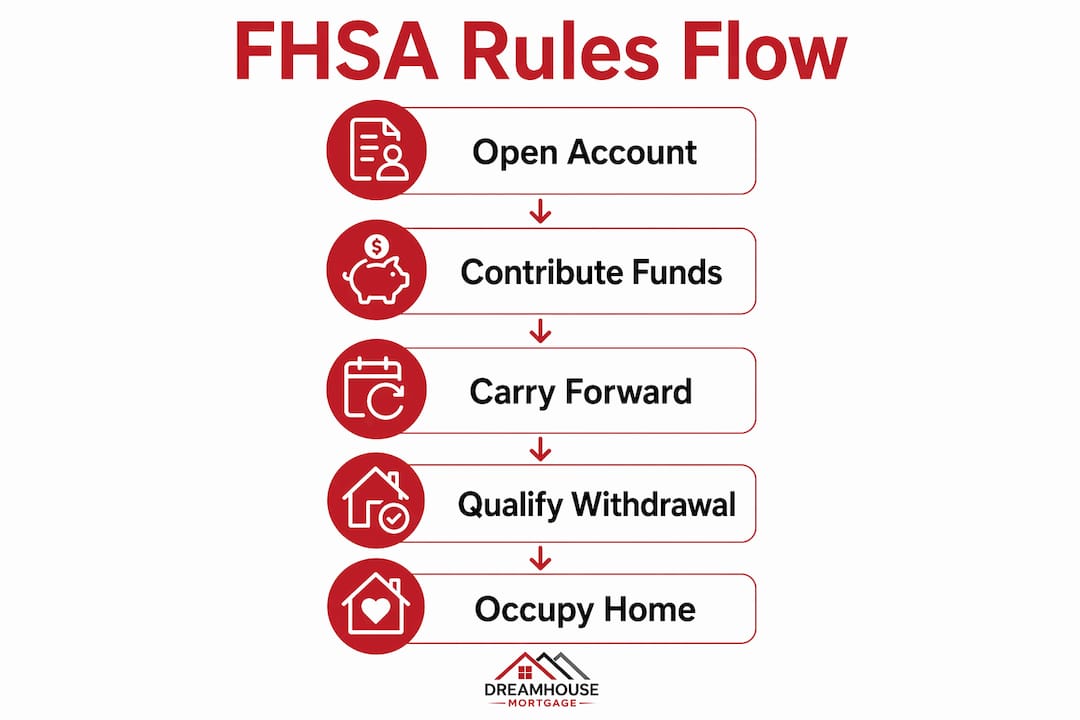
To make a qualifying withdrawal, you must satisfy all of the following conditions:
- Sign a written purchase agreement. A verbal offer or accepted offer in principle is not sufficient. You need a signed, written contract to purchase or build a qualifying home before you submit your withdrawal request.
- Submit Form RC725. This is the CRA form that designates your withdrawal as a qualifying FHSA withdrawal. Your financial institution requires this form before releasing funds.
- Withdraw within 30 days of closing. The withdrawal timing rule requires that you receive the funds no more than 30 days after the closing date of your home purchase.
- Occupy the home as your principal residence. You must move into the home by october 1 of the calendar year following your withdrawal. Missing this deadline converts your withdrawal into taxable income.
- Have not previously made a qualifying FHSA withdrawal. Each account holder gets one qualifying withdrawal event. You cannot split withdrawals across multiple home purchases.
“A written agreement must be signed before any FHSA withdrawal is initiated. Verbal agreements, accepted offers, or conditional approvals do not satisfy the CRA’s documentation requirement. Missing this step means the entire withdrawal is treated as taxable income, with no option to reverse the tax treatment after the fact.”
Non-qualifying withdrawals are subject to withholding tax and are included in your taxable income for that year. The contribution room is also permanently forfeited. This is not a situation where you can simply re-contribute and try again.
The occupancy deadline of october 1 in the year following withdrawal is a hard cutoff. If you withdraw in december 2025, you must be living in the home as your principal residence by october 1, 2026. Delays caused by construction, possession disputes, or personal circumstances do not extend this deadline.
How can Alberta buyers maximize FHSA benefits by combining programs?
The FHSA and the Home Buyers’ Plan (HBP) can be used together on the same home purchase. This combination is one of the most underused strategies available to first-time buyers in Alberta. The FHSA combined with HBP effectively doubles the tax deduction available for down payment savings, because each program operates independently with its own deduction and withdrawal rules.
| Feature | FHSA | RRSP Home Buyers’ Plan | TFSA |
|---|---|---|---|
| Annual contribution limit | $8,000 | Based on RRSP room | $7,000 (2026) |
| Lifetime limit | $40,000 | $35,000 per person | No lifetime cap |
| Contribution tax deduction | Yes | Yes (RRSP contribution) | No |
| Withdrawal tax treatment | Tax-free (qualifying) | Must repay over 15 years | Tax-free |
| Repayment required | No | Yes | No |
| First-time buyer restriction | Yes | Yes | No |
The FHSA has a clear structural advantage over the HBP: no repayment obligation. When you withdraw from your RRSP under the HBP, you must repay the full amount over 15 years or the unpaid balance is added to your income each year. FHSA qualifying withdrawals carry no repayment requirement.
The TFSA is a useful complement to the FHSA, not a replacement. TFSA contributions are not tax-deductible, but withdrawals are always tax-free. Alberta buyers who have maximized their FHSA room for the year can direct additional savings into a TFSA and draw on both accounts for the down payment.
Alberta does not currently offer a standalone provincial down payment grant program equivalent to the federal FHSA. However, Alberta down payment assistance options do exist through specific lender programs and municipal initiatives in cities like Calgary and Edmonton. These programs can layer on top of FHSA savings without affecting your federal eligibility.
Pro Tip: If your partner does not qualify for the FHSA because they previously owned a home, they may still qualify for the HBP if they meet the five-year look-back rule. Each person’s eligibility is assessed independently, so a couple can sometimes combine one FHSA and one HBP withdrawal for the same purchase.
For a full breakdown of how these programs interact, the first-time home buyer benefits guide from Dreamhouse Mortgage covers the FHSA, HBP, and GST rebate together.
What practical tips help Alberta buyers avoid FHSA mistakes?
The most common FHSA mistakes fall into three categories: timing errors, documentation gaps, and over-contribution. Each carries a financial penalty that can erase months of savings.
- Do not withdraw before signing a written agreement. The CRA requires a signed purchase contract before you submit Form RC725. Withdrawing funds based on a verbal agreement or a conditional offer is a non-qualifying withdrawal and is fully taxable.
- Track your contribution room in CRA My Account. The CRA updates your FHSA room after you file your annual tax return. Check your room before contributing each year to avoid the 1% monthly penalty on excess contributions.
- Do not assume the carry-forward compounds. Unused room from year one carries into year two only. If you skip two years of contributions, you do not accumulate two years of carry-forward room.
- Plan your withdrawal timing around your closing date. The 30-day window after closing is strict. Work with your lawyer and financial institution to coordinate the withdrawal request so funds are released within that window.
- Occupy the home on time. The october 1 occupancy deadline in the year following withdrawal is non-negotiable. If your closing is delayed past a point where you cannot occupy by that date, consult a tax advisor before withdrawing.
- Close the account after your qualifying withdrawal. The CRA requires you to close your FHSA by december 31 of the year following your qualifying withdrawal. Failing to close it on time can create administrative tax issues.
If you never buy a home, your FHSA does not disappear. Unused FHSA funds can be transferred tax-free to your RRSP or RRIF at any time before the account must close, which happens at the end of the year you turn 71 or 15 years after you first opened the account, whichever comes first. This transfer does not use up any RRSP contribution room, making it a genuinely risk-free savings vehicle even if your home purchase plans change.
Pro Tip: If you are buying a home in Calgary, Airdrie, or Cochrane and your closing date is in late december, withdraw your FHSA funds before december 31 to keep the tax-free status tied to that tax year. Waiting until january creates a new tax year event with different reporting requirements.
For buyers who want a complete picture of mortgage options for first-time buyers in Alberta, Dreamhouse Mortgage’s 2026 guide covers qualification, stress testing, and down payment strategy in one place.
Key Takeaways
The FHSA is the most tax-efficient down payment savings tool available to first-time home buyers in Alberta, combining a tax deduction on contributions, tax-free growth, and tax-free qualifying withdrawals with no repayment obligation.
| Point | Details |
|---|---|
| Annual and lifetime limits | Contribute up to $8,000 per year and $40,000 total; carry-forward unused room one year only. |
| Qualifying withdrawal requirements | Sign a written agreement, submit Form RC725, and withdraw within 30 days of closing. |
| Occupancy deadline | Move into the home as your principal residence by october 1 of the year after withdrawal. |
| Combine with HBP | Use both FHSA and the Home Buyers’ Plan on the same purchase for double tax deductions. |
| Unused funds protection | Transfer unused FHSA funds tax-free to RRSP or RRIF if you do not buy a home. |
Working with Dreamhouse Mortgage on your FHSA strategy
Knowing the rules is one thing. Applying them correctly to a real purchase in Calgary, Edmonton, Red Deer, or Cochrane requires coordination between your savings timeline, your mortgage pre-approval, and your closing date.

Dreamhouse Mortgage, led by Guriqbal Chahal, MBA, PMP, works directly with Alberta first-time buyers to align FHSA withdrawals with mortgage approvals and possession dates. The team helps you understand mortgage rate options alongside your down payment strategy so nothing falls through the cracks. Whether you are buying your first home in Airdrie, Chestermere, Okotoks, or anywhere across Alberta, Guriqbal and the Dreamhouse Mortgage team provide clear, personalized guidance from pre-approval through funding. Call Guriqbal Chahal at 403-966-6072 or connect on Google to book your free consultation today.
FAQ
What is the FHSA annual contribution limit in Canada?
The FHSA annual contribution limit is $8,000, with a lifetime maximum of $40,000. Unused room from one year carries forward to the next year only, up to $8,000.
Can I use both the FHSA and the Home Buyers’ Plan for the same purchase?
Yes. The FHSA and the RRSP Home Buyers’ Plan can both be used on the same qualifying home purchase, effectively doubling the tax deductions available for your down payment savings.
What happens if I withdraw from my FHSA without a signed purchase agreement?
A withdrawal without a signed written agreement is a non-qualifying withdrawal. It is included in your taxable income, subject to withholding tax, and the contribution room is permanently forfeited.
How long do I have to move into the home after an FHSA withdrawal?
You must occupy the home as your principal residence by october 1 of the calendar year following your qualifying withdrawal. Missing this deadline makes the withdrawal fully taxable.
What happens to my FHSA if I never buy a home?
Unused FHSA funds can be transferred tax-free to your RRSP or RRIF without affecting your existing RRSP contribution room. The account must close by the end of the year you turn 71 or 15 years after opening, whichever comes first.