Qualifying for a first-time home buyer mortgage in Alberta means meeting a specific set of federal eligibility rules, providing a minimum down payment tied to your purchase price, and passing the federal mortgage stress test administered by the Office of the Superintendent of Financial Institutions (OSFI). Alberta buyers also benefit from programs like the First Home Savings Account (FHSA), the RRSP Home Buyers’ Plan, and the First-Time Home Buyers’ Tax Credit, all of which can improve your qualification odds. Alberta charges no provincial land transfer tax, which gives buyers in Calgary, Edmonton, Airdrie, Cochrane, and Red Deer a financial edge over buyers in most other provinces. This guide walks you through every qualification step in plain language so you can move forward with confidence.
What are the eligibility criteria for first-time home buyer mortgages in Alberta?
The federal definition of a first-time home buyer is the starting point for every Alberta mortgage application. Federal eligibility rules require that neither you nor your spouse or common-law partner can have owned and lived in a principal residence during the current calendar year or any of the previous four years. That four-year window is the most commonly misunderstood rule. A buyer who sold a home five years ago qualifies. A buyer who sold three years ago does not.

Alberta does not add its own provincial homeownership restrictions on top of the federal definition. The criteria that apply across Canada apply equally in Calgary, Cochrane, Chestermere, Okotoks, and every other Alberta community. That consistency makes the qualification process more predictable for buyers moving within the province.
To qualify as a first-time buyer, you must meet all of the following conditions:
- Age: You must be at least 18 years old at the time of application.
- Residency: You must be a Canadian resident for tax purposes, which includes Canadian citizens, permanent residents, and certain visa holders.
- Prior ownership: Neither you nor your spouse can have owned and occupied a principal residence in the current year or the prior four calendar years.
- Income documentation: Lenders require T4 slips, Notices of Assessment, recent pay stubs, and bank statements to verify income.
- Credit history: A credit score of 680 or higher is the standard threshold for insured mortgages, though some lenders accept lower scores with compensating factors.
- Net worth limits: Certain assistance programs, such as Edmonton’s First Place program, set income or net worth caps that buyers must stay under to qualify for that specific benefit.
Gathering your documentation early is the single most effective way to speed up your mortgage approval. Lenders in Calgary and Edmonton report that incomplete files are the leading cause of approval delays. A Notice of Assessment from the Canada Revenue Agency, two years of T4s, and three months of bank statements form the core of any complete mortgage application.
How much down payment do you need to qualify in Alberta?
The minimum down payment in Alberta follows a federal tiered structure based on the purchase price of the home. The rules changed in 2026, and the new thresholds give buyers more flexibility on mid-range properties.
The 2026 tiered down payment rules work as follows:
- 5% on the first $500,000 of the purchase price.
- 10% on the portion between $500,001 and $1,499,999.
- 20% on any home priced at $1,500,000 or more, which cannot be insured under Canada Mortgage and Housing Corporation (CMHC) rules.
Calculating the down payment on a typical Alberta home
A $700,000 home in Calgary or Airdrie is a realistic purchase price in 2026. The minimum down payment on that property is $45,000, calculated as $25,000 (5% of $500,000) plus $20,000 (10% of the remaining $200,000). That number surprises many first-time buyers who assume 5% applies to the full price.
| Purchase Price | Down Payment Calculation | Minimum Down Payment |
|---|---|---|
| $400,000 | 5% of $400,000 | $20,000 |
| $700,000 | 5% of $500,000 + 10% of $200,000 | $45,000 |
| $1,000,000 | 5% of $500,000 + 10% of $500,000 | $75,000 |
| $1,500,000+ | 20% of full price | $300,000+ |
Insured vs. uninsured mortgages
Any mortgage with less than 20% down requires CMHC mortgage insurance. That insurance protects the lender, not you, and the premium is added to your mortgage balance. The premium ranges from 2.8% to 4% of the insured amount depending on your down payment percentage. Putting 20% or more down eliminates the insurance requirement entirely and reduces your total borrowing cost.
Where your down payment can come from
Alberta buyers have access to several registered savings vehicles that count as eligible down payment sources:
- First Home Savings Account (FHSA): Contributions are tax-deductible and withdrawals for a qualifying home purchase are tax-free up to $40,000 lifetime.
- RRSP Home Buyers’ Plan: You can withdraw up to $60,000 tax-free from your RRSP for a first home purchase, repayable over 15 years.
- Personal savings and gifts: Gifted funds from an immediate family member are accepted by most lenders with a signed gift letter.
Alberta charges no provincial land transfer tax. Land title registration fees apply instead, calculated as a $50 base plus $2 per $5,000 of property value for title transfer and $1.50 per $5,000 for mortgage registration. On a $500,000 home with a $400,000 mortgage, total registration fees come to approximately $420. Buyers in Ontario or British Columbia pay thousands more in land transfer taxes on the same property.
Pro Tip: Open your FHSA as early as possible. Contribution room accumulates at $8,000 per year, and unused room carries forward. A buyer who opens an FHSA two years before purchasing can contribute up to $16,000 in tax-deductible savings before closing.
What is the mortgage qualification process including the stress test in Alberta?
The federal mortgage stress test is the most significant qualification hurdle for first-time buyers in Alberta. OSFI requires all federally regulated lenders to qualify borrowers at the higher of their contract rate plus 2%, or a floor rate of 5.25%. That rule applies regardless of the actual rate you negotiate.
For example, if your lender offers a contract rate of 3.79%, you must qualify at 5.79% because 3.79% plus 2% exceeds the 5.25% floor. That higher qualifying rate reduces the maximum mortgage amount you can carry. A buyer who qualifies for $600,000 at their contract rate may only qualify for $480,000 under the stress test. That gap directly affects which neighborhoods and property types are within reach.
GDS and TDS ratio limits
Lenders use two debt ratios to assess your mortgage application:
- Gross Debt Service (GDS) ratio: Your housing costs (mortgage principal and interest, property taxes, heating, and 50% of condo fees) must not exceed 39% of your gross income under insured mortgage rules.
- Total Debt Service (TDS) ratio: All housing costs plus all other monthly debt payments (car loans, credit cards, student loans) must not exceed 44% of your gross income.
Both ratios are calculated using the stress test qualifying rate, not your actual contract rate. Reducing existing debt before applying directly improves both ratios and increases your maximum approved mortgage amount.
The 30-year amortization advantage
A significant 2026 policy change benefits first-time buyers in Alberta. 30-year amortization is now available on insured mortgages for new construction homes and for first-time buyers purchasing any eligible property. Extending amortization from 25 to 30 years lowers monthly payments by approximately 8%. That reduction can be the difference between passing and failing the GDS ratio test. Dreamhouse Mortgage clients in Calgary and Edmonton have used this option to qualify for properties that would have been out of reach under the previous 25-year maximum. Learn more about your amortization options and how they affect your monthly payment.
Getting pre-approved
Mortgage pre-approval is a formal assessment by a lender that confirms your maximum borrowing amount before you make an offer. Pre-approval requires a full credit check, income verification, and a review of your assets and liabilities. It is valid for 90–120 days at most lenders. Pre-approval does not guarantee final approval, but it gives you a realistic budget and signals to sellers that you are a serious buyer.
Pro Tip: The stress test applies to your pre-approval amount, not just your final mortgage. Ask your broker to calculate your maximum purchase price under stress test conditions before you start house hunting in Calgary, Airdrie, or Cochrane.
What financial programs and incentives can help first-time home buyers in Alberta qualify?
Alberta first-time buyers have access to a strong set of federal programs that reduce the upfront cost of homeownership and improve mortgage qualification. These programs work together, and using more than one at the same time is both legal and common.
The key federal programs available to Alberta buyers in 2026 include:
- First Home Savings Account (FHSA): Save up to $8,000 per year and $40,000 lifetime in a registered account. Contributions are tax-deductible, and qualifying withdrawals for a home purchase are completely tax-free. The FHSA is the most tax-efficient savings vehicle available to first-time buyers in Canada.
- RRSP Home Buyers’ Plan: Withdraw up to $60,000 tax-free from your existing RRSP. You and a qualifying spouse can each withdraw $60,000, giving a couple access to up to $120,000 combined. Repayment begins two years after withdrawal and must be completed within 15 years.
- First-Time Home Buyers’ Tax Credit: A non-refundable federal tax credit worth $1,500 applied to your income tax return in the year you purchase. The credit does not require a separate application; you claim it on your T1 return.
- Enhanced GST/HST New Housing Rebate: Buyers of new construction homes priced under $1,000,000 can receive a rebate of up to $50,000 on the GST paid. This rebate applies to new builds in Calgary, Edmonton, Red Deer, and across Alberta.
- Down payment assistance programs: Several municipal and provincial programs provide additional support. Edmonton’s First Place program, for example, offers eligible buyers assistance with down payment costs subject to income and net worth limits. Review the Alberta down payment assistance options available in your community.
Alberta’s most significant built-in advantage is the absence of a provincial land transfer tax. Buyers in Ontario pay up to 2% of the purchase price in land transfer tax, and Toronto buyers pay an additional municipal tax on top of that. An Alberta buyer purchasing a $700,000 home saves between $10,000 and $20,000 compared to a buyer in those provinces. That savings can go directly toward a larger down payment or closing costs.
Combining the FHSA and the RRSP Home Buyers’ Plan is the most effective strategy for first-time buyers who have time to save. A buyer who maximizes both accounts over two years can accumulate a substantial down payment while reducing their taxable income each year they contribute.
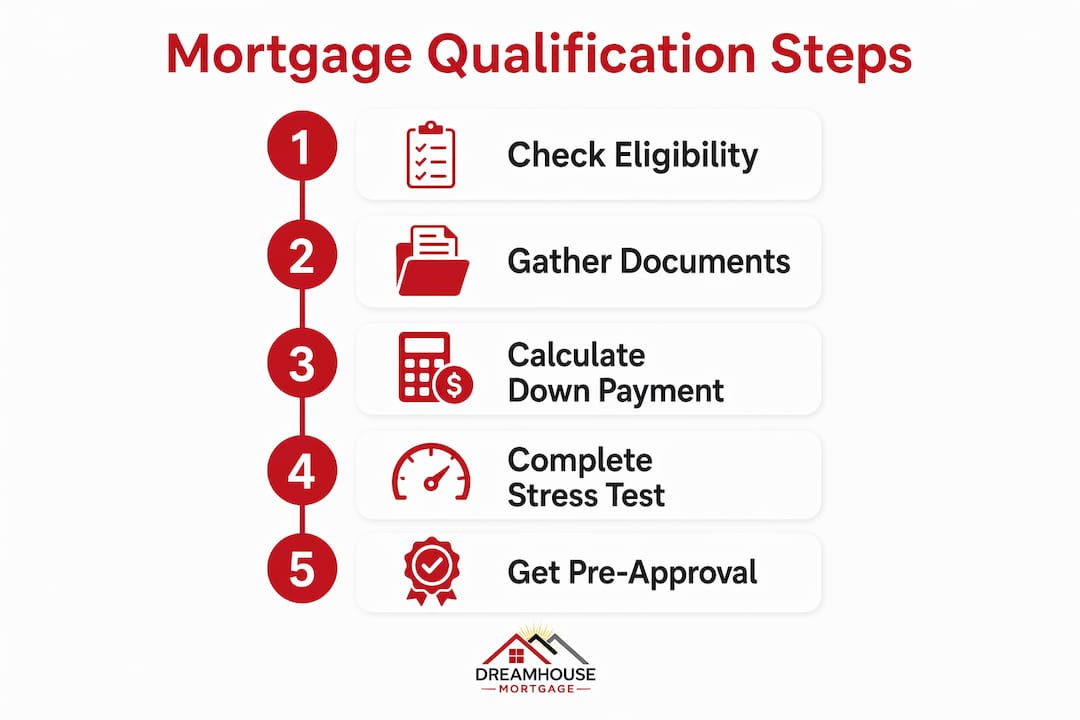
What are the key steps in the first-time mortgage application process?
The mortgage application process in Alberta follows a clear sequence. Understanding each step prevents delays and reduces the chance of a declined application.
Determine your budget. Calculate your maximum purchase price using the stress test qualifying rate, your gross income, and your existing debts. Use the GDS and TDS ratio limits as your guide. Dreamhouse Mortgage provides a detailed breakdown of the mortgage affordability factors that affect your qualification.
Save your down payment. Open an FHSA immediately if you have not already. Combine FHSA savings with RRSP Home Buyers’ Plan withdrawals and personal savings to reach your target down payment amount.
Get pre-approved. Submit your income documents, credit authorization, and asset statements to a lender or mortgage broker. Pre-approval locks in a rate for 90–120 days and confirms your maximum mortgage amount.
Make an offer. Once pre-approved, you can make offers with confidence. Your offer should include a financing condition that gives you time to finalize your mortgage approval after a specific property is chosen.
Complete the full mortgage application. After your offer is accepted, your lender orders a property appraisal and reviews the specific property details. This is when the final approval is issued.
Consult a real estate lawyer. Alberta requires a lawyer to complete the title transfer and mortgage registration. Your lawyer reviews the purchase agreement, confirms title is clear, and registers the mortgage with Alberta Land Titles.
Sign and close. You sign mortgage documents with your lawyer, transfer the down payment and closing costs, and receive the keys on your possession date.
Common challenges at each stage include credit score issues discovered during the pre-approval check, income documentation gaps for self-employed buyers, and appraisals that come in below the purchase price. Working with a mortgage broker who knows Alberta lenders reduces the risk at every step. Brokers have access to banks, credit unions, monoline lenders, and alternative lenders, which means more options if one lender declines.
Pro Tip: Never apply for new credit, change jobs, or make large purchases between pre-approval and closing. Any change to your financial profile can trigger a re-assessment and delay or cancel your approval.
Key Takeaways
Qualifying for a first-time home buyer mortgage in Alberta requires meeting federal eligibility rules, providing the correct tiered down payment, passing the OSFI mortgage stress test, and using available programs like the FHSA and RRSP Home Buyers’ Plan to maximize your purchase power.
| Point | Details |
|---|---|
| Eligibility definition | You must not have owned a principal residence in the current year or the prior four years. |
| Tiered down payment | Minimum is 5% up to $500,000, then 10% up to $1.5M; 20% required above $1.5M. |
| Stress test qualifying rate | You must qualify at your contract rate plus 2%, or 5.25%, whichever is higher. |
| 30-year amortization | First-time buyers on insured mortgages can now access 30-year terms, reducing monthly payments by about 8%. |
| Alberta tax advantage | No provincial land transfer tax saves Alberta buyers thousands compared to most other provinces. |
Dreamhouse Mortgage: Expert Help for Alberta First-Time Buyers
Qualifying for your first mortgage in Alberta involves federal rules, provincial programs, and lender-specific requirements that change regularly. Dreamhouse Mortgage, led by Guriqbal Chahal, MBA, PMP, has guided first-time buyers across Calgary, Airdrie, Cochrane, Chestermere, Okotoks, Red Deer, and Edmonton since 2013. The team works with banks, credit unions, monoline lenders, and alternative lenders to find the best rate and product for your situation.

Dreamhouse Mortgage handles pre-approval applications, stress test calculations, lender comparisons, and document coordination so you can focus on finding the right home. Guriqbal Chahal specializes in mortgage broker rate negotiation and can often secure rates and terms that individual buyers cannot access on their own. Book a free mortgage broker consultation or call Guriqbal Chahal directly at 403-966-6072. You can also find Dreamhouse Mortgage on Google.
FAQ
Who qualifies as a first-time home buyer in Alberta?
A first-time home buyer in Alberta must be at least 18, be a Canadian resident for tax purposes, and must not have owned and lived in a principal residence in the current year or any of the previous four years. The same rule applies to your spouse or common-law partner.
What is the minimum down payment on a $700,000 home in Alberta?
The minimum down payment on a $700,000 home is $45,000, calculated as 5% of the first $500,000 ($25,000) plus 10% of the remaining $200,000 ($20,000).
How does the mortgage stress test affect first-time buyers in Alberta?
The stress test requires you to qualify at the higher of your contract rate plus 2% or 5.25%, which reduces your maximum approved mortgage amount compared to qualifying at your actual rate.
What is the First Home Savings Account and how does it help?
The FHSA is a registered account that lets first-time buyers save up to $8,000 per year and $40,000 lifetime with tax-deductible contributions and tax-free withdrawals for a qualifying home purchase.
Does Alberta charge a land transfer tax for first-time buyers?
Alberta does not charge a provincial land transfer tax. Buyers pay only land title registration fees, which total approximately $420 on a $500,000 home with a $400,000 mortgage.