For Canadian real estate investors, the choice between a commercial vs residential investment mortgage comes down to one factor: how many units the property has and what generates the income. Use a residential investment mortgage for 1–4 unit rental properties in Calgary, Airdrie, or Cochrane, where lenders qualify you on personal income and credit. Choose a commercial mortgage for 5+ unit apartment buildings, mixed-use properties, or income-producing commercial assets, where lenders underwrite on the property’s net operating income (NOI) and debt service coverage ratio (DSCR). CMHC, OSFI, and the lender type you work with all shift depending on which side of that line your deal falls on. Dreamhouse Mortgage, led by Guriqbal Chahal, MBA, PMP, Broker of Record, helps Alberta investors identify which path fits their deal and structures the file accordingly.
Quick decision rules:
- 1–4 unit rental property (single-family, duplex, triplex, fourplex): apply for a residential investment mortgage; get a pre-approval based on your personal income and credit score.
- 5+ unit apartment building or mixed-use: prepare a DSCR pro forma and approach a commercial lender or CMHC-insured multi-residential program.
- Commercial retail, office, or industrial: conventional commercial mortgage only; no CMHC insurance available; plan for 25–35% down.
- Non-standard income (self-employed, corporate): work with a broker who can package alternative income evidence before approaching any lender.
- Unsure which category your property falls into: contact Guriqbal Chahal at 403-966-6072 for a lender classification review before you make an offer.
Table of Contents
- How Canada defines residential vs commercial for mortgage purposes
- Core structural differences between the two mortgage types
- What closing and due-diligence costs to budget for in Canada
- How lenders underwrite commercial deals vs residential files
- When does residential investment financing make more sense than commercial?
- How to prepare a strong mortgage application for either route
- How Dreamhouse Mortgage helps investors navigate these financing decisions
- Key Takeaways
- Dreamhouse Mortgage: Alberta investor mortgage expertise
- FAQ
How Canada defines residential vs commercial for mortgage purposes
The classification is not just about building type. It is about unit count, zoning, and intended use, and lenders apply these definitions consistently across Alberta.
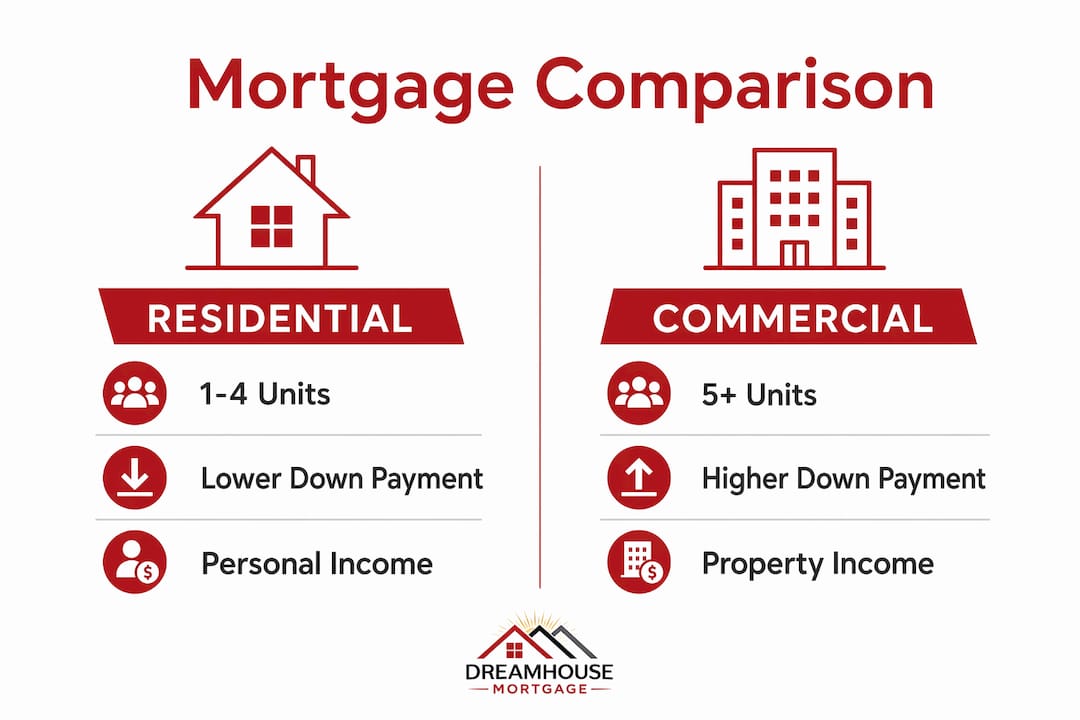
Residential properties cover single-family homes, condominiums, townhouses, and multi-unit buildings with up to four units. A duplex in Chestermere, a triplex in Red Deer, and a fourplex in Edmonton’s Glenora neighbourhood all qualify as residential for mortgage purposes. Lenders treat these as personal real estate, and CMHC’s Income Property program covers 2-to-4-unit rental properties up to 80% LTV with a maximum 25-year amortization.
Commercial properties begin at five units and extend to retail plazas, office buildings, industrial warehouses, hotels, and mixed-use developments. A 12-unit apartment building in Calgary’s Beltline, a strip mall in Cochrane, or a mixed-use building with ground-floor retail and upper-floor suites in Airdrie all fall into commercial territory. Zoning and intended use matter too: a property zoned commercial but used entirely for residential tenants may still be underwritten as commercial, depending on the lender.
Mixed-use properties sit in a grey zone. A building with retail on the ground floor and two residential suites above it will typically be treated as commercial by most institutional lenders, even though the majority of income comes from residential tenants. The lender’s classification determines which products, rates, and underwriting standards apply, so confirming the category before bidding protects your financing assumptions.
CMHC’s multi-residential programs apply specifically to 5+ unit residential buildings, not to retail or office assets. That distinction matters because CMHC-insured programs can raise maximum LTV to approximately 85% and allow longer amortizations, changing the economics of a multi-residential deal significantly compared to conventional commercial financing.
Core structural differences between the two mortgage types
The differences in investment mortgage types are most visible in four areas: down payment, qualification method, amortization, and rate structure.
| Feature | Residential Investment (1–4 units) | Commercial (5+ units / non-residential) |
|---|---|---|
| Minimum down payment | 20% (non-owner-occupied) | 20–35% (conventional); lower with CMHC MLI |
| Maximum LTV | 80% (CMHC-insured 2–4 units) | Up to 85% (CMHC MLI Select); — conventional |
| Qualification basis | Borrower income, GDS/TDS, credit score | Property NOI, DSCR, rent roll, asset condition |
| Amortization | Up to 30 years (uninsured) | Up to 25 years conventional; up to 25 years (CMHC MLI) |
| Typical term | 1–5 years fixed or variable | 1–10 years; balloon payments common |
| Rate profile | Lower; investment premium over owner-occupied | Higher; priced to asset risk and lender type |
| CMHC insurance | Available (2–4 units, non-owner-occupied) | Available for 5+ residential units only |
| Stress test (OSFI) | Applies to federally regulated lenders | Applies; commercial lenders may use internal benchmarks |
Down payment and LTV. A non-owner-occupied residential investment property in Calgary requires a minimum 20% down payment. Duplexes and triplexes often require 20–25% depending on the lender. Once you cross into commercial territory, conventional commercial loans typically require 25–35% down, though CMHC’s multi-residential insurance program can reduce that for qualifying 5+ unit buildings.
Qualification. Residential investment mortgage qualification is borrower-focused: lenders verify your personal income, calculate your Gross Debt Service (GDS) and Total Debt Service (TDS) ratios, and review your credit score. Commercial mortgage qualification is asset-focused: lenders evaluate the property’s rent roll, NOI, and DSCR. Your personal credit still matters for commercial deals, but the property’s ability to service the debt is the primary filter.

Amortization and term. Residential investment mortgages can have longer amortization periods, keeping monthly payments lower and improving cash flow on smaller properties. Commercial mortgages typically have shorter amortization periods on a conventional basis, with balloon payments at term end requiring refinancing. CMHC’s MLI Select program for multi-residential buildings permits extended amortization for qualifying projects, which materially changes monthly cash flow. Amortization length directly affects your monthly payment and total interest paid over the life of the loan.
Rate structure. Residential investment properties carry a rate premium over owner-occupied mortgages. Commercial mortgages carry a further premium, priced to the asset type, DSCR, and lender risk appetite. Private and alternative lenders charge more than institutional lenders in both categories.
What closing and due-diligence costs to budget for in Canada
Costs differ substantially between the two routes, and underestimating them is one of the most common errors investors make when building a pro forma.
Residential investment (1–4 units):
- Residential appraisal: typically $300–$600 for a single-family or small multi-unit property in Alberta.
- Home inspection: $400–$700.
- Legal fees: $1,200–$2,000 for a standard purchase.
- CMHC insurance premium: for a non-owner-occupied 2–4 unit property at 75.01–80% LTV, the premium is 2.90% of the total loan amount, added to the mortgage.
- Title insurance: $150–$400.
- No environmental report required for standard residential properties.
Commercial (5+ units / non-residential):
- Commercial appraisal: $3,000–$8,000 or more depending on asset size and complexity.
- Phase I Environmental Site Assessment (ESA): $2,500–$5,000; required by most institutional lenders.
- Legal fees: $3,000–$8,000+, often higher when lender counsel is involved.
- Lender commitment and processing fees: 0.5–1.5% of the loan amount on conventional commercial deals.
- CMHC application fee for multi-residential: varies by program; confirm current rates with CMHC directly.
- Interest-only periods and yield-maintenance prepayment penalties are common on commercial mortgages and can add significant cost if you refinance or sell before term end.
Pro tip for pro forma accuracy:
Pro Tip: Add a 10–15% contingency on top of your estimated closing costs for commercial deals. Phase I ESAs sometimes trigger Phase II investigations, and lender legal fees can exceed initial estimates on complex titles. Budget the contingency before you finalize your offer price.
Quick cost checklist before bidding:
- Appraisal (residential or commercial grade)
- Legal fees (buyer and, for commercial, lender counsel)
- Environmental assessment (commercial only)
- CMHC insurance premium (if applicable)
- Lender commitment fee (commercial)
- Title insurance
- Property transfer tax (Alberta has no provincial land transfer tax, but confirm municipal levies)
- Prepayment penalty estimate if you plan to refinance within the term
How lenders underwrite commercial deals vs residential files
The fundamental difference is risk allocation. Residential underwriting focuses on personal creditworthiness. Commercial underwriting focuses on the asset’s cash flow and business viability.
Commercial underwriting: NOI, DSCR, and cap rate
Net Operating Income (NOI) is the property’s total rental income minus operating expenses (property taxes, insurance, maintenance, management fees, utilities paid by the landlord), before mortgage payments. It is the starting point for every commercial underwriting calculation.
DSCR formula:
DSCR = NOI ÷ Annual Debt Service
A DSCR of 1.00 means income exactly covers the mortgage. Most lenders will not approve a commercial mortgage with a DSCR below 1.20. The standard institutional target is 1.20–1.25x for conventional multi-residential; CMHC-insured multi-residential can qualify at 1.10–1.25x due to the insurance protection.
Sample DSCR calculation:
| Item | Amount |
|---|---|
| Gross annual rent (12 units × $1,200/month) | $172,800 |
| Vacancy allowance (5%) | (—) |
| Operating expenses (taxes, insurance, maintenance, management) | (—) |
| Net Operating Income (NOI) | — |
| DSCR | 1.26x |
At 1.26x, this property clears the 1.20–1.25x threshold most conventional lenders require. A DSCR below 1.20 would require a larger down payment, a rate adjustment, or expense reduction to qualify.
Cap rate (capitalization rate) measures the property’s return independent of financing: NOI ÷ Purchase Price. Lenders use cap rates to assess whether the purchase price is reasonable relative to income, and to set LTV limits. A property priced at a cap rate significantly below market norms signals overpayment risk.
Key metric: DSCR targets of 1.20–1.25x are the standard threshold for conventional commercial multi-residential mortgages in Canada.
Residential investment underwriting: GDS, TDS, and credit
For 1–4 unit investment properties, lenders calculate your GDS ratio (housing costs as a percentage of gross income) and TDS ratio (all debt obligations as a percentage of gross income). Lenders typically allow up to 50–80% of expected rental income to offset the property’s carrying costs in the TDS calculation, depending on the lender and whether the property is owner-occupied.
Credit score expectations for residential investment mortgages at institutional lenders generally start at 680+. Commercial lenders also review personal credit, but a score below 650 typically redirects the file to alternative or private lenders at higher rates.
Document requirements by route
| Document | Residential Investment | Commercial |
|---|---|---|
| Personal income verification | T4s, NOAs, pay stubs | Required; plus corporate financials |
| Rent roll | Not always required | Required (current, signed leases) |
| 2–3 years property financials | Not required | Required |
| Commercial appraisal | Not required | Required |
| Phase I ESA | Not required | Required by most institutional lenders |
| Corporate structure documents | Not required | Required if borrowing through a corporation |
Business financials and corporate structure affect qualification differently for each route, particularly when the borrower is self-employed or holds properties in a holding company.
When does residential investment financing make more sense than commercial?
The answer depends on your deal size, capital position, and investment strategy.
Choose residential investment financing when:
- The property has 1–4 units (single-family rental, duplex in Airdrie, triplex in Red Deer).
- You want longer amortization (up to 30 years) to maximize monthly cash flow.
- Your personal income is strong enough to support GDS/TDS qualification.
- You are building a portfolio incrementally and want lower entry costs per deal.
- The property qualifies for CMHC Income Property insurance (2–4 units, non-owner-occupied, purchase price under $1,000,000).
Choose commercial financing when:
- The property has 5+ residential units or includes any commercial component.
- The deal must be underwritten on property cash flow because your personal income cannot support the debt load.
- You are acquiring a retail plaza, office building, or industrial property in Calgary or Edmonton.
- You want to use a corporate entity as the borrower without a personal income test.
- The property’s NOI and DSCR are strong enough to support the higher down payment and rate.
Scenario examples:
Duplex in Cochrane: Residential investment mortgage. 20% down, personal income qualification, up to 30-year amortization. Straightforward file for most institutional lenders.
12-unit apartment building in Calgary’s Inglewood: Commercial mortgage or CMHC multi-residential. DSCR-based underwriting, 25–35% down (conventional) or lower with CMHC MLI. Longer closing timeline; commercial appraisal and Phase I ESA required.

Mixed-use building (ground-floor retail, two residential suites) in Okotoks: Commercial mortgage. Even with residential tenants above, the commercial component triggers commercial underwriting at most lenders. Conventional financing; no CMHC insurance available.
Risk trade-offs to consider. Residential investment properties are generally less sensitive to economic cycles than retail or office commercial assets. Vacancy in a single-family rental in Chestermere is a temporary income loss; vacancy in a retail plaza can persist for months or years. Commercial assets offer higher income potential but require more active management, longer due diligence, and greater tolerance for vacancy risk.
For investors building a scalable real estate portfolio in Alberta, starting with residential investment properties and transitioning to commercial as capital and experience grow is a common and practical path.
How to prepare a strong mortgage application for either route
The steps differ by route, but the principle is the same: lenders approve well-documented, well-structured files faster and at better terms.
Residential investment application steps
- Confirm property classification. Verify unit count, zoning, and whether CMHC Income Property insurance applies before approaching lenders.
- Pull your credit report. Review your Equifax and TransUnion reports for errors. A score of 680+ gives you access to the widest range of institutional lenders.
- Gather personal income documents. Two years of T4s or Notices of Assessment, recent pay stubs, and a current employment letter.
- Calculate your GDS/TDS. Include all existing debt obligations and the new property’s carrying costs. Confirm you are within lender thresholds before applying.
- Get a residential pre-approval. This confirms your borrowing capacity and strengthens your offer position in competitive Calgary and Airdrie markets.
- Order a residential appraisal at the offer stage to confirm value and satisfy lender requirements.
- Submit the full file. Lender review and approval typically takes 5–15 business days for a clean residential investment file.
Commercial application steps
- Build a DSCR pro forma. Calculate NOI from current rent roll and realistic operating expenses. Confirm DSCR clears 1.20x before approaching lenders.
- Prepare 2–3 years of property financials. Signed leases, operating statements, and a current rent roll are non-negotiable for institutional lenders.
- Assess your net worth position. Conventional commercial lenders typically expect net worth equal to or exceeding the loan amount. CMHC-insured multi-residential requires a minimum net worth of 25% of the loan value.
- Order a commercial appraisal and Phase I ESA early. These take 3–6 weeks and sit on the critical path to closing.
- Obtain a term sheet. This is the commercial equivalent of a pre-approval; it outlines proposed rate, LTV, DSCR requirements, and conditions.
- Complete lender due diligence. Respond to conditions promptly; delays in document delivery are the most common cause of extended commercial closing timelines.
- Close. Institutional and CMHC-insured commercial mortgages typically take 45–90 days from initial submission to funding.
Negotiation levers for better terms. A larger down payment improves LTV and can lower the rate on both routes. On commercial deals, improving the DSCR (through lease-up, rent increases, or expense reduction) before applying gives you negotiating room on rate and amortization. For CMHC multi-residential, qualifying for MLI Select can extend amortization and reduce the effective rate.
Pro Tip: If your income is non-standard — self-employed, incorporated, or drawn from multiple holding companies — work with Dreamhouse Mortgage before approaching any lender. Guriqbal Chahal packages add-back income and corporate structures in a format lenders accept, which can be the difference between an approval and a declined file.
How Dreamhouse Mortgage helps investors navigate these financing decisions
Guriqbal Chahal, MBA, PMP, is the Broker of Record at Dreamhouse Mortgage and has been advising Alberta investors on residential and commercial investment financing since the brokerage was founded in 2013. The MBA and PMP designations reflect both financial analysis depth and structured project management, which matters when coordinating multi-party commercial closings with appraisers, environmental consultants, lender counsel, and title companies simultaneously.
Dreamhouse Mortgage’s value for investors is access and structuring. The brokerage works with banks, credit unions, monoline lenders, alternative lenders, and private lenders, which means a deal that does not fit one channel can be repositioned for another without starting over. For a Calgary investor buying a 10-unit building in Forest Lawn, that might mean comparing a CMHC MLI application against a conventional commercial term sheet from a credit union to determine which produces better cash flow after debt service. For a self-employed investor in Cochrane buying a duplex, it means packaging T1 Generals and corporate financials in a format that satisfies residential lender income requirements.
The investor workflow at Dreamhouse Mortgage follows four stages: assess the deal and classify the property, structure the file for the most suitable lender channel, shop the application across multiple lenders simultaneously, and coordinate closing. OSFI’s stress-testing guidance applies to federally regulated lenders on both residential and commercial files, and CMHC insurance can materially change LTV and amortization outcomes on qualifying multi-residential deals. Guriqbal Chahal navigates both frameworks as part of standard file preparation.
For investors in Calgary, Edmonton, Airdrie, Cochrane, Chestermere, and Red Deer, local investment mortgage expertise means understanding which lenders are active in specific Alberta submarkets and which asset types they are currently pricing competitively.
Key Takeaways
Residential investment mortgages (1–4 units) and commercial mortgages (5+ units, non-residential) are underwritten on fundamentally different criteria, and choosing the wrong route for your deal type adds cost, delays, and qualification risk.
| Point | Details |
|---|---|
| Unit count is the dividing line | Properties with 1–4 units use residential investment financing; 5+ units or any commercial use require a commercial mortgage. |
| Qualification basis differs | Residential files are qualified on borrower income and credit; commercial files are qualified on property NOI and DSCR (target: 1.20–1.25x). |
| Down payment and amortization | Residential investment requires 20% down and allows up to 30-year amortization; conventional commercial requires 25–35% down with shorter amortization. |
| CMHC changes the math | CMHC-insured multi-residential programs can raise LTV to approximately 85% and extend amortization, improving cash flow on qualifying 5+ unit deals. |
| Dreamhouse Mortgage | Guriqbal Chahal, MBA, PMP, structures residential and commercial investor files across Alberta and shops them to banks, credit unions, and alternative lenders for the best available terms. |
Dreamhouse Mortgage: Alberta investor mortgage expertise
Investors comparing financing routes for Calgary, Edmonton, Airdrie, Cochrane, Chestermere, or Red Deer properties get direct access to multiple lender channels through Dreamhouse Mortgage. Whether the deal is a duplex in Okotoks or a 20-unit building in Edmonton’s Oliver neighbourhood, Guriqbal Chahal structures the file, identifies the right lender, and negotiates terms across banks, credit unions, monoline lenders, alternative lenders, and private lenders.

Dreamhouse Mortgage handles CMHC-insured multi-residential applications, conventional commercial term sheets, and residential investment property mortgages across Alberta. For investors with non-standard income, corporate structures, or complex portfolios, the brokerage packages files that institutional lenders accept. Local market knowledge across Alberta communities means lender selection is matched to the specific asset type and submarket, not just the province-wide average.
To compare residential and commercial financing options for your next Alberta investment property, contact Guriqbal Chahal, MBA, PMP, Mortgage Broker, Dreamhouse Mortgage at 403-966-6072 or book a free consultation. Find Dreamhouse Mortgage on Google.
This article provides general information about Canadian mortgage products and is not financial or legal advice. Confirm current qualification rules, rates, and CMHC program requirements with a licensed mortgage professional for your specific situation.
FAQ
Is commercial or residential real estate better for investors in Canada?
Neither is universally better. Residential investment properties (1–4 units) offer simpler financing, lower down payments, and longer amortizations; commercial properties offer higher income potential but require larger down payments, shorter amortizations, and asset-based underwriting. The right choice depends on your capital, risk tolerance, and management capacity.
Do you need 20% down on a commercial mortgage in Canada?
Conventional commercial mortgages typically require 25–35% down. CMHC-insured multi-residential programs for 5+ unit buildings can reduce that requirement, with maximum LTV reaching approximately 85% for qualifying deals.
What is DSCR and what target do Canadian commercial lenders use?
DSCR (Debt Service Coverage Ratio) equals NOI divided by annual debt service. Most Canadian institutional lenders require a minimum DSCR of 1.20 for conventional commercial mortgages; CMHC-insured multi-residential deals can qualify at 1.10–1.25x depending on the program.
Can a self-employed investor qualify for a commercial mortgage in Canada?
Yes. Commercial mortgage qualification is primarily based on the property’s NOI, not personal income, which can benefit self-employed investors whose personal income documentation is complex. Personal credit and net worth are still reviewed, and a mortgage broker can package the file to match lender requirements.
What is the stress test rule for investment mortgages in Canada?
OSFI’s stress test applies to federally regulated lenders on both residential and commercial investment mortgages. Borrowers must qualify at the greater of the contract rate plus 2% or the minimum qualifying rate set by OSFI. Credit unions and private lenders may apply different internal benchmarks.
Recommended
- Investment Property Mortgage Calgary | DreamHouse
- Ultimate Investment Property Mortgage Alberta Guide: Down Payment, Rates & Secrets to Maximize Profit
- Investment Property Mortgage Calgary 2026: Best Rates, Down Payment & Qualification Guide
- Rental Property Mortgage Canada: Avoid Costly Investor Mistakes & Secure Smarter Financing