An appraisal estimates a home’s market value for the lender; a home inspection checks the home’s physical condition for the buyer. In most Calgary purchases, the inspection happens first, during your due diligence period, and the appraisal follows once your lender orders it to confirm financing. Both protect against different risks, and a well-prepared buyer budgets time and money for each.
TL;DR:
- Buyers should schedule their home inspection immediately after offer acceptance, as it occurs during conditions and influences negotiations.
- Appraisals in Calgary typically take 20 to 40 minutes, focus on comparable sales, and are independent of property condition assessments.
- Both reports are critical: inspections protect the buyer from hidden defects, while appraisals safeguard the lender from overvalued collateral.
- Costs for inspections are paid upfront by the buyer, whereas appraisal fees may be built into lender costs or paid directly, varying by lender.
- If a report reveals issues or a low appraisal, buyers can renegotiate, request repairs, or in some cases, increase their down payment or explore alternative financing options.
Table of Contents
- Appraisal Vs Inspection: What Each Report Actually Does
- What A Home Inspection Covers And Why It Protects You
- Appraisal Vs Home Inspection: A Side-By-Side Comparison
- Which Comes First: Inspection Or Appraisal?
- Budgeting For Both Fees In Your Closing Costs
- Vetting The Professionals Before You Pay Them
- When A Report Comes Back With Bad News
- How DreamHouse Mortgage Helps When Reports Affect Financing
- How Appraisals And Inspections Affect Mortgage Approval
- Regional And Property-Type Differences Worth Knowing
- A Broker’s Honest Take On Getting This Sequence Right
- Get Your Financing Ready Before The Appraisal Comes Back
- Sources
- FAQ
Appraisal Vs Inspection: What Each Report Actually Does
A home appraisal is a professional opinion of market value, produced for your lender to confirm the property is worth what you’re paying for it. It has nothing to do with whether the furnace works or the roof leaks. A home inspection, by contrast, is a visual assessment of the property’s condition, produced for you, the buyer, so you know what you’re actually purchasing before you’re locked into a deal.
This is where the “appraisal vs assessment” confusion usually starts. People use “assessment” loosely to mean a municipal property tax assessment, a general property evaluation, or sometimes the appraisal itself. In Calgary, your property’s tax assessment (set annually by the City of Calgary) is a completely separate number from your mortgage appraisal, and the two rarely match. Don’t be surprised if they’re thousands of dollars apart. They’re calculated for different purposes by different parties, and lenders never use your tax assessment to size your mortgage.
How appraisals work in Canada
Appraisers in Canada follow the Canadian Uniform Standards of Professional Appraisal Practice (CUSPAP), the professional rulebook maintained by the Appraisal Institute of Canada. Look for a member holding the AACI™ (Accredited Appraiser Canadian Institute) or CRA™ (Canadian Residential Appraiser) designation. These credentials signal that the appraiser has met formal education, experience, and ethics requirements and answers to a national professional body.
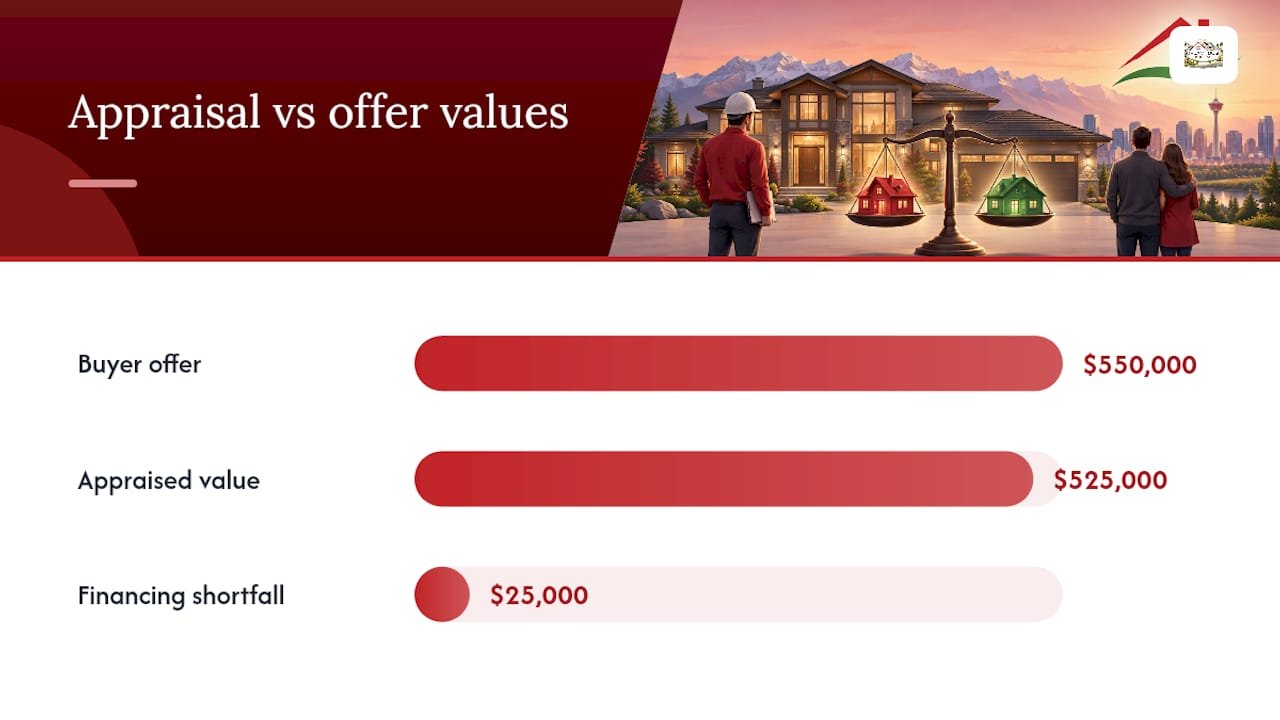
An appraiser’s interior visit is often brief, sometimes just 20 to 40 minutes, focused on collecting data rather than performing a detailed condition check. According to the Appraisal Institute of Canada, the lender uses the appraised value, not your agreed purchase price, to set the maximum mortgage loan amount. If your offer is $550,000 but the appraisal comes back at $525,000, your lender bases financing on the lower figure.
Appraisal reports come in a few standard formats:
- Form reports — the most common for typical residential purchases, using standardized templates with comparable sales data.
- Short narrative reports — add brief written commentary for more unusual properties or lending scenarios.
- Full narrative reports — reserved for complex assignments, such as acreage properties, luxury homes, or commercial-residential hybrids.
One detail buyers should know and trust: appraiser fees are flat, based on the complexity of the assignment, and never contingent on the value they report. That independence is what keeps the number honest even in a hot Calgary market where emotions run high. An appraisal is not a condition report. It won’t tell you the shingles are near the end of their life or that the electrical panel needs updating. That job belongs entirely to the inspector, which is exactly why relying on an appraisal alone before writing an offer is one of the more expensive mistakes a first-time buyer can make. For a deeper look at how appraised values are calculated in this market, see our Calgary home valuation guide.
What A Home Inspection Covers And Why It Protects You
A home inspection is a non-invasive, visual evaluation of a property’s main systems and components, done specifically to protect you, the buyer, from unpleasant surprises after closing. Where the appraisal answers “what is this worth,” the inspection answers “what am I actually buying, and what’s going to break first.”
Home inspector regulation varies across Canada, and not every province requires licensing. That makes credentials matter even more. Look for membership in the Canadian Association of Home & Property Inspectors (CAHPI), and ask whether the inspector follows the voluntary CSA A770-16 Home Inspection Standard, a national benchmark published to bring consistency to what a proper inspection should cover.
A typical Calgary home inspection checklist walks through:
- Roof and exterior — shingle condition, flashing, eavestroughs, grading around the foundation.
- Foundation and structure — cracking, settling, moisture intrusion (a real concern in older Calgary neighborhoods like Bowness or Killarney with aging foundations).
- Electrical system — panel capacity, wiring type (knob-and-tube or aluminum wiring are common red flags in older infill homes).
- Plumbing — water pressure, pipe material, water heater age and condition.
- Heating and cooling — furnace age, venting, and whether the system matches Alberta’s winter demands.
- Insulation and ventilation — attic insulation levels, signs of ice damming, and moisture in the attic space.
- Interior and windows — signs of water damage, window seal failure, and general wear.
Even a thorough inspection has limits. Inspectors can’t see inside walls, can’t test every latent defect, and don’t assess code compliance, that’s a separate function handled by municipal inspectors during permitted work. A clean inspection report reduces risk; it doesn’t eliminate it entirely.
Pro Tip: Always attend your own inspection in person. CAHPI’s own guidance for buyers confirms that being there trains you on how the home’s systems actually operate and lets you ask questions the written report will never fully capture. Request a sample report from any inspector before hiring them, so you know exactly what level of detail you’re paying for.
Appraisal Vs Home Inspection: A Side-By-Side Comparison
Buyers often ask which one they “really need.” The honest answer is both, because they answer different questions for different people in the transaction.
| Factor | Home Appraisal | Home Inspection |
|---|---|---|
| Purpose | Confirms market value for lending | Assesses physical condition and defects |
| Who it protects | The lender (and indirectly, you) | You, the buyer, directly |
| Scope | Comparable sales, market trends, brief property review | Roof, foundation, electrical, plumbing, HVAC, structure |
| Deliverable | Form, short narrative, or full narrative valuation report | Detailed written condition report with photos |
| Typical timing | After your offer is accepted, ordered by the lender | During your conditional/due diligence period, ordered by you |
| Who pays | Often built into lender/borrower closing costs | Paid directly by the buyer |
| Governing standard | CUSPAP (AIC) | CSA A770-16 / CAHPI National Standards of Practice |
Both fees sit inside your overall closing cost picture. According to Canada, total closing costs generally run between 1.5% and 4% of your purchase price, and inspection fees are commonly bundled into that upfront cash requirement, separate from your down payment.
Which Comes First: Inspection Or Appraisal?
In the typical Calgary purchase sequence, your home inspection comes first. It happens during the conditions period after your offer is accepted but before you remove your financing and inspection conditions. Your lender’s appraisal usually follows, ordered once your mortgage application moves toward final approval.
That order exists for a practical reason. You want to know about condition problems before you’re financially committed, while you still have room to negotiate or walk away. The appraisal, meanwhile, is really a lender safeguard confirming the collateral behind your mortgage is sound, and it typically happens once the deal already looks like it’s proceeding.
A well-structured offer builds in both contingencies:
- Inspection condition — usually 5 to 10 business days in the Calgary market, giving your inspector time to complete the report and you time to review it.
- Financing condition — often 7 to 15 business days, which needs to allow enough time for the lender’s appraisal to come back.
- Sequencing tip — book your inspector as soon as your offer is accepted; delays here can eat into your financing condition window too.
- Coordination checklist — confirm your inspection date, share the accepted offer with your mortgage broker immediately, and ask your lender how soon they can schedule the appraisal once conditions look likely to be met.
Certain situations flip this order or compress the timeline. Cash offers with no financing condition sometimes skip the appraisal altogether, since there’s no lender requiring one. Buyers in competitive multiple-offer situations in communities like Auburn Bay or Mahogany sometimes waive the inspection condition to strengthen their offer, a move worth discussing carefully with your mortgage broker before you commit to it. Private lender or alternative financing deals may also require the appraisal earlier in the process, since some private lenders won’t even consider an application without one in hand.
Budgeting For Both Fees In Your Closing Costs
Home inspection fees are paid directly by you, the buyer, generally due at the time of service. Appraisal fees work differently. They’re sometimes charged directly to you and sometimes rolled into your lender’s underwriting costs, depending on the lender and mortgage product, so it’s worth asking early which model applies to your file.
Both costs live inside your broader closing cost budget. Per Canada.ca’s guidance, buyers should plan for closing costs of roughly a low to moderate percentage of the purchase price, on top of the down payment itself. On a $500,000 Calgary home, that’s a range of $7,500 to $20,000 covering legal fees, title insurance, land transfer registration, and yes, your inspection fee.
A few scenarios can add extra costs beyond the basic appraisal and inspection:
- Acreage or rural properties around Rocky View County or south of Okotoks often require a full narrative appraisal, which costs more than a standard form report.
- Older homes in established Calgary communities may call for specialist follow-up inspections, such as a WETT (Wood Energy Technology Transfer) inspection for a wood-burning fireplace, or a sewer scope for aging clay pipe.
- Condos frequently need a status certificate review alongside the standard inspection, an added document review cost many buyers forget to budget for.
- New construction sometimes skips a full home inspection in favor of a pre-delivery inspection process instead, though an independent inspector is still worth hiring where your builder allows it.
Ask your appraiser and inspector upfront exactly what’s included in their fee and what triggers an additional charge. An appraiser working under CUSPAP should be able to quote you a flat fee before starting, since their compensation is never tied to the value they report.
Vetting The Professionals Before You Pay Them
Not every appraiser or inspector operating in Calgary carries the same level of credential, and the gap matters more than most buyers realize until something goes wrong.
For appraisers, look for these markers before hiring:
- AIC membership with either the AACI™ or CRA™ designation displayed on their report or website.
- CUSPAP compliance, which you can ask about directly; a legitimate appraiser will confirm it without hesitation.
- A stated independence policy confirming their fee isn’t tied to the appraised value, a standard AIC members must follow.
- Relevant local experience in Calgary, Airdrie, or Cochrane specifically, since comparable sales knowledge varies significantly by community.
For inspectors, check for:
- CAHPI membership, verifiable through their buyer and seller resources.
- Adherence to CSA A770-16 or the CAHPI National Standards of Practice, which define what a proper inspection scope looks like.
- Proof of liability insurance, which protects you if something is missed.
- A sample report you can review before booking, showing photo quality, level of detail, and how clearly issues are explained.
Watch for a few red flags that should make you pause: any inspector or appraiser who prices based on the outcome or value of the report, anyone unwilling to share a sample report, and anyone who can’t clearly explain what standard they follow. A professional confident in their work has no reason to be vague about any of this.
Pro Tip: Before you hire either professional, ask three questions: “What standard do you follow?”, “Can I see a sample report?”, and “Are you insured?” A confident, specific answer to all three is a strong sign you’re working with someone reputable. Hesitation on any one of them is worth taking seriously.
When A Report Comes Back With Bad News
An inspection report flagging problems doesn’t automatically kill your deal, and neither does an appraisal that lands below your purchase price. Both situations have practical paths forward.
If your inspection reveals issues, your options generally include:
- Asking the seller for a repair credit or price reduction based on a contractor’s written estimate.
- Requesting the seller complete specific repairs before closing, with a re-inspection to confirm the work.
- Walking away cleanly under your inspection condition if the issues are significant enough and negotiations stall.
- Proceeding as-is if the issues are minor and you’ve factored the repair cost into your offer already.
If the appraised value comes in lower than purchase price, a more common headache in fast-moving Calgary micro-markets, your realistic options are to renegotiate the purchase price down to match the appraisal, increase your down payment to cover the gap, or explore alternative lender options through your mortgage broker. Some private and alternative lenders weigh a file differently than the big banks do, and a bridge financing structure can sometimes cover a temporary shortfall while you sort out longer-term financing.
Document everything you present to a seller or lender: the full inspection report, contractor repair quotes with dates, and a clear written summary of what you’re asking for and why. Vague verbal complaints rarely move a negotiation forward the way a specific, priced estimate does. This is exactly the point in the process where calling a mortgage broker early pays off, before you’re stuck scrambling for financing options with only days left on your condition.
How DreamHouse Mortgage Helps When Reports Affect Financing
When an appraisal comes in low or an inspection uncovers a costly repair, the mortgage side of your deal often needs to move fast, and that’s where having an experienced broker in your corner makes a real difference. A mortgage preapproval is a helpful starting point, but the Financial Consumer Agency of Canada is clear that preapproval isn’t a guarantee. Your lender still verifies the property and your file before funding, which is exactly why appraisal outcomes matter so much at the finish line.
As your broker, we coordinate between you and multiple lenders, banks, credit unions, monoline lenders, and alternative or private lenders, so a single low appraisal doesn’t necessarily end your purchase. If one lender’s underwriting gets stuck on an appraised value shortfall, another lender’s guidelines or a restructured down payment can often bridge the gap. We also help buyers explore renovation financing when an inspection uncovers repairs worth rolling into the mortgage rather than paying out of pocket at closing.
Mortgage brokers with experience in Calgary, Airdrie, and Cochrane help first-time buyers align their preapproval numbers with what properties appraise for in the current market, reducing surprises between offer and closing.
If you’re heading into an offer and want your financing structured to handle whatever the appraisal comes back at, a short consultation before you write that offer is worth far more than a scramble afterward.
How Appraisals And Inspections Affect Mortgage Approval
Your mortgage approval hinges on more than your income and credit score. The appraisal directly determines your maximum loan amount, since lenders lend against the lower of purchase price or appraised value, not simply what you agreed to pay. A shortfall here can force last-minute changes to your down payment or loan structure.
The inspection’s influence on approval is more indirect but still real. If a property has serious structural or safety issues, some lenders and mortgage insurers may require repairs before closing or hesitate to approve financing at all. This matters especially for insured mortgages, where the insurer is taking on risk alongside the lender and cares about the long-term condition of the collateral.
Neither report guarantees approval on its own. A clean inspection with a strong appraisal still needs to sit alongside your income documentation, credit profile, and debt ratios for full approval to come through. Treat both reports as pieces of a larger financing puzzle rather than standalone hurdles, and loop your broker in the moment either one raises a concern, not after you’ve already tried to sort it out alone.
Regional And Property-Type Differences Worth Knowing
Appraisal and inspection processes shift depending on where in Alberta you’re buying and what type of property you’re after. A condo appraisal in downtown Calgary factors in building reserve fund health and comparable unit sales within the same complex, details that simply don’t apply to a detached home in Airdrie’s Bayside community.
Acreage and rural properties around Rocky View County or Cochrane often need a full narrative appraisal report rather than the standard form report, since comparable sales are scarcer and features like wells, septic systems, and outbuildings need individual assessment. Inspections on rural properties typically expand to cover well water quality and septic system function, items a standard urban inspection checklist doesn’t touch.
New construction in growing communities like Airdrie’s Windsong or Calgary’s University District follows a different rhythm entirely, often relying on a builder’s pre-delivery inspection process supplemented by an independent inspection where the buyer arranges one. Older Calgary infill neighborhoods, meanwhile, tend to surface more inspection findings around aging electrical systems, foundation settling, and outdated insulation, simply because the housing stock is older.
A Broker’s Honest Take On Getting This Sequence Right
The biggest mistake I see first-time buyers make isn’t misunderstanding the difference between appraisal and inspection, it’s treating them as sequential boxes to check rather than connected pieces of the same financial decision. Your inspection findings should shape how you approach your financing conversation, not sit in a folder you forget about once conditions are removed.
My practical advice: get your mortgage preapproval in place before you start touring homes seriously, book your inspector the day your offer is accepted, and call your broker the moment either report shows something unexpected. Waiting until the financing condition deadline is looming to raise a concern leaves far fewer options on the table than raising it three days earlier would have.
Talk to a mortgage broker early in your search, not just when a problem shows up. That single habit saves more Calgary-area deals than any negotiating tactic ever will.
— Guriqbal Chahal, MBA, PMP
Get Your Financing Ready Before The Appraisal Comes Back
Most Calgary buyers only think about their mortgage broker after a problem shows up, a low appraisal, a repair estimate that changes their budget, a lender getting cold feet. A mortgage brokerage can get your financing structured and lender options mapped out before appraisal and inspection reports arrive, so a low appraisal or costly inspection finding doesn’t derail your closing date.

Whether you need a mortgage pre-approval that reflects realistic Calgary market values, access to alternative lenders when a bank says no, or renovation financing to roll inspection repairs into your mortgage, our team works with banks, credit unions, monoline, and private lenders to find a structure that fits your file. As a first-time buyer navigating Calgary, Airdrie, or Cochrane, you deserve a broker who explains every option in plain language and moves quickly once conditions start ticking down.
Call Guriqbal Chahal, MBA, PMP, Mortgage Broker, at 403-966-6072, check out our Google Business Profile, or start with our complete guide for first-time Calgary homebuyers to see how we can structure your financing before you write your next offer.
This article is general information, not a substitute for advice from a qualified financial advisor. Consult a qualified financial professional about your own circumstances before acting on anything here.
Sources
- Canada
- For residential property owners – Appraisal Institute of Canada
- Home inspections – Office of Consumer Affairs
- Buyers & Sellers – CAHPI
FAQ
What Is The Biggest Red Flag In A Home Inspection?
Structural issues, active water intrusion, and outdated or unsafe electrical systems (like knob-and-tube wiring) top the list of red flags inspectors flag most seriously. These typically require professional evaluation and can carry significant repair costs, making them worth negotiating over rather than dismissing.
Do Appraisals Usually Come Back Low?
Not usually, but it happens more often in fast-moving markets where offers exceed recent comparable sales. When it does, the lender bases your maximum mortgage on the appraised value rather than the purchase price, which can mean renegotiating price, increasing your down payment, or exploring alternative lender options.
What Is The “3-Day Appraisal Rule”?
There’s no universal “3-day appraisal rule” in Canadian mortgage practice; timelines are set by your specific lender and financing condition, not a fixed national regulation. Ask your mortgage broker for your lender’s exact appraisal turnaround time as soon as your offer is accepted, since it directly affects how much room you have in your financing condition.
Do You Need A Home Inspection If You’re Getting An Appraisal?
Yes. An appraisal only confirms market value for your lender; it isn’t a condition report and won’t catch issues like foundation cracks, roof wear, or outdated electrical systems. A separate home inspection is the only way to understand the property’s actual physical condition before you close.
What Happens If The Appraisal Is Lower Than The Purchase Price?
Your lender will finance based on the appraised value, not what you agreed to pay, which usually means covering the gap with a larger down payment or renegotiating price with the seller. A mortgage broker can also check whether a different lender’s guidelines or an alternative financing structure closes that gap without derailing your purchase.