Yes, you can finance acreage in Alberta, but land loans work differently than a city mortgage. Expect to bring 25% to 50% down depending on servicing and zoning, with farm-specific programs sometimes lowering that bar for qualifying producers. Before you call a lender, confirm zoning and servicing status, tally your cash-to-close including GST and land titles fees, and talk to a mortgage broker who has actually closed acreage files in Alberta.
TL;DR:
- Down payments for Alberta acreage generally range from 25% for serviced lots to over 50% for unserviced or remote parcels, with farm programs sometimes lowering requirements.
- Lenders prefer property zoning and servicing status before approving; approvals are easier for serviced parcels and are more challenging for raw land or larger farms.
- Farm credit programs like FCC and AFSC can reduce initial down payments to as low as 10-25% for qualifying agricultural operations, especially with a solid farm plan.
- Land prices are higher than residential mortgages due to increased risk, with private lenders charging the most and amortizations often limited to 20-25 years.
- Closing costs include land transfer fees, GST (if applicable), legal fees, and title registration costs, which can significantly increase the cash needed on closing day.
Table of Contents
- What Counts as Acreage, Raw Land, and Agricultural Property?
- How Much Down Payment Do You Need for Alberta Acreage?
- Which Lenders Finance Acreage in Alberta?
- What Do Acreage Mortgages Cost in Alberta?
- What Documents Do Lenders Require for Acreage Financing?
- How Long Does an Acreage Mortgage Application Take?
- Real Alberta Acreage Scenarios and When to Call a Broker
- Closing Costs and Taxes Alberta Acreage Buyers Should Budget For
- What Most Guides Get Wrong About Alberta Acreage Financing
- How DreamHouse Mortgage Helps Alberta Acreage Buyers Close Faster
- Sources
- FAQ
What Counts as Acreage, Raw Land, and Agricultural Property?
Lenders don’t treat all rural real estate the same. A serviced residential lot with municipal water, power, and road access underwrites almost like a suburban home. A country residential property, meaning a house on a few acres outside city limits, sits in the middle. Raw or unserviced land, and larger working farms, carry the most risk from a lender’s point of view, which is why pricing and down payment requirements shift so much across categories.
The property type you’re buying determines which lender will even look at your file:
- Serviced residential lots — utilities and road access in place, closest to a standard mortgage
- Country residential (home plus small acreage) — typically under 10 acres with an existing dwelling
- Larger acreages — bare or improved land beyond typical residential size, often 10 to 160 acres
- Raw or unserviced parcels — no septic, well, or hydro connection yet
- Working farms — land tied to active agricultural income or production history
One detail catches a lot of first-time land buyers off guard: CMHC does not insure vacant land, so every acreage or raw land purchase is a conventional loan. There’s no 5% insured down payment option here, no matter how strong your credit is.
How Much Down Payment Do You Need for Alberta Acreage?
Down payment size is the first number every acreage buyer needs to nail down, and it varies more than most people expect. According to financing data compiled for Alberta land buyers, serviced lots typically require 25% to 35% down, raw land runs 35% to 50%, and remote or hard-to-access parcels can push past 50%.
Down payment bands by property type:
- Serviced residential lot: 25% to 35%
- Raw or unserviced land: 35% to 50%
- Remote or difficult-access parcels: 50% or more
- Working farm through FCC or AFSC: as low as 10% to 25% for qualifying producers
Pro Tip: If you have a genuine farm business plan, whether livestock, grain, or a hobby operation with real production goals, ask about agricultural lending before assuming you need half down. Farm Credit Canada and the Agriculture Financial Services Corporation exist specifically to make that gap smaller.
Your cash-to-close checklist should include the deposit itself, GST if the land qualifies as taxable farmland, Alberta land titles registration fees, a lawyer’s fee, a current survey, and an appraisal tailored to rural property. Skip any one of these and your closing day gets stressful fast.
Which Lenders Finance Acreage in Alberta?
Not every lender wants acreage on their books, and knowing which channel fits your property saves weeks of dead-end applications.
- Major banks tend to be selective, usually approving serviced parcels or existing clients with strong banking relationships rather than raw or remote land.
- Credit unions and monoline lenders are generally more flexible on acreage size and servicing status than the big banks.
- Farm Credit Canada (FCC) finances farmland up to 80% of appraised value for established operations, with room to go higher for qualifying young or new farmers.
- Agriculture Financial Services Corporation (AFSC) offers Alberta-specific fixed-rate term loans built around producer cash flow rather than a standard salary.
- The Canadian Agricultural Loans Act (CALA) guarantee backs a large share of lender loss on farm loans, which makes banks far more willing to say yes; it can fund land purchases up to program limits with pricing capped around prime plus 1% on variable-rate loans.
- Private lenders cost more but can close on parcels that no traditional lender will touch, including remote or unserviced land.
Pro Tip: Ask any broker how many acreage or farm files they’ve closed in the past year. Acreage lending is a specialty, not a side skill, and the difference shows up in approval speed.
What Do Acreage Mortgages Cost in Alberta?
Land loans price higher than residential mortgages because the risk profile is different for the lender, not because rural buyers are somehow riskier borrowers. Pricing generally breaks into three buckets:
- Serviced lots priced close to standard mortgage rates, often within a point of prime
- Raw or unserviced land priced with a wider spread, since the lender has less collateral certainty
- Private lender financing priced highest, reflecting the speed and flexibility they offer on difficult parcels
CALA and FCC financing can meaningfully undercut those spreads. CALA pricing caps variable-rate farm land loans around prime plus 1%, which is a real discount against unguaranteed private financing. For a live reference point on where prime currently sits, check the Bank of Canada’s rate data before running your own numbers.
Amortization on land loans also tends to run shorter than the 25 or 30 years you’d get on a house, often capped closer to 20 to 25 years depending on the lender and property type. If prime moves up half a point, a $300,000 land loan at a 25-year amortization can add well over $80 a month to your payment, so lock in your rate expectations early rather than assuming residential math applies.
What Documents Do Lenders Require for Acreage Financing?
Underwriters move faster when your file arrives complete the first time. Build your package around these categories:
- Personal and income documents — pay stubs, T4s, notices of assessment, or two years of financial statements if you’re self-employed
- Property paperwork — zoning confirmation, well and septic details, a current survey, any access or right-of-way agreements, and an appraisal from someone qualified on rural property
- Farm-specific documents — production history, a written business plan, and projected cash flow if you’re applying through CALA or FCC
New farm entrants without long income history aren’t automatically shut out; lenders will often work from forward cash-flow projections and a credible production plan instead of years of tax returns.
How Long Does an Acreage Mortgage Application Take?
Expect the timeline to run longer than a standard purchase, mainly because rural appraisals and municipal checks take more coordination than a city condo file.
- Appraisal on rural property: often 1 to 2 weeks, longer for remote parcels
- Municipal zoning and servicing checks: a few days to two weeks depending on the county
- Underwriting and conditional approval: typically 1 to 3 weeks once the file is complete
- Final closing: scheduled once title work and legal review are done
Pro Tip: A broker who already works with FCC, AFSC, and private lenders can run these steps in parallel instead of one at a time, which is often the real difference between a six-week close and a three-month one.
A broker becomes essential once your file involves complex zoning, active farm use, or a parcel far enough from Calgary that a bank appraiser won’t take the assignment.
Real Alberta Acreage Scenarios and When to Call a Broker
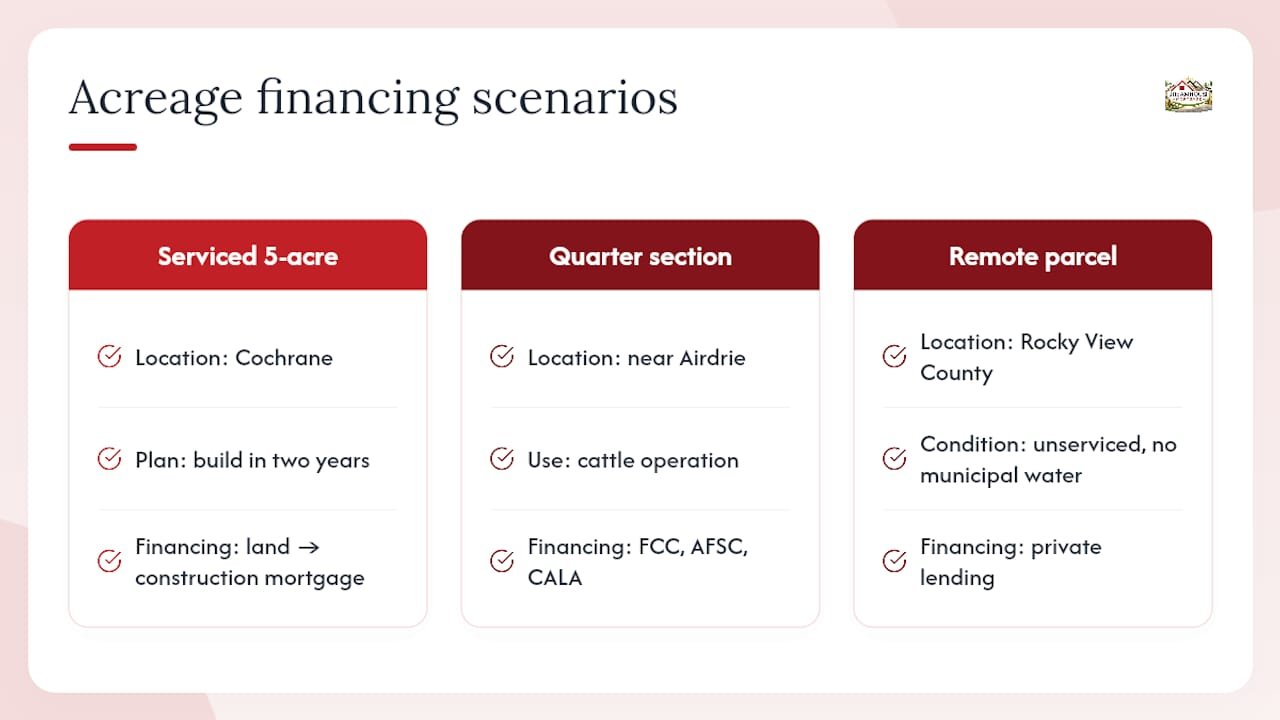
A young couple buying a 5-acre serviced lot near Cochrane with plans to build in two years needs a land loan structured to convert into a construction mortgage once they break ground. A first-generation farmer near Airdrie exploring a quarter section for cattle can lean on CALA and FCC programs to bring their down payment down substantially. An investor eyeing a remote, unserviced parcel in Rocky View County with no municipal water access may find private lending is the only realistic route to close on time.
A mortgage brokerage with Alberta financing experience since 2013 understands which lender fits various acreage financing situations across Calgary, Airdrie, Cochrane, and surrounding communities.
Closing Costs and Taxes Alberta Acreage Buyers Should Budget For
Your down payment is only part of the cash you need on closing day. Farmland can carry GST depending on how the property is classified and used, and that GST is due in cash. It cannot be rolled into your mortgage.
- GST on farmland where applicable, paid at closing, not financed
- Alberta land titles registration fees, calculated at a base fee plus a per-$5,000 increment on both transfer and mortgage registration
- Legal fees for a lawyer experienced with rural title work
- Title insurance, a current survey, and possibly an environmental or site assessment for larger parcels
On a $600,000 acreage purchase, registration fees alone can run into several hundred dollars once you account for both the transfer and the mortgage registration components, so build that into your cash-to-close figure rather than discovering it at the lawyer’s office.
What Most Guides Get Wrong About Alberta Acreage Financing
Most articles on this topic treat acreage financing like a slightly harder version of a residential mortgage. That’s a mistake. The bigger issue is that generic advice skips the two things that actually decide your file before income is even discussed: zoning and servicing. Confirm those first, because they set your expected down payment before a lender looks at anything else.
The second gap I see constantly is buyers assuming a 50% down payment is automatic on rural land. If you have a real farm plan, even a modest one, FCC, AFSC, and CALA-backed financing can bring that number down dramatically. Too many buyers never ask because they assume farm programs are only for large commercial operations.
Finally, don’t underestimate how much recent Alberta title fee changes affect large purchases. A jump in land titles registration costs on a $700,000 property adds up fast, and it catches buyers who budgeted based on older figures. Alberta’s rural financing market rewards buyers who verify property specifics early and work with a broker who places acreage files regularly, not occasionally.
— Guriqbal Chahal, MBA, PMP
How DreamHouse Mortgage Helps Alberta Acreage Buyers Close Faster
DreamHouse Mortgage is the alternative to walking into a single bank branch and hoping they say yes to your acreage file. Because we work across banks, credit unions, farm lenders, and private lending sources, you get access to FCC and AFSC-aware financing, land-to-construction conversions, and private-lender placement for parcels that traditional underwriters won’t touch, all coordinated through one point of contact instead of five separate applications.
We work with buyers across Calgary, Airdrie, Cochrane, Chestermere, Okotoks, Rocky View County, Edmonton, and Red Deer, and rural financing is one of the areas where local knowledge genuinely changes outcomes. Knowing which county moves fast on zoning confirmations, or which credit union already has an appetite for a specific area, shortens your timeline in ways a generic online application never will.
If you’re ready to find out what down payment and rate you actually qualify for, start with a mortgage pre-approval or call Guriqbal Chahal, MBA, PMP, Mortgage Broker, directly at 403-966-6072. You can also reach the team through the DreamHouse Mortgage Google Business Profile to book a consultation.
This article is general information, not a substitute for advice from a qualified financial advisor. Consult a qualified financial professional about your own circumstances before acting on anything here.
Sources
- How to Finance Land in Alberta: Down Payments, Lenders and Farm Credit
- How to Finance an Acreage or Farm in Alberta: Your Complete 2025 Guide to Rural
FAQ
How Much Down Payment Do You Need for an Acreage in Alberta?
Most acreage purchases require 25% to 50% down depending on servicing and location, since CMHC does not insure vacant land. Farm buyers working with FCC or AFSC can sometimes qualify with as little as 10% to 25% down.
Can You Get a Mortgage for Land in Alberta?
Yes, land mortgages are available through credit unions, farm lenders, and private lenders, though major banks are more selective and often restrict approvals to serviced parcels. A broker with acreage experience can widen your lender options considerably.
Is Alberta Acreage a Good Investment?
Acreage can build equity and offer lifestyle value, but land value can be more volatile and slower to resell than a serviced urban home. Confirm zoning, servicing, and access before treating any parcel as a guaranteed investment.
How Much Income Do You Need to Qualify for a $500,000 Mortgage?
Required income depends on your down payment, debt load, interest rate, and the property type, since acreage and land loans use different qualifying rules than a standard urban mortgage. A broker like Guriqbal Chahal at DreamHouse Mortgage can run your exact numbers and tell you where you stand before you make an offer.