
Bridge financing lets you use the equity trapped in your current home to fund the purchase of a new one before your existing property sells. It works when you have a firm sale agreement, an approved mortgage on the new home, and enough equity to cover the gap. It stops making sense when your sale isn’t firm, your timeline stretches past 90 days, or the cost of carrying two mortgages outweighs the convenience. If you’re weighing this option in Calgary, Airdrie, or Cochrane, read on for the numbers before you call a lender.
TL;DR:
- Bridge financing is most suitable when your sale is firm, your home’s expected sale price covers your remaining mortgage, and the closing process aligns within 90 days.
- Rates typically range from prime plus 1 to 3% for banks and up to 18% for private lenders, with private options often offering faster but more costly decisions.
- Having an approved mortgage on the new property and a firm sale agreement are essential; private lenders can be an alternative if your bank declines.
- Shorter bridge terms, ideally under 30 days for banks, reduce costs, while extended private bridges may incur significant fees and higher interest.
- Alternative solutions like HELOC, rent-back agreements, or timing negotiations should be considered first, especially if your sale isn’t firm or timelines are uncertain.
Table of Contents
- What Is Bridge Financing in Canada?
- Bridge Loan Pros and Cons for Calgary Buyers
- How Do Lenders Calculate a Bridge Loan Amount?
- Do You Qualify for a Bridge Loan? A Quick Checklist
- Real Bridge Loan Cost Examples and Red Flags
- Alternatives to Bridge Financing Worth Considering
- A Calgary Broker’s Take on Getting Bridge Financing Right
- Does Your Credit Score Affect Bridge Loan Approval in Canada?
- Do Bridge Financing Rules Differ Across Alberta and Other Provinces?
- Are Bridge Loan Interest and Fees Tax Deductible in Canada?
- How Do Market Conditions Change Your Bridge Financing Options?
- How Do You Choose the Right Bridge Lender in Canada?
- Bridge Financing Canada: How Calgary Buyers Bridge Buy-Before-Sell Gaps
- Get Bridge Financing Sorted Before Your Offer Deadline
- Sources
- FAQ
What Is Bridge Financing in Canada?
Bridge financing is a short-term loan that lets you tap the equity in your current home to cover the down payment or closing costs on a new property when your purchase closes before your sale does. TD Canada Trust describes it as a way to carry mortgage responsibility on two properties for a short window, and most Canadian banks structure it the same way.
Terms vary sharply depending on the lender:
- Bank bridges typically last a few days to a few months, tied directly to your closing dates.
- Private and alternative lender bridges can extend longer, with more flexible underwriting.
- Both types are secured against your current home’s equity, and both generally require a firm sale agreement before funding.
A bridge loan differs from a home equity line of credit (HELOC) in one key way: a HELOC is a standing facility you can draw on repeatedly, while a bridge is a one-time advance built around a specific closing date and repaid the moment your sale funds land.
Bridge Loan Pros and Cons for Calgary Buyers
The appeal is obvious: you don’t lose the house you want because your current one hasn’t sold yet.
Benefits:
- Lets you make a firm, unconditional offer instead of a sale-contingent one, which matters in competitive Calgary neighborhoods
- Frees up equity you’d otherwise leave sitting in your existing home
- Funds move quickly once the exit strategy is documented
Trade-offs:
- Interest rates run well above a standard mortgage rate
- If your sale falls through or closing is delayed, you’re carrying two mortgages at once
- Private-lender bridges carry higher fees than bank products
Pro Tip: Keep your bridge term as short as possible and hold back one month of both mortgage payments in reserve. A firm sale removes most of the risk, but a short buffer protects you if your buyer’s financing gets delayed by even a few days.
How Do Lenders Calculate a Bridge Loan Amount?
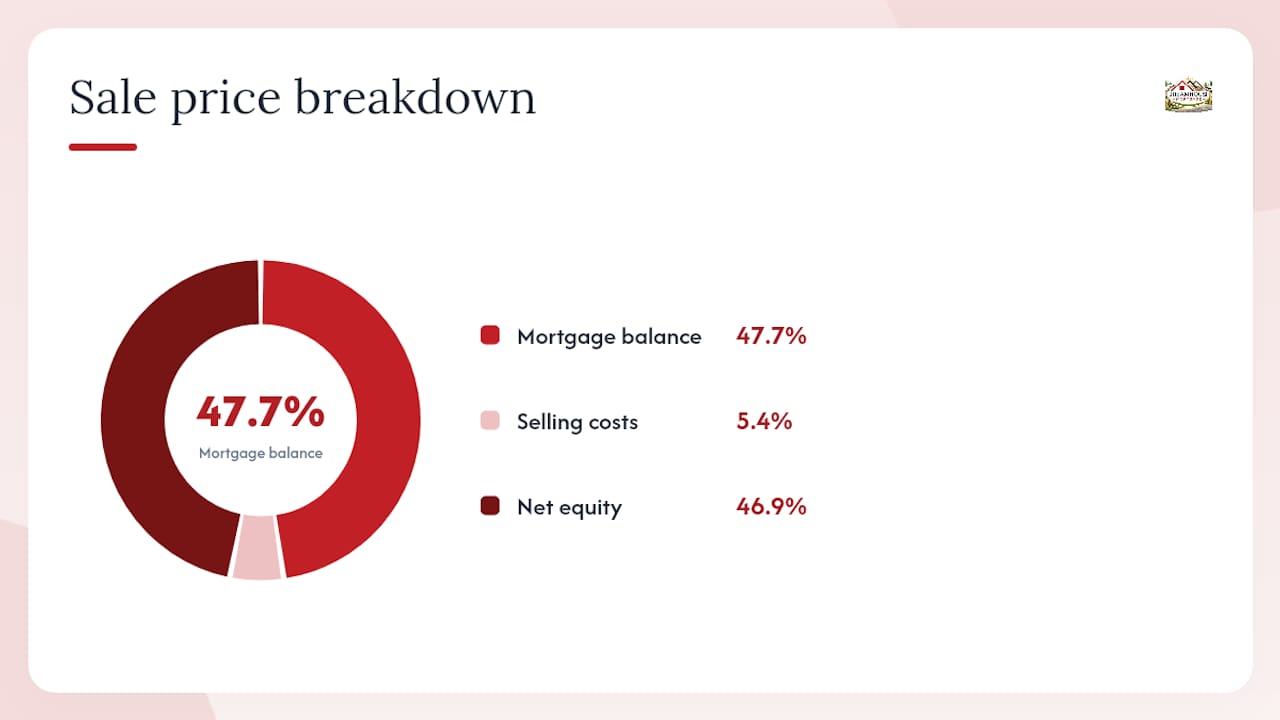
Lenders start with a simple formula: your home’s expected sale price, minus your remaining mortgage balance, minus estimated selling costs like real estate commission and legal fees. What’s left is your net equity, and lenders typically advance a portion of that figure as your bridge amount, according to WealthNorth’s breakdown of Canadian bridge financing.
Here’s a simplified example: say your home sells for $650,000, your remaining mortgage is $310,000, and selling costs run $35,000. That leaves roughly $305,000 in net equity. A bank might advance a large share of that toward your new down payment, holding back a buffer for closing adjustments.
Pricing benchmarks: NerdWallet Canada reports bank bridge loans commonly cap out near 90 days and price around prime plus 1 to 3%. Private lenders charge substantially more, often in the 10 to 18% range, plus setup fees.
The typical process runs like this:
- You get an approved mortgage commitment on the new property.
- Your realtor and lawyer confirm a firm sale agreement on the current home.
- Your broker or lender packages the bridge request alongside the new mortgage.
- Your lawyer coordinates the draw at your purchase closing and the repayment at your sale closing, often on the same day or within days of each other.
Interest on many bridge loans accrues only for the days the loan is outstanding, which keeps short bridges relatively affordable in dollar terms even at a higher rate.
Do You Qualify for a Bridge Loan? A Quick Checklist
Before you contact a broker, run through this self-check:
- Firm sale agreement: Your current home sale must be unconditional, not subject to financing or inspection.
- Approved mortgage commitment: You need a signed approval on the new property, not just a pre-approval.
- Sufficient net equity: Banks generally want to see comfortable equity remaining after your existing mortgage and selling costs are deducted.
- Credit and debt service: Standard mortgage-grade credit and income documentation apply, since you’re technically qualifying to carry two properties briefly.
- Fallback plan: If your file doesn’t fit bank criteria, private lenders can often step in, though at a materially higher cost.
If you check most of these boxes, you’re in reasonable shape. If your sale isn’t firm yet, wait before applying.
Real Bridge Loan Cost Examples and Red Flags
Numbers make this clearer than percentages alone. Here’s how a short bank bridge compares with a longer private bridge on a $100,000 amount.
| Scenario | Term | Rate range | Estimated interest cost | Typical fees |
|---|---|---|---|---|
| Bank bridge | 30 days | Prime + 1–3% | Roughly a few hundred dollars | Admin fee, varies by lender |
| Private lender bridge | 90 days | 10–18% | Several thousand dollars | Origination/lender fee, plus legal costs |
Budget separately for legal fees on both the purchase and sale closings, since your lawyer handles the draw and repayment coordination. Voxen Capital notes that private bridges can close in days when the exit strategy is well documented, but rate and fee variation between private lenders is significant.
Red flags that should make you pause: a sale that’s still conditional, a bridge term stretching past 90 days with no clear end date, or a lender who won’t clearly disclose the total interest and fee cost upfront.
Pro Tip: Ask your lender for the total dollar cost of the bridge, not just the rate. A 12% rate sounds alarming until you see it’s $1,200 for a 30-day, $120,000 bridge, which is often cheaper than losing your dream home.
Alternatives to Bridge Financing Worth Considering
A bridge isn’t always your cheapest or safest option. A HELOC on your current home can cost less if you already have one set up, since it avoids new lender fees and lets you draw only what you need, according to CreditResources.
- HELOC: Cheaper when already in place, but requires approval before your home sells and won’t help if you have no existing line.
- Negotiating closing dates: Asking your buyer for a longer closing, or your seller for a later possession date, can eliminate the need for a bridge entirely.
- Rent-back arrangement: Renting your old home from the new buyer for a few weeks buys you time without bridge costs.
- Mortgage portability: Porting your existing mortgage to the new property, where possible, can reduce or reshape your financing gap. Learn more about how open versus closed mortgage terms affect portability.
When your closing dates genuinely can’t be aligned and no rent-back is possible, a bridge remains the most practical tool.
A Calgary Broker’s Take on Getting Bridge Financing Right
Getting bridge financing approved quickly comes down to preparation, not luck. Before you call a broker, gather your firm sale agreement, your purchase agreement, current mortgage statements, and government-issued ID. Brokers can often bundle your new mortgage approval and your bridge request into the same underwriting process, which cuts down the back-and-forth that slows independent applications, as DreamHouse Mortgage’s own workflow reflects.
In Calgary, Airdrie, and Cochrane, timelines matter because closing dates in this market often land tighter than buyers expect, especially during busy spring and summer selling seasons. A broker with access to multiple lenders, banks, credit unions, and private options, can shop your file rather than force it through one institution’s rigid bridge policy. That access matters most when your existing mortgage sits with a lender who won’t bridge for you directly. Start the pre-approval conversation early using our guide to the mortgage pre-approval process for Alberta buyers, since a signed mortgage commitment is a prerequisite most bridge lenders won’t skip.
Does Your Credit Score Affect Bridge Loan Approval in Canada?
Your credit score matters for bridge financing, but not in isolation. Because a bridge loan technically has you qualifying to carry two mortgage obligations simultaneously, even briefly, lenders look at your full debt service picture, not just a credit number.
A strong credit history speeds up approval and often improves your rate, particularly with bank lenders who apply standard mortgage underwriting to bridge requests. Where credit and financial history really bite is at the margins: a borrower with a thin credit file, recent missed payments, or high existing debt load may find bank bridge products harder to access, since the lender is essentially extending trust that you’ll carry both properties without strain until your sale closes.
This is where private and alternative lenders play a genuine role. They tend to weigh the strength of your exit strategy, your equity position, and the firmness of your sale agreement more heavily than a raw credit score. If your bank declines a bridge request over credit concerns but your sale is firm and your equity is solid, that doesn’t mean you’re out of options. It usually means you need a lender whose underwriting model fits your actual situation rather than a rigid checklist. If your credit needs work before you go this route, our page on improving credit for a Canadian mortgage application walks through practical steps that can shift you from a private-lender rate to a bank-grade one.
Do Bridge Financing Rules Differ Across Alberta and Other Provinces?
Bridge financing itself isn’t a federally regulated mortgage product with a single national rulebook. It’s a lending practice each institution structures under its own policies, which means the exact terms, maximum amounts, and required documentation can shift depending on where you’re buying and which lender you approach.
In Alberta, the practical variation shows up less in formal regulation and more in local market timing. Calgary, Airdrie, and Cochrane real estate transactions commonly use possession dates and firm conditions that align well with 30 to 60 day bridge windows, since Alberta’s standard purchase contracts build in clear condition-removal deadlines that lenders can underwrite against confidently.
Other provinces, particularly those with different standard contract forms or longer closing customs, can produce bridge requests that look different on paper even when the underlying loan structure is identical. Quebec’s civil law system, for example, handles real estate transactions under a different legal framework than Alberta’s common law approach, which can affect how quickly a notary confirms a firm sale compared to an Alberta lawyer.
For Alberta buyers specifically, the practical takeaway is this: your lawyer’s familiarity with local closing customs and Alberta Land Titles Office processing times matters as much as the lender’s bridge policy itself. A broker who works Alberta transactions regularly will know which lenders move fastest through Calgary and area closings, which shortens the anxious gap between your two closing dates.
Are Bridge Loan Interest and Fees Tax Deductible in Canada?
Bridge financing costs aren’t automatically deductible just because the loan is short-term. The Canada Revenue Agency generally treats interest and fees on money borrowed to purchase your principal residence as a personal expense, not a deductible one, the same way regular mortgage interest on your home isn’t deductible for most Canadian homeowners.
The picture changes if the property involved is a rental or investment property rather than your primary home. If you’re bridging to acquire or carry an income-producing property, the interest and associated financing fees may be deductible against that rental or business income, following the same general principle that applies to other investment property financing costs. This is a meaningful distinction for anyone using bridge financing as part of a rental portfolio move rather than a straightforward owner-occupied purchase.
Because tax treatment depends heavily on how the property is used and documented, this is one area where guessing costs you more than it saves you. Keep every statement showing your bridge interest charged and fees paid, note clearly whether the property was your principal residence or an investment property during the bridge period, and bring those records to a tax professional at filing time. If your bridge situation involves an investment or rental property, our overview of investment property mortgage financing in Alberta covers related qualification and structuring considerations worth reviewing alongside your tax question.
How Do Market Conditions Change Your Bridge Financing Options?
Lender flexibility on bridge financing moves with the broader housing market, and Calgary buyers have felt that shift firsthand over recent selling seasons. In a fast-moving seller’s market, homes sell quickly and firm sale agreements land sooner, which makes lenders more comfortable extending bridge financing because the exit strategy is short and well-defined.
In a slower or more balanced market, where homes sit longer before firming up, lenders get more cautious. A longer expected time-to-sale means more uncertainty about exactly when your bridge gets repaid, and some lenders respond by tightening equity requirements, shortening maximum bridge terms, or asking for a larger contingency buffer before approval.
Interest rate cycles matter too. When the Bank of Canada’s policy rate rises, prime rate rises with it, and since most bank bridge pricing is set at prime plus a fixed spread, your bridge cost moves directly with that rate environment. During periods of rate uncertainty, some lenders also become more selective about which files they’ll bridge, favoring borrowers with the strongest equity positions and cleanest firm sale documentation.
The practical lesson for Calgary, Airdrie, and Cochrane buyers: don’t assume the bridge terms a friend got two years ago still apply today. Market conditions and rate environments shift what’s available, which is exactly why checking current terms with a broker who watches multiple lenders’ policies in real time beats relying on outdated advice from a past transaction.
How Do You Choose the Right Bridge Lender in Canada?
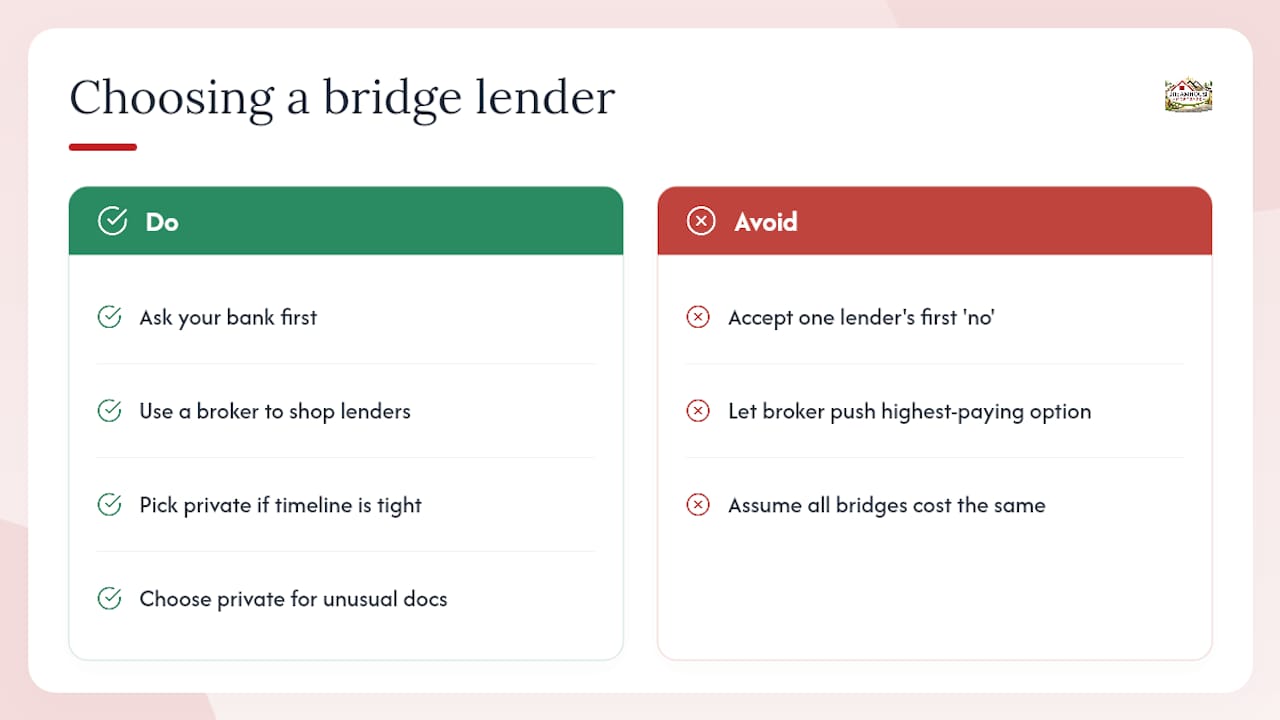
Choosing between a bank, a credit union, and a private lender for bridge financing comes down to three factors: your existing banking relationship, how firm your sale is, and how much cost flexibility you have.
If your current mortgage sits with a major bank and your new purchase mortgage is going through the same institution, that bank is often your fastest and cheapest bridge option, since they already hold both files and can underwrite the bridge alongside your new approval. This is the path worth exploring first for most straightforward Calgary buy-before-sell situations.
Where it gets more complicated is when your existing lender won’t bridge for you, whether because your new mortgage is with a different institution or because your file doesn’t fit their bridge criteria exactly. This is where working with a broker pays off directly: instead of accepting one lender’s answer, a broker can shop your file across banks, credit unions, and monoline lenders that offer bridge products, often finding a fit that a single institution wouldn’t have offered.
Private lenders become the right conversation when your timeline is tight, your sale is firm but your bank has declined, or your situation involves unusual income documentation. Private bridge financing costs more, but it can close in days and gets built specifically around your exit strategy rather than a standardized bank checklist. A broker who works with both institutional and private lending sources can tell you honestly which category actually fits your file, rather than pushing you toward whichever option pays them best.
Bridge Financing Canada: How Calgary Buyers Bridge Buy-Before-Sell Gaps
Most articles on this topic treat bridge financing as a straightforward math problem: figure out your equity, apply a rate, done. That undersells the real risk, which isn’t the cost, it’s the timeline. I’ve seen more buyers get burned by an optimistic closing date than by a high interest rate. A 90 day private bridge at a steep rate is manageable if your sale is genuinely firm. A 30 day bank bridge becomes a real problem if your buyer’s financing falls through on day 25.
The conventional advice tells buyers to “compare rates.” That’s the wrong first question. The right first question is whether your sale agreement is unconditional, and whether your lawyer has confirmed the buyer’s financing is in place, not just applied for. Rate shopping matters, but it’s the second decision, not the first.
What Calgary buyers underestimate is how much a broker’s lender access changes the outcome. Your own bank might decline a bridge outright if your new mortgage isn’t with them. A broker working multiple lenders at once often finds a bank or credit union willing to bridge your exact file, at a fraction of what a private lender would charge, simply because they know which institutions still say yes to complex timing.
— Guriqbal Chahal, MBA, PMP
Get Bridge Financing Sorted Before Your Offer Deadline
Mortgage brokers can provide Calgary-area buyers access to multiple banks, credit unions, and private lenders under one roof, so your bridge request gets shopped instead of stuck with whichever answer your current bank gives you.

By packaging your new mortgage approval and your bridge request together, and coordinating directly with your lawyer on the draw and repayment timing, you can avoid the scramble of managing two separate closings on your own. This matters most for buyers in Calgary, Airdrie, Cochrane, Edmonton, and Red Deer who’ve found their next home but haven’t firmed up their sale yet, and for anyone whose current bank won’t bridge because their new mortgage is going elsewhere.
If you’re weighing a bridge loan against an offer deadline, start with a mortgage pre-approval so your bridge request has a foundation to build on. Then call Guriqbal Chahal, MBA, PMP, Mortgage Broker, at 403-966-6072 to walk through your equity position and timeline, or find DreamHouse Mortgage on Google Business Profile to see local reviews before you reach out.
This article is general information, not a substitute for advice from a qualified financial advisor. Consult a qualified financial professional about your own circumstances before acting on anything here.
Sources
FAQ
How Does Bridge Financing Work in Canada?
A lender advances funds against the equity in your current home so you can close on a new purchase before your existing property sells, then you repay the bridge in full once your sale closes, typically within days to 90 days for bank products.
What Are the Downsides of a Bridge Loan?
The main downsides are higher interest costs than a standard mortgage and the risk of carrying two mortgage payments if your sale is delayed or falls through, which is why lenders insist on a firm sale agreement first.
Is It Hard to Get Bridge Financing?
It’s straightforward if you have a firm sale agreement, an approved mortgage on the new property, and solid equity; it gets harder if your sale is still conditional or your existing mortgage is with a lender unwilling to bridge, though a broker can often find an alternative lender in that case.
Is Bridge Financing a Good Idea?
It’s a good idea when the cost of a short bridge is lower than the risk of losing the home you want, and a bad idea when your sale timeline is uncertain or the bridge would stretch on for months with no clear end date.
Recommended
- Calgary Buyers: 4 Alternative Lender Types and Your Exit Plan
- The Ultimate Guide to B-lender mortgage Calgary: Alt‑A & B‑Lender Mortgages—When and Why to Use Them
- Mortgage Checklist Calgary: The Ultimate Proven Guide — Everything You Need Before Applying (2026)
- Newcomer Mortgage Calgary: The Ultimate 2026 Guide for New to Canada Mortgage borrowers to Buy a Home Faster