
A trigger rate is the interest rate at which your variable-rate, fixed-payment mortgage stops covering any principal at all, so every dollar you pay goes toward interest alone. Once you cross it, your balance can start growing instead of shrinking, a situation called negative amortization. If you suspect you’re close, contact your lender or a mortgage broker before the account flags it for you.
TL;DR:
- Your trigger rate is specific to your mortgage terms and can be crossed sooner or later depending on your interest rate, payment amount, and remaining amortization.
- When you reach the trigger rate, interest consumes your entire payment, and any unpaid interest can be capitalized, causing your balance to grow through negative amortization.
- Lenders may delay action after crossing the trigger rate, but proactive steps like increasing payments or making lump-sum payments can prevent forced capitalization or payment increases.
- Estimating your trigger rate involves comparing your fixed payment to monthly interest at increasing rates, considering your balance and payment frequency.
- Managing trigger-rate risk before renewal by early repayment or refinancing can help avoid higher payments or limited options at the end of your mortgage term.
Table of Contents
- What a trigger rate is and how it differs from your lender’s trigger point
- How reaching your trigger rate changes payment allocation and creates negative amortization
- What lenders commonly do at trigger rates and what regulators expect
- Practical options if you hit your trigger rate
- How to estimate your trigger rate using your own mortgage details
- Longer-term consequences at renewal and how to plan ahead
- A broker’s view on managing trigger-rate risk in Calgary
- Get local help with your trigger rate from DreamHouse Mortgage
- FAQ
- Sources
What a trigger rate is and how it differs from your lender’s trigger point
Your trigger rate is specific to your mortgage contract. It depends on your original interest rate, your fixed payment amount, and your remaining amortization, so no two borrowers hit it at the same point even with identical mortgage balances. According to the Financial Consumer Agency of Canada, this is the rate at which your payment covers $0 of principal and interest alone consumes the full payment amount.
A trigger point is a different, lender-set threshold. It is the balance level, often expressed as a percentage of the original principal, at which your lender requires you to act, whether that means raising your payment, making a lump sum, or converting to a fixed rate.
Consider two Calgary borrowers with identical mortgages.
- Borrower A locked in at 2.1% with a 25-year amortization and reaches a trigger rate sooner as rates climb.
- Borrower B started at 3.4% with a 20-year amortization and has more room before interest costs catch up to the fixed payment.
How reaching your trigger rate changes payment allocation and creates negative amortization
Every payment splits between interest and principal, and that split shifts as rates rise. Here is the sequence that typically unfolds:
- Rates rise, but your fixed payment stays the same under your contract terms.
- More of each payment is absorbed by interest, leaving less for principal.
- At the trigger rate, principal reduction hits zero, interest consumes the entire payment.
- If rates climb further, unpaid interest gets added to your balance rather than paid down, a process the Bank of Canada refers to as negative amortization.
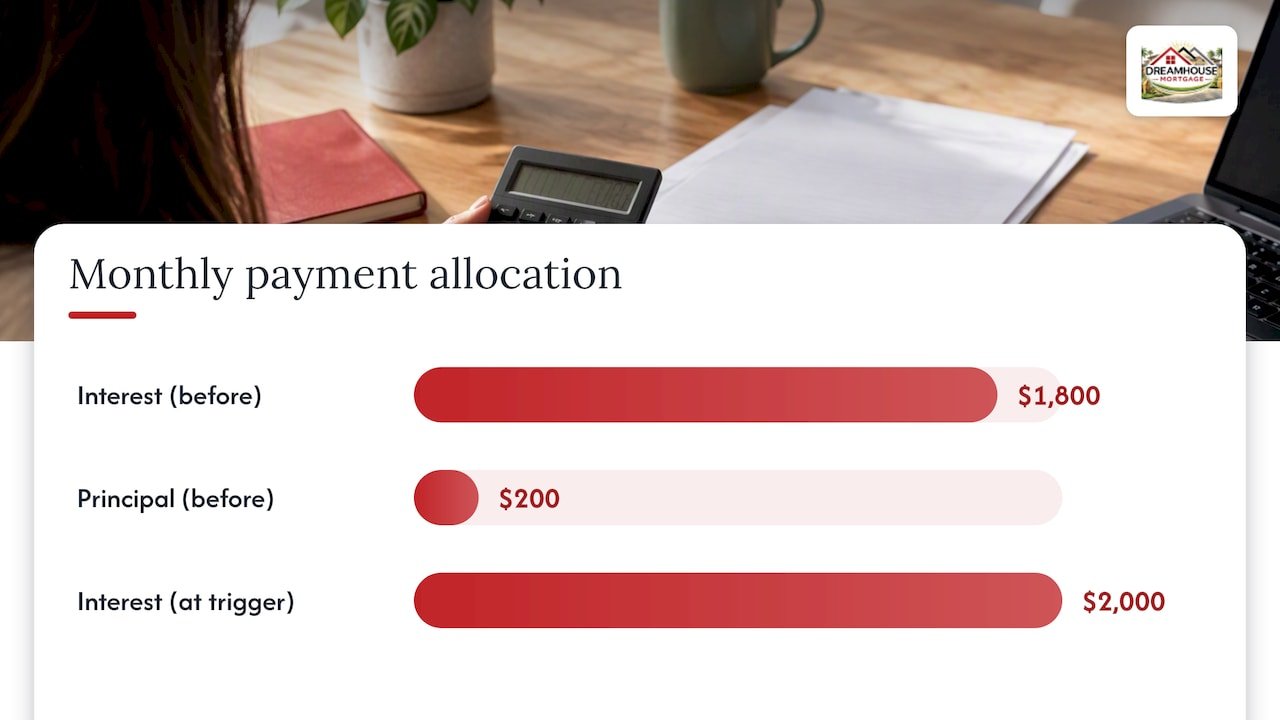
Picture a $400,000 balance where the fixed payment covers $1,800 in interest and $200 in principal. If rate increases push the monthly interest cost to $2,000, your payment no longer covers it, and the shortfall gets capitalized onto your balance.
Variable-rate, fixed-payment mortgages often crossed their trigger rate during the rapid rate increases of 2022, though lender responses varied widely in whether payments were adjusted immediately or interest was allowed to capitalize toward a trigger point.
What lenders commonly do at trigger rates and what regulators expect
Lenders are not required to act the moment you cross your trigger rate. Some follow a staged approach:
- Automatically raise your payment to restore principal reduction once a threshold is crossed.
- Allow interest to capitalize up to a trigger point, deferring action until the balance grows further.
- Reach out directly and ask you to choose between a payment increase, a lump sum, or a product switch.
OSFI’s guidance on variable-rate mortgages with fixed payments makes clear that your contractual amortization does not change automatically just because rates moved. Monthly statements may show a longer, hypothetical payoff timeline, but the original agreed schedule still governs what you owe and when. OSFI and the Financial Consumer Agency of Canada both expect lenders to proactively identify at-risk accounts and offer tailored relief rather than wait for a crisis. Watch for early signals: a letter about your amortization extending, a call from your lender’s retention team, or a note on your statement flagging reduced principal reduction.
Practical options if you hit your trigger rate
You have more control here than most borrowers realize. The main paths:
- Increase your payment voluntarily. Even a modest bump restores principal reduction and avoids forced capitalization.
- Make a lump-sum payment. This works best when you have available prepayment privileges, and some lenders will waive fees for borrowers acting proactively near a trigger point, per FCAC’s relief guidance.
- Refinance or switch to a fixed rate. This makes sense if you value payment certainty, though it may involve a rate differential or administrative cost depending on your remaining term. Our refinancing guidance for Calgary homeowners walks through what to expect.
- Ask about temporary relief. Many lenders can waive fees or avoid charging interest on capitalized interest when you ask before the account becomes delinquent.
Pro Tip: Borrowers who acted early, through prepayments or a fixed-rate switch, were far more likely to avoid a lender-mandated payment increase than those who waited for a notice.
How to estimate your trigger rate using your own mortgage details
You can estimate your trigger rate with five inputs: current balance, fixed payment amount, remaining amortization, payment frequency, and your current contractual rate.
- Calculate the monthly interest-only payment at increasing rate increments using your current balance.
- Compare each result against your fixed payment amount.
- The rate at which the interest-only figure equals your payment is your approximate trigger rate.
Say your balance is $350,000 and your fixed monthly payment is $1,650. When using an online calculator, confirm whether it uses the Bank of Canada’s overnight rate, your lender’s prime rate, or a posted rate, since mixing these up produces a misleading result. Watch also for payment frequency mismatches, since biweekly accelerated payments behave differently than monthly ones.
Longer-term consequences at renewal and how to plan ahead
Interest that gets added to your balance during negative amortization does not disappear, it shows up as a higher principal owing when your term ends. That means a larger amount to requalify for, and you will face the current stress test rules at renewal regardless of how your balance grew.
- A higher renewal balance typically means a higher payment, even if rates have leveled off by then.
- Lenders reassess your file at renewal, so a larger balance paired with tighter qualifying rules can limit your options.
- Rebuilding equity ahead of renewal, through extra payments or a planned refinance, gives you more room to negotiate.
Our breakdown of why many Albertans overpay at renewal covers how deferred principal compounds this risk if left unaddressed.
A broker’s view on managing trigger-rate risk in Calgary
Calgary, Cochrane, and Airdrie lenders vary in how quickly they flag trigger-point accounts, and some are faster to act than others based on internal risk policies. If your statement shows extending amortization, a quick call to a broker can clarify whether your lender will act automatically or wait for you to request a change. We offer a no-cost trigger-rate review for clients across these communities who want clarity before a lender notice arrives.
— Guriqbal Chahal, MBA, PMP
Get local help with your trigger rate from DreamHouse Mortgage

Running your own trigger-rate numbers is useful, but having someone negotiate on your behalf with lenders across Calgary, Cochrane, and Airdrie often gets faster answers. We help clients model payment-increase scenarios, compare lump-sum versus refinance options, and present a documented case to lenders when relief measures are on the table.
- Mortgage review and trigger-rate scenario modeling
- Refinancing and renewal negotiation support
- First-time buyer guidance for Calgary and area communities
For a direct conversation about your situation, call Guriqbal Chahal, MBA, PMP, Mortgage Broker, at 403-966-6072, visit our consultation page, or find us on our Google Business Profile.
This article is general information, not a substitute for advice from a qualified financial advisor. Consult a qualified financial professional about your own circumstances before acting on anything here.
FAQ
What is a trigger rate?
A trigger rate is the interest rate at which your variable-rate, fixed-payment mortgage payment no longer covers any principal, only interest. Beyond this point, unpaid interest can be added to your balance, a process known as negative amortization, as described by the Financial Consumer Agency of Canada.
What income do you need for a $1,000,000 mortgage in Canada?
The income required depends on your down payment, interest rate, amortization, and other debts, since lenders apply the federal stress test alongside your debt service ratios. Because this varies significantly by individual circumstances, speaking with a broker who can run your specific numbers against current lender guidelines gives a far more accurate answer than a general estimate.
Is 3.75% a good mortgage rate?
Whether a rate is favorable depends on the term, whether it is fixed or variable, and the broader rate environment at the time you lock it in. Rather than comparing against a single number, it helps to compare offers across multiple lenders for your specific qualifying profile, which a broker can arrange on your behalf.
How much is a $500,000 mortgage payment per month?
Monthly payment amounts depend on your interest rate, amortization period, and payment frequency, so there is no single figure that applies to every borrower. A broker can calculate this precisely for your situation using current lender rates and your preferred amortization schedule.
Sources
- Financial Consumer Agency of Canada — Rights and responsibilities: mortgages and financial difficulties
- Bank of Canada — Variable-rate mortgages with fixed payments: Examining trigger rates
- OSFI — OSFI’s view: Variable rate mortgages with fixed payments and extended amortizations
- Financial Consumer Agency of Canada — Mortgage relief options
Recommended
- Mortgage Amortization Calculator: How Amortization Affects Your Calgary Mortgage Payment (20 vs 25 vs 30 Years)
- Amortization vs Term: 30 Year Costs Calgary Buyers ~$94,000
- Calgary Mortgage Calculators 2026: Avoid Costly Payment Mistakes & Estimate Your Monthly Mortgage Accurately
- Calgary Mortgage Affordability Calculator (2026 Guide): How to Use It Right, Avoid Costly Mistakes & Buy With Confidence