Budget between 1.5% and 4% of the purchase price for closing costs when buying a home. These can amount to several thousand dollars depending on the home price. The final number depends on whether you are buying new construction, a condo, or a resale property, and whether mortgage loan insurance applies to your file. Use the worked examples below to find your range, or call for a precise figure based on your address and lender.
TL;DR:
- Alberta buyers should budget between 1.5% and 4% of the purchase price for closing costs, which include legal fees, registration, inspections, and potential mortgage insurance premiums.
- With the recent increase in Alberta Land Titles registration levy to $5 per $5,000 of property value as of October 2024, registration costs rise proportionally with property prices.
- Buyers with a down payment under 20% must pay mortgage loan insurance, which can be added to the mortgage or paid upfront, affecting total borrowing costs over time.
- New construction purchases may incur higher costs due to GST and warranty registration, while resale homes typically involve fewer additional fees.
- Getting a precise, property-specific cost estimate from a mortgage broker before house hunting helps avoid surprises and ensures accurate budgeting.
Table of Contents
- At-a-Glance Breakdown of Closing Costs Alberta Buyers Should Expect
- Alberta Land Titles Fees and the 2024 Registration Levy Explained
- Mortgage Loan Insurance and Its Effect on Your Closing Costs
- When GST Applies and How the New-Home Rebate Works
- Professional Fees: What Lawyers, Inspectors, and Appraisers Actually Charge
- Deposits, Closing-Day Funds, and Who Pays What
- Sample Closing Cost Budgets for $350,000, $500,000, and $750,000 Homes
- Practical Ways to Reduce Your Closing Costs
- Why Trust This Guide: Local Expertise Behind the Numbers
- What Most Closing-Cost Advice Gets Wrong for Alberta Buyers
- Get a Precise Closing-Cost Estimate for Your Calgary Purchase
- Primary Sources Used for These Alberta Closing Cost Figures
- Sources
- FAQ
At-a-Glance Breakdown of Closing Costs Alberta Buyers Should Expect
Every Alberta purchase carries a mix of fixed fees, percentage-based charges, and property-specific costs. Some apply to every buyer, while others depend on whether you are purchasing a new build, a condo, or a resale home. CMHC’s purchase cost worksheet groups these into categories buyers can check off one by one before they get to their lawyer’s office.
Here is what typically shows up on a Calgary or Edmonton closing statement:
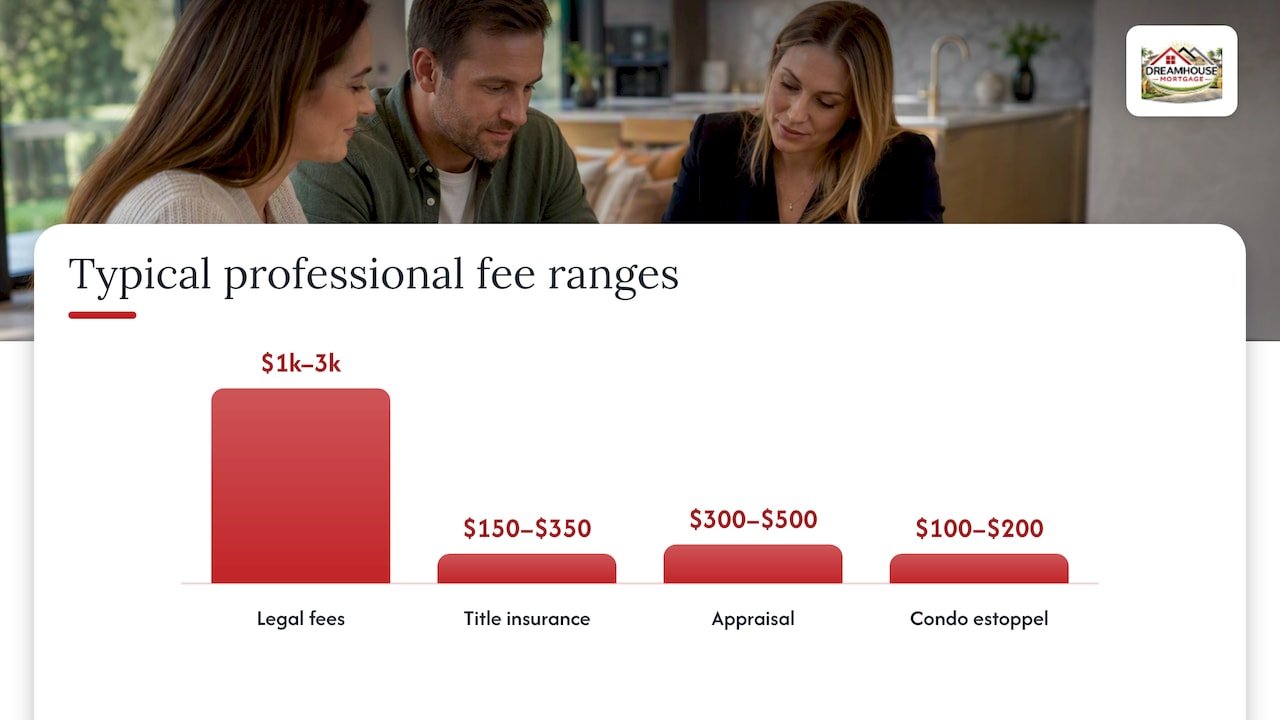
- Legal fees and disbursements: usually $1,000 to $3,000, covering your lawyer’s time plus title searches, courier charges, and administrative costs.
- Land Titles registration fees: a fixed per-document charge plus a value-based levy calculated on your purchase price and mortgage amount.
- Title insurance: often $150 to $350, protecting against title defects, fraud, or survey issues your lawyer cannot catch through standard searches.
- Home inspection: generally $400 to $800 for a single-family home, more for larger properties or homes with additional systems to test.
- Appraisal fee: typically $300 to $500, charged when your lender requires an independent valuation before funding.
- Mortgage loan insurance premium: applies only when your down payment is under 20%, calculated as a percentage of your loan amount.
- GST: relevant mainly on new builder-sold homes, not on resale properties in most cases.
- Prepaid property tax and utility adjustments: reimbursing the seller for amounts they already paid covering your possession date onward.
- Condo estoppel certificate fee: commonly $100 to $200, required when purchasing a condo or bare land condo unit.
- Utility hookup and meter deposits: small setup charges from your local utility provider, particularly for new construction.
- Moving and immediate setup costs: not a closing cost technically, but worth budgeting alongside everything else.
New builds tend to carry higher closing costs than resale purchases because of GST and new-home warranty registration. Condo buyers should budget separately for the estoppel certificate, since condo boards charge for producing it and timelines can be tight before possession. Resale buyers, meanwhile, mostly deal with legal fees, registration charges, adjustments, and inspection costs, without the GST question that new-build buyers face.
Alberta Land Titles Fees and the 2024 Registration Levy Explained
Alberta calculates registration charges using a Tariff of Fees that combines a fixed per-document charge with a value-based levy tied to the property price and mortgage amount. This structure applies province-wide, whether you are closing in Calgary, Cochrane, or Airdrie.
Effective October 20, 2024, Alberta increased the Land Titles Registration Levy to $5 per $5,000 of property value for both transfer registrations and mortgage registrations. That change raised the value-based portion of registration costs for every buyer closing after that date, and it applies on top of the fixed per-document charges listed in the Land Titles and Surveys fee schedule.
As a practical example, the levy on a property is calculated by dividing the property value by $5,000, then multiplying by the set rate per $5,000 of value. Buyers can apply this formula to estimate their levy costs. A separate levy applies to the mortgage registration, calculated the same way against your mortgage amount. On top of these levies, add the fixed per-title and per-instrument charges listed in the Tariff PDF, since those do not change based on value.
Your lawyer will calculate your exact registration total once they know your purchase price and mortgage amount, and understanding the formula helps you verify the numbers on your statement. For the precise per-document fees that apply to your file, the Tariff PDF linked above is the authoritative source, and Alberta’s Land Titles overview page explains how the assurance fund fee and other smaller charges fit into the total.
Mortgage Loan Insurance and Its Effect on Your Closing Costs
If your down payment is less than 20% of the purchase price, your lender requires mortgage loan insurance, whether through CMHC or a private insurer. This is not optional for high-ratio mortgages in Canada, and it directly affects how much cash you need at closing, or how much larger your mortgage balance becomes.
CMHC calculates the premium as a percentage of your loan amount, with the exact rate depending on your loan-to-value ratio. The lower your down payment relative to the purchase price, the higher the percentage applied. Lenders typically pass this premium along to you as the borrower, and CMHC’s calculators can give you a starting estimate before you talk to a broker.
Most lenders allow you to add the premium to your mortgage principal rather than paying it in cash at closing. This preserves your available funds for legal fees, inspections, and moving costs, but it also means you pay interest on that premium for the life of the mortgage, which adds to your total borrowing cost over time. Paying the premium upfront in cash can reduce total interest costs but requires more funds at closing. Many buyers choose to finance the premium to preserve cash flow.
A mortgage broker can run the numbers both ways for your specific file and show you the difference in monthly payment and total interest cost, so you are choosing based on your actual cash flow rather than a general rule of thumb.
When GST Applies and How the New-Home Rebate Works
GST generally does not apply to resale home purchases in Alberta, but may apply to new construction purchased from a builder, potentially appearing as a line item due at or before closing.
The federal first-time home buyers’ GST/HST rebate reduces this burden for qualifying new-build purchases, with the rebate amount declining as the purchase price rises between $350,000 and $450,000, and no rebate available above $450,000. Builders often price GST into the advertised purchase price and handle the rebate application on your behalf, but this varies by builder and by contract, so you cannot assume it is automatic.
Before you sign anything on a new build, confirm in writing with the builder and your own lawyer whether GST is included in the purchase price or added separately at closing, and whether the builder is applying the rebate for you or whether you need to file for it yourself. This single conversation can prevent a five-figure surprise on your final statement.
Professional Fees: What Lawyers, Inspectors, and Appraisers Actually Charge
Every Alberta closing runs through a real estate lawyer, and most involve at least one inspection and often an appraisal. Understanding what each fee buys you helps you compare quotes intelligently rather than just picking the lowest number.
Legal fees typically run $1,000 to $3,000 total, combining the lawyer’s flat or hourly fee with disbursements such as title searches, tax certificates, courier charges, and the registration fee components covered in the Land Titles section above. Get quotes from two or three real estate lawyers before you commit, since the range within Calgary and Cochrane firms can be wide.
Title insurance protects you against title defects, boundary disputes, or fraud that a standard search might miss, and premiums usually fall in the $150 to $350 range. Some lawyers include it in their package; others charge separately, so ask directly.
Home inspections should happen before your financing condition expires, not after, so you have room to renegotiate or walk away if something serious turns up. Condo estoppel certificates carry their own fee, commonly $100 to $200, and condo boards can take one to two weeks to produce them, so order yours early.
Appraisals are required by most lenders on conventional and high-ratio mortgages alike, and Alberta appraisals typically run $300 to $500 depending on property type and location.
Budget between 1.5% and 4% of your purchase price for total closing costs, according to federal buying-a-home guidance, a range that captures all the professional fees above plus registration and adjustment costs.
Deposits, Closing-Day Funds, and Who Pays What
Your deposit and your closing funds are two different payments, and mixing them up is a common source of confusion for first-time buyers. The deposit is paid when your offer is accepted, usually held in trust by the seller’s brokerage, and later credited toward your down payment. Closing funds are the remaining cash you wire or certify to your lawyer on or before possession day, covering your down payment balance plus all closing costs.
Certain items get adjusted between buyer and seller at closing rather than paid outright. If the seller prepaid property taxes for the year, you reimburse them for the portion covering your ownership period. The same applies to prepaid utility charges in some cases, though most utilities are simply transferred into your name as of possession day.
Before closing day, prepare the following:
- Confirm your final mortgage approval and rate lock with your broker or lender.
- Arrange certified funds or a wire transfer for your lawyer’s trust account.
- Review and sign your mortgage documents with your lawyer.
- Confirm home insurance is in place, since lenders require proof before funding.
- Bring government-issued photo identification for your lawyer meeting.
- Verify the property tax and utility adjustment figures on your statement of adjustments.
- Confirm your possession date and key pickup arrangements.
- Keep a small cash buffer beyond your estimated total, since minor adjustments can shift the final number.
Sample Closing Cost Budgets for $350,000, $500,000, and $750,000 Homes
These examples assume a resale purchase with standard legal fees, registration charges, inspection, and a mortgage requiring insurance, so treat them as illustrative starting points rather than your exact number.
On a $350,000 home, 1.5% works out to $5,250 and 4% works out to $14,000, so a realistic mid-range budget lands around $8,000 to $9,000 once you include legal fees, registration, inspection, and adjustments.
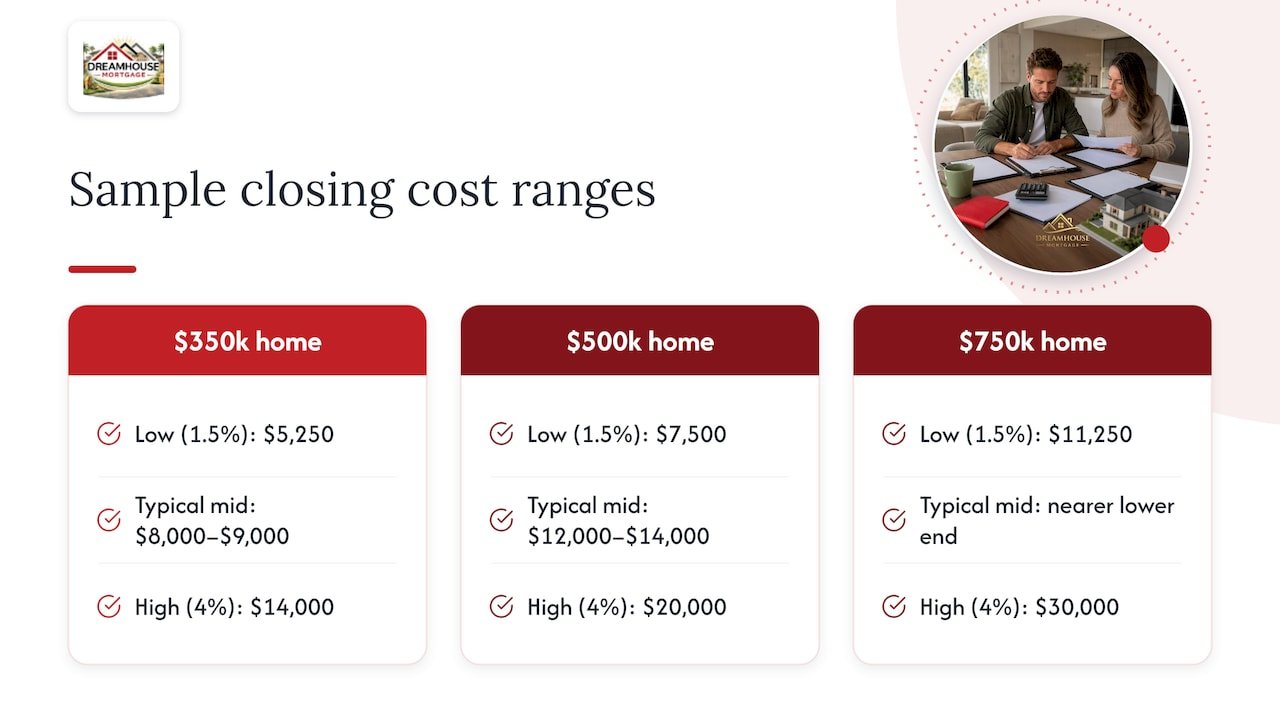
On a $500,000 home, the same math gives $7,500 at the low end and $20,000 at the high end, with most straightforward resale purchases landing closer to $12,000 to $14,000 once mortgage insurance is financed rather than paid in cash.
On a $750,000 home, 1.5% is $11,250 and 4% is $30,000, and buyers at this price point often see costs cluster nearer the lower end as a percentage, since several fees like legal retainers and inspections do not scale directly with purchase price.
New builds push these numbers higher because of GST, while condo purchases add the estoppel certificate fee on top of the standard list.
Practical Ways to Reduce Your Closing Costs
You cannot eliminate closing costs, but you can manage how much cash you need on hand and where the money comes from. A few approaches make a real difference for Calgary-area buyers.
Negotiating seller credits toward closing costs is possible in some Calgary market conditions, particularly when a property has sat on the market or when a seller is motivated to close quickly. It is not guaranteed, but it is worth raising through your realtor as part of your offer strategy.
On the financing side, adding the CMHC premium to your mortgage principal reduces the cash you need immediately, though it increases your long-term interest cost as noted earlier. Gifted funds from family members are commonly used to cover closing costs, provided your lender’s documentation requirements for gift letters are met. Some lender programs also offer flexibility on closing timelines that can ease cash-flow pressure.
Practically, get two or three legal fee quotes rather than accepting the first one, compare what title insurance costs against what additional lawyer searches would cost, and schedule your inspection early enough to negotiate if issues appear. Ask your builder directly how GST is being handled before you sign anything.
Pro Tip: Book a broker consultation before you start house hunting, so your pre-approval already accounts for closing costs and you know your true purchasing power.
Why Trust This Guide: Local Expertise Behind the Numbers
This guide was prepared under the direction of Guriqbal Chahal, MBA, PMP, Broker of Record at DreamHouse Mortgage, a mortgage brokerage headquartered in Calgary serving buyers across Calgary, Airdrie, Cochrane, Chestermere, Okotoks, and surrounding Alberta communities since 2013.
Some mortgage brokerages work with banks, credit unions, monoline lenders, and alternative lenders to help Alberta buyers structure financing that accounts for closing costs from the start, not as an afterthought discovered days before possession. Services relevant to this stage of the process include first-time buyer mortgages, mortgage pre-approvals, and one-on-one consultations that walk through your specific purchase price, down payment, and property type.
If you want a closing-cost worksheet built around your actual numbers rather than a general range, a consultation is the fastest way to get one.
What Most Closing-Cost Advice Gets Wrong for Alberta Buyers
Buyers relying on older articles or generic Canadian calculators are working with registration levy figures that no longer match what their lawyer will actually charge them. That gap matters more on higher-value Calgary and Edmonton purchases, where the value-based levy portion grows fastest.
The bigger mistake I see is buyers treating closing costs as a single lump sum to save for, rather than a list of distinct payments with different deadlines, some due at offer, some at closing, some adjusted after the fact. Prioritize understanding the Land Titles levy and your mortgage insurance decision first, since those two items move the most money and offer the most room for planning. Everything else on the list is smaller and more predictable once you have those two figures locked down.
— Guriqbal Chahal, MBA, PMP
Get a Precise Closing-Cost Estimate for Your Calgary Purchase

Generic percentage ranges get you in the ballpark, but a closing-cost figure built around your actual purchase price, property type, and down payment tells you exactly how much to have ready. DreamHouse Mortgage works with first-time buyers across Calgary, Cochrane, and Airdrie to build that number into your pre-approval from day one, not as a surprise at the lawyer’s office.
Call Guriqbal Chahal, MBA, PMP, Mortgage Broker at DreamHouse Mortgage, at 403-966-6072, or visit our mortgage broker consultation page to get started.
Primary Sources Used for These Alberta Closing Cost Figures
These are the official sources behind the figures in this guide, useful if you want to verify a number or dig into the exact fee tables yourself.
- Canada: best for the overall 1.5% to 4% budgeting range.
- CMHC purchase cost worksheet: best for itemizing individual cost categories.
- Alberta Land Titles registration page: best for the 2024 registration levy details.
- Land Titles Tariff PDF: check this directly for exact per-document fees before closing.
- For a title and settlement perspective on cost factors, see this closing cost overview from a real estate law and title services firm.
This article is general information, not a substitute for advice from a qualified financial advisor. Consult a qualified financial professional about your own circumstances before acting on anything here.
Sources
FAQ
What is the most expensive part of closing costs in Alberta?
For most buyers, mortgage loan insurance and legal fees together make up the largest share, since the CMHC premium is calculated as a percentage of your entire loan amount. Land Titles registration fees add a further cost tied to your purchase price, especially after the 2024 levy increase.
What percentage do most realtors charge in Alberta?
Realtor commissions are negotiated individually between sellers and their brokerage, and they are not a standardized percentage set by any regulator. Buyers typically do not pay realtor commissions directly, since these are negotiated into the seller’s listing agreement.
What is the minimum salary required to afford a $500,000 house in Canada?
Affordability depends on your down payment, interest rate, existing debts, and the mortgage stress test applied by your lender, not on income alone. A mortgage broker can calculate your specific qualifying amount based on current rates and your full financial picture rather than a generic salary figure.
How much does it cost to close on a $600,000 house in Alberta?
Using the 1.5% to 4% guidance, closing costs usually range between 1.5% and 4% of the purchase price, depending on whether mortgage insurance applies and whether the property is new construction or resale. A broker consultation can narrow that range to a specific figure based on your down payment and property type.