Yes, you can get a land mortgage in Alberta, and lenders across Calgary, Cochrane, and Airdrie finance both serviced lots and rural acreages, though the terms shift significantly with the type of land. Your best first move is to identify the land classification, then get pre-approved with a mortgage broker who can match you to the right lender.
TL;DR:
- Lenders in Alberta finance serviced lots more easily than raw or recreational land, which often requires larger down payments and stricter documentation.
- Mortgage qualification for land is heavily influenced by the land’s classification, with uninsured mortgages stress-tested at the higher of the contract rate plus 2% or 5.25%.
- A title search, survey, and clear zoning confirmation are crucial early steps to prevent delays in securing land financing approval.
- Private lenders and seller take-back financing are options for parcels outside standard bank criteria, but typically involve higher costs.
- For non-Canadian buyers, Alberta’s foreign ownership rules require statutory declarations at registration, potentially adding extra steps to the process.
Table of Contents
- Quick run-through of land financing options in Alberta
- Down payment expectations and how rates are set
- How lenders classify land and what it means for approval
- Loan types and alternatives worth comparing
- What lenders look for before approving your file
- Alberta-specific rules that affect financing and timing
- Step-by-step checklist for preparing and closing a land mortgage
- What Calgary-area buyers get wrong about land mortgages
- How DreamHouse Mortgage helps you finance land in Calgary and beyond
- Where these figures and rules come from
- Sources
- FAQ
Quick run-through of land financing options in Alberta
Financing vacant land works differently than financing a finished home, and the route you take depends heavily on what you plan to do with the property.
- Conventional land loans apply mainly to serviced lots with municipal water, sewer, and road access; raw land rarely qualifies for the same terms.
- Construction mortgages let you buy the land and fund the build in stages, with lenders releasing money as work is completed.
- Home equity lines of credit (HELOC) give existing homeowners a flexible way to tap equity for a land purchase without a separate application process.
- Private lenders and seller take-back financing fill the gap when a parcel does not meet standard bank criteria, particularly for raw or recreational land.
Each option carries its own qualification bar and cost structure, which is why matching the land type to the lender matters before you make an offer.
Down payment expectations and how rates are set
Down payment size in Alberta land lending tracks directly with how much risk the lender assigns to the parcel.
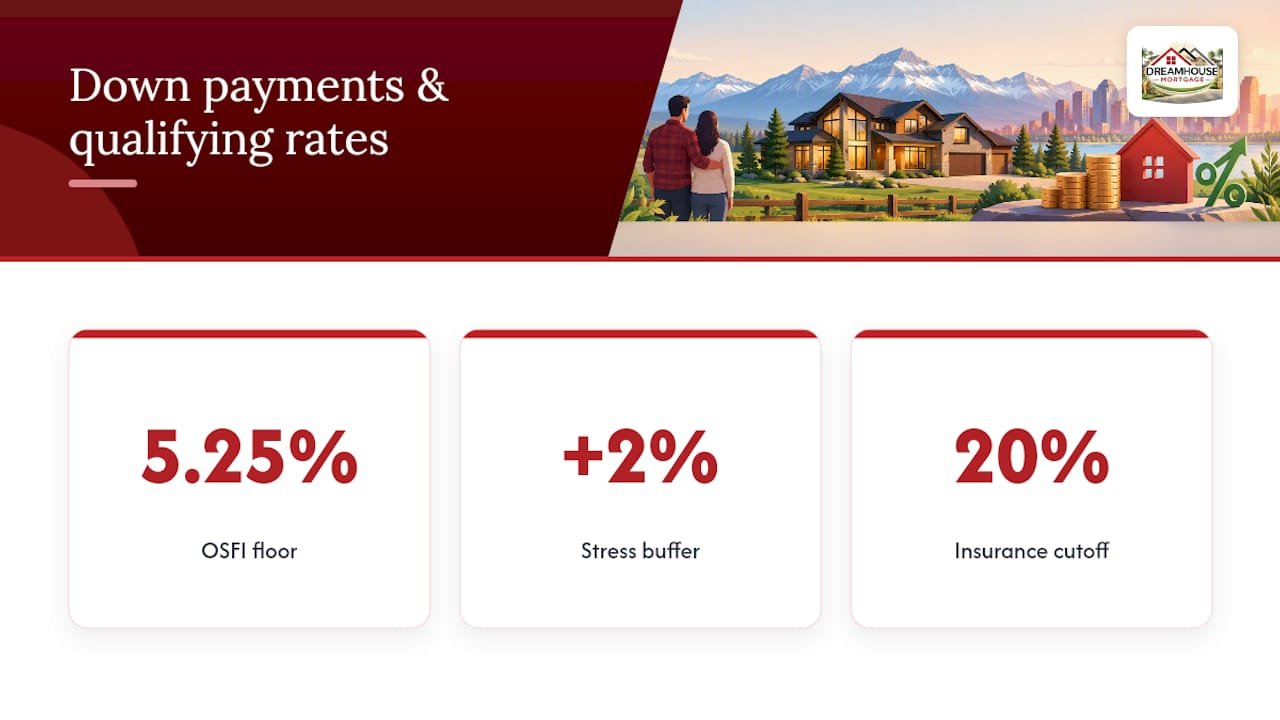
The OSFI minimum qualifying rate requires uninsured mortgages to be stress-tested at the greater of the contract rate plus 2% or 5.25%, a rule set by Canada’s banking regulator that directly affects how much land-loan payment you can qualify for, since most land purchases fall outside insured mortgage programs.
Because mortgage loan insurance is generally not required once you put down 20% or more, and land loans rarely qualify for that insurance regardless of down payment size, lenders lean harder on your down payment and title clarity than on extending your amortization.
How lenders classify land and what it means for approval
Alberta lenders sort land into categories, and where your parcel lands determines how much paperwork and scrutiny you should expect.
- Serviced lots have municipal water, sewer, and road access already in place, which makes them the easiest category to finance.
- Raw or unserviced land lacks one or more of those connections, pushing lenders to demand larger down payments and tighter documentation.
- Lake lots and recreational parcels near places like Sylvan Lake or the foothills west of Cochrane often carry seasonal access concerns that affect valuation.
- Small acreages and farmland around Rocky View County or Airdrie get reviewed for zoning, agricultural use restrictions, and environmental flags before approval.
Underwriters check zoning designation, confirmed access routes, utility availability, and any environmental or floodplain restrictions before they will commit to funding a parcel outside a serviced subdivision.
Loan types and alternatives worth comparing
Once you know your land category, the financing vehicle you choose should match your timeline and how much cash you can put down.
- Construction mortgages combine land purchase and build costs, typically requiring 20% to 35% down with funds released in stages as the foundation, framing, and finishing stages complete.
- HELOCs work well if you already own a home with equity, since they move faster than a new application but only exist if that equity is already there.
- Private and alternative lenders step in when a parcel is raw, remote, or otherwise outside standard criteria, offering speed at a higher cost than a bank or credit union.
- Seller take-back financing lets the seller carry part of the loan directly, which can bridge a financing gap but carries tax and term implications that deserve a conversation with a tax professional before you sign.
What lenders look for before approving your file
Lenders build their decision around your documentation and the land’s own paper trail, so gathering the right materials early speeds up the whole process.
- Government-issued ID and proof of employment or self-employment income, including recent tax returns.
- Proof of down payment source, showing the funds have been in your account long enough to satisfy the lender’s seasoning requirements.
- A current title search and, where available, a land survey confirming boundaries and any registered interests.
- Confirmation of municipal zoning and services, especially for acreage or rural parcels outside city limits.
Credit history and your debt-service ratio still matter, but a strong down payment often offsets some of the added risk lenders see in vacant land. Watch for red flags such as unresolved leases, caveats on title, missing development permits, or disputed access routes, any of which can stall or kill an application.
Pro Tip: Order your title search before you write an offer, not after, so encumbrances or caveats do not surface once you are already committed to a purchase deadline.
Alberta-specific rules that affect financing and timing
Alberta applies its own provincial rules on top of federal mortgage requirements, and both can affect how fast your deal closes.
- Foreign Ownership of Land Administration (FOLA) restricts non-Canadian buyers to limited holdings of controlled agricultural or recreational land, and Alberta’s government guidance confirms that statutory declarations are required at registration even for parcels under 20 acres.
- Land title and mortgage registration are processed through Alberta Land Titles, which publishes the registration levies that apply when your mortgage is recorded as a charge against the property.
- Subdivision approvals and municipal permits can delay funding if the parcel is not yet fully subdivided or if a development permit is still pending, since lenders generally want a clear path to use before releasing funds.
A statutory declaration under FOLA is required at registration for non-Canadian buyers even on smaller parcels, according to Alberta’s foreign ownership guidance, so instructing your lawyer to prepare that paperwork early avoids a bottleneck at the Land Titles Office.
Step-by-step checklist for preparing and closing a land mortgage
A land purchase moves through several checkpoints before funding, and knowing the sequence helps you avoid surprises.
- Identify the land type (serviced, raw, acreage, or recreational) and confirm zoning with the municipality.
- Order a title search and survey to catch encumbrances, caveats, or access issues early.
- Get pre-approved with a broker who can compare lenders suited to your specific land category.
- Submit your documents and order an appraisal once you have an accepted offer.
- Move through underwriting, then coordinate closing with your lawyer and lender.
Pre-approval to funding on a straightforward serviced lot can move in a few weeks, while raw land or construction financing often takes longer because of appraisal and permitting steps.
Pro Tip: Start your municipal zoning inquiry the same week you find a property. Waiting until after your offer is accepted is one of the most common reasons land deals stall in underwriting.
What Calgary-area buyers get wrong about land mortgages
Buyers underestimate the down payment gap between serviced and raw land more often than any other mistake, and skipping the title search until after an offer is accepted is a close second. FOLA paperwork also catches people off guard on smaller acreage parcels near Cochrane and Rocky View County. A broker who knows the Calgary-area market can shorten your timeline by flagging these issues before they become delays.
— Guriqbal Chahal, MBA, PMP
How DreamHouse Mortgage helps you finance land in Calgary and beyond
Land financing rewards preparation, and that is exactly where a local broker earns their place in your deal. The mortgage brokerage works with various lenders across Calgary and surrounding communities, matching your land type to the lender most likely to approve it on workable terms.

A consultation typically covers your target land type, down payment plan, and timeline, and you should bring recent income documents, a copy of any purchase agreement or listing, and details on the parcel’s zoning if you already have them. From there, Mortgage Pre-Approval sets the foundation for construction draw planning, private-lender introductions where needed, and coordination with your lawyer and appraiser through closing.
Call Guriqbal Chahal, MBA, PMP, Mortgage Broker at DreamHouse Mortgage, at 403-966-6072, or visit the DreamHouse Mortgage site to start your land financing conversation today. You can also find DreamHouse Mortgage on its Google Business Profile.
Where these figures and rules come from
The regulatory and procedural details in this guide come from OSFI’s minimum qualifying rate guidance, the Financial Consumer Agency of Canada’s down payment guidance, Alberta’s foreign ownership of land rules, and Alberta’s land title registration guidance. These are official government and regulator publications, and they are worth reviewing directly if you want the full text behind any figure cited here.
This article is general information, not a substitute for advice from a qualified financial advisor. Consult a qualified financial professional about your own circumstances before acting on anything here.
Sources
- Minimum qualifying rate for uninsured mortgages | OSFI
- Down payments for homes | Financial Consumer Agency of Canada
- Foreign ownership of land in Alberta | Government of Alberta
- Alberta
FAQ
Can I get a mortgage for land in Alberta?
Yes, Alberta lenders finance both serviced lots and rural acreages, though qualifying terms depend heavily on land type.
How much down payment do I need for raw land in Alberta?
Because mortgage loan insurance generally is not available once financing exceeds standard down payment thresholds, lenders lean on a larger down payment instead.
What is the best way to borrow money to buy land in Alberta?
The right approach depends on the land type and your existing assets: a construction mortgage suits a build-ready serviced lot, a HELOC works if you already own a home with equity, and a private lender or seller take-back arrangement fills the gap for raw or recreational parcels. Speaking with a mortgage broker helps match the land to the lender most likely to approve it.
Do foreign buyers face restrictions on Alberta land purchases?
Yes, Alberta restricts non-Canadian buyers to limited holdings of controlled agricultural or recreational land under the Foreign Ownership of Land rules, and a statutory declaration is required at registration even for smaller parcels. Filing this paperwork early with your lawyer helps avoid delays at the Land Titles Office.
How does the OSFI stress test affect land mortgage qualification?
Uninsured mortgages, which include most land loans, must be stress-tested at the greater of the contract rate plus 2% or 5.25% under OSFI’s minimum qualifying rate rule. This buffer can reduce how much you qualify to borrow compared to the rate you are actually offered.
Recommended
- Mortgage Checklist Calgary: The Ultimate Proven Guide — Everything You Need Before Applying (2026)
- First-Time Home Buyers in Alberta: 2026 Mortgage Guide
- Mortgage Pre-Approval Process Explained for Alberta Buyers
- Ultimate Guide to Mortgage Documents Required Alberta (2026 Checklist That Gets You Approved Faster)