Yes, newcomers and temporary residents authorized to work in Canada can qualify for a mortgage, including in Calgary, Airdrie and Cochrane, once they meet down payment, work authorization, mortgage insurance and stress-test rules. The Canada Mortgage and Housing Corporation (CMHC) runs a dedicated Newcomers program, and lenders who underwrite these files provide financing for newcomers. Your first move: confirm your work authorization status, start saving toward your down payment, and book a pre-approval conversation with a broker who understands newcomer files.
TL;DR:
- Newcomers with work permits, whether permanent or non-permanent residents, can qualify for a mortgage in Canada, but must meet documentation and work authorization criteria.
- Borrowers need to confirm their legal work status, gather adequate income proof, and organize source-of-funds documentation to expedite approval.
- Down payments below 20% require mortgage insurance premiums of approximately 0.6% to 4.5%, while larger down payments trigger the stress test for uninsured mortgages.
- Eligibility for insured programs includes owner-occupied primary residences within property value caps, with exemptions possible for temporary residents outside major census areas.
- Working with a knowledgeable broker can improve approval chances by matching applicants to lenders familiar with newcomer files and alternative credit evidence.
Table of Contents
- Who qualifies: residency, CMHC Newcomers rules and purchase limits
- How lenders underwrite newcomer files: insurance premiums, the stress test and loan-to-income limits
- What to prepare: documents, alternative credit evidence and down-payment options
- How a local Alberta mortgage broker helps newcomers
- Overview of eligibility criteria specifically for non-resident borrowers
- Types of properties non-residents can purchase with a mortgage in Canada
- List of Canadian lenders and financial institutions that offer mortgages to non-residents
- Typical interest rates and mortgage terms offered to non-residents
- Tax implications for non-resident property buyers in Canada
- Next steps for Calgary-area newcomers: quick timeline and roadmap to pre-approval
- Get personalized help from DreamHouse Mortgage
- Sources
- FAQ
Who qualifies: residency, CMHC Newcomers rules and purchase limits
The CMHC Newcomers program opens mortgage loan insurance to both permanent residents and non-permanent residents who are legally authorized to work in Canada. This matters because insured financing typically unlocks lower down payment requirements and a wider pool of lenders willing to fund your purchase, according to CMHC’s Newcomers guidance.
You do not need a minimum number of years living in Canada to qualify. What matters is that your work permit conditions are met and that you can document your status and income. This is a meaningful difference from how many newcomers assume the system works: the barrier is not time in the country, it is documentation and proof of legal work authorization.
That said, eligibility comes with structure. Property use and price caps still apply under insured lending:
- You must occupy the property as your primary residence, since CMHC newcomer insurance is not designed for rental or investment purchases.
- Purchase price limits under insured programs follow standard CMHC thresholds, which cap the maximum insurable home price nationally.
- You still need a valid work permit or permanent resident status recognized under Canadian immigration rules.
- Alternative credit evidence, discussed later, can stand in for a Canadian credit history when your file otherwise qualifies.
Before you commit to a purchase, it is worth checking whether your situation intersects with Canada’s Prohibition on the Purchase of Residential Property by Non-Canadians Act, which includes specific exemptions for temporary residents with sufficient permit validity and for purchases outside major census areas. A broker can confirm whether your situation falls within an exemption before you make an offer, which avoids a costly surprise late in the process. If you are building your Canadian credit profile from scratch, our guide on newcomer mortgages without Canadian credit history walks through what lenders accept in place of a traditional credit score.
How lenders underwrite newcomer files: insurance premiums, the stress test and loan-to-income limits
Once you clear the eligibility bar, lenders apply the same underwriting mechanics to newcomer files that they apply to any other Canadian mortgage application. Three levers decide how much you can borrow and what it costs.
Mortgage loan insurance premiums for high-ratio mortgages in Canada run from about 0.6% to 4.5% of the mortgage amount, and this insurance is mandatory whenever your down payment is below 20%. The exact premium depends on how large your down payment is: a larger down payment brings a lower premium percentage, so every extra dollar you put down before closing tends to reduce this cost.
If your down payment reaches 20% or more, your mortgage becomes uninsured, and a different rule kicks in: the stress test. Per OSFI’s minimum qualifying rate guidance, lenders must qualify uninsured borrowers at the greater of their contract rate plus 2%, or 5.25%. This exists to confirm you could still handle your payments if interest rates climbed after you signed. Our Alberta-specific breakdown of the stress test shows how this plays out with real numbers.
The third lever is less visible but just as important: loan-to-income expectations. OSFI guidance on uninsured mortgage portfolios references portfolio-level limits, with a 4.5 times income indicator cited as a reference point for lenders managing overall household indebtedness. In practice, this means:
- A larger, well-documented income file gives you more room under loan-to-income constraints.
- A larger down payment reduces reliance on insured financing and can simplify your qualifying math.
- Lenders vary in how strictly they apply portfolio-level limits, which is exactly where a broker’s lender knowledge helps.
What to prepare: documents, alternative credit evidence and down-payment options
Newcomer files move faster when the paperwork is ready before you start shopping for a home. Lenders assessing a non-resident mortgage Canada file typically want to see the same categories of proof, just sourced differently than a lifelong Canadian resident would provide them.
- Government-issued photo identification and your valid work permit or permanent resident documentation.
- An employment letter confirming your position, salary and start date, supported by recent pay stubs.
- Bank statements covering the past few months, showing income deposits and account activity.
- Tax documents where available, or an international credit report and bank reference letter when a Canadian tax history does not yet exist.
- Source-of-funds documentation for your down payment, including foreign bank statements and, where funds originate overseas, a letter explaining where the money came from.
When you lack a Canadian credit file, CMHC’s Newcomers program explicitly allows alternative credit evidence: an international credit report, a reference letter from your overseas bank, or documented rent and utility payment history can all support your application. Lenders differ in which international credit bureaus and letter formats they accept, which is another reason a broker who screens lenders in advance saves you rejected applications.
On the savings side, the First Home Savings Account (FHSA) lets qualifying first-time buyers contribute up to $8,000 per year, up to a $40,000 lifetime limit, with tax-deductible contributions and tax-free withdrawals when used toward a first home. If you are transferring down payment funds from abroad, expect your lender to ask for certified translations of any documents not in English or French. Our guides on FHSA down payment rules for Alberta buyers and verifying foreign down payment funds cover both pieces in detail.
Pro Tip: Request certified English or French translations of your foreign bank statements and credit letters before you apply. Waiting until a lender asks adds weeks to your timeline.
How a local Alberta mortgage broker helps newcomers
A broker’s job on a newcomer file is matchmaking and preparation, not paperwork for its own sake. Mortgage brokers work with banks, credit unions, monoline lenders and alternative lenders across Alberta to identify who actively underwrites non-permanent resident files and what international credit evidence is accepted.
- We match your file to lenders whose newcomer underwriting fits your work permit type, income source and credit history.
- We help assemble an alternative credit package when you do not yet have a Canadian credit score.
- We coordinate document collection and pre-approval timing so you are ready to make an offer when you find the right property.
- We work with clients across Calgary, Airdrie, Cochrane, Chestermere and the surrounding Rocky View County communities.
Guriqbal Chahal, MBA, PMP, leads DreamHouse Mortgage as Broker of Record, and the brokerage’s New To Canada mortgage program exists specifically to reduce the friction newcomers face when a Canadian credit file does not yet reflect their real financial standing.
Overview of eligibility criteria specifically for non-resident borrowers
Eligibility for a newcomer mortgage in Canada rests on four pillars: legal work authorization, income documentation, down payment funds and, where applicable, alternative credit evidence. You do not need Canadian citizenship, and you do not need years of residency history. What you do need is a valid permit or status that confirms you are authorized to work, plus income that a lender can verify through pay stubs, an employment letter or, for self-employed newcomers, business records.
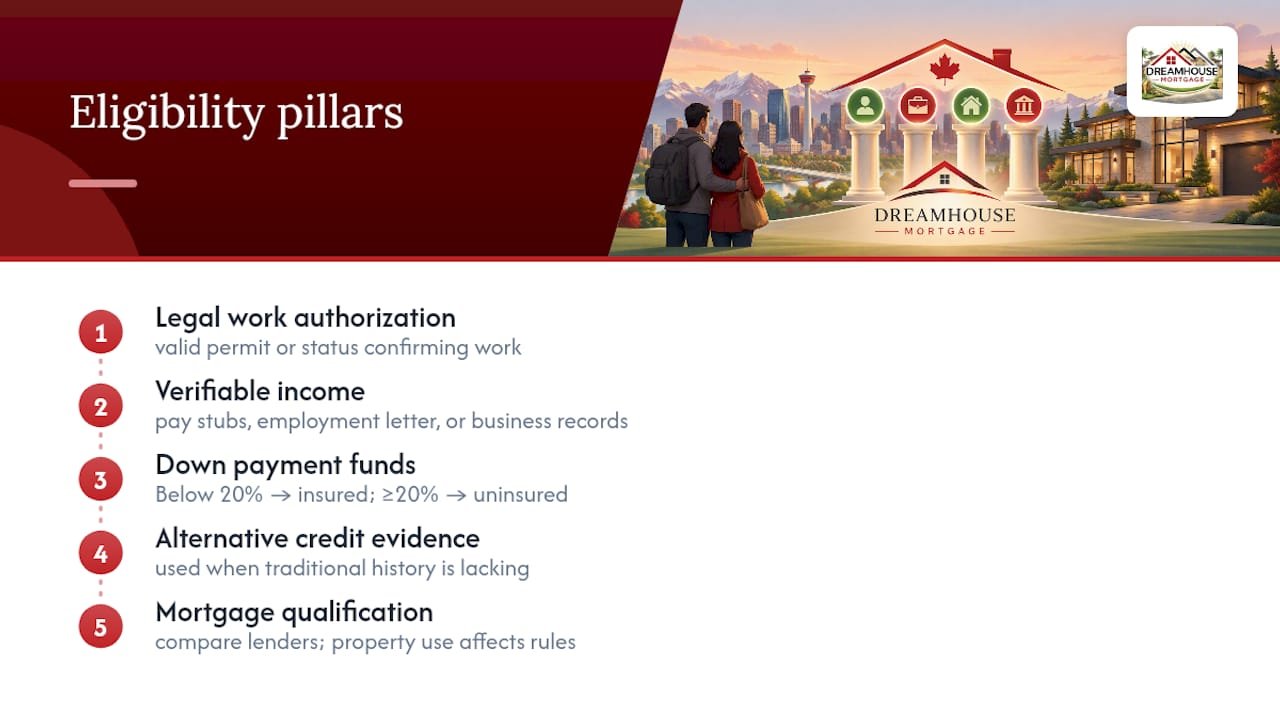
Down payment size shapes which financing path applies to you. Below 20% down, you fall into insured lending territory under CMHC’s Newcomers program, which is generally the more accessible route since it accepts alternative credit evidence. At 20% or above, you move into uninsured lending, which avoids the insurance premium but requires you to clear the OSFI stress test at the higher qualifying rate.
Property use matters too. Programs built around newcomer eligibility are generally structured for owner-occupied primary residences rather than rental or investment purchases, so if your goal is an income property, expect different qualifying rules and a larger down payment requirement. Every lender applies these pillars somewhat differently, which is precisely why comparing more than one lender, rather than applying at a single bank, tends to produce a better outcome for a newcomer file.
Types of properties non-residents can purchase with a mortgage in Canada
Newcomers financing a home through CMHC’s Newcomers program are generally purchasing owner-occupied residential property: a detached house, a town house or a condominium unit that will serve as your primary residence in Calgary, Airdrie, Cochrane or another Alberta community. This owner-occupancy requirement is a defining feature of the newcomer insurance program, which is built to support settlement rather than investment.
Condominiums come with their own layer of due diligence. Lenders will want to review the condo corporation’s reserve fund study and status certificate before approving financing, since a poorly funded reserve fund can affect a property’s long-term value and your monthly condo fees.
If your goal is a rental or investment property rather than a primary residence, that shifts you into a different financing category with different down payment minimums and qualifying rules, since insured newcomer programs are not built around rental purchases. Buyers considering that route should also review the exemptions and restrictions under Canada’s Prohibition on the Purchase of Residential Property by Non-Canadians Act, since eligibility can depend on permit validity and whether the property sits inside a major census area. A broker can confirm early which property type fits your status before you start touring listings.
List of Canadian lenders and financial institutions that offer mortgages to non-residents
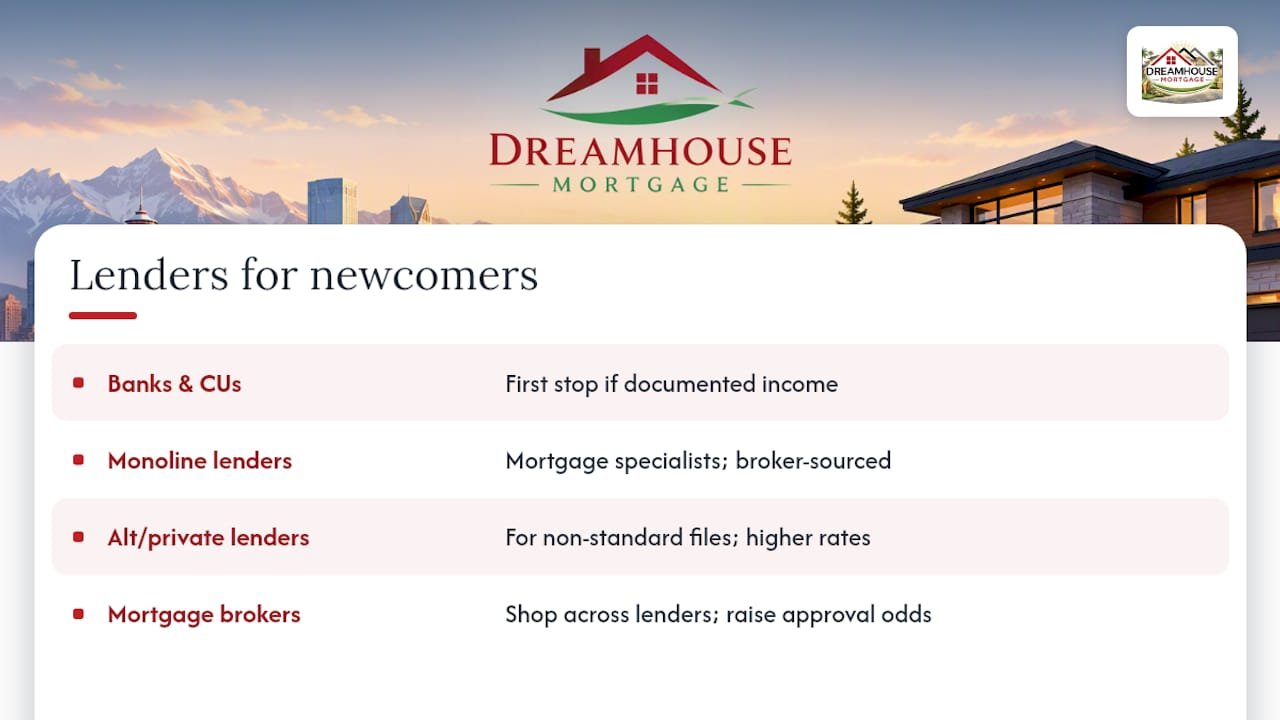
Newcomer files are underwritten by the same broad categories of lenders active across the Alberta market: major banks, credit unions, monoline lenders that specialize in mortgages, and alternative or private lenders for files that do not fit standard bank criteria. Each category has a different appetite for newcomer files, and that appetite can shift based on your specific work permit type, income source and available credit documentation.
Banks and credit unions tend to be the first stop for newcomers who already have a Canadian bank account and a documented income history, since they often have internal newcomer programs built around CMHC’s insurance rules. Monoline lenders, which focus exclusively on mortgage lending rather than full retail banking, can sometimes offer competitive terms for well-documented files and often work through mortgage brokers rather than directly with the public. Alternative and private lenders serve a smaller but important role for newcomers whose income structure or credit documentation does not yet fit standard bank criteria, typically at a different rate and term structure than a bank would offer.
Rather than approach these categories one at a time, working with a broker who already has relationships across all four means your file gets presented to the lenders most likely to say yes, instead of collecting rejections from lenders whose newcomer criteria you did not fit. That efficiency alone can be the difference between a smooth approval and a frustrating string of declined applications.
Typical interest rates and mortgage terms offered to non-residents
Newcomers who meet CMHC’s Newcomers eligibility criteria and provide the required documentation generally qualify for the same rate categories and term structures available to any other qualified Canadian borrower. Your specific rate depends on your down payment size, whether your mortgage is insured or uninsured, your credit profile (Canadian or alternative), and current market conditions at the time you lock in your rate, rather than on your residency status itself.
Term lengths follow standard Canadian mortgage conventions, most commonly a five-year term with either a fixed or variable rate, though shorter and longer terms are available depending on the lender. Amortization periods typically run up to 25 years for insured mortgages, with longer amortizations sometimes available on uninsured mortgages depending on the lender’s policies.
Because insured mortgages carry a mortgage loan insurance premium while uninsured mortgages face the stricter OSFI stress test, the practical rate and cost trade-off between the two paths depends heavily on your down payment size. A broker who can model both scenarios against your actual numbers gives you a clearer picture than a generic rate comparison, since your specific documentation and down payment source both affect which lenders will offer their best pricing to your file.
Tax implications for non-resident property buyers in Canada
Once you become a Canadian resident for tax purposes, whether under a work permit, permanent residency or another recognized status, your home purchase generally falls under the same tax rules that apply to any Canadian resident buyer. This is a distinct category from foreign, non-resident buyers who do not live in Canada, whose purchases can trigger different federal and provincial tax and reporting obligations.
As a newcomer living and working in Canada, your primary residence purchase is typically eligible for standard homeowner tax treatment, including principal residence considerations when you eventually sell. Land transfer or property transfer considerations vary by province, and Alberta does not currently charge a provincial land transfer tax, though municipal and registration fees still apply at closing.
Because tax residency status and immigration status are not always the same thing, and because rules can shift depending on your specific permit type and timeline in Canada, it is worth confirming your tax residency status with the Canada Revenue Agency or a qualified tax professional before you close on a property. A mortgage broker can walk you through the financing side of your purchase, but your tax residency determination should come from a tax professional who can review your specific immigration and income documentation.
Next steps for Calgary-area newcomers: quick timeline and roadmap to pre-approval
Getting from “eligible” to “pre-approved” is a short, sequential process when your documents are ready.
- Confirm your work authorization status and check it against CMHC Newcomers criteria.
- Gather your identification, employment and income documents, plus alternative credit evidence if needed.
- Open an FHSA or begin transferring down payment funds, keeping source-of-funds paperwork organized.
- Contact a broker for pre-approval and lender matching suited to your specific file.
- Shop for a home with pre-approval in hand, so you can move quickly on the right property.
Most newcomer files reach pre-approval within two to twelve weeks, depending on documentation speed and down payment source. Prioritize Alberta lenders and credit unions already familiar with newcomer underwriting, since that familiarity often means fewer back-and-forth document requests.
— Guriqbal Chahal, MBA, PMP
Get personalized help from DreamHouse Mortgage
Mortgage brokers match newcomer borrowers to Alberta lenders who actively underwrite non-permanent resident files, and help coordinate documents for these applications.

Whether you are settling in Calgary, Airdrie or Cochrane, our New To Canada mortgage program is built around exactly the documentation challenges covered in this guide. Call Guriqbal Chahal, MBA, PMP, Mortgage Broker, at 403-966-6072, or visit our mortgage broker consultation page to start your pre-approval today.
Sources
Verify every rule in this guide directly with the government and regulator sources behind it:
- OSFI — Minimum qualifying rate for uninsured mortgages
- CMHC — Newcomers mortgage loan insurance
- Canada Revenue Agency — First Home Savings Account (FHSA)
This article is general information, not a substitute for advice from a qualified financial advisor. Consult a qualified financial professional about your own circumstances before acting on anything here.
FAQ
Can a temporary resident get a mortgage in Calgary?
Yes, a temporary resident authorized to work in Canada can qualify for a mortgage in Calgary through CMHC’s Newcomers program, provided they meet work permit, income and down payment requirements. A broker can confirm which lenders in the Calgary market actively underwrite these files.
How much down payment does a newcomer need?
Down payment minimums follow standard Canadian rules based on purchase price, and any down payment below 20% requires mortgage loan insurance with premiums ranging from about 0.6% to 4.5% of the mortgage amount. Building savings through a First Home Savings Account, which allows up to $8,000 per year toward a $40,000 lifetime limit, can help newcomers reach that threshold faster.
What happens if I do not have a Canadian credit history?
CMHC’s Newcomers program allows alternative credit evidence such as an international credit report, a letter from your overseas bank, or documented rent and payment history in place of a Canadian credit file. Lenders vary in which formats they accept, so working with a broker who can screen lender requirements in advance helps avoid unnecessary declines.
Does the mortgage stress test apply to newcomer mortgages?
Yes, the stress test applies once your mortgage is uninsured, meaning your down payment is 20% or more. Per OSFI’s guidance, lenders qualify you at the greater of your contract rate plus 2%, or 5.25%, regardless of residency status.
How can DreamHouse Mortgage help with a newcomer mortgage?
Mortgage brokers work with various lenders across Alberta to match newcomer borrowers to lenders suited to their permit type and credit documentation. Call 403-966-6072 to discuss your specific situation and start the pre-approval process.