Foreclosure in Alberta is a court supervised process that can end in the sale or loss of your home once a fixed redemption period expires. Residential borrowers typically get six months to catch up before a judge finalizes the outcome. If you have missed a payment or received a demand letter, call your lender and a mortgage professional today, gather your mortgage statements, and ask about relief options before the court file moves forward.
TL;DR:
- Borrowers should act early, ideally during the demand letter stage, to explore refinancing or restructuring options before legal proceedings begin.
- The typical redemption period for residential properties in Alberta is six months, but courts can shorten or lengthen this window based on individual circumstances.
- Failing to redeem within the allotted time usually results in a judicial sale of the property or transfer of title to the lender through a final order of foreclosure.
- Contact a mortgage broker for immediate assistance with refinancing, arrears management, and exploring relief tools before the court process advances.
- Most foreclosure triggers, beyond missed payments, include property damage, unpaid taxes, or breach of loan terms, with legal enforcement governed by Alberta’s Property Act.
Table of Contents
- Understanding the Foreclosure Process in Alberta: What Triggers It
- Alberta Foreclosure Timeline: From Default to Judicial Sale
- Your Options After Being Served With a Foreclosure Claim
- How Much Time You Actually Have to Redeem Your Home
- What Happens If You Don’t Redeem in Time
- Steps to Take Right Now to Protect Your Calgary Home
- An Alberta-First Perspective on Foreclosure Fear
- Talk to Dreamhouse Mortgage Before the Court Date Arrives
- Sources
- FAQ
Understanding the Foreclosure Process in Alberta: What Triggers It
Foreclosure doesn’t start the moment you miss a single payment, but it can. Everything depends on your mortgage agreement and how quickly your lender chooses to act once you fall behind. Most lenders in Calgary, Cochrane, and Airdrie will attempt collection calls, letters, and payment plans for weeks or months before involving a lawyer, but the mortgage document itself usually gives them the right to act sooner if the default is serious enough.
Default isn’t limited to missed mortgage payments. Alberta lenders can treat several situations as grounds to start the foreclosure process:
- Missing one or more scheduled mortgage payments
- Letting homeowner’s insurance lapse
- Falling behind on municipal property taxes
- Failing to pay condominium fees, which can trigger a lender response under the mortgage terms
- Causing damage to the property or allowing it to fall into serious disrepair
- Breaching another material term of the mortgage or loan agreement
The legal foundation for all of this sits in Part 5 of Alberta’s Law of Property Act (RSA 2000, c L-7), which governs how a mortgage holder pursues a defaulting borrower through the Alberta Court of King’s Bench. Any registered encumbrance or charge against your land, not just a conventional mortgage, can be enforced under similar rules, so don’t assume a differently labeled loan document offers extra protection.
Alberta Foreclosure Timeline: From Default to Judicial Sale
Once a lender decides to act, the Alberta foreclosure timeline follows a fairly predictable sequence through the court system. Knowing where you sit in that sequence tells you exactly how much time you have left and what your options look like.
- Demand and pre-litigation contact. Most lenders send a formal demand letter and attempt to negotiate before filing anything in court. This stage can stretch on for weeks, and CMHC guidance notes that lenders generally prefer negotiated solutions over full litigation because court proceedings are slower and more expensive for everyone involved.
- Statement of claim. If negotiation fails, the lender’s lawyer files a statement of claim with the Court of King’s Bench and has it formally served on you. This document starts the clock.
- Your response window. You generally have a limited number of days to file a statement of defence, a demand of notice, or a consent to judgment once served. Missing this window doesn’t end your options, but it narrows them considerably.
- Order nisi. If the matter proceeds without a successful defence, the court grants an order nisi, which fixes the redemption period during which you can pay out the mortgage in full and keep the property.
- Judicial sale or final order. If you don’t redeem within that window, the lender applies for either a judicial sale of the property or, in more limited circumstances, a final order of foreclosure that transfers title outright.
A detail many Alberta homeowners don’t realize: courts in this province generally require a judicial sale attempt before granting final foreclosure, except in limited cases where a sale isn’t practical. That judicial oversight is a deliberate design feature. Alberta’s court-directed model exists specifically to confirm a fair price gets paid for the home, which sets it apart from provinces that rely more heavily on private power-of-sale mechanisms.
Your Options After Being Served With a Foreclosure Claim
Getting served with a statement of claim feels alarming, but it is not the end of the conversation. You have several legitimate paths forward, and the right one depends on your finances, how far behind you are, and whether you want to keep the home.
- Pay out the arrears or redeem in full. Bringing the account current, or paying the mortgage balance in full before the redemption deadline, stops the process entirely.
- Negotiate directly with your lender. Many lenders will consider a payment deferral, a temporary reduced payment, or rolling arrears into the mortgage balance rather than pursue a costly court file to the end.
- File a statement of defence. If you believe the lender made an error, miscalculated arrears, or didn’t follow proper notice procedures, a defence puts those issues before a judge.
- File a demand of notice. This ensures you receive notice of every further step in the proceeding, which buys you visibility even if you aren’t actively contesting the claim.
- Consent to judgment. Some borrowers who know they can’t keep the home choose to consent early, which can shorten timelines and reduce legal costs on both sides.
CMHC’s guidance for lenders and borrowers outlines specific relief tools, including payment deferrals, extended amortization, and adding arrears to the principal balance. CMHC’s Default Management Tool Selector helps lenders identify which of these tools fits your situation, and asking your lender directly whether they use it is a reasonable first move. Extending your amortization period can lower your monthly payment enough to make arrears manageable again.
Pro Tip: Before you call your lender, put together a folder with your last twelve months of mortgage statements, a written summary of what caused the hardship (job loss, illness, divorce), and proof of any income change. Lenders respond faster and more favorably to borrowers who show up organized.
Get legal advice as soon as you’re served, not after the response deadline passes. For comprehensive mortgage support, consider resources like BFIL mortgage support services to explore your options. An Alberta lawyer can tell you whether a defence has merit; a mortgage broker can tell you whether refinancing or a private lending solution could resolve the default before the court file advances further.
How Much Time You Actually Have to Redeem Your Home
The redemption period is the single most important number in the entire foreclosure process, and it varies by property type. Once a court grants an order nisi, the redemption period is typically several months for residential property and longer for farm land, but courts have discretion to adjust this period, though a judge retains discretion to shorten or lengthen either window based on the facts of the case.
| Property type | Typical redemption period | Court discretion |
|---|---|---|
| Residential (single-family, condo) | Six months | Can be shortened or extended |
| Farm land | One year | Can be shortened or extended |
A judge might shorten the window if the property is vacant, deteriorating, or if the borrower has shown no realistic path to redemption. Conversely, a judge might extend it if you can demonstrate a pending sale, refinancing approval in progress, or a documented hardship with a clear resolution timeline. Either way, the redemption period is when you have leverage. Waiting until the final weeks to explore refinancing or a private lending option leaves almost no room for error.
What Happens If You Don’t Redeem in Time
If the redemption period passes without payment, the lender applies to the court for either a judicial sale or a final order of foreclosure. These are not the same thing, and the difference matters a great deal to your financial future.
A judicial sale lists the property for sale under court supervision, typically through a real estate listing process the court approves. The proceeds pay off the mortgage, legal costs, and any other registered charges, with any surplus returned to the borrower. A final order of foreclosure instead transfers title of the property directly to the lender, with no sale and no surplus calculation, and Alberta courts generally reserve this for cases where a sale isn’t practical.
- Legal costs and enforcement fees are typically added to the amount owed and are usually the borrower’s responsibility.
- Deficiency judgments, where a lender sues for the shortfall between sale proceeds and the debt, are limited in scope and courts scrutinize them closely against the property’s fair value.
- A completed foreclosure or judicial sale appears on your credit report and can affect your ability to qualify for a mortgage for several years afterward.
- If possession is required, enforcement follows Alberta’s formal process through civil enforcement agencies and bailiffs, not a lender showing up unannounced.
The credit impact alone is worth taking seriously. A foreclosure on file makes future lenders far more cautious, and rebuilding that trust takes years of consistent on-time payments and, often, targeted credit repair work before conventional financing becomes available again.
Steps to Take Right Now to Protect Your Calgary Home
Waiting rarely helps in a foreclosure situation. Here’s what to do today:
- Call your lender and explain your circumstances honestly. Ask specifically about deferrals, arrears capitalization, or amortization changes.
- Pull together your mortgage statements, payment history, and a short written hardship summary.
- Contact a mortgage broker who works across Calgary, Cochrane, and Airdrie about refinancing, alternative lending, or restructuring the mortgage before the court timeline advances.
Guriqbal Chahal, MBA, PMP, Broker of Record at Dreamhouse Mortgage, has guided Alberta homeowners through payment hardship, refinancing, and lender negotiations for years, drawing on relationships across banks, credit unions, monoline, alternative, and private lenders throughout the Calgary region. A broker-guided application can sometimes open refinancing paths a borrower wouldn’t find approaching a single bank alone.
An Alberta-First Perspective on Foreclosure Fear
Most articles on this topic read like a legal textbook, heavy on statute citations and light on what a homeowner in Airdrie or Cochrane should actually do this week. That gap is the real problem. The Law of Property Act gives you a six-month redemption period on residential property, and I’d argue that window is far more generous than most borrowers realize once panic sets in.
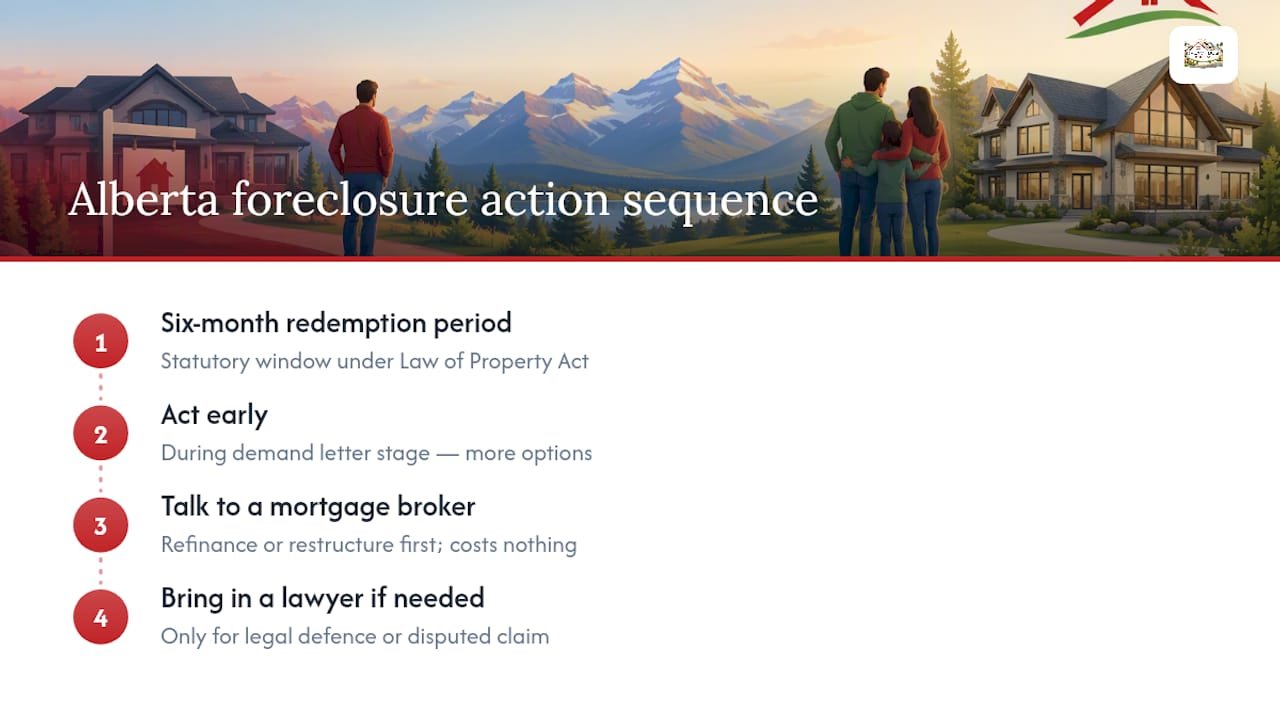
The conventional advice, “contact a lawyer,” is only half right. A lawyer defends your legal position; a mortgage broker can often solve the underlying financial problem before the case ever needs defending. I’ve seen the sequence work best in reverse order from what most people assume: talk to a broker about refinancing or restructuring first, because that conversation costs nothing and can resolve arrears in days, then bring in legal counsel only if a genuine dispute over the claim itself exists.
What gets overlooked most is timing. Borrowers who call in month one of default have dramatically more options than borrowers who wait until the order nisi is already granted. Act during the demand letter stage, not after the statement of claim arrives.
— Guriqbal Chahal, MBA, PMP
Talk to Dreamhouse Mortgage Before the Court Date Arrives
Mortgage brokers can help Calgary, Cochrane, and Airdrie homeowners facing arrears explore refinancing, mortgage restructuring, debt consolidation, and alternative lending options across multiple lenders to find workable paths forward.

If you’ve missed a payment or received a demand letter, the fastest thing you can do is talk to someone who negotiates with Alberta lenders every day. Call Guriqbal Chahal, MBA, PMP, Mortgage Broker, at 403-966-6072, or explore refinancing and mortgage restructuring options at Dreamhouse Mortgage. You can also find the brokerage’s Google Business Profile here for reviews and directions. Dreamhouse Mortgage serves homeowners throughout Calgary, Cochrane, Airdrie, and the surrounding Rocky View communities, and urgent consultations can often be arranged within days, not weeks.
This article is general information, not a substitute for advice from a qualified financial advisor. Consult a qualified financial professional about your own circumstances before acting on anything here.
Sources
- Foreclosure proceedings and available remedies for mortgage holders and other creditors — Torys
- Dealing with mortgage payment difficulties — CMHC
- Property seizures and evictions by civil enforcement agencies — Government of Alberta
FAQ
How Long Before a Mortgage Goes Into Foreclosure in Alberta?
There’s no single fixed number of days written into law. Most lenders begin formal contact after one missed payment and may involve a lawyer within a few months of continued default, though practices vary by lender. Once a statement of claim is filed and an order nisi granted, the redemption period is commonly six months for residential property.
What Can I Legally Take From My Foreclosed Home in Canada?
You’re generally entitled to remove your personal belongings and possessions that aren’t fixtures attached to the property before a court-ordered move-out date. Fixtures like built-in appliances, light fixtures, and anything permanently attached to the structure typically stay with the home under Alberta property law.
How Many Missed Mortgage Payments Trigger Foreclosure in Alberta?
There’s no universal threshold. A single missed payment can technically permit a lender to act under most mortgage agreements, though in practice most Alberta lenders attempt collection efforts and negotiation for several missed payments before involving legal counsel. Contacting your lender at the first missed payment gives you the most options.
What Is a Final Order of Foreclosure?
A final order of foreclosure transfers title of the property directly to the lender without a sale process, and Alberta courts generally reserve this outcome for cases where a judicial sale isn’t practical. In most cases, courts require a judicial sale attempt first, with any surplus proceeds returned to the borrower.
Can Dreamhouse Mortgage Help Me Avoid Foreclosure?
Dreamhouse Mortgage works with banks, credit unions, monoline, and private lenders across Calgary, Cochrane, and Airdrie to explore refinancing, debt consolidation, and restructuring options before a foreclosure case advances. Call Guriqbal Chahal, MBA, PMP, at 403-966-6072 for a consultation on your specific situation.