
In Canada, the two main penalty formulas are three months’ interest and the interest rate differential, and federally regulated lenders usually charge whichever is greater. Open mortgages and the prepayment privileges built into most closed mortgages can reduce or eliminate that cost entirely. Beyond those two formulas, you may also face administration or discharge fees, which stack on top of whichever penalty applies.
TL;DR:
- The interest rate differential can be significantly higher than three months’ interest, often four times or more, depending on lender comparison methods.
- Prepayment privileges like “10 plus 10” allow penalty-free extra payments annually, but exceeding these limits triggers penalties based on the appropriate formula.
- Getting a written payout statement, including specific details and calculation methods from your lender, is essential before breaking your mortgage.
- Opening mortgages offer full prepayment flexibility with higher rates, while closed mortgages have lower rates but limited prepayment options.
- Porting your mortgage or timing your transaction close to your term’s end can often reduce or eliminate penalties before refinancing or sale.
Table of Contents
- Types of Mortgage Penalties in Canada
- How Penalties Are Calculated: Formulas and a Real Example
- Prepayment Privileges: Open vs Closed Mortgages
- How to Check Your Penalty: Requesting a Written Payout Statement
- Ways to Reduce or Avoid Mortgage Penalties
- How DreamHouse Mortgage Helps Calgary-Area Homeowners With Penalty Questions
- Penalty Differences Across Provinces and Lenders
- Does Breaking a Mortgage Early Hurt Your Credit Score?
- How Penalties Affect Your Refinancing Decision
- Legal Rules Governing Mortgage Penalties in Canada
- When Does a Penalty Apply After You Break Your Mortgage?
- Deciding Whether a Penalty Is Worth Paying
- Talk to a Calgary Mortgage Broker Before You Break Your Mortgage
- FAQ
- Sources
Types of Mortgage Penalties in Canada
Before you can estimate what breaking your mortgage will cost, you need to know which penalty type applies to your contract. There are four categories we see most often with clients in Calgary, Airdrie, and Cochrane.
Three months’ interest is the simpler calculation and typically applies to variable-rate mortgages. It is calculated by taking your current interest rate, applying it to your outstanding balance, and charging the equivalent of three months of interest payments.
The interest rate differential (IRD) usually applies to closed fixed-rate mortgages, and it can produce a far steeper bill. Lenders compare the rate on your existing contract to the rate they could charge today on a similar term, then apply that difference to your remaining balance over your remaining term. According to Canada, the prepayment charge is usually whichever of the two amounts, three months’ interest or IRD, turns out higher.
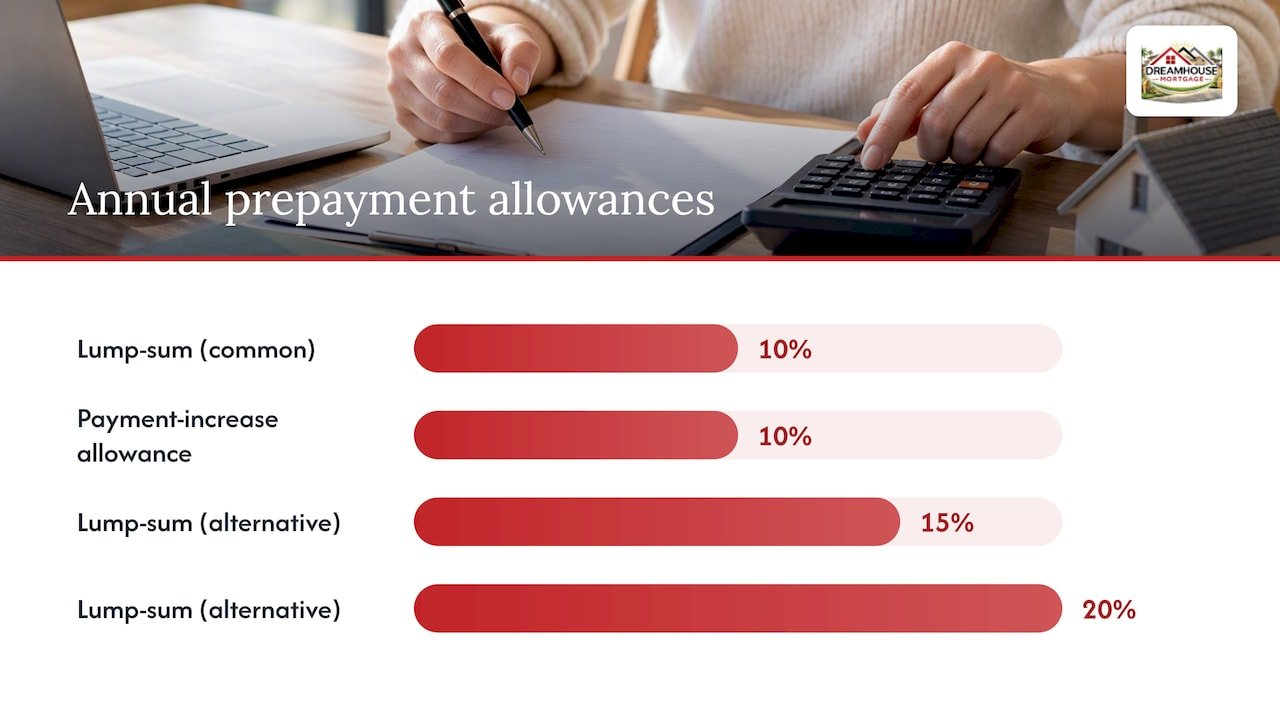
Prepayment privilege breaches happen when you pay down more than your contract allows in a given year. Most closed mortgages include an annual privilege, often structured as “10+10,” letting you prepay up to 10% of the original balance as a lump sum and increase your regular payment by up to 10%, without penalty. Exceed that and the extra amount is treated as a break, triggering whichever formula applies.
Administration or discharge fees are smaller flat charges, often a few hundred dollars, that lenders add regardless of which penalty formula applies. They cover the paperwork of releasing the mortgage and registering the discharge.
- Three months’ interest: common on variable-rate mortgages, calculated on the current rate and balance.
- IRD: common on fixed-rate closed mortgages, compares your contract rate to current rates for the remaining term.
- Privilege breach: applies when prepayments exceed the annual allowance, often 10% lump sum plus 10% payment increase.
- Admin or discharge fee: a flat charge added on top of whichever main penalty applies.
How Penalties Are Calculated: Formulas and a Real Example
Once you know which penalty type applies to your mortgage, the next step is running the numbers yourself so you can sanity-check whatever figure your lender quotes.
The three months’ interest formula is straightforward: take your outstanding balance, multiply by your current annual interest rate, then divide by four to isolate three months of interest.
The IRD formula takes more inputs: your outstanding balance, your contract rate, a comparison rate for the remaining portion of your term, and the number of months left. The lender finds the rate it currently offers for a term matching your remaining time, subtracts that from your contract rate, and applies the difference to your balance over the months remaining.
Canada.ca provides a worked example that shows how different these two numbers can be:
- A borrower has a substantial mortgage balance with a fixed contract rate and several years left on the term.
- The three months’ interest penalty is calculated based on the current interest rate and outstanding balance.
- The IRD penalty, calculated using the difference between the contract rate and current posted rates for the remaining term, can be significantly higher.
- Lenders charge the greater of the two calculated amounts, plus any administration fee.
The gap between formulas can be four times larger or more: in the Canada.ca example above, the IRD penalty of $12,000 dwarfs the $3,000 three months’ interest figure, which is why knowing your mortgage type matters before you assume a penalty will be minor.
What makes IRD harder to predict is that lenders do not all select the comparison rate the same way. Some use the posted rate for the term closest to your remaining time; others first subtract whatever discount you received off the posted rate at origination, then apply a different comparison rate. That single choice can swing your penalty substantially, which is why asking your lender directly how they select the comparison rate is one of the most useful questions you can ask before signing anything.
Prepayment Privileges: Open vs Closed Mortgages
Not every mortgage carries a penalty risk the same way. An open mortgage lets you pay off any portion, or the entire balance, at any time with no penalty, though it typically carries a higher interest rate in exchange for that flexibility. A closed mortgage locks in a lower rate but restricts prepayment outside of specific allowances.
Most closed mortgages include annual prepayment privileges, commonly structured as “10+10”: up to 10% of the original principal as a lump sum, plus a 10% increase to your regular payment amount, both penalty-free. Some lenders offer different structures, such as 15% or 20% lump-sum allowances, so it pays to check your specific contract rather than assume the common figure applies.
- Open mortgages: full prepayment flexibility, typically at a higher rate.
- Closed mortgages: lower rate, but prepayment limited to contractual privileges.
- 10+10 structure: 10% lump sum plus 10% payment increase, penalty-free, in most standard closed products.
- Privileges rarely carry forward: an unused allowance from last year usually does not roll into the next.
Pro Tip: Check your annual anniversary date, since privileges often reset then rather than on the calendar year, and using your allowance right before a break can meaningfully shrink the balance your penalty is calculated against.
If you are weighing whether an open or closed mortgage structure fits your plans better, especially if you expect to sell or refinance within a few years, that decision at the outset shapes how much flexibility you have later.
How to Check Your Penalty: Requesting a Written Payout Statement
Online calculators give you a rough idea, but only a written statement from your lender is reliable enough to act on. Here is the process we walk clients through.
- Gather your mortgage details: outstanding balance, contract interest rate, start date, and term length, plus any discount noted on your original commitment letter.
- Contact your lender and formally request a written payout or prepayment statement, not just a verbal estimate.
- Confirm the statement includes your balance, contract rate, the comparison rate used, your remaining term, and the statement’s validity period, since these figures expire and need to be reissued if your closing date shifts.
- Use your lender’s online calculator for a ballpark figure, but treat the written statement as the number you act on. Federally regulated lenders are required to disclose prepayment privileges and explain how the charge was calculated when you ask.
- If porting, refinancing, or comparing offers from multiple lenders, bring the statement to a mortgage broker who can run a net-benefit comparison before you commit to breaking the mortgage.
Ways to Reduce or Avoid Mortgage Penalties
A penalty is rarely a fixed cost you simply have to accept. Several tactics can shrink or eliminate it depending on your situation.
Porting your mortgage to a new property, or having a buyer assume it during a sale, often preserves your existing rate and avoids an IRD charge entirely, though it requires lender approval and careful timing around your closing dates.
Using your annual prepayment privilege before you break the mortgage reduces the balance the penalty is calculated against, since both three months’ interest and IRD are applied to your outstanding amount.
Timing your transaction close to your term’s natural end can eliminate the penalty altogether if you can hold off even a few months, particularly when you’re within range of a scheduled mortgage renewal.
- Port the mortgage to a new property or to the buyer, where the lender allows it.
- Apply your lump-sum and payment-increase privileges before calculating a break cost.
- Wait out the remaining months if your term end is close and savings from breaking early are marginal.
- Add the penalty and admin fees together, then compare that total against the actual savings a new rate would deliver.
Pro Tip: Always compare the full cost of breaking, penalty plus admin fees plus any new mortgage setup costs, against the total interest you’d save, not just the headline rate difference, since a lower advertised rate does not guarantee a smaller net cost.
A broker can also source lender options where the comparison-rate rule works more favorably for your situation, which sometimes narrows the gap between the two penalty formulas before you commit to a decision.
How DreamHouse Mortgage Helps Calgary-Area Homeowners With Penalty Questions
Working through a penalty calculation alone is manageable, but confirming you’re reading the right inputs, and that porting or refinancing actually nets out ahead, is where a second set of eyes helps.
- We help clients request and interpret written payout statements so they can understand the actual contract terms clearly.
- We evaluate whether porting to a new property is realistic given your closing timeline and the receiving lender’s requirements.
- We run net-benefit scenarios comparing your penalty and fees against the savings a new rate or amortization would deliver.
- We coordinate timing on renewals, refinances, and new-to-Canada mortgage programs so breaks happen only when the math supports it.
Our mortgage broker works directly with homeowners across Calgary, Airdrie, and Cochrane on renewal, refinance, and portability questions. If you’re unsure whether your lender’s quoted penalty is accurate, a conversation before you sign anything costs nothing and often saves far more than the call takes.
Penalty Differences Across Provinces and Lenders
Mortgage penalty rules in Canada are not set by province, since mortgage contracts are governed by federal disclosure requirements for federally regulated lenders alongside the specific terms in your individual agreement. What varies far more than geography is which lender you’re with and which formula your particular contract specifies.
Federally regulated banks, credit unions, and monoline lenders each build their own IRD methodology into their standard mortgage documents, including how they select a comparison rate and whether they apply the original discount before or after that comparison. Alberta homeowners working with a credit union may find a different privilege structure than someone with a major bank, even on an otherwise similar fixed-rate product.
This is why reading your specific mortgage commitment matters more than assuming a “typical” Canadian rule applies. Two neighbors in Cochrane, each with a five-year fixed mortgage from different lenders, could see meaningfully different penalty amounts on an identical balance and rate simply because their lenders calculate IRD differently.
Enhanced disclosure requirements under the Mortgage Prepayment Information Code require federally regulated lenders to explain their specific calculation method when you ask, which is the most reliable way to understand the variation that applies to your own contract rather than relying on general guidance.
Does Breaking a Mortgage Early Hurt Your Credit Score?
Paying a prepayment penalty and discharging your mortgage early is a financial decision, not a credit event. Breaking your mortgage to refinance, port, or pay out your balance does not, on its own, lower your credit score, because you are fulfilling the terms of your agreement, including whatever penalty applies, rather than defaulting on it.
What can affect your credit is what happens around the break. If you take on a new mortgage with a significantly higher balance, open new credit products at the same time, or your overall debt load rises relative to your income, that can shift how lenders view your file on future applications. Multiple credit inquiries within a short window, from shopping several lenders for a new rate, can also have a modest, temporary effect.
The penalty itself is a cost you pay at discharge, not a mark on your credit history. As long as payments continue on schedule through the transition and the new mortgage is properly registered, your credit profile should carry through the break without disruption.
How Penalties Affect Your Refinancing Decision
A prepayment penalty is often the single biggest factor in whether refinancing makes financial sense right now or whether it’s better to wait. The math is simple in concept: the penalty and any associated fees need to be smaller than the interest savings you’d gain from the new rate or terms over your planning horizon.
If your current rate is well above what’s available today and you have several years left on your term, a large IRD penalty can still make sense once you account for years of lower payments ahead. If your remaining term is short, or the rate gap is narrow, the penalty may erase most or all of the benefit.
Refinancing to consolidate debt, access equity, or adjust your amortization carries the same consideration. The penalty becomes one line item in a larger comparison that should also include appraisal costs, legal fees, and any new lender’s discharge or setup fees. Running that full comparison before applying, rather than after, is what determines whether refinancing actually improves your position.
Legal Rules Governing Mortgage Penalties in Canada
Mortgage penalty disclosure in Canada is governed primarily through the Financial Consumer Agency of Canada and the obligations it places on federally regulated lenders. Under the Mortgage Prepayment Information Code, lenders must provide enhanced prepayment information, including a clear explanation of which prepayment privileges apply to your mortgage and how any prepayment charge is calculated.
When you request a payout statement, your lender is required to supply the applicable charge along with the inputs used to calculate it, your balance, contract rate, comparison rate, remaining term, and how long the quoted figure remains valid.

A regulatory compliance review found instances where lenders did not clearly disclose every component of their IRD calculation, which is a useful reminder to request the full breakdown rather than accept a single total figure at face value.
Separately, OSFI removed the requirement to apply the minimum qualifying rate to uninsured straight-switch renewals as of November 21, 2024, provided there’s no increase to the loan amount or amortization. That change affects how easily you can switch lenders at renewal without re-qualifying at a higher stress-test rate, but it does not change or reduce penalties owed during an active mortgage term.
When Does a Penalty Apply After You Break Your Mortgage?
A mortgage penalty applies at the point you formally discharge or pay out your mortgage ahead of its maturity date, not at some fixed number of months into your term. There is no universal waiting period before a penalty can apply. It is tied to your term’s end date and the terms written into your specific contract.
In practice, the timeline looks like this: you request a payout statement, which your lender issues with a stated validity window, often a short number of weeks. If your closing or refinance completes within that window, the quoted penalty holds. If it slips past that window, the figures can change, particularly for IRD, since the comparison rate used is tied to current market rates at the time of calculation.
This is why timing your request matters as much as the calculation itself. Requesting a statement too early, before your closing date is firm, risks having to request a fresh one if rates move or the window lapses. Requesting it only once terms are set, ideally with a realistic closing date in hand, keeps the figure you’re working from accurate when it matters.
Deciding Whether a Penalty Is Worth Paying
The penalty itself is rarely the whole answer. Compare it against roughly two years of interest savings from the new rate, plus any refinance or discharge fees, before deciding.
Watch your qualification too: a larger loan amount or longer amortization on the new mortgage means requalifying at today’s stress-test rate, which isn’t guaranteed.
Pay the penalty when the rate drop is substantial or a sale is time sensitive. Wait when your term is nearly up or the gap is narrow.
— Guriqbal Chahal, MBA, PMP
Talk to a Calgary Mortgage Broker Before You Break Your Mortgage
A penalty quote from your lender is a starting point, not the final word. We help homeowners across Calgary, Airdrie, and Cochrane confirm whether the figure they’ve been quoted matches their actual contract terms, and whether breaking now actually makes financial sense once every cost is on the table.

- We request and interpret written payout statements so you’re comparing accurate numbers, not estimates.
- We evaluate porting, refinancing, and renewal timing side by side so you see the full picture before committing.
- We work with banks, credit unions, monoline, and alternative lenders to find terms that fit your specific situation.
If you’re weighing a penalty against a renewal, refinance, or sale, call our mortgage broker at 403-966-6072, or find us on our Google Business Profile. You can also start with a consultation request and we’ll walk through your numbers together.
This article is general information, not a substitute for advice from a qualified financial advisor. Consult a qualified financial professional about your own circumstances before acting on anything here.
FAQ
What are the penalties for paying off a mortgage early in Canada?
Lenders typically charge whichever is greater between three months’ interest or the interest rate differential, as explained in Canada.ca’s prepayment penalty guidance. An administration fee is usually added on top, and the exact amount depends on your specific contract terms.
What happens if I pay an extra $100 a month on my mortgage?
Most closed mortgages include an annual prepayment privilege, often allowing a 10% increase to your regular payment without triggering a penalty. Whether a small extra payment falls within that allowance depends on your original mortgage amount and your lender’s specific privilege terms, so check your commitment letter or ask your lender directly.
What penalties are there for paying off a mortgage early?
The two core formulas are three months’ interest, common on variable-rate mortgages, and the interest rate differential, common on fixed-rate closed mortgages, with federally regulated lenders generally charging the greater of the two. Administration or discharge fees often apply regardless of which formula is used.
How do I avoid a mortgage penalty?
Use your annual prepayment privileges before making a larger payout, time your transaction close to your term’s natural end, or port your existing mortgage to a new property where your lender allows it. Comparing the total cost of breaking against your actual savings, with a written payout statement in hand, is the most reliable way to confirm whether a penalty can be avoided or minimized in your situation.
Sources
Recommended
- Avoid Calgary Mortgage Renewal Penalties: Start Four Months Early
- How to Break Mortgage Penalty Alberta: Save $10,000+ with This 2026 Insider Guide!
- Mortgage Terms Explained Alberta Mortgage Glossary: 60 Essential Terms Every Calgary Buyer Must Know (2026)
- Mortgage Broker Calgary: 10 Essential Questions That Can Save You Thousands Before You Sign