
Renewing your mortgage at the end of its term is penalty-free across Canada, including Calgary and the rest of Alberta. Breaking a closed mortgage before that date is a different story: most lenders charge either three months’ interest or an Interest Rate Differential (IRD), whichever is higher. If you’re weighing a mid-term change, get a written payout quote from your lender and start comparing options about four months before your term ends.
TL;DR:
- Most lenders charge a penalty based on the higher of three months’ interest or the interest rate differential, which varies significantly depending on the lender’s calculation method.
- Using your prepayment privilege before breaking your mortgage reduces the outstanding balance that the penalty is calculated on, lowering potential costs.
- Waiting until your actual renewal date or exploring porting and blend-and-extend options can help you avoid or minimize penalties altogether.
- Comparing written payout quotes and understanding the IRD calculation method used by your lender are essential for accurate cost estimation before breaking or renewing a mortgage.
- Starting the rate comparison process four to six months before your mortgage maturity allows sufficient time to find the best terms and avoid passive, costly renewal decisions.
Table of Contents
- Mortgage Renewal Penalties Calgary: When Do They Apply?
- How Lenders Calculate the Penalty: Three Months’ Interest vs IRD
- A Worked Example: Comparing 3 Months’ Interest to IRD
- How to Reduce or Avoid Renewal Penalties Altogether
- Your Renewal Timeline: What to Do and When
- Fees That Have Nothing to Do With Penalties
- How a Calgary Broker Approaches Renewal Penalty Reviews
- What Homeowners Get Wrong About Mortgage Penalties
- Get a Free Renewal Review Before You Decide Anything
- Sources
- FAQ
Mortgage Renewal Penalties Calgary: When Do They Apply?
The word “renewal” causes more confusion than almost any other term in a Canadian mortgage contract, and it’s worth clearing up before anything else. Renewal happens on your maturity date, the day your current term expires. At that point, you’re free to switch lenders, renegotiate your rate, or change your amortization without paying a cent in prepayment penalties. That rule holds for both fixed and variable-rate closed mortgages.
Breaking your mortgage contract mid-term is a separate event entirely. That’s when you pay off or replace your mortgage before the term ends, and it’s where prepayment penalties come into play.
A few definitions matter here:
- Closed mortgage: The type most Calgary homeowners hold. It offers a lower rate in exchange for restrictions on early repayment.
- Open mortgage: Allows repayment at any time without penalty, but typically carries a higher rate.
- Prepayment privileges: Most closed mortgage contracts let you pay down a limited portion of your original principal each year without charge.
There are exceptions worth flagging. Some insured mortgages carry different penalty structures, and if you exceed your annual prepayment privilege even by a small margin, the penalty applies to the excess amount. Under the Cost of Borrowing Regulations, federally regulated lenders must clearly disclose how they calculate these charges in your original mortgage documents, not bury it in fine print you discover only when you call to break the contract.
How Lenders Calculate the Penalty: Three Months’ Interest vs IRD
Calgary homeowners breaking a variable-rate mortgage almost always pay three months’ interest. It’s calculated on your outstanding balance at your current interest rate, divided by four. Simple, predictable, and usually the smaller number.
Fixed-rate mortgages work differently. Lenders charge the greater of three months’ interest or the Interest Rate Differential, and the IRD is where costs can balloon. The FCAC explains that IRD exists to compensate the lender for interest income lost when you break a contract during a period when rates have dropped below what you originally locked in. The bigger the gap between your rate and current rates, the bigger the IRD.
Here’s the detail most articles skip: your lender’s IRD method changes the outcome dramatically. Big banks frequently compare your rate against their posted rates, which run higher than market rates, inflating the penalty. Monoline lenders and credit unions more often use actual market comparison rates, which tend to produce a smaller IRD result for an identical mortgage balance and remaining term.
Statistic Callout: Two homeowners with identical mortgage balances, rates, and remaining terms can receive IRD quotes that differ significantly, purely because one lender uses posted rates and the other uses market rates.
Under federal disclosure rules, your lender must show you the specific components used to calculate your penalty, including:
- Your outstanding mortgage balance
- Your remaining term (in months)
- The comparison rate the lender applies (posted or market)
- Any unused prepayment privilege for the current year
Ask which method applies to your mortgage before you sign anything, let alone before you break your term.
A Worked Example: Comparing 3 Months’ Interest to IRD
Numbers make this concrete.
Three months’ interest: Calculated as balance multiplied by rate divided by 4.
IRD: Calculated as the rate differential applied to your balance, prorated across the remaining term.
| Method | Calculation basis | Approximate result |
|---|---|---|
| Three months’ interest | Balance x rate ÷ 4 | example amount |
| Interest Rate Differential | Balance x rate gap x remaining term | example amount |
Your lender charges whichever number is higher, so in this scenario, you’d owe the IRD amount. Two things reduce that base number. First, using your annual prepayment privilege before breaking your term shrinks your outstanding balance, which shrinks the penalty calculation that follows. Second, a smaller rate gap between your contract rate and current rates always produces a smaller IRD, regardless of lender.
How to Reduce or Avoid Renewal Penalties Altogether
You have more control over this than most homeowners realize. A few moves, made in the right order, change the outcome substantially.
- Use your prepayment privilege first. Paying down 10% to 20% of your original principal before breaking your term lowers the balance the penalty is calculated against.
- Wait for your actual renewal date if you can. Even a few weeks can be the difference between a penalty-free switch and a four-figure charge.
- Ask about porting. Some lenders let you transfer your existing rate and remaining term to a new property, avoiding the break entirely.
- Consider blend-and-extend. Your current lender blends your existing rate with a new rate over an extended term, often without triggering the full IRD.
- Get a written payout quote before deciding anything. Then run the numbers: does the interest savings from switching actually outweigh the penalty?
Pro Tip: Never rely solely on an online penalty calculator to make your decision. These tools use simplified assumptions and can be off by a significant margin. Only your lender’s written payout statement reflects the real number.
Your Renewal Timeline: What to Do and When
Calgary’s mortgage market moves fast, and lenders start courting your renewal months before your term ends. Use that window.
- Four months before renewal: Start comparing rates and reviewing your current mortgage terms. Some lenders allow discussions up to six months out.
- Three months before: Gather your mortgage statement, proof of income, and current property tax details.
- One month before: Get a written offer from your existing lender and at least one competing quote. If you’re switching lenders, budget time for an appraisal.
- Renewal date: Sign your new terms with no prepayment penalty applied.
A broker can run these comparisons simultaneously across multiple lenders, saving you the legwork of contacting each one individually.
Fees That Have Nothing to Do With Penalties
Prepayment penalties get the attention, but they’re not the only cost when you switch lenders or refinance in Alberta. Budget for these separately:
- Discharge fees: Your current lender charges this to release the mortgage from title, typically a few hundred dollars.
- Appraisal costs: New lenders often require a fresh property valuation before approving your switch.
- Legal and title fees: Registering a new mortgage against your property involves legal work and Alberta land title registration charges.
- Administration fees: Some lenders charge a flat fee to process a switch or refinance.
If you’re refinancing with new terms rather than a straight switch, you may also face the mortgage stress test again, along with fresh underwriting conditions. None of these fees are prepayment penalties, but they belong in the same cost comparison. Skipping them gives you an incomplete picture of what a lender switch actually costs.
How a Calgary Broker Approaches Renewal Penalty Reviews
A broker’s job at renewal time is straightforward: get you the real numbers before you commit to anything. That means requesting a written payout statement from your current lender, checking whether they calculate IRD using posted or market rates, and comparing that figure against what switching lenders would actually save you over the remaining term.
For homeowners in Calgary, Airdrie, and Cochrane, this comparison work happens simultaneously across multiple lender options rather than one at a time. Practical services during a renewal review typically include:
- Pulling payout quotes and breaking down the IRD methodology behind each one
- Comparing renewal offers from your current lender against outside options
- Negotiating rate and term adjustments, including porting or blend-and-extend structures
- Timing the review to land four months ahead of your maturity date
Reach out before your renewal notice arrives, not after.
What Homeowners Get Wrong About Mortgage Penalties
Most of the advice circulating about mortgage penalties treats every lender as identical, and that’s the biggest gap I see between what people expect and what actually happens at payout time. The formula for three months’ interest is standard. The IRD is not. Two lenders can hand a Calgary homeowner with an identical balance and rate two wildly different numbers, and almost nobody asks which comparison rate method produced their quote until after they’ve already paid it.
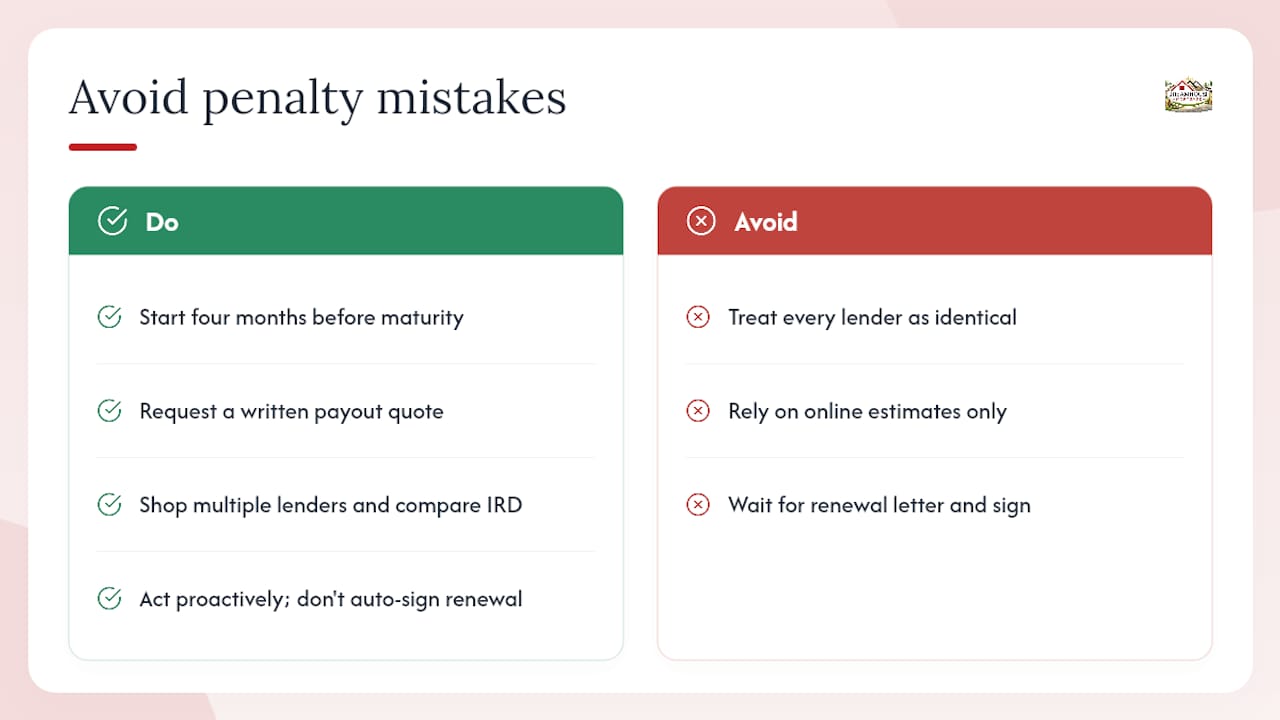
The other misconception is treating renewal as a passive event. Waiting for your lender’s renewal letter to show up and signing whatever rate they offer is the single most expensive habit I see among Alberta borrowers, not because the letter is dishonest, but because it’s rarely their most competitive offer. The four month window before maturity exists precisely so you can shop it properly, and most homeowners let that window close unused.
Prioritize the written payout quote over every online estimate, and prioritize an early start over a passive renewal. Everything else, the tactics, the timing tricks, the porting options, only works if those two habits are already in place.
— Guriqbal Chahal, MBA, PMP
Get a Free Renewal Review Before You Decide Anything
Guessing at your penalty or accepting the first renewal letter that lands in your mailbox costs Calgary homeowners real money every year. A mortgage broker can review your written payout quote, check how your lender calculated it, and compare that number against what switching could actually save you, all before you sign anything.

If your renewal is coming up in the next four to six months, or you’re considering breaking your term now, call Guriqbal Chahal, MBA, PMP, Mortgage Broker, at 403-966-6072 for a free renewal review and written cost comparison. You can also reach the team through the Google Business Profile or start with a rate negotiation consultation online. Bring your mortgage statement and renewal date, and the comparison work starts from there.
This article is general information, not a substitute for advice from a qualified financial advisor. Consult a qualified financial professional about your own circumstances before acting on anything here.
Sources
FAQ
How early can you renew your mortgage without penalty in Canada?
Renewal at your maturity date is always penalty-free, but you can typically start reviewing and locking in new terms with lenders four to six months before that date without triggering any prepayment charge.
How do I avoid a mortgage penalty in Canada?
Use your prepayment privilege before breaking your term, time any lender switch to your actual renewal date whenever possible, and consider porting or a blend-and-extend arrangement with your current lender instead of a full break.
What is the difference between three months’ interest and an IRD penalty?
Three months’ interest is a flat calculation based on your balance and rate, typically applied to variable-rate mortgages, while the IRD compensates the lender for lost interest income on fixed-rate mortgages when current rates are lower than your contract rate, and lenders charge whichever amount is higher.
Do I need a lawyer or broker to calculate my exact penalty?
You don’t need a lawyer for the calculation itself, since your lender is required to provide a written payout statement showing the exact figure, but a mortgage broker can help you interpret the calculation method used and compare it against your renewal or refinancing options.