Yes, you must repay your Home Buyers’ Plan withdrawal, and the repayment period runs up to 15 years into your RRSP, PRPP, or SPP. Temporary relief pushes the first required payment to the fifth year after your first withdrawal if that withdrawal happened between 2022 and 2028. Miss a minimum payment and the shortfall gets added to your taxable income that year.
TL;DR:
- The extended repayment start for HBP withdrawals made between 2022 and 2028 shifts the first repayment year to five years after the withdrawal, not two.
- You must designate your own RRSP contributions, made during or shortly after the year, specifically for HBP repayment, and file Schedule 7 accordingly.
- Missed minimum repayments are added to your income for that year, increasing your tax liability, and do not reduce your total owed amount.
- Your repayment amount is based on dividing your remaining balance by the years left, typically 15, and recalculates annually as your balance changes.
- Confirm your repayment schedule with your CRA statement and plan early, especially when coordinating with mortgage applications or potential withdrawals.
Table of Contents
- When your HBP repayment period actually starts
- How to make a valid HBP repayment
- Calculating your minimum annual HBP repayment
- Reporting HBP activity on your tax return
- Cancellations, deadlines, and other exceptions
- Practical advice for Calgary buyers managing HBP repayment
- A broker’s view on the temporary deferral
- How DreamHouse Mortgage helps you plan around HBP rules
- FAQ
- Sources
When your HBP repayment period actually starts
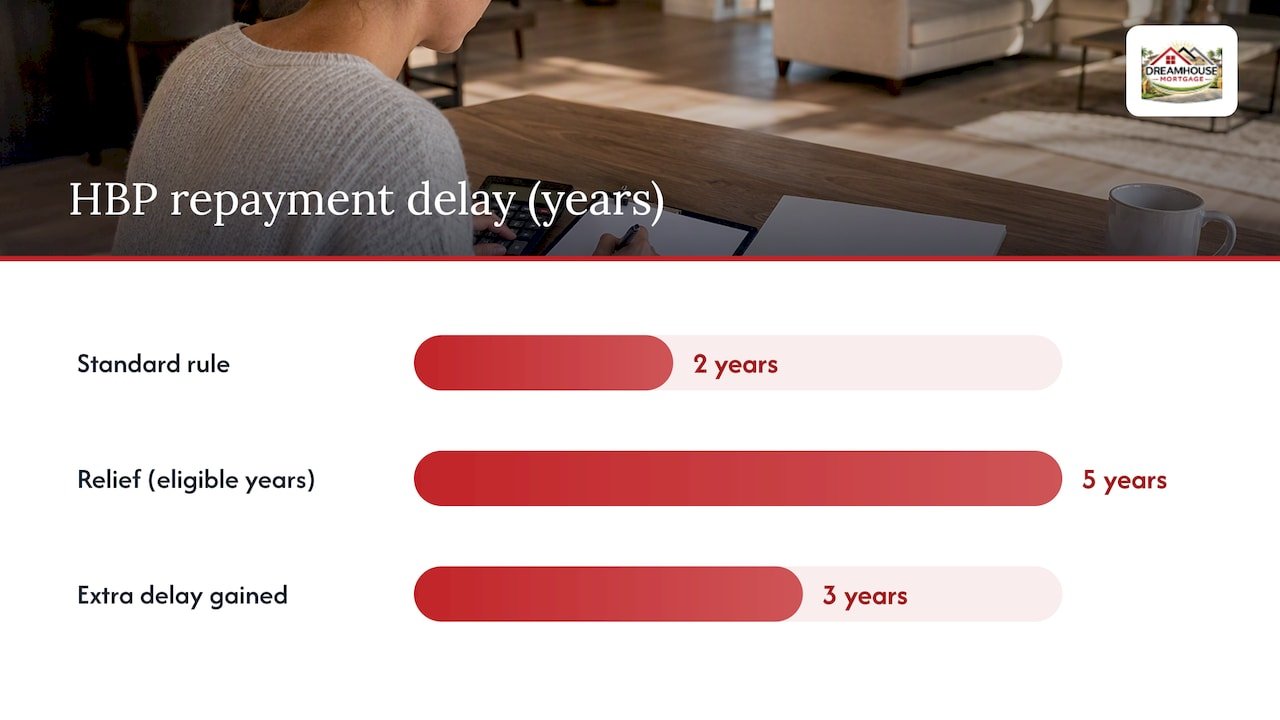
Under the standard rule, your repayment period begins in the second year after the year you first withdrew funds under the Home Buyers’ Plan. If you withdrew in 2024, your first payment would normally be due in 2026. That math changed for a large group of buyers.
Temporary repayment relief defers the start of the 15 year clock to the fifth year after your first withdrawal, for first withdrawals made between January 1, 2022 and December 31, 2028. Finance Canada’s legislative notes extended this relief through the 2028 withdrawal year, with the following mapping for first-withdrawal years:
- A first withdrawal in 2026 means your first required repayment year is 2031.
- A first withdrawal in 2027 pushes the first repayment to 2032.
- A first withdrawal in 2028 sets the first repayment year at 2033.
This mapping comes directly from Finance Canada’s implementation notes, which also lay out the revised repayment ranges tied to each withdrawal year. The deferral does not erase your obligation. It simply gives you several extra years before the clock starts ticking on mandatory annual payments.
One detail trips people up: the qualifying home still has to be bought or built within the usual completion window tied to your withdrawal year. If your purchase falls through or gets delayed past that window, your repayment timeline and your eligibility for the deferral can both be affected. Before you assume you qualify for the extended schedule, confirm your exact dates against your CRA HBP statement rather than relying on a general rule of thumb.
How to make a valid HBP repayment
Repaying your HBP balance is not as simple as putting money into any RRSP and calling it done. CRA has specific rules about which contributions count and how you need to report them.
Contributions to your own RRSP, PRPP, or SPP count toward your HBP repayment, provided you designate them correctly. Contributions to a spousal RRSP generally do not count toward your personal HBP balance. Transfers between registered plans and contributions designated under the Lifelong Learning Plan follow separate rules and should not be confused with HBP designations. FHSA transfers have their own treatment and are not interchangeable with HBP repayment designations.
Here is the process to follow each year you owe a repayment:
- Check your CRA HBP statement of account, included with your notice of assessment, to confirm your outstanding balance and the minimum amount due.
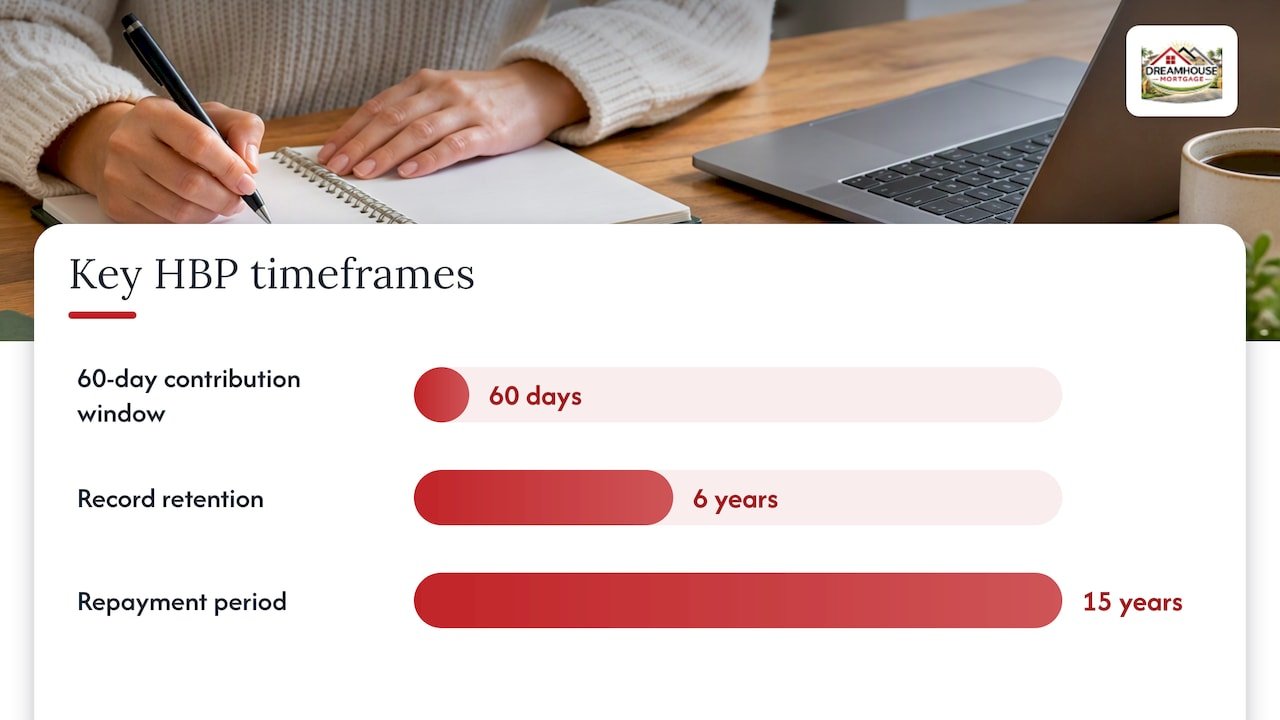
- Make an eligible contribution to your RRSP, PRPP, or SPP either during the calendar year or within the first 60 days of the following year.
- Complete Schedule 7 and designate the contribution as an HBP repayment on line 24600, rather than claiming it as a regular RRSP deduction.
- File your return with Schedule 7 attached and keep your contribution receipts and designation records for six years, as outlined in CRA’s reporting guidance.
Repaying early, even before your official start year, reduces your HBP balance and your future minimum payments. It does not move up your repayment schedule or shorten the 15 year window.
Pro Tip: File your contribution receipt with your tax documents the moment you make the payment. Reconciling a missed designation a year later with CRA is far more work than keeping one folder updated as you go.
Calculating your minimum annual HBP repayment
The formula CRA uses is straightforward: divide your remaining HBP balance by the number of years left in your repayment period, typically 15 at the outset. The result is your minimum required payment for that year.
CRA’s own worked example illustrates this clearly: a $30,000 withdrawal produces a minimum annual repayment of $2,000, since $30,000 divided by 15 equals $2,000.
CRA’s repayment formula turns a 15 year obligation into a manageable, predictable annual figure rather than one large repayment looming at the end.
Say you withdrew $40,000 in 2026 as your first HBP withdrawal. Under the temporary relief, your 15 year repayment period would not begin until 2031, meaning your minimum annual payment of roughly $2,667 would start that year rather than in 2028.
A few points worth holding onto:
- Your minimum payment recalculates each year based on your remaining balance, not the original withdrawal amount.
- Paying more than the minimum in one year lowers the balance used to calculate every future year’s minimum.
- Paying only the minimum each year means your final payment in year fifteen clears the balance exactly, assuming no missed years along the way.
Reporting HBP activity on your tax return
Your tax return needs to reflect your HBP activity every single year you are in repayment, not just the year you withdrew the funds.
- In the year of your first withdrawal, you report HBP details in Part E of Schedule 7.
- In every subsequent repayment year, you use Part B of Schedule 7 to record your designated repayment.
- Designated repayments go on line 24600 and should never be claimed again as a regular RRSP deduction on line 20800.
- If you contribute less than your required minimum in a given year, the shortfall is added to your income on line 12900 for that tax year, under CRA’s reporting rules.
Your CRA HBP statement of account, issued with your notice of assessment, tracks your remaining balance and confirms whether your designated repayments were processed correctly. Keep your own records, including contribution receipts and copies of filed schedules, for six years in case CRA requests verification.
Cancellations, deadlines, and other exceptions
Not every HBP participant ends up buying the home they planned for, and CRA has specific rules for that scenario.
- Your qualifying home generally must be bought or built before October 1 of the year after your withdrawal.
- If the purchase does not go through, cancellation payments are due by December 31 of the year after you received the funds, under CRA’s cancellation guidance.
- Amounts not repaid under a cancellation may be included in your income for that year rather than carried forward in the standard repayment schedule.
- If you turn 71 in a repayment year, your RRSP conversion deadline interacts with your HBP balance, and any remaining amount may need to be addressed before you convert your plan.
- Non-residency changes your repayment picture too. If you plan to leave Canada, confirm with CRA how your remaining HBP balance will be treated, since departure can accelerate your obligations.
These scenarios are the exception rather than the rule for most first-time buyers, but they matter if your plans shift after you withdraw.
Practical advice for Calgary buyers managing HBP repayment
Coordinating HBP repayment with a mortgage application takes more than knowing the CRA rules. It takes checking your own numbers against what the agency has on file, every year, without exception.
Pull your CRA HBP statement annually and match it against your own RRSP contribution receipts rather than trusting your memory of what you paid. A missed designation one year compounds into a larger required payment later, and that can catch buyers off guard right when they are also budgeting for closing costs or renovation financing.
Making a repayment within the first 60 days of the year, rather than waiting until December, gives you more flexibility if your income fluctuates seasonally, which is common among self-employed buyers across Calgary, Airdrie, and Cochrane. Before refinancing an existing mortgage or applying for a new one, confirm your outstanding HBP balance with your broker. Lenders reviewing your RRSP and savings documentation sometimes ask about HBP status, and having a clear answer prevents delays in underwriting.
Pro Tip: Bring your latest CRA HBP statement to your mortgage consultation. It saves a step and gives your broker the full picture of your savings and obligations.
A broker’s view on the temporary deferral
The deferral is genuinely useful for cash flow, especially for buyers stretching every dollar toward a down payment in Calgary’s current market. What it does not do is reduce the total amount you owe. Treat the extra years as breathing room, not forgiveness, and plan your RRSP contributions accordingly.
Confirm your personal repayment schedule against your CRA HBP statement rather than a general rule you read online, since completion dates and withdrawal years both affect your timeline. For buyers in Calgary, Airdrie, and Cochrane coordinating this with a mortgage application, a conversation with a local broker early in the process tends to prevent surprises later.
— Guriqbal Chahal, MBA, PMP
How DreamHouse Mortgage helps you plan around HBP rules

Juggling an HBP repayment schedule alongside mortgage qualification, down payment timing, and closing costs is a lot to manage on your own. Mortgage brokers work with first-time buyers to integrate HBP obligations into a broader mortgage plan, so RRSP repayments and mortgage payments coordinate effectively.
Whether you are applying for your first mortgage pre-approval or weighing how much to withdraw under the HBP before you shop for a home, getting that sequencing right from the start matters more than most buyers expect.
Call Guriqbal Chahal, MBA, PMP, Mortgage Broker at DreamHouse Mortgage at 403-966-6072, or visit our Google Business Profile to book a consultation and get your HBP and mortgage timelines lined up before you make an offer.
This article is general information, not a substitute for advice from a qualified financial advisor. Consult a qualified financial professional about your own circumstances before acting on anything here.
FAQ
What are the repayment rules for HBP?
HBP withdrawals must be repaid over up to 15 years into your RRSP, PRPP, or SPP, with your minimum annual payment calculated by dividing your remaining balance by the years left in the period. Temporary relief defers the start of this period to the fifth year after your first withdrawal for withdrawals made between 2022 and 2028.
Is HBP repayment mandatory?
Yes, repayment is mandatory once your repayment period begins, and CRA sets a minimum amount due each year based on your HBP balance. If you contribute less than the required minimum, the shortfall is added to your taxable income for that year under CRA’s reporting rules.
How do I pay back my HBP?
You make an eligible contribution to your own RRSP, PRPP, or SPP during the repayment year or within the first 60 days of the following year, then designate that contribution as an HBP repayment on line 24600 of Schedule 7. Spousal RRSP contributions generally do not count toward your personal HBP balance, so the designation needs to be made on your own plan.
What happens if I don’t repay my HBP?
If you contribute less than your required minimum in a given year, the unpaid portion is added to your income for that tax year rather than carried forward silently. Your remaining HBP balance and minimum requirement for future years then recalculate based on what is still outstanding.
Sources
- How to repay the amounts withdrawn from your RRSPs under the Home Buyers’ Plan
- Legislative commentary — temporary repayment relief (Finance Canada)
Recommended
- Calgary Mortgage Calculators 2026: Avoid Costly Payment Mistakes & Estimate Your Monthly Mortgage Accurately
- Insured Mortgage Rules and Affordability in 2026: A Practical Guide for Canadian Homebuyers
- FHSA vs Home Buyers Plan Calgary: Which Saves You More?
- Mortgage Checklist Calgary: The Ultimate Proven Guide — Everything You Need Before Applying (2026)