An uninsurable mortgage is a home loan that does not meet the rules set by Canada’s default mortgage insurers, regardless of down payment size, which means it falls outside standard insured financing and usually requires a different lender or structure. If your file looks uninsurable, the first move is a conversation with a mortgage broker who can confirm the classification and map out your financing path before you commit to a property.
TL;DR:
- With at least 20% down, a loan may still qualify as insurable and use underwriting aligned with insurer rules, without the insurance premium.
- Federally regulated lenders stress test uninsured loans at the greater of the contract rate plus 2 percentage points or 5.25%; private channels may differ.
- Portfolio and private lenders may fund files banks decline, but their rates are usually higher and terms shorter than standard bank financing.
Table of Contents
- Insured, insurable and uninsurable mortgages explained for Canada
- How insured, insurable and uninsurable loans differ in practice
- Common reasons mortgages are uninsurable in Canada
- How underwriting changes when insurance isn’t available: OSFI’s stress test
- Actionable options for borrowers in Canada when a mortgage is uninsurable
- How DreamHouse Mortgage helps Calgary-area buyers with uninsurable or complex files
- Local perspective for first-time buyers in Calgary, Cochrane and Airdrie: wait or proceed?
- Consult DreamHouse Mortgage for your Calgary mortgage questions
- FAQ
- Sources
Insured, insurable and uninsurable mortgages explained for Canada
These three terms get mixed up constantly, so let’s separate them clearly.
An insured mortgage carries mortgage loan insurance from CMHC or a private insurer, required whenever your down payment is below 20%. CMHC’s purchase program covers eligible one to four unit, owner-occupied homes for Canadian citizens, permanent residents, or certain authorized non-permanent residents, subject to a $1,500,000 purchase price cap and maximum amortization limits.
Lenders still price these files closer to insured rates because the risk profile qualifies.
An uninsurable mortgage fails the insurer’s criteria outright. Common examples in Alberta include:
- A purchase price above $1,500,000, which exceeds the CMHC cap regardless of down payment
- A rental or non-owner-occupied property that does not meet owner-occupancy rules
- A refinance beyond 80% loan to value, since refinances are not eligible for mortgage insurance at all
How insured, insurable and uninsurable loans differ in practice
The classification changes almost everything about how your mortgage gets priced and approved.
- Insured loans let you buy with as little as 5% down on homes up to $500,000, with a sliding scale above that threshold, and the premium is added to your loan or paid up front.
- Insurable loans require 20% or more down but still benefit from insurer-aligned underwriting, which often keeps rates competitive even without the insurance premium.
- Uninsurable loans shift the risk entirely onto the lender’s balance sheet, so underwriting gets stricter, rate premiums are more common, and your maximum borrowing amount can shrink even when your income looks strong on paper.
For a deeper breakdown of how these thresholds affect affordability, our guide on insured mortgage rules and affordability walks through the math for different purchase prices.
Common reasons mortgages are uninsurable in Canada
Before you talk to a lender, run through this checklist to spot red flags early.
- Property type or condition issues, such as certain non-warrantable condos, seasonal or recreational properties, or homes needing major repairs that fail appraisal standards.
- Loan purpose conflicts, including refinances, second mortgages, or amortizations longer than the insurer allows on a standard purchase.
- Non-arm’s-length transactions, where the buyer and seller are related or otherwise connected, which insurers typically exclude.
- Documentation gaps, particularly for self-employed borrowers who cannot show the standard two years of confirmed income, or down payment sources that cannot be traced and seasoned properly.
- Credit history concerns, where past bankruptcies, consumer proposals, or low scores push a file outside insurer guidelines even if the lender is otherwise willing to fund it.
How underwriting changes when insurance isn’t available: OSFI’s stress test
Once a mortgage is uninsured, federally regulated lenders apply a stress test called the minimum qualifying rate, or MQR. Under OSFI’s guidance, the MQR is the greater of your contract rate plus 2 percentage points, or 5.25%.
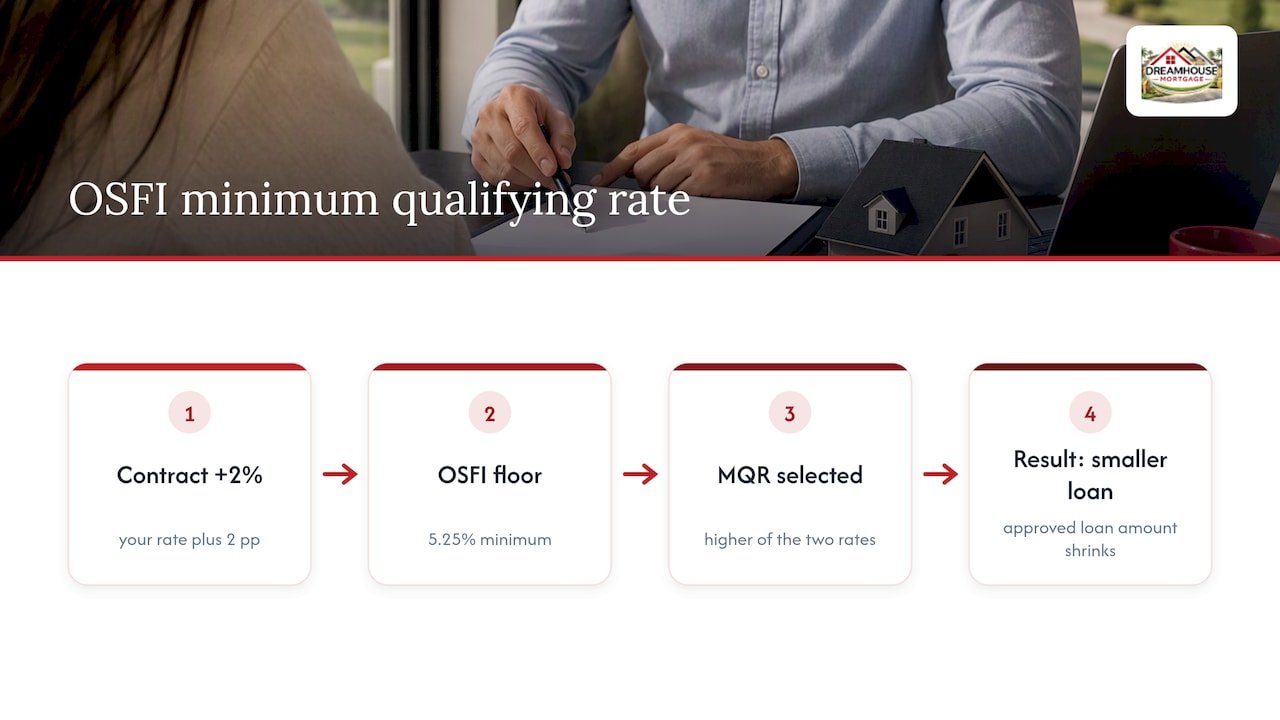
The MQR exists to build resilience into the mortgage system, not to penalize borrowers, but the practical effect is that your qualifying rate is almost always higher than the rate you actually pay.
That gap matters because it shrinks your approved loan amount. A borrower who qualifies for a certain mortgage at their contract rate might qualify for noticeably less once the lender runs the math at the stress-tested rate. This is why the lowest advertised rate you see in an ad rarely reflects what you can actually borrow.
It’s worth noting that “uninsured” and “uninsurable” are not the same thing. A borrower whose file fails insurer rules entirely, regardless of down payment, is in uninsurable territory, and the lender sets its own qualifying approach since OSFI’s MQR technically applies to federally regulated uninsured lending, not to every private or alternative channel.
The 2024 federal mortgage reforms raised the insured price cap to $1,500,000 and adjusted renewal and switching rules, giving some first-time buyers greater opportunity to qualify within the insured system rather than fall into uninsurable territory.
Actionable options for borrowers in Canada when a mortgage is uninsurable
If your file lands in uninsurable territory, you still have real paths forward.
- Increase your down payment to 20% or more, which can shift a marginal file into insurable territory and often improves your rate.
- Work with a broker who has access to portfolio and private lenders, since these channels fund files that banks decline, though typically at higher rates and with shorter terms.
- Adjust the property or transaction structure where possible, such as negotiating a purchase price under the insured cap or restructuring a non-arm’s-length deal.
- Look into flexible insured programs for self-employed borrowers, like CMHC Self-Employed, which uses alternative documentation to qualify income that would otherwise look marginal.
Pro Tip: Ask your broker to run both an insured and an uninsured scenario side by side before you make an offer, so you know your real borrowing capacity under each path.
How DreamHouse Mortgage helps Calgary-area buyers with uninsurable or complex files
We work through pre-approval, lender matching, and documentation coaching for files that don’t fit neatly into standard insured boxes. We have access to multiple types of lenders, which helps place files that a single bank might turn away.
To speed up approval on a complex file, we typically ask for:
- Two years of income documentation, including tax returns and notices of assessment
- Proof of down payment source with a clear paper trail
- Condo documents or property disclosures when applicable
- A signed purchase agreement once you’re ready to move
Timelines vary with lender type: bank-insured files often move fastest, while private or portfolio solutions can take longer but open doors that would otherwise stay closed.
Local perspective for first-time buyers in Calgary, Cochrane and Airdrie: wait or proceed?
Saving to 20% down takes time, and home prices in Calgary, Cochrane, and Airdrie don’t pause while you wait. For many first-time buyers, moving forward with insured financing sooner, even with mortgage insurance premiums added to the loan, works out better than delaying a purchase for years. The right call depends on your income trajectory and local price trends, which is exactly why modeling both scenarios with a local broker early makes sense.
— Guriqbal Chahal, MBA, PMP
Consult DreamHouse Mortgage for your Calgary mortgage questions

We help Calgary, Cochrane, Airdrie, and surrounding Alberta buyers work through complex or uninsurable files by drawing on multiple lender channels rather than a single institution’s rulebook. Whether your situation involves a non-traditional down payment, self-employment income, or a property that doesn’t fit standard insurer rules, we build a plan around your actual numbers rather than a generic formula.
Before you call, have these ready:
- Government-issued ID
- A signed purchase agreement, if you have one
- Recent income documents, such as T4s, tax returns, or notices of assessment
- Proof of your down payment source
Call Guriqbal Chahal, MBA, PMP, Mortgage Broker, at 403-966-6072, or book a session through our mortgage broker consultation page to get a clear read on your options before you start shopping for a home.
This article is general information, not a substitute for advice from a qualified financial advisor. Consult a qualified financial professional about your own circumstances before acting on anything here.
FAQ
How do Canadian mortgages differ from US mortgage rules?
Canadian mortgages use a federally mandated stress test on uninsured loans, require default insurance below 20% down through CMHC or a private insurer, and cap insured purchases at $1,500,000. Canadian mortgage terms are typically shorter, often renewing every three to five years, rather than locking in for the full amortization period.
Can a 50 year old get a 25 year mortgage in Canada?
Yes, age alone does not disqualify a borrower from a standard amortization in Canada, as lenders base approval on income, credit, and the property itself rather than age. Insured mortgages follow amortization limits set by CMHC, and these apply the same way regardless of the borrower’s age.
How much is mortgage insurance on a mortgage in Canada?
Mortgage loan insurance premiums in Canada typically range from about 0.6% to 4.5% of the loan amount, depending on your loan to value ratio. The exact premium depends on your down payment size and the specific insurer’s rate schedule at the time of your purchase.
What should I check before choosing a mortgage protection option?
Mortgage default insurance, which protects the lender, is different from optional creditor life or disability coverage, which protects you and your family. The Financial Consumer Agency of Canada recommends comparing optional coverage terms and costs carefully, since these products are not mandatory and vary by provider.
Sources
- Minimum qualifying rate for uninsured mortgages – Office of the Superintendent of Financial Institutions
- Canada