
What is debt service coverage ratio and why it matters
The debt service coverage ratio (DSCR) measures whether a property or business generates enough income to cover its debt payments. Lenders across Alberta and Canada treat it as a primary underwriting metric, often reviewing it before any other number on a loan application.
The core formula is straightforward:
- DSCR = Net Operating Income (NOI) ÷ Total Debt Service
- NOI is gross rental or business income minus operating expenses
- Total Debt Service includes annual principal and interest payments
- A DSCR of 1.20 means income exceeds debt payments by 20%
- A ratio below 1.0 means income does not cover payments and is a red flag for any lender
- A DSCR above a certain healthy threshold is widely viewed as a benchmark of financial health in Canadian commercial real estate
DSCR evaluates the asset’s income strength, not the borrower’s personal finances. For investors in Calgary, Airdrie, Cochrane, Edmonton, or Red Deer, that distinction shapes how lenders size loans and set terms.
Table of Contents
- How to calculate DSCR: formula and worked example
- How Canadian lenders use DSCR in mortgage decisions
- Common adjustments lenders make to DSCR calculations
- Limitations of using DSCR as a standalone metric
- Industry-specific DSCR benchmarks across property types
- How DSCR changes affect loan covenants and refinancing
- Ready to apply your DSCR knowledge in Alberta?
- Key Takeaways
- FAQ
How to calculate DSCR: formula and worked example
Calculating DSCR accurately requires two clean inputs: NOI and total annual debt service.
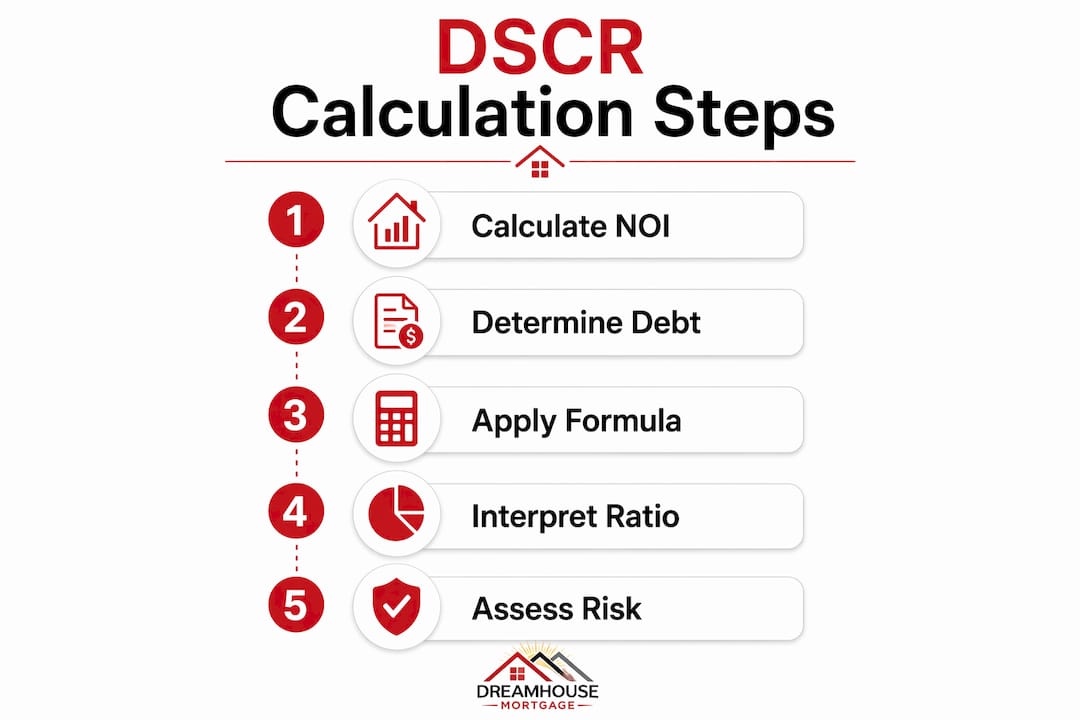
Step-by-step process:
- Start with gross annual rental or business income
- Subtract operating expenses: property taxes, insurance, utilities, and management fees
- Apply a vacancy allowance, typically 5–15% of gross income
- The result is your NOI
- Identify total annual debt service: all principal and interest payments on the loan
- Divide NOI by total debt service to get DSCR
Sample calculation for an Alberta investment property:
| Item | Amount (CAD) |
|---|---|
| Gross annual rental income | a defined amount |
| Operating expenses (taxes, insurance, management) | a defined amount |
| Vacancy allowance | a percentage of gross income |
| Net Operating Income (NOI) | the resulting income |
| Annual mortgage payments (principal + interest) | total annual debt service |
| DSCR | net operating income divided by total debt service |
A DSCR of 1.20 tells the lender the property generates 20% more income than needed to service the debt; a ratio of 1.30 means 30% more. The higher the number, the more cushion the property carries.

How Canadian lenders use DSCR in mortgage decisions
DSCR is often the first constraint in commercial lending, running alongside loan-to-value (LTV) as a parallel test. Even a well-appraised property can receive a smaller loan if its income falls short.
- Conventional commercial loans in Canada typically require a DSCR in a moderate range
- CMHC-insured multi-unit loans may permit a somewhat lower threshold
- In Ontario and Alberta, institutional lenders set minimums that vary depending on property type and lender tier
- A DSCR above a healthy benchmark can result in better interest rates, higher leverage, and faster approvals
- A DSCR below 1.0 signals that income does not cover mortgage payments, indicating high risk to any lender
DSCR and LTV work together. A property may pass the LTV test based on appraised value, yet fail the DSCR test if rental income is thin. Savvy investors in Calgary and Edmonton calculate both constraints before finalizing offers on investment properties.
Common adjustments lenders make to DSCR calculations

There is no single standardized formula for DSCR across Canadian lenders. Each institution applies its own assumptions, and those differences can shift your ratio meaningfully.
Lenders often apply stricter vacancy and reserve assumptions than what a property owner reports on tax returns. A lender may use a 10% vacancy rate on a property that has run at 2% vacancy for three years. That conservative NOI calculation directly affects the DSCR outcome and the loan amount offered.
Common lender-specific adjustments include:
- Standardized vacancy allowances of 5–15%, regardless of actual history
- Management fee deductions, even for self-managed properties
- Capital reserve requirements for older buildings
- Exclusion of non-recurring income from NOI
Pro Tip: Prepare a detailed income and expense statement before approaching any lender in Alberta. Use conservative vacancy and maintenance figures. A DSCR calculator can help you model different scenarios before your application is submitted.
Guriqbal Chahal, MBA, PMP, Mortgage Broker at Dreamhouse Mortgage, works with borrowers across Calgary, Cochrane, Chestermere, and surrounding Alberta communities to structure loan applications that reflect lender-specific DSCR expectations accurately.
Limitations of using DSCR as a standalone metric
DSCR is a useful snapshot, but it has real limits. It reflects income at a single point in time and does not account for future vacancy, rising interest rates, or capital expenditure needs.
A property can show a healthy DSCR today and face cash flow pressure within 12 months if a major tenant vacates or if rates reset at renewal. Lenders who rely solely on DSCR without stress-testing those scenarios may underestimate actual risk. DSCR also differs from the debt-to-income (DTI) ratio: DSCR assesses the asset’s income, while DTI measures the borrower’s personal income against personal obligations. For scaling an investment portfolio in Alberta, that distinction is critical because the property’s income must qualify the loan independently of the owner’s personal budget.
Industry-specific DSCR benchmarks across property types
DSCR minimums vary by asset class. Lenders apply different thresholds based on income stability and risk profile.
| Property or business type | Typical minimum DSCR |
|---|---|
| Multi-unit residential (CMHC-insured) | 1.10 |
| Conventional multi-unit residential | 1.20–1.25 |
| Commercial retail or office | 1.25–1.30 |
| Industrial or warehouse | 1.20–1.30 |
| Manufacturing or operating business | 1.30 |
| Hospitality or seasonal properties | above 1.30 |
Hospitality and seasonal properties carry the highest thresholds because income is volatile. Multi-unit residential, particularly CMHC-insured deals, sits at the lower end because vacancy risk is distributed across multiple units. For investment property financing in Alberta, knowing the benchmark for your specific asset type before approaching a lender saves time and prevents surprises.
How DSCR changes affect loan covenants and refinancing
Many commercial loan agreements in Canada include DSCR maintenance covenants. If a property’s DSCR drops below the agreed threshold during the loan term, the lender may require additional security, restrict cash distributions, or trigger a review of the loan.
At renewal or refinancing in Calgary, lenders recalculate DSCR based on current income and updated debt service figures. A property that qualified at 1.25 five years ago may face a tighter review if rents have stagnated or expenses have risen. Borrowers who monitor DSCR annually, rather than only at application, are better prepared for renewal negotiations. Consulting a mortgage broker familiar with current lender expectations in Alberta, such as Guriqbal Chahal at Dreamhouse Mortgage, helps borrowers anticipate covenant risks and plan refinancing timing effectively.
Ready to apply your DSCR knowledge in Alberta?

Dreamhouse Mortgage helps investors, homeowners, and first-time buyers across Calgary, Airdrie, Cochrane, Chestermere, Edmonton, and Red Deer structure mortgage applications that meet lender DSCR requirements. Guriqbal Chahal, MBA, PMP, brings direct experience with Alberta lender underwriting standards and rate negotiation strategies that support stronger approvals.
Call Guriqbal Chahal at 403-966-6072 or connect via Google Business Profile for a mortgage consultation.
Key Takeaways
A DSCR above a certain benchmark is often used by Canadian lenders to approve commercial and investment property loans with favorable terms.
| Point | Details |
|---|---|
| Core DSCR formula | Divide net operating income by total annual debt service to get the ratio. |
| Healthy threshold | A DSCR of 1.20 or above is typically used as a benchmark for sufficient income buffer by most Canadian lenders, though some lenders may require higher thresholds depending on the property type. |
| Lender adjustments | Lenders apply their own vacancy and reserve assumptions, which can lower your calculated NOI. |
| DSCR vs. DTI | DSCR measures the asset’s income; DTI measures the borrower’s personal income against personal debt. |
| Covenant risk | A DSCR drop below the agreed threshold during a loan term can trigger lender review or restrictions. |
FAQ
How is DSCR calculated?
Divide the property’s net operating income by its total annual debt service, which includes principal and interest payments. A DSCR of 1.20 means income exceeds debt payments by 20%.
What does a DSCR above 2 mean?
A DSCR above 2 means the property or business generates at least double the income needed to cover its debt obligations, indicating strong financial health and very low lender risk.
What is the minimum DSCR most Canadian lenders accept?
Conventional commercial lenders in Canada typically require a DSCR between 1.20 and 1.30, while CMHC-insured multi-unit loans may accept a lower ratio around 1.10.
How does DSCR differ from the debt-to-income ratio?
DSCR assesses the asset’s income relative to its debt payments, while DTI compares a borrower’s personal income to personal debt obligations. For investment properties, the property must qualify on its own income.
Can DSCR affect my mortgage at renewal?
Yes. Lenders recalculate DSCR at renewal using current income and updated debt service figures, and a ratio that has declined since the original approval can affect the terms or amount offered.
Recommended
- GDS TDS Ratio Calgary: The Ultimate Guide to Qualifying for a Mortgage in Calgary (2026 Insider Strategy)
- Self Employed Mortgage Lender Types in Canada: Complete 2026 Guide
- Self Employed Mortgage Lender Types in Canada: Complete 2026 Guide
- Rental Property Mortgage Canada: Avoid Costly Investor Mistakes & Secure Smarter Financing