Can freelancers get approved for a mortgage in Alberta?
Yes. Freelancers and self-employed borrowers in Alberta qualify for mortgages every day. The process differs from a salaried application, but the outcome is the same: a funded mortgage at a competitive rate. What changes is how lenders verify your income and assess risk.

Canadian mortgage rules treat self-employed income as inherently variable. Lenders cannot rely on a T4 slip, so they require two or more years of documented income history to establish a pattern. Most lenders require at least two years of consistent self-employed income before approving a mortgage application. That requirement is the foundation of freelancer mortgage approval explained in plain terms: prove your income is real, stable, and sustainable.
Approval depends on three core factors:
- Documented income: Tax returns, Notices of Assessment (NOA), and supporting financial statements
- Credit standing: A personal credit score above 650 is generally considered sufficient for approval and a clean repayment history
- Down payment: A minimum amount for insured mortgages, with larger payments strengthening your position considerably
Working with a broker who specializes in self-employed mortgages, such as Dreamhouse Mortgage in Calgary, gives you access to lenders who understand freelance income structures. Not every lender applies the same criteria, and matching your file to the right lender is often the difference between approval and denial.
Table of Contents
- What Canadian lenders look for when approving mortgages for freelancers
- What documents do freelancers need for a mortgage application in Alberta?
- How to improve your mortgage approval odds as a freelancer
- What mortgage products are available to self-employed borrowers in Alberta?
- How Dreamhouse Mortgage helps freelancers navigate approval in Alberta
- Dreamhouse Mortgage: a direct path to self-employed mortgage approval
- Key Takeaways
- FAQ
What Canadian lenders look for when approving mortgages for freelancers
Lenders evaluate self-employed mortgage applications through a more detailed lens than salaried files. Understanding each factor helps you prepare a stronger application.
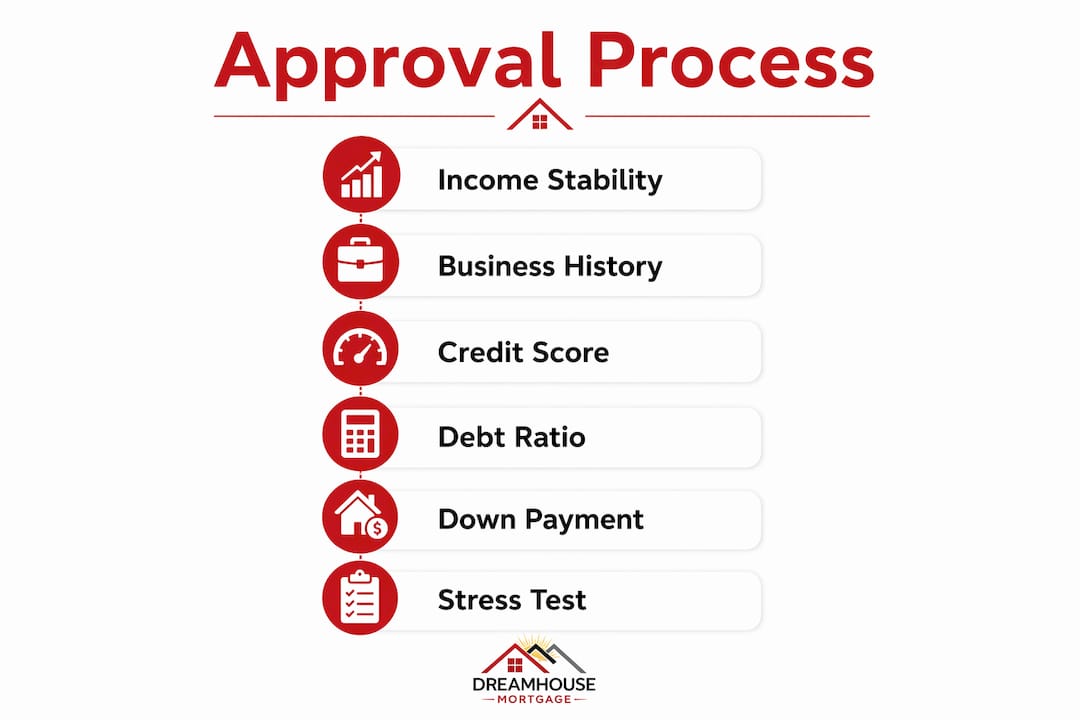
Income stability over two or more years
Lenders average your net income across the two most recent tax years. If your income dropped significantly in one year, lenders may qualify you on the lower figure rather than the average. Consistent or growing income across both years produces the strongest qualification number.
Business history and financial health
Most lenders want to see at least 24 months of operating history in the same business or industry. A longer track record signals lower risk. Lenders also review your client base, revenue trends, and whether your business generates enough gross income to support both operating expenses and personal living costs.
Credit score and credit history
A strong personal credit score above 650 carries significant weight because self-employed income is less predictable than employment income. Lenders review both your personal credit report and, where applicable, your business credit report. Late payments, collections, or high credit utilization all reduce your approval odds and push rates higher.
Debt-to-income ratio
Lenders calculate your total debt service (TDS) ratio by comparing your monthly debt obligations to your gross monthly income. For self-employed borrowers, the income figure used in this calculation comes from your tax returns, not your gross revenue. Aggressive write-offs that reduce taxable income also reduce the income lenders can use to qualify you.
Down payment size and source
A larger down payment reduces lender risk. Borrowers with less predictable income documentation often benefit from putting down 20% or more, which removes the requirement for mortgage default insurance and opens access to a broader range of lenders. The down payment source must be verifiable: bank statements, investment account records, or a gift letter from a family member.
The mortgage stress test
All federally regulated lenders in Canada apply the mortgage stress test, requiring borrowers to qualify at the greater of the contract rate plus 2%, or the Bank of Canada’s minimum qualifying rate. For freelancers, this test is applied to the income figure derived from tax returns, which can be lower than actual cash flow. The stress test effectively reduces the maximum mortgage amount a freelancer can qualify for compared to a salaried borrower with the same gross earnings.
Recent changes in Canadian mortgage rules
As of August 2024, the federal government extended 30-year amortization periods to all first-time home buyers purchasing new builds, and to all buyers of new builds regardless of first-time status. This change gives self-employed first-time buyers in Calgary, Airdrie, Cochrane, and Edmonton more room on monthly payments, which helps offset the income reduction caused by write-offs and the stress test.
What documents do freelancers need for a mortgage application in Alberta?
Document preparation is where freelancer mortgage applications succeed or fail. Lenders need a clear, organized picture of your financial situation. Gaps or inconsistencies in your file create underwriting delays and can trigger a denial.
The CMHC Self-Employed mortgage insurance program outlines the core documentation standards that most Canadian lenders follow. Here is what to prepare:
- Personal tax returns (T1 General) for the past two years, supported by the Notice of Assessment from the Canada Revenue Agency (CRA) for each year
- Business tax returns (T2 for incorporated companies, T2125 Statement of Business Activities for sole proprietors) for the same two-year period
- CPA-prepared financial statements, including profit and loss statements and a balance sheet. Year-to-date financial statements prepared by an accountant give lenders real-time visibility into current business performance
- Six to twelve months of business and personal bank statements to verify that income reported on tax returns actually flows through your accounts
- Proof of business registration, such as a business license, articles of incorporation, or GST/HST registration documents
- Client contracts or invoices demonstrating active, ongoing work relationships
- Proof of no outstanding CRA tax arrears. Unpaid taxes can block mortgage approval entirely, regardless of income or credit score. Request a CRA My Account statement showing your account is current
For a detailed checklist specific to Calgary and Alberta borrowers, the self-employed mortgage documents guide from Dreamhouse Mortgage covers each item with lender-specific context.
Pro Tip: Before submitting your application, log in to CRA My Account and download your most recent NOA and proof of account standing. Lenders increasingly verify CRA account status directly, and any discrepancy between your filed returns and CRA records can stall funding at the last stage.
How to improve your mortgage approval odds as a freelancer
Preparation before you apply has a direct impact on both your approval odds and the rate you receive. These steps apply whether you are buying in Calgary, Chestermere, Okotoks, or Red Deer.
Keep tax filings current and organized
File your personal and business tax returns on time, every year. Late filings raise questions about financial discipline. Organized, consistent filings signal to lenders that your business operates professionally.

Balance write-offs against qualifying income
Write-offs reduce your tax burden, but they also reduce the income lenders use to qualify you. If you are planning to apply for a mortgage within the next one to two years, discuss with your accountant which deductions to moderate. The income add-back approach used by some lenders allows certain expenses to be added back to your qualifying income, which can meaningfully increase your maximum mortgage amount.
Build your credit score above 650
Pay all credit obligations on time. Keep credit card balances below 30% of your limit. Avoid applying for new credit in the six months before your mortgage application. A score above 700 gives you access to the widest range of lenders and the most competitive rates.
Increase your down payment
A larger down payment reduces the lender’s risk exposure. Borrowers who put down 20% or more avoid mortgage default insurance premiums and qualify with a broader set of lenders, including those with more flexible income verification standards.
Separate business and personal finances
Mixing business and personal accounts is a red flag in underwriting. Maintain dedicated business bank accounts and a separate personal account. This separation makes income verification faster and demonstrates financial organization.
Provide letters of explanation proactively
If your income dropped in one year due to a contract gap, a health issue, or a business pivot, write a clear, factual letter explaining the circumstance and what changed. Lenders respond better to a documented explanation than to an unexplained gap.
Work with a broker who specializes in self-employed mortgages
Mortgage brokers with self-employed expertise match your file to lenders whose underwriting guidelines fit your income structure. A broker also knows which lenders are currently approving files similar to yours, which saves time and protects your credit score from multiple hard inquiries. The benefits of working with a specialized broker are particularly clear for freelancers whose income does not fit a standard T4 template.
What mortgage products are available to self-employed borrowers in Alberta?
Not all mortgage products are structured the same way for freelancers. Understanding your options helps you target the right lender from the start.
A-lenders (major banks and credit unions)
Major banks and federally regulated credit unions offer the lowest rates but apply the strictest documentation standards. To qualify with an A-lender, you generally need two full years of tax returns showing consistent or growing income, a credit score above 650, and a debt-to-income ratio within standard guidelines. If your file meets these criteria, an A-lender gives you the best rate available.
B-lenders (alternative regulated lenders)
B-lenders operate under provincial or federal regulation but apply more flexible underwriting criteria. Stated income mortgages through B-lenders allow borrowers to declare a reasonable income supported by bank statements and business activity, rather than relying solely on tax return figures. These products typically require a larger down payment (often 20% or more) and carry slightly higher rates than A-lender products. They are a practical option for freelancers whose taxable income understates actual cash flow. A full breakdown of lender types and how they assess self-employed income is available for Alberta borrowers.
Private lenders
Private lenders offer the most flexible qualification criteria but charge the highest rates and fees. They are typically used as a short-term bridge: a freelancer secures a private mortgage, spends one to two years building their documented income history, then refinances to a B-lender or A-lender. Private mortgages are not a long-term strategy, but they can make homeownership possible when other options are not yet accessible.
CMHC Self-Employed mortgage insurance
The CMHC Self-Employed program provides mortgage loan insurance for self-employed borrowers at the same premium rates as salaried borrowers, with flexible income and employment documentation requirements. Borrowers must have been operating their business for at least 24 months or have equivalent experience in the same industry. For recently self-employed borrowers under the 24-month threshold, CMHC considers compensating factors such as cash reserves, predictable earnings, and prior training. The minimum credit score for CMHC-insured mortgages is 600, and the maximum purchase price is below $1,500,000.
Down payment thresholds determine which products you can access. A 5% down payment qualifies for CMHC-insured products on properties up to $500,000 (with 10% on the portion above). A 20% down payment removes the insurance requirement entirely and opens access to conventional products from both A-lenders and B-lenders.
How Dreamhouse Mortgage helps freelancers navigate approval in Alberta
Guriqbal Chahal, MBA, PMP, Broker of Record at Dreamhouse Mortgage, has spent over a decade working specifically with self-employed borrowers across Calgary, Airdrie, Cochrane, Chestermere, Edmonton, Red Deer, and surrounding Alberta communities. The brokerage’s approach to freelancer mortgage approval is built on two things: matching the right lender to the borrower’s actual income structure, and presenting the file in a way that gives underwriters confidence before they review a single number.
Dreamhouse Mortgage works with banks, credit unions, monoline lenders, B-lenders, and private lenders. That breadth of access means a freelancer whose file does not fit an A-lender’s criteria today has a clear path through a B-lender or a stated income product, with a defined strategy to move to better terms at renewal.
A common scenario: a Calgary-based graphic designer with two years of self-employment history, strong bank deposits, but modest taxable income after write-offs. A major bank declines the application based on net income. Dreamhouse Mortgage repackages the file for a B-lender using a stated income approach supported by 12 months of bank statements and a CPA-prepared profit and loss statement. The mortgage closes at a rate within a reasonable margin of the A-lender’s posted rate, and the client has a clear plan to qualify conventionally at renewal.
Transparency and borrower education are central to how Dreamhouse Mortgage operates. Clients understand exactly why a lender is selected, what the approval criteria are, and what steps to take before renewal to improve their position. To discuss your specific situation, contact Guriqbal Chahal directly at 403-966-6072 or visit the Google Business Profile to read client reviews and connect.
Dreamhouse Mortgage: a direct path to self-employed mortgage approval
Freelancers in Alberta who have been declined by a bank, or who are not sure where to start, have a concrete alternative. Dreamhouse Mortgage gives self-employed borrowers direct access to a lender network that includes A-lenders, B-lenders, and private lenders, matched to each client’s income documentation and financial profile.
The difference from going directly to a bank is lender selection. A bank can only offer its own products. Dreamhouse Mortgage compares options across multiple lenders and negotiates on your behalf, which typically produces better rates and terms than a single-lender application. The mortgage broker rate negotiation process is particularly valuable for self-employed borrowers, where rate differences between lenders can be significant depending on how income is documented.
Dreamhouse Mortgage serves clients throughout Calgary, Airdrie, Cochrane, Chestermere, Okotoks, High River, Rocky View County, Edmonton, and Red Deer. The consultation is free. Call Guriqbal Chahal, MBA, PMP, at 403-966-6072 to start your mortgage pre-approval today.
Key Takeaways
Freelancers in Alberta can qualify for mortgages by documenting two or more years of stable income, maintaining a credit score above 650, and working with a broker who matches their file to the right lender.
| Point | Details |
|---|---|
| Two-year income history | Lenders require at least two years of self-employed income; they may qualify you on the lower of the two years if income fluctuates. |
| Credit score threshold | A score above 650 significantly improves approval odds and rate options for self-employed borrowers. |
| Down payment impact | A 20% or higher down payment removes mortgage insurance requirements and opens access to more lenders. |
| CMHC Self-Employed program | CMHC insures self-employed mortgages at standard premium rates for borrowers with 24+ months of business history or qualifying compensating factors. |
| Dreamhouse Mortgage | Guriqbal Chahal and the Dreamhouse Mortgage team match Alberta freelancers to A-lenders, B-lenders, or private lenders based on their documented income profile. |
FAQ
How do you qualify for a mortgage as a freelancer in Canada?
You need at least two years of self-employed income documented through CRA tax returns and Notices of Assessment, a personal credit score above 650, and a verifiable down payment. Working with a broker who specializes in self-employed files significantly improves your chances of matching with the right lender.
What income do lenders use to qualify self-employed borrowers?
Lenders use your net income as reported on your T1 General tax return, averaged over two years. If income dropped in one year, lenders may use the lower figure. Aggressive write-offs that reduce taxable income also reduce the income available for mortgage qualification.
What red flags do mortgage lenders look for in freelancer applications?
Outstanding CRA tax arrears are the most common cause of denial for self-employed borrowers. Other red flags include declining income year-over-year, mixed business and personal bank accounts, unexplained income gaps, and credit scores below 650.
How much do you need to earn to qualify for a $400,000 mortgage in Alberta?
The qualifying income depends on your amortization period, interest rate, and existing debts. As a general reference, lenders apply the stress test rate and calculate that your total debt service ratio stays within acceptable limits. A mortgage broker can run the exact calculation based on your current income documentation and debt obligations.
Does CMHC insure mortgages for self-employed borrowers?
Yes. The CMHC Self-Employed program provides mortgage loan insurance for self-employed borrowers at standard premium rates, with flexible documentation requirements. Borrowers need a minimum credit score of 650 and at least 24 months of business operating history, or qualifying compensating factors for recently self-employed applicants.