
TL;DR:
- A blended mortgage rate is a weighted average combining your current contract rate with a new market rate to avoid a full prepayment penalty. It generally offers modest savings when penalties are high and the rate gap is moderate, but may be less advantageous if rates drop significantly and long-term savings outweigh penalties. Canadian lenders use different formulas, so borrowers should request written calculations and compare total costs before deciding.
A blended mortgage rate is the weighted average interest rate your lender creates by combining your existing contract rate with a new rate, producing a single rate without triggering a full prepayment penalty. For most Canadian borrowers, blending makes sense when the break penalty is large relative to the savings a lower market rate would deliver. It tends to fall short when rates have dropped significantly and the long-term interest savings from breaking and refinancing outweigh the penalty cost. One critical point the Financial Consumer Agency of Canada makes clear: lenders use different formulas, and there is no single industry-wide standard. Always ask your lender for the exact calculation in writing before agreeing to anything.
Table of Contents
- What is a blended mortgage rate and how does it differ from a simple average?
- How do lenders calculate a blended mortgage rate?
- What are the two main types of blended mortgages?
- What are the pros and cons of blending your mortgage?
- What alternatives to blending should you consider?
- How do you decide? A checklist for Alberta borrowers
- How to calculate a blended rate yourself in four steps
- An Alberta case study: blend vs. break in Calgary
- Key Takeaways
- When blending makes sense and when it doesn’t, from a broker’s perspective
- Get a blended-rate assessment from Dreamhouse Mortgage
- Useful sources
- FAQ
What is a blended mortgage rate and how does it differ from a simple average?
A blended mortgage rate is not a simple arithmetic average of two rates. It is a weighted calculation that accounts for the outstanding balance on your existing mortgage and the amount of any new funds being added, or in some cases the remaining term on your contract. The result sits between your original contract rate and the current market rate — closer to whichever side carries more weight.
According to NerdWallet Canada, a blended mortgage combines your original contract rate with a new current rate and typically produces a rate between the two. The two most common product types are blend-and-extend and blend-to-term.
Here is how blending differs from the alternatives:
- Simple average: — Adds two rates and divides by two. Ignores balance sizes entirely. Lenders do not use this method.
Pro Tip: Before accepting any blended offer, ask your lender to provide a written amortization schedule showing the blended rate, the new monthly payment, and the total interest cost over the remaining term. Compare that document to your own quick calculation.
How do lenders calculate a blended mortgage rate?
The most common method is the balance-weighted average, described by WealthNorth as:
Blended Rate = (Balance₁ × Rate₁ + Balance₂ × Rate₂) ÷ (Balance₁ + Balance₂)
Some lenders apply a time-weighted variant that also factors in the months remaining on the original term. This can push the blended rate closer to the current market rate when significant time remains on the contract, which sometimes shifts the math in favor of breaking and refinancing instead.
Variables that matter
- Rate₁: — Your current contract rate
Worked numeric example (Alberta scenario)
A Calgary homeowner has an outstanding mortgage balance of $400,000 at a contract rate of 5.50% with two years remaining. They want to access $50,000 in equity. The lender’s current 5-year fixed rate is 4.25%.
| Input | Value |
|---|---|
| Existing balance (Balance₁) | $400,000 |
| Existing contract rate (Rate₁) | 5.50% |
| Top-up amount (Balance₂) | $50,000 |
| Current market rate (Rate₂) | 4.25% |
| Total new balance | $450,000 |
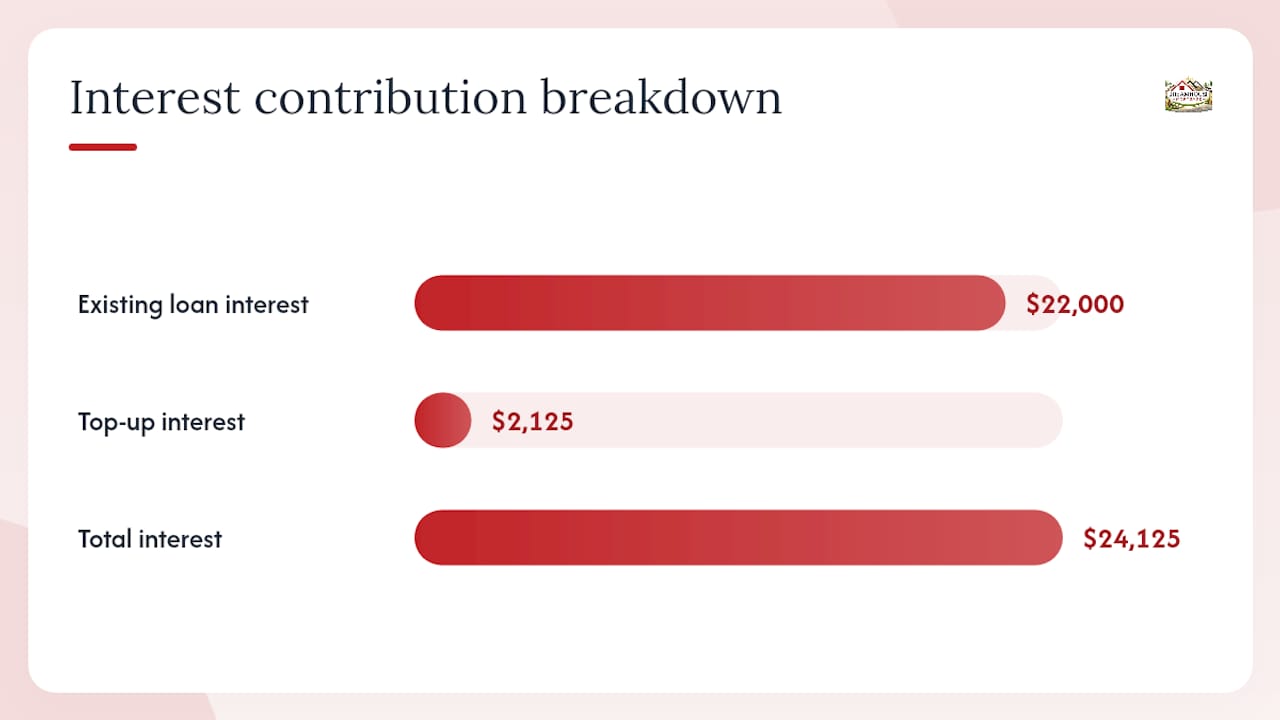
Calculation:
($400,000 × 5.50%) + ($50,000 × 4.25%) = $22,000 + $2,125 = $24,125
$24,125 ÷ $450,000 = 5.36% blended rate
On a standard amortization schedule, the difference between 5.50% and 5.36% on a $450,000 balance translates to a modest monthly savings. That modest saving must be weighed against any administrative fees and the opportunity cost of not accessing a lower market rate through a full refinance. Check current Alberta mortgage rate trends to populate the market-rate input with a live figure before running your own numbers.
What are the two main types of blended mortgages?
Canadian lenders typically offer two structures, and knowing which one you are being offered changes the decision significantly.
Blend-to-term
- Keeps your original maturity date intact
- Blends the existing rate with the current market rate for the remaining term only
- Often used when the borrower wants a modest top-up without resetting the clock
- Lower commitment: your renewal date stays the same, so you regain full flexibility sooner
- Lenders may require a minimum top-up to justify the offer
Blend-and-extend
- Resets the mortgage to a new full term (commonly 5 years) from today
- Blends the existing rate with the current market rate across the new term
- Commonly offered by Canadian banks when there is a sizable rate gap and the borrower wants to stay with the lender, according to MortgageRenewalHub
- Useful when you need a larger top-up or want to lock in a lower rate for a longer period
- Trade-off: you are committing to a new term, which limits flexibility if you plan to sell or switch lenders within a few years
Practical rule: If you plan to stay in the property for the full new term and need additional funds, blend-and-extend often delivers better monthly savings. If your renewal is already close or you may sell within two to three years, blend-to-term preserves more flexibility. Explore mortgage renewal options for a broader view of what Canadian lenders typically offer at renewal.
What are the pros and cons of blending your mortgage?
Ratehub.ca notes that blending avoids the full prepayment penalty but may not deliver the lowest market rate. Administrative fees or partial penalties can still apply, so the net benefit depends on your specific numbers.
Advantages:
- Avoids the full prepayment penalty (Interest Rate Differential or three-month interest charge)
- Faster process than a full refinance — often handled as a retention product by your existing lender
- Allows access to equity through a top-up without breaking the mortgage
- Predictable: one rate, one payment, one lender relationship
Drawbacks:
- The blended rate is always higher than the current best market rate
- Blend-and-extend locks you into a new term, reducing flexibility
- Administrative fees may apply even when no full penalty is charged
- You stay with the existing lender, losing the ability to shop competing offers
When blending typically wins: The break penalty (especially an IRD penalty) is large, the rate gap between your contract and the market is moderate, or you need a top-up and want to avoid a full refinance.
When breaking and refinancing typically wins: Rates have dropped substantially, your remaining term is long, and the long-term interest savings outpace the penalty cost over a 3–5 year horizon.
Pro Tip: Run a 5-year net-cost comparison. Add up total interest paid under the blended option (including any fees) and compare it to total interest under a full refinance (penalty included). The option with the lower 5-year total cost is usually the right call.
What alternatives to blending should you consider?
Blending is one of several paths. The right choice depends on your rate gap, penalty size, equity needs, and how long you plan to stay in the property.
- Break and refinance: Best when market rates have fallen enough that the long-term interest savings clearly outweigh the prepayment penalty and legal/appraisal fees. Review mortgage refinancing options in Calgary to understand the full cost picture before deciding.
- Switch lenders at renewal: — No penalty applies at the end of your term. If your renewal is within 120 days, most lenders allow a rate hold. This is the lowest-cost path to a new rate.
- Porting: If you are selling and buying simultaneously, porting your mortgage may let you carry your existing rate to the new property, avoiding both a penalty and a blend.
The comparison dimensions that matter most: total fees and penalties, the resulting monthly payment, the new term length and its flexibility, and the total interest cost over your planned holding period.
How do you decide? A checklist for Alberta borrowers
Before accepting or rejecting a blended offer, work through these steps.
- Request the lender’s written blended-rate calculation. Ask specifically whether it is balance-weighted or time-weighted and what administrative fees apply.
- Get a written amortization schedule showing the new monthly payment and total interest over the proposed term.
- Calculate the prepayment penalty you would pay to break the mortgage. Ask the lender for the exact IRD figure in writing.
- Run the 5-year net-cost comparison described in the pros and cons section above.
- Confirm the term length. For blend-and-extend, note the new maturity date and consider whether it aligns with your plans.
- Ask what happens if you sell early. Understand the penalty structure on the new blended term.
Questions to ask your lender directly:
- Is this offer balance-weighted or time-weighted?
- Are there administrative fees, and are they deducted from the advance or added to the balance?
- Can I port this blended mortgage if I sell?
- What is the prepayment privilege on the new term?
Red flags to watch for:
- Lender refuses to provide the blended-rate formula in writing
- Administrative fees that consume most of the monthly savings
- A blended rate that is only marginally lower than your current contract rate
Documentation to bring to a broker meeting: current mortgage statement, property address, recent pay stubs or income confirmation, and your planned term preference. A broker can then model the blended offer against competing lender rates in minutes. Understanding mortgage renewal rate negotiation before that meeting gives you a stronger starting position.
How to calculate a blended rate yourself in four steps
You do not need specialized software to verify a lender’s blended-rate offer. The balance-weighted formula is straightforward.
- Multiply your outstanding balance by your current contract rate — ($400,000 × 5.50% = $22,000)
That figure is your blended rate. If the lender’s written offer shows a different number, ask them to walk through their formula step by step.
Online tools to use:
- The Financial Consumer Agency of Canada mortgage calculator helps model break costs
- Ratehub.ca and WealthNorth both publish blended-rate scenario tools
- Use current Canadian mortgage rates to populate the market-rate input with a real, up-to-date figure
Once you have the blended rate, plug it into any standard mortgage payment calculator alongside the new balance and amortization period to see the monthly payment delta. A 0.14% rate reduction on $450,000 over 25 years is modest. A 0.75% reduction on the same balance is material. The math tells you whether the offer is worth taking.
An Alberta case study: blend vs. break in Calgary
Consider a Cochrane homeowner with $380,000 outstanding at 5.75%, three years into a 5-year term. Current 5-year fixed rates sit at 4.10%. They want a $30,000 top-up for a renovation.
Blended rate calculation:
($380,000 × 5.75%) + ($30,000 × 4.10%) = $21,850 + $1,230 = $23,080
$23,080 ÷ $410,000 = 5.63% blended rate
| Option | Rate | Est. Monthly Payment* | Penalty/Fees | Term Reset |
|---|---|---|---|---|
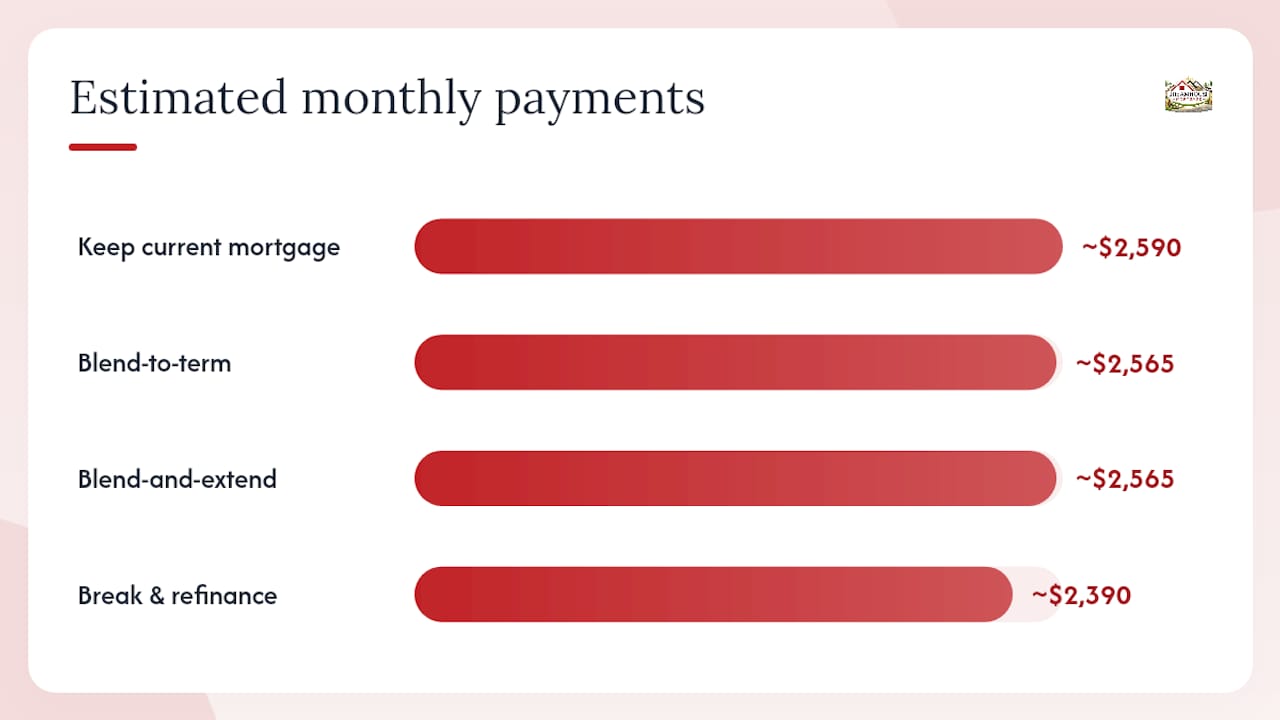
| Keep current mortgage | 5.75% | ~$2,590 | None | No |
| Blend-to-term | 5.63% | ~$2,565 | Admin fee only | No |
| Blend-and-extend | 5.63% | ~$2,565 | Admin fee only | New 5-year term |
| Break and refinance | 4.10% | ~$2,390 | IRD penalty (varies) | New 5-year term |
Estimates based on $410,000 balance, 22-year remaining amortization. Actual payments depend on lender terms.
The blend options save a small amount monthly over keeping the current mortgage. Breaking and refinancing saves more per month but requires paying the IRD penalty first. If the IRD penalty is significant, the break-even point on refinancing depends on how long you plan to keep the mortgage. If the homeowner plans to stay for the full new term, refinancing likely wins. If they plan to sell within two years, blending is the lower-risk path.
Dreamhouse Mortgage evaluates exactly these trade-offs for Calgary, Airdrie, Cochrane, Chestermere, and Edmonton clients. A broker with access to multiple lenders can also determine whether a competing lender’s rate makes the break penalty worth paying, something a single-lender retention call cannot do. For borrowers considering alternative lender options, a B lender mortgage in Alberta may also be worth modeling if qualification criteria have changed since the original mortgage was funded.
Key Takeaways
A blended mortgage rate is a weighted average of your existing contract rate and a new rate, and it makes the most sense in Canada when the prepayment penalty is large relative to the savings a full refinance would deliver.
| Point | Details |
|---|---|
| Definition | A blended rate is a weighted average of your old contract rate and a new rate, not a simple arithmetic average. |
| Two product types | Blend-to-term keeps your maturity date; blend-and-extend resets to a new full term. |
| When blending wins | Large IRD penalty, moderate rate gap, or need for a top-up without a full refinance. |
| Always get it in writing | Lender formulas vary; request the exact calculation and a written amortization schedule before agreeing. |
| Dreamhouse Mortgage | Guriqbal Chahal models blend vs. refinance scenarios for Alberta borrowers across Calgary, Airdrie, Cochrane, and Edmonton. |
When blending makes sense and when it doesn’t, from a broker’s perspective
Most borrowers who call about a blended offer have already received a retention pitch from their existing lender. The lender’s framing is almost always “you avoid the penalty.” That is true. What the lender rarely volunteers is whether the penalty avoidance actually saves money over the new term, or whether a competing lender’s rate would more than offset the penalty cost.
In Alberta, IRD penalties on fixed-rate mortgages can be substantial, particularly when the original rate was set during a higher-rate period and current posted rates have since declined. In those cases, blending genuinely reduces the borrower’s total cost. But when the rate gap is large and the remaining term is long, the math often favors breaking. The monthly savings from a materially lower rate compound over five years in a way that a one-time penalty does not.
The other factor Alberta borrowers underestimate is term flexibility. A blend-and-extend commits you to a new 5-year term today. If you sell within that term, you face a new penalty on the blended mortgage. For homeowners in Calgary’s active resale market, or those in Airdrie and Cochrane who may upsize within a few years, that locked-in term carries real cost risk.
Dreamhouse Mortgage’s approach is to model both paths with real numbers before recommending either. Access to multiple lenders means the comparison is not limited to what the existing lender offers. That independent view is where broker value shows up most clearly.
Get a blended-rate assessment from Dreamhouse Mortgage
Dreamhouse Mortgage provides Alberta borrowers with a direct comparison of blended-rate offers against current market refinance options, using real lender rates and your actual mortgage numbers. For homeowners in Calgary, Airdrie, Cochrane, Chestermere, Okotoks, Edmonton, and Red Deer, the brokerage offers rate negotiation, renewal strategy, refinancing, and access to banks, credit unions, monoline lenders, and alternative lenders.

The process is straightforward: bring your current mortgage statement, the lender’s written blended-rate offer, and your planned term preference. Guriqbal Chahal will run the blend vs. refinance numbers and tell you which option costs less over your intended holding period. For borrowers who want to understand how broker-led rate negotiation works before the call, that resource covers the process in detail.
Call Guriqbal Chahal, MBA, PMP, Mortgage Broker at 403-966-6072 or visit the Dreamhouse Mortgage Google Business Profile to book a no-obligation consultation.
This article provides general information about blended mortgage rates in Canada. It is not financial or legal advice. Confirm current rates, penalties, and eligibility with your lender or a licensed mortgage professional before making any mortgage decision.
Useful sources
These Canadian resources support the calculations and guidance in this article.
- Break a mortgage contract | Financial Consumer Agency of Canada
- How a blended mortgage works — NerdWallet Canada
- Blended Mortgage Rate Canada: How Blend-Rate Mortgages Work (WealthNorth)
- Blend-and-Extend Mortgage Guide — Canada 2026
- What are Blended Mortgages | Ratehub.ca
- How a blended mortgage works (Forbes Advisor Canada)
Bring any lender-supplied blended-rate calculation to a broker for an independent verification before signing.
FAQ
What is a blended mortgage rate in Canada?
A blended mortgage rate is the weighted average of your existing contract rate and a new rate, calculated by your lender to produce a single rate that sits between the two. It lets you modify your mortgage without paying a full prepayment penalty.
Is a blended mortgage a good idea?
It depends on the size of your prepayment penalty relative to the savings a lower rate would deliver. Blending is usually the better choice when the IRD penalty is large; breaking and refinancing tends to win when the rate gap is substantial and your remaining term is long.
Is a blended rate the same as an average rate?
No. A blended rate is a weighted average that accounts for the size of each balance, not a simple arithmetic average of two rates. Lenders may also weight by remaining term months, which produces a different result.
How do I calculate a blended mortgage rate manually?
Multiply each balance by its corresponding rate, add the two products together, then divide by the total combined balance. For example: ($400,000 × 5.50%) + ($50,000 × 4.25%) = $24,125 ÷ $450,000 = 5.36%.
What is the difference between blend-to-term and blend-and-extend?
Blend-to-term keeps your original maturity date and blends rates for the remaining term only. Blend-and-extend resets the mortgage to a new full term, typically five years, while blending the rates across that new period.
Recommended
- Mortgage Affordability Factors for First-Time Buyers in Alberta
- How to Get a Lower Mortgage Rate Alberta: Broker vs Bank (Best Strategies to Save Thousands in 2026)
- Fixed vs Variable Mortgage Alberta: 2025 Decision Guide | Dreamhouse Mortgage
- How to Calculate Mortgage Payment Alberta: The Complete Guide – DreamHouse Mortgage