If you are comparing BOSI Financial against other mortgage options in Alberta, DreamHouse Mortgage stands out as the strongest local alternative, particularly for first-time buyers, self-employed applicants, and anyone with a file that does not fit neatly into a bank’s checkbox system. Beyond DreamHouse Mortgage, your realistic alternatives fall into a few categories: national franchise broker networks, independent Alberta brokerages, online rate aggregators, credit union direct lending, and private or alternative lenders.
- National franchise networks — broad lender panels, standardized processes
- Independent Alberta brokerages — local relationships, hands-on service
- Online rate aggregators — quick rate comparisons before you commit
- Credit unions — direct lending with member perks
- Private lenders — fast, flexible, higher cost
Call Guriqbal Chahal, MBA, PMP directly at 403-966-6072, or book a free mortgage broker consultation to compare your options with a licensed Alberta broker.
Key Takeaways
A local Alberta broker with wide lender access typically costs first-time buyers nothing out of pocket, since the lender pays the finder’s fee on standard A-lender mortgages.
| Point | Details |
|---|---|
| A-lender fees are lender-paid | Standard mortgages typically cost 0.5% to 1.1% commission, paid by the lender, not you. |
| B-lender fees need written disclosure | Complex files may carry 0.5% to 2% borrower-paid fees, disclosed in writing before signing. |
| Lender access drives better rates | Brokers shopping dozens of lenders often beat single-bank pricing through competition. |
| Timeline depends on file complexity | Straightforward files close in one to two weeks post-approval; complex files take longer. |
| DreamHouse Mortgage fits complex Alberta files | Local Broker of Record access suits first-time buyers, self-employed borrowers, and investors best. |
Table of Contents
- Comparing Services: bosifinancial.com Alternatives Side by Side
- What Do These Alternatives Actually Cost?
- How Do Clients Rate These Mortgage Options?
- From Pre-Approval to Funding: What to Expect
- Why Local Alberta Experience Changes the Outcome
- Ready to Talk to a Local Alberta Broker?
- Sources
- FAQ
Comparing Services: bosifinancial.com Alternatives Side by Side
The real differences between these options show up in what they actually do for you, not just the rate quoted on a homepage. A local Alberta brokerage like DreamHouse Mortgage handles first-time buyer programs, refinancing, renewals, debt consolidation, self-employed income structuring, investment property financing, and new-to-Canada mortgage programs, all under one point of contact. National franchise networks offer similar product breadth but route you through whichever broker in the branch happens to be available, which can mean less continuity between your pre-approval and your closing.
Independent Alberta brokerages tend to specialize narrowly, often excelling at credit union relationships but offering thinner private lender access. Online rate aggregators are useful for a first look at posted rates, but they do not negotiate on your behalf or manage your document collection. Credit unions offer direct products with member benefits, though you are limited to that single institution’s underwriting rules. Private and alternative lenders fill gaps banks won’t touch, usually for shorter terms and at a real cost premium.
| Option | Best for | Lender access | Fee transparency | Alberta presence |
|---|---|---|---|---|
| DreamHouse Mortgage | First-time buyers, self-employed, investors | Banks, credit unions, monoline, alternative, private | Full written disclosure | Calgary-based, serves Airdrie, Cochrane, Chestermere, Edmonton, Red Deer |
| National franchise network | Buyers wanting broad national coverage | Wide panel via regional brokers | Varies by branch | Inconsistent local depth |
| Independent Alberta brokerage | Buyers wanting local lender ties | Strong credit union links | Generally disclosed | Provincial focus |
| Online rate aggregator | Quick rate shopping | Comparison only, no direct lending | Rate-based, no advisory fee | No local service |
| Credit union direct | Relationship banking | Single institution | Standard bank disclosure | Branch-dependent |
| Private/alternative lender | Fast or non-standard approvals | Non-bank lenders via broker | Fee disclosed in writing | Access-dependent on broker |
Brokers typically have access to dozens of lenders spanning banks, monoline companies, and private sources, which is something a single-bank relationship simply cannot match.
What Do These Alternatives Actually Cost?
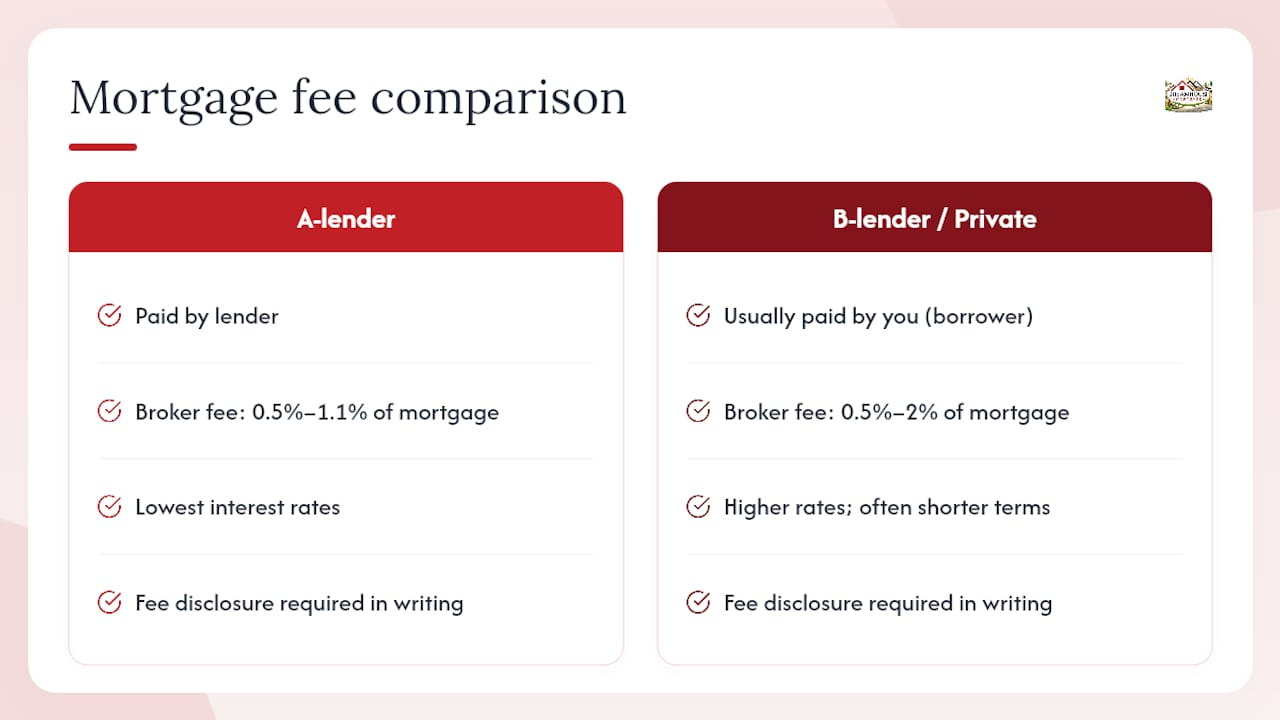
For a standard residential mortgage through an A-lender, the lender pays your broker’s commission directly, meaning the service typically costs you nothing out of pocket. That finder’s fee generally runs 0.5% to 1.1% of the mortgage amount, paid by the bank, not the borrower.
Complex files change the math. If your situation requires a B-lender or private mortgage, that same source notes broker fees charged directly to you typically range from 0.5% to 2% of the mortgage. Regulators require your broker to disclose that fee in writing before you sign anything, so there should never be a surprise charge buried in the paperwork.
Interest rate implications matter just as much as the fee itself. A-lender mortgages generally carry the lowest rates because the risk profile is lowest. B-lender and private products carry higher rates and often shorter terms, sometimes with prepayment penalties attached to compensate the lender for taking on more risk. Online rate aggregators show you posted numbers, but they cannot negotiate; a broker who shops multiple lenders on your behalf often secures better pricing than a single-bank quote, since competition among lenders tends to push rates down. Before choosing based on price alone, ask any brokerage for a full breakdown using our mortgage broker fees guide.
How Do Clients Rate These Mortgage Options?
Reviews tell you a lot, but they rarely tell you everything. A brokerage with strong ratings usually reflects consistent communication and follow-through, while thin review counts often mean limited public feedback rather than poor service.
What matters more than star counts is what clients are actually rating: response time, clarity on fees, and whether the broker found a lender that matched their specific situation. Self-employed borrowers and newcomers to Canada tend to leave the most detailed feedback, since their files usually involve more back-and-forth with underwriters. National franchise networks often show high review volume simply due to scale, spread across many individual brokers rather than one consistent point of contact. Independent Alberta brokerages and local operations like DreamHouse Mortgage tend to build reviews around a single broker’s reputation, which means the feedback reflects one person’s track record rather than an average across a large team.
When you compare options, ask each brokerage directly about recent client outcomes for situations similar to yours, particularly if you are self-employed or buying an investment property. A broker’s willingness to answer specifics, rather than pointing you to a generic testimonial page, tells you more than any star rating.
From Pre-Approval to Funding: What to Expect
Pre-approval is where the process actually starts, and it typically takes a few business days once your income and credit documents are submitted. A broker with strong lender relationships can often move this faster than shopping bank branches directly, since local relationships with provincial credit unions and regional lenders can meaningfully shorten timelines.

After pre-approval, you move into house hunting with a clear budget. Once you have an accepted offer, your broker submits the full application to the chosen lender, which triggers formal underwriting. This stage usually takes one to two weeks for straightforward A-lender files, longer for self-employed applicants or investment properties requiring additional documentation.
B-lender and private files often involve more underwriting work and conditional approvals, since these lenders take on more risk and structure terms accordingly. Expect shorter terms, higher rates, and sometimes prepayment penalties in exchange for approval speed and flexibility. Funding typically closes within a few days of your possession date, coordinated between your lawyer, lender, and broker. A step-by-step pre-approval guide can help you understand exactly what documents to prepare before you start.
Why Local Alberta Experience Changes the Outcome
Alberta buyers consistently do better with a broker who understands provincial credit unions, regional lender quirks, and the local market pace in Calgary, Airdrie, Cochrane, and Edmonton. First-time buyers and self-employed applicants especially benefit from someone who has placed similar files before. Broker of Record credentials, MBA and PMP designations, and full written fee disclosure are not paperwork formalities. They are what separates a broker you can verify from one you have to take on faith.
Ready to Talk to a Local Alberta Broker?
Comparing categories on a page only gets you so far. The advantage DreamHouse Mortgage offers over a national franchise, an online aggregator, or a single credit union branch is direct access to a Broker of Record who works Alberta files daily, without routing you through a call center or a different rep at every stage.

DreamHouse Mortgage offers a free consultation for first-time home buyers across Calgary, Airdrie, Cochrane, Red Deer, and Edmonton, with fast local pre-approval support for buyers who need an answer before they start touring homes. If you are self-employed, buying an investment property, or simply want a second opinion on a rate someone else quoted you, review our questions to ask a mortgage broker before your call so you get the most out of the conversation. When you are ready, book your free consultation online, check our Google Business Profile for local reviews, or call Guriqbal Chahal, MBA, PMP directly at 403-966-6072.
Sources
- What Is a Mortgage Broker? – NerdWallet Canada
- Mortgage brokers explained: What they do, and what they don’t (Part 1) – CMT Nouvelles
- What Is a Mortgage Broker in Canada? Complete Guide (2026) | WealthNorth
- Rates
This article is general information, not a substitute for advice from a qualified financial advisor. Consult a qualified financial professional about your own circumstances before acting on anything here.
FAQ
Which alternative lenders are the best in Canada?
The strongest alternative lenders depend on your file. Brokers with access to banks, monoline companies, and private lenders can match you to the right one based on your income type, credit, and timeline rather than a single fixed answer.
Which mortgage brokerage is the best in Canada?
There is no single national answer since fit depends on your location and file complexity. For Alberta buyers, particularly first-time buyers and self-employed applicants, DreamHouse Mortgage’s local lender relationships in Calgary, Airdrie, Cochrane, and Edmonton often produce faster, more tailored outcomes than a national call center model.
Who is the easiest lender to get a mortgage from?
There is no universally “easiest” lender since qualification depends on income verification, credit history, and down payment. Brokers now place borrowers at every credit tier, including prime bank products, so working with one widens your options rather than narrowing them.
Are B-lenders a bad option for mortgages?
B-lenders are not inherently bad. They fill a real gap for self-employed borrowers or those with non-standard income, though they typically involve more underwriting work and higher costs in exchange for approval flexibility.
Who typically pays the mortgage broker’s fee?
On standard A-lender mortgages, the lender pays the broker’s commission. For private or B-lender deals, the borrower may pay a disclosed fee, typically 0.5% to 2% of the mortgage.