Yes, most qualified first-time buyers in Alberta can get a mortgage right now, and the process starts with pre-approval, not house hunting. The Government of Canada specifically recommends getting pre-approved before you shop for a home, since it tells you the loan amount you actually qualify for. Alberta gives first-time buyers two built-in advantages over most other provinces: there is no land transfer tax, and federal savings tools like the FHSA and HBP are still fully available.
Before you call anyone, here is what to pull together:
- Recent pay stubs and a letter of employment (or two years of tax returns if self-employed)
- Government-issued photo ID, and your Social Insurance Number
- A rough idea of your savings across FHSA, RRSP, and regular accounts
- Guriqbal Chahal’s direct line for a pre-approval conversation: 403-966-6072
Getting pre-approved with DreamHouse Mortgage takes one phone call and gives you a firm number to shop with.
Key Takeaways
Getting a mortgage as a first-time buyer in Alberta requires pre-approval first, stacking FHSA and HBP funds for your down payment, and confirming which federal programs are actually still open before you apply.
| Point | Details |
|---|---|
| Pre-approval comes first | It sets your real budget using GDS/TDS ratios and the stress test before you shop for homes. |
| Stack FHSA and HBP | Combine up to $40,000 (FHSA) and $60,000 (HBP) per person for down payment funds, subject to eligibility. |
| Confirm program status | CMHC’s First-Time Home Buyer Incentive is closed to new applicants; FHSA, HBP, and the GST/HST rebate remain open. |
| Alberta has no land transfer tax | You pay a small Land Titles registration fee instead, roughly $250 on a $500,000 home. |
| Work with a local broker | DreamHouse Mortgage compares multiple Alberta lenders and handles program paperwork at 403-966-6072. |
This article is general information, not a substitute for advice from a qualified financial advisor. Consult a qualified financial professional about your own circumstances before acting on anything here.
Table of Contents
- Steps to Getting a Mortgage: An At-a-Glance Checklist for Alberta Buyers
- How Do You Apply for a Mortgage in Alberta, Step by Step?
- Which First-Time Buyer Programs Are Still Available in Alberta?
- What Do Lenders Check Before Approving Your Mortgage?
- How Much Down Payment Do You Need and When Does Mortgage Insurance Apply?
- What Closing Costs and Timeline Should Alberta Buyers Expect?
- How a Local Mortgage Broker Makes This Easier
- What Mortgage Products Should First-Time Buyers Consider?
- How Does Mortgage Default Insurance Affect Your Monthly Payment?
- How Should You Choose Between Lenders and Mortgage Brokers in Alberta?
- What Housing Market Challenges Are Unique to Alberta?
- How Are Mortgage Interest Rates Determined in Alberta?
- What Documents Do You Need for a Mortgage Application in Alberta?
- A Broker’s Perspective on First-Time Buyers in Alberta
- Ready to Get Pre-Approved? Here’s How DreamHouse Mortgage Helps
- Sources
- FAQ
Steps to Getting a Mortgage: An At-a-Glance Checklist for Alberta Buyers
Before you tour a single property, run through this list:
- Get pre-approved. Know your maximum budget using your gross debt service (GDS) and total debt service (TDS) ratios, not just a lender’s advertised rate.
- Confirm your down payment source. Combine personal savings with an FHSA and, if needed, a Home Buyers’ Plan withdrawal from your RRSP.
- Gather your documents early. Pay stubs, T4s or tax returns, ID, and bank statements save weeks of back-and-forth with underwriters.
- Talk to a broker, not just one bank. A broker compares products across multiple lenders instead of pushing one institution’s rate sheet.
Pro Tip: If you’re buying with a partner, you can each use your own FHSA and HBP room on the same home. Confirm the exact numbers with the Canada Revenue Agency and your mortgage broker before you count on both, since eligibility conditions apply at the time of withdrawal.
How Do You Apply for a Mortgage in Alberta, Step by Step?
Getting from “thinking about buying” to holding keys follows a fairly predictable sequence in Alberta, and knowing it in advance saves you from panic decisions later.
- Get pre-approved first. A mortgage broker pulls your credit, verifies income, and locks in an estimated rate for 90 to 120 days. This is also when your broker runs your file through the mortgage stress test to confirm your real qualifying amount, not just the advertised rate amount.
- Shop with a real number in hand. Realtors take pre-approved buyers more seriously, and you avoid falling for a home priced above what you can actually finance.
- Make an offer with conditions. Alberta purchase contracts typically include financing, home inspection, and (for condos) a condo document review period, usually 7 to 14 days.
- Submit your firm mortgage application. Once your offer is accepted, your broker sends your full file, subject property details, and appraisal request to the chosen lender for final underwriting.
- Remove conditions. Once financing is fully approved, the inspection is clean, and condo docs are reviewed, you remove conditions and the deal becomes firm.
- Close with your lawyer. Your lawyer registers title, your lender releases mortgage funds, and ownership transfers, typically 30 to 60 days after your offer is accepted.
On closing day, you or your lawyer will handle: final mortgage funding confirmation, property tax and utility adjustments, title registration at Alberta Land Titles, and signing the mortgage documents. DreamHouse Mortgage stays involved at every stage, negotiating with the lender if an appraisal comes back low or a condition needs an extension.
- Book your pre-approval call before you view homes
- Keep conditional periods realistic, rushing an inspection is how buyers miss foundation or roof problems
- Have your down payment funds sitting in your account (not freshly deposited) for at least 90 days, since lenders scrutinize large recent deposits
Pro Tip: Ask your broker for a 120-day pre-approval instead of 90 if you’re buying in a competitive Calgary or Airdrie market. That extra month often covers the gap between finding a home and closing.
Which First-Time Buyer Programs Are Still Available in Alberta?
Several federal programs remain open to Alberta buyers in 2026, but one popular incentive has already been shut down, and mixing them up wastes time.
The First Home Savings Account (FHSA) gives eligible first-time buyers $8,000 in contribution room per year, up to a $40,000 lifetime limit, according to the Canada Revenue Agency. Withdrawals used toward a qualifying first home come out completely tax-free, and unlike the Home Buyers’ Plan, you never have to repay it.
The Home Buyers’ Plan (HBP) lets you withdraw up to $60,000 from your RRSP for a first home, repayable over 15 years starting the second year after withdrawal, per Canada.ca. You can combine an FHSA withdrawal with an HBP withdrawal on the same home if you meet each program’s conditions.
FHSA + HBP combined, a couple buying together could potentially bring a significant amount in tax-advantaged funds to a down payment, subject to individual contribution history and lender qualification.
The Home Buyers’ Amount is a federal tax credit claimed on your income tax return the year you buy, reducing what you owe rather than adding to your down payment.
The First-Time Home Buyers’ GST/HST Rebate is genuinely new: CRA is now accepting applications for agreements entered into on or after March 20, 2025, covering up to 100% of the federal GST on new or substantially renovated homes priced up to $1 million, phasing out between $1 million and $1.5 million.
One program to stop relying on: CMHC’s First-Time Home Buyer Incentive closed to new applications on March 21, 2024. If you see it mentioned in older guides, it no longer applies to new buyers. Local programs like Attainable Homes Calgary and Edmonton First Place have limited or seasonal availability, so check directly with the municipality before counting on a spot.
What Do Lenders Check Before Approving Your Mortgage?
Alberta lenders look at four things above everything else, and skipping preparation on any one of them is the most common reason pre-approvals stall.
- Income. Payroll employees need pay stubs and a letter of employment; self-employed buyers typically need two years of tax returns, often with add-backs for legitimate business deductions.
- Credit score. Most conventional lenders want to see 680 or higher for the best rates, though some programs work with scores in the low 600s at a cost.
- GDS and TDS ratios. Gross debt service (housing costs divided by income) generally needs to stay under 39%, and total debt service (housing plus all other debt) under 44%.
- The stress test. Every insured and most uninsured mortgages are qualified at either the Bank of Canada’s benchmark qualifying rate or your contract rate plus 2%, whichever is higher.
A borrower who could technically afford payments at a 5% contract rate might still need to qualify at 7% under the stress test, which is exactly why many buyers get pre-approved for less than they expected.
How Much Down Payment Do You Need and When Does Mortgage Insurance Apply?
Alberta follows the same national down payment rules as the rest of Canada. Homes up to $500,000 need a minimum 5% down. On the portion between $500,000 and $1.499 million, you need 10% on that portion. At $1.5 million or above, minimum down payment jumps to 20% with no default insurance option.
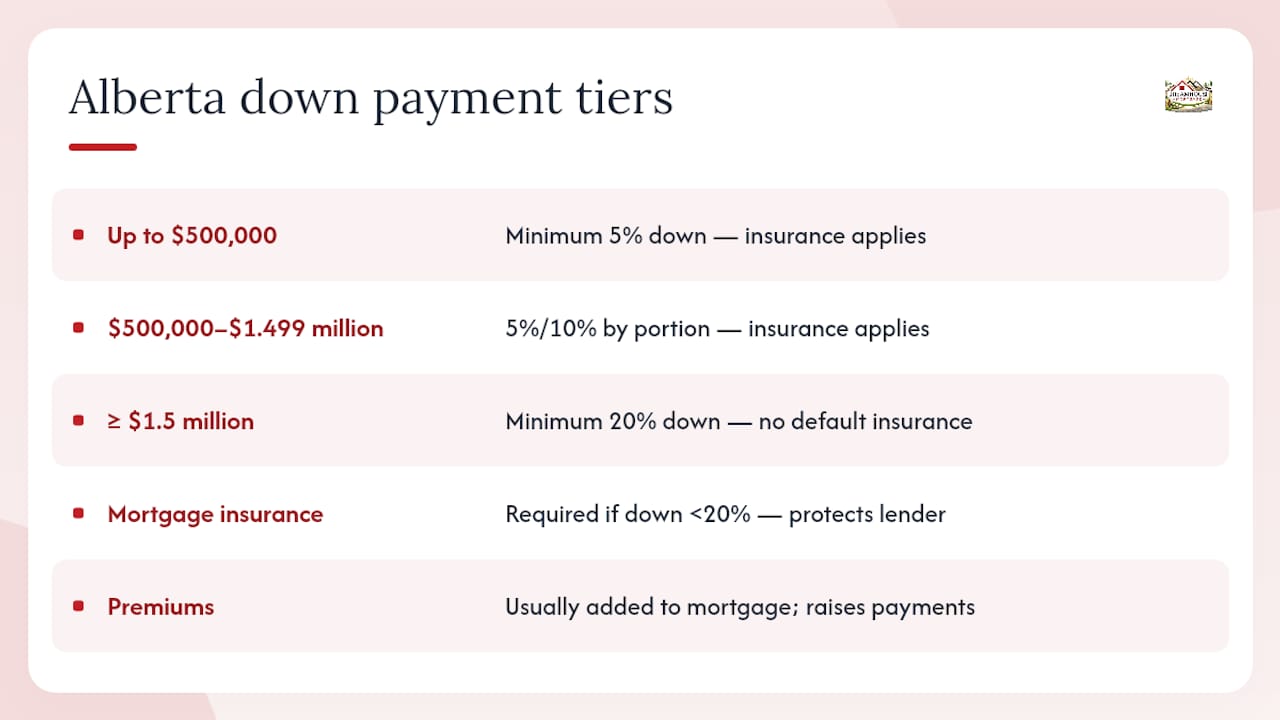
Any purchase with less than 20% down requires mortgage default insurance through CMHC, Sagen, or Canada Guaranty. This insurance protects the lender, not you, but it is what allows you to buy with as little as 5% down instead of the standard 20%.
Premiums are usually added directly to your mortgage rather than paid upfront, which raises your monthly payment slightly over the life of the loan. Buyers with more complex income, like self-employed applicants with add-back income, sometimes explore alternative lender paths when traditional insurance guidelines don’t fit their file, though these routes usually carry higher rates.
What Closing Costs and Timeline Should Alberta Buyers Expect?
Alberta buyers benefit from one major cost advantage: no provincial land transfer tax. Instead, you pay a Land Titles registration fee, calculated as $50 plus $2 per $5,000 of property value. On a $500,000 home, that works out to just $250, a fraction of what buyers in Ontario or British Columbia pay in land transfer tax on a similarly priced property.
Budget for these typical Alberta closing costs:
- Legal fees: $1,200 to $1,800
- Title registration and mortgage registration fees: roughly $300 to $500 combined
- Home inspection: $400 to $600
- Property tax and utility adjustments: varies by closing date
Most Alberta purchases close 30 to 60 days after an accepted offer. Delays usually come from slow appraisals, condo document reviews, or last-minute financing conditions. Have certified funds ready, confirm your lawyer’s trust account details early, and get final mortgage documents signed at least a few days before possession.
How a Local Mortgage Broker Makes This Easier
Guriqbal Chahal, MBA, PMP, is Broker of Record at DreamHouse Mortgage, serving Calgary, Airdrie, Cochrane, Chestermere, Edmonton, and Red Deer. A broker shortens approval time by shopping your file across banks, credit unions, and monoline lenders simultaneously, and handles the FHSA, HBP, and GST rebate paperwork so nothing falls through at closing.

The path looks like this: initial consult, pre-approval, lender negotiation, closing support.
Pro Tip: Send your pay stubs, ID, and two years of tax documents (if self-employed) before your first call. It cuts approval time by days.
What Mortgage Products Should First-Time Buyers Consider?
Alberta lenders offer two main rate structures, and the choice affects your budget more than most buyers expect. A fixed-rate mortgage locks your interest rate for the entire term, usually one to five years, so your payment never changes regardless of what happens in bond markets. A variable-rate mortgage moves with the lender’s prime rate, which tracks the Bank of Canada’s policy rate. Your payment either stays fixed with the portion going to principal shifting (adjustable), or fluctuates directly with rate changes, depending on the lender’s structure.
First-time buyers in Calgary and Edmonton often lean toward fixed rates for the predictability, especially when household budgets are already stretched by a new mortgage payment. Variable rates can save money when the Bank of Canada is cutting rates, but they carry the risk of payment increases if rates rise during your term.
Term length is a separate decision from rate type. A five-year fixed term is the most common choice in Alberta, giving you rate certainty through most of an amortization cycle. Shorter terms, one to three years, suit buyers who expect their income or plans to change soon, or who are betting rates will drop before renewal.
Amortization also matters. Comparing fixed versus variable structures against your income stability and risk tolerance is worth doing before you commit to either.
How Does Mortgage Default Insurance Affect Your Monthly Payment?
That means you finance the premium over your full amortization period, paying interest on it along with the rest of your loan.
Some buyers choose to pay the premium upfront in cash instead, which avoids paying interest on it over 25 or 30 years but requires more cash at closing.
The trade-off is straightforward: a smaller down payment gets you into the market sooner, but it costs more over the life of the loan once insurance premiums and the interest on them are factored in.
How Should You Choose Between Lenders and Mortgage Brokers in Alberta?
Choosing where to get your mortgage matters as much as choosing which home to buy. A single bank can only offer you that bank’s products, at that bank’s posted or negotiated rate. A mortgage broker works with banks, credit unions, monoline lenders, and alternative lenders simultaneously, comparing rates and approval criteria across all of them for your specific file.
When evaluating a broker or lender, ask these questions:
- How many lenders do you actively work with, and do you have access to monoline lenders that don’t operate branches?
- What is your average pre-approval turnaround time?
- Do you charge the client directly, or is your compensation paid by the lender (standard for most Alberta brokers)?
- Can you help coordinate FHSA, HBP, and GST rebate paperwork alongside the mortgage application?
- What happens if my rate changes or my closing date shifts?
Local experience matters more than it seems. A broker who regularly closes deals in Cochrane, Chestermere, or Rocky View County understands municipal quirks, appraisal timelines, and which lenders move fastest in specific Alberta markets. Credentials worth checking include Broker of Record status and professional designations, both signals that the person guiding your largest financial decision has formal accountability and training behind them.
What Housing Market Challenges Are Unique to Alberta?
Alberta’s housing market behaves differently than Ontario’s or British Columbia’s, and first-time buyers benefit from knowing the local quirks before they start shopping. Calgary and Edmonton have both seen tighter inventory and faster-moving listings in recent buying seasons, which pushes some buyers toward waiving conditions they should keep, particularly financing and inspection clauses.
Property type eligibility varies more than buyers expect. Acreages and rural properties outside Rocky View County or Red Deer County often require different lending criteria than a standard city lot, sometimes needing a larger down payment or a different insurer. Condos come with their own layer of scrutiny: lenders and insurers review the condo corporation’s reserve fund and any special assessments before approving financing, which is why condo document review periods exist in Alberta purchase contracts.
New construction adds another wrinkle. Buyers purchasing a pre-construction home in a growing community like Airdrie or Chestermere need financing that accounts for possession date uncertainty, since builder delays can push closing months past the original estimate, requiring a pre-approval extension.

Rural and acreage buyers should budget extra time for well and septic inspections, which most urban lenders and inspectors don’t factor into standard timelines.
How Are Mortgage Interest Rates Determined in Alberta?
Mortgage rates in Alberta follow the same national mechanics as the rest of Canada, but the products available and how aggressively lenders compete can shift by region. Fixed rates are priced off Government of Canada bond yields, since lenders fund fixed mortgages by matching them against bonds of similar terms. When bond yields rise, fixed rates typically follow within days or weeks.
Variable rates track each lender’s prime rate, which moves directly with the Bank of Canada’s overnight policy rate. When the Bank of Canada adjusts its rate at scheduled announcement dates throughout the year, variable mortgage holders see the change reflected almost immediately.
Individual factors also affect the rate you’re offered: your credit score, down payment size, amortization length, and whether your mortgage is insured or uninsured.
Rate competition among Calgary and Edmonton lenders tends to be sharper for insured mortgages, since insurers reduce lender risk. This is one reason working with a broker who can compare multiple lenders’ current offers matters more than chasing a single bank’s advertised rate, which often applies only to the most qualified borrowers.
What Documents Do You Need for a Mortgage Application in Alberta?
Every Alberta lender asks for a similar core document package, though self-employed and newcomer files need extras. Having these ready before your first call with a broker speeds up pre-approval significantly.
Standard documentation includes:
- Government-issued photo ID (driver’s license or passport)
- Recent pay stubs and a letter of employment confirming salary, position, and start date
- Two most recent years of tax returns and Notice of Assessment (required for self-employed applicants, and helpful for everyone)
- Two to three months of bank statements showing down payment funds
- Written authorization allowing the lender to pull your credit report
- Purchase agreement and property details once you’re under contract
- Mortgage default insurance application (if putting down less than 20%)
Self-employed buyers often need business financial statements or add-back documentation showing legitimate business write-offs that boost qualifying income. Newcomers to Canada typically need proof of landing date, a foreign credit reference letter, and sometimes a larger down payment depending on how long they’ve held Canadian credit history. Getting this paperwork organized before you apply for pre-approval is the single biggest thing you control in how fast your file moves.
A Broker’s Perspective on First-Time Buyers in Alberta
Most first-time buyers underestimate how much a properly structured pre-approval protects them, not just from disappointment, but from overpaying for the wrong mortgage product. Helping buyers across Calgary, Airdrie, and Cochrane close quickly comes down to catching document gaps early and matching each file to the right lender the first time, not the third. Client results and case studies are available on request during a consultation.
Ready to Get Pre-Approved? Here’s How DreamHouse Mortgage Helps
DreamHouse Mortgage gives first-time buyers something a single bank branch cannot: access to multiple lenders competing for your business instead of one institution’s rate sheet. Guriqbal Chahal and the team handle pre-approval, negotiate your rate directly with lenders, and walk you through FHSA, HBP, and GST rebate paperwork so nothing gets missed at closing.
Whether you’re buying in Calgary, Airdrie, Cochrane, Chestermere, Edmonton, or Red Deer, the process starts with one call. Reach Guriqbal Chahal, MBA, PMP, directly at 403-966-6072, or view the DreamHouse Mortgage Google Business Profile to see local reviews and book a consultation. If you want to see the full range of first-time buyer services first, the First Time Home Buyer Alberta page breaks down pre-approval, rate comparison, and closing support in one place. Getting pre-approved costs nothing and takes one phone call, so there’s no reason to keep guessing at your budget.
Sources
FAQ
What Are the Requirements for a First-Time Home Buyer in Alberta?
How Much Mortgage Can I Get With a $70,000 Salary in Canada?
Using standard GDS and TDS ratios and current stress test rules, your income and financial situation determine the mortgage you can afford. A pre-approval with DreamHouse Mortgage gives you a precise figure based on your full financial picture.
How Much Down Payment Do I Need on a $250,000 Home in Alberta?
How Much Mortgage Can I Get if I Earn $30,000 a Year?
At a given income with minimal existing debt, most lenders’ GDS and TDS ratios determine your qualifying mortgage amount, which varies with credit score, down payment, and other debts. Speaking with a broker gives you an exact figure rather than a rough estimate.