
Both Equifax and TransUnion operate in Canada, and neither one is universally “better” for a mortgage application. A gap of 20 to 50 points between your two scores is common and usually explainable, not a red flag. Before you apply for a mortgage in Calgary, Airdrie, Cochrane, or anywhere else in Alberta, do three things:
- Pull both credit reports and compare them line by line.
- Flag any account, balance, or inquiry that appears on one report but not the other.
- Dispute genuine errors immediately, and call a mortgage broker if either score sits close to a lender’s cutoff.
If your scores diverge and you’re not sure which one your target lender will pull, that’s exactly the kind of gap Guriqbal Chahal at Dreamhouse Mortgage sorts out daily for Alberta buyers.
Key Takeaways
Checking both your Equifax and TransUnion reports before applying for a mortgage in Alberta prevents rate-tier surprises and gives you time to fix errors that a single-bureau check would miss.
| Point | Details |
|---|---|
| Score gaps are normal | A 20 to 50 point difference between bureaus is common and usually explained by reporting coverage or timing. |
| Models differ | Equifax uses the Equifax Risk Score; TransUnion uses CreditVision, which weighs trended payment history. |
| Lenders don’t all pull the same bureau | Which bureau a lender favors can affect your rate tier, so match your application to your stronger file. |
| Check both before applying | Pull both reports 30 to 60 days before your mortgage application, then again before underwriting. |
| Disputes are separate per bureau | Correcting an error at Equifax does not update TransUnion automatically; file both, each takes about 30 days. |
Table of Contents
- Equifax vs TransUnion: Key Differences in Scoring and Reporting
- Which Bureau Do Mortgage Lenders Actually Pull?
- How to Check Your Equifax and TransUnion Reports in Canada
- Fixing Score Gaps Before You Apply for a Mortgage
- How Dreamhouse Mortgage Reads Bureau Differences for Alberta Buyers
- Why the “Just Check One Score” Advice Falls Short
- Sources
- FAQ
Equifax vs TransUnion: Key Differences in Scoring and Reporting
The two bureaus run separate databases, use different proprietary scoring formulas, and don’t always hear from the same creditors. That’s the root cause of most “why don’t my scores match” confusion.
Both bureaus report scores on the same 300 to 900 scale used across Canada, but the math behind the number differs. Equifax uses its own Equifax Risk Score model. TransUnion uses CreditVision, which weighs trended data, meaning it looks at how your balances and payments moved over roughly the past two years rather than just a single snapshot. A borrower who paid down a card aggressively over six months might see that reflected faster in a CreditVision-based score than in a model that leans more on point-in-time balances.
Reporting coverage is the bigger driver of score gaps. Not every creditor reports to both bureaus. Smaller credit unions, some fintech lenders, and certain retail card issuers often report to only one, and that’s the single biggest cause of discrepancy between your files. Two people can have identical debt loads and see meaningfully different scores simply because a car loan reports to Equifax and a store card reports to TransUnion.
Update timing adds another layer. Creditors typically report once a month, but the exact day varies by bureau and by lender, so one bureau can show up to a 45-day lag on the same account. A large payment can lift one score days before the other bureau catches up.
Quick differences at a glance:
- Score range: 300 to 900 on both bureaus.
- Scoring model: Equifax Risk Score vs TransUnion CreditVision.
- Update cadence: monthly, with reporting lags of up to 45 days depending on the creditor.
- Coverage: not every lender reports to both bureaus.
Which Bureau Do Mortgage Lenders Actually Pull?
Some Canadian lenders lean on one bureau by default for certain mortgage products, while others pull both as a matter of policy. Federally regulated banks and monoline lenders often have long-standing data partnerships that favor one bureau, while credit unions and alternative lenders sometimes default to the other. This isn’t published as a rule anywhere. It’s operational preference, and it varies by lender and even by product line.
OSFI’s residential mortgage underwriting guideline is clear that a bureau score is one input among several, not the sole basis for a lending decision. Underwriters weigh income, down payment, debt ratios, and the mortgage stress test alongside whatever credit file they pull. Still, if your Equifax score is 680 and your TransUnion score is 640, and a lender you’re targeting pulls TransUnion, that 40-point gap can push you into a different rate tier or trigger extra conditions.
- Major banks often default to a preferred bureau for conventional mortgages.
- Monoline and alternative lenders may pull the other bureau, or both.
- CMHC-insured deals typically hinge on whichever score the lender’s system flags first.
Pro Tip: Don’t guess which bureau a lender favors. A broker with access to multiple lenders can match your file to whichever pull works in your favor, especially useful for first-time buyers in Calgary sitting near a rate-tier cutoff.
How to Check Your Equifax and TransUnion Reports in Canada
Getting both reports costs nothing and takes less than a week if you order by mail, or minutes online.
- Request your free Equifax Canada report online or by mail through Equifax’s consumer disclosure process.
- Request your free TransUnion Canada report the same way through its consumer portal.
- Cross-reference both reports side by side, account by account.
- Flag discrepancies: missing tradelines, wrong balances, duplicate collections, or unfamiliar inquiries.
- File a dispute with whichever bureau shows the error.
Canada for ordering free reports and your rights as a consumer to dispute inaccurate information. Monitoring apps can help between full report pulls, but check which bureau powers the one you’re using. Borrowell, for instance, draws from Equifax data, while Credit Karma Canada draws from TransUnion. Using only one app means you’re only watching half your file.
Check both reports:
- Once when you start seriously shopping for a home.
- Again roughly 30 to 60 days before submitting a mortgage application.
- A final time right before your application goes to underwriting, in case something changed.
Fixing Score Gaps Before You Apply for a Mortgage
A discrepancy isn’t a mystery you have to live with. Most gaps trace back to one of a handful of causes, and each has a fix.
- Compare side by side. Look for accounts on one report that don’t appear on the other, and note whether negative marks (a late payment, a collection) show up on just one file.
- Check reporting dates. A recent payment might already show on one bureau and not the other, which can explain a temporary gap that will close on its own within a billing cycle or two.
- Dispute errors separately. Equifax and TransUnion run independent investigations, so a correction filed with one does not automatically update the other. Each investigation typically takes about 30 days, and you’ll want statements, payment confirmations, or account numbers ready to submit.
- Work on the fundamentals. Paying down high-utilization cards and confirming your address and employment details are current on both files helps both scores move together over time.
- Build tradelines that report to both bureaus. A secured card or installment loan from a major bank tends to report broadly, unlike some smaller lenders.
Pro Tip: If a dispute is still open when you plan to apply, tell your broker before submitting anything. A pending investigation can be explained to an underwriter with documentation. A surprise discovered mid-file can delay your closing.
Once you’ve done what you can on your own, that’s the point to bring in a broker. Matching your improved file to the right lender is where the real gains show up, which is covered next.

How Dreamhouse Mortgage Reads Bureau Differences for Alberta Buyers
Guriqbal Chahal, MBA, PMP, has spent years interpreting exactly this kind of bureau mismatch for buyers across Calgary, Airdrie, Cochrane, and Red Deer. A 30-point gap between Equifax and TransUnion means very little in isolation. It matters enormously once you know which bureau your target lender pulls.
Dreamhouse Mortgage works through this with clients directly:
- Identify which lenders in a given deal pull which bureau, and target applications accordingly.
- Package supporting documentation when a one-sided negative shows up on only one file, so an underwriter sees the full picture rather than a flagged score.
- Point clients toward products, like certain secured cards or installment loans, that report to both bureaus and improve overall credit health for CMHC-insured mortgages.
Alberta first-time buyers rarely lose a deal over a 20-point score gap. They lose ground when nobody checks both reports before the lender does.
Pro Tip: If your Equifax and TransUnion scores differ and you’re within 60 days of applying, get a pre-application credit review before you shop for rates. Call Guriqbal Chahal, MBA, PMP, Mortgage Broker, at 403-966-6072, or find Dreamhouse Mortgage on Google Business Profile to book a consultation. For buyers weighing rate tiers tied to their credit file, rate negotiation strategy is often the next conversation worth having.
Why the “Just Check One Score” Advice Falls Short
Most generic credit advice tells you to check “your credit score” as if there’s one number that follows you around. That framing doesn’t hold up once you’re shopping for a mortgage in Alberta’s lending environment, where the bureau a lender pulls can shift which rate tier you land in.
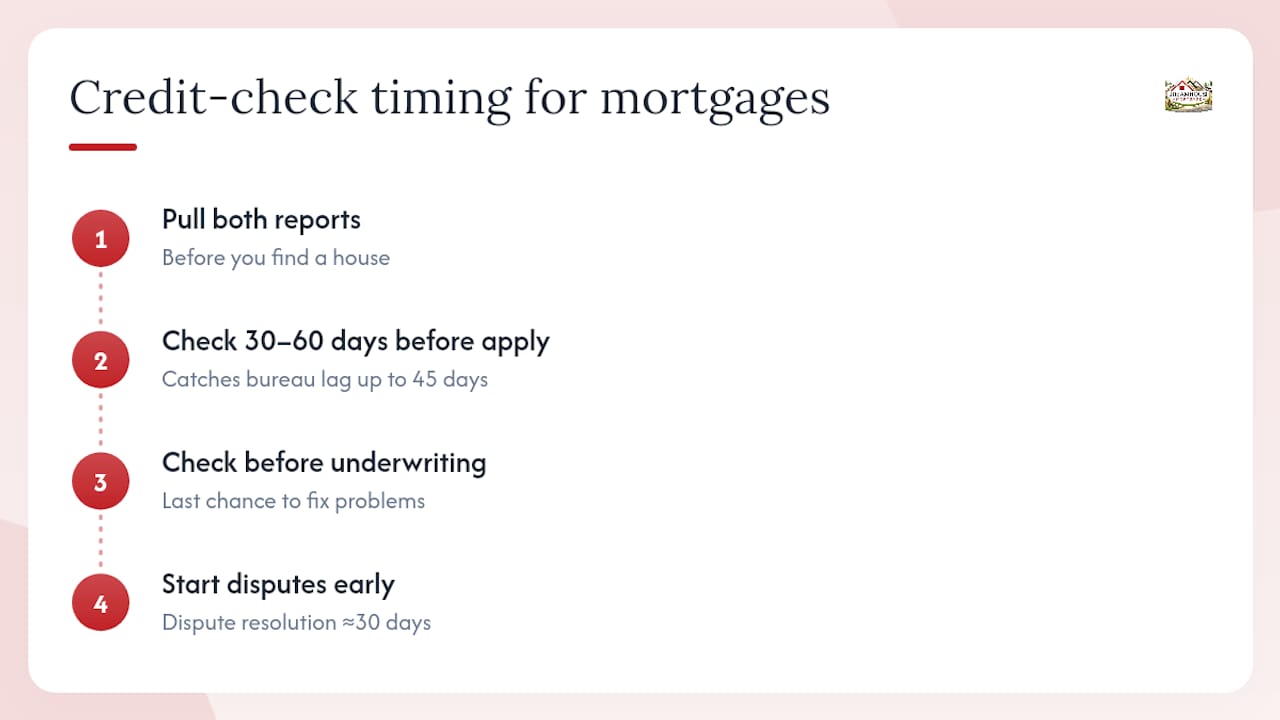
The bigger miss in conventional advice is timing. Plenty of guides tell you to check your credit once a year and call it done. For a mortgage applicant, that’s not enough. Reporting cycles run monthly, and a bureau can lag up to 45 days behind a payment you already made. Checking both reports 30 to 60 days before you apply, then again right before underwriting, catches problems while there’s still time to fix them.
What should you prioritize first? Pull both reports now, not after you’ve found a house. A dispute takes about 30 days to resolve, and you don’t want that clock running during a firm offer deadline. If your scores diverge and you’re unsure what it means for your file, that’s a conversation for a broker, not a guessing game.
— Guriqbal Chahal, MBA, PMP
This article is general information, not a substitute for advice from a qualified financial advisor. Consult a qualified financial professional about your own circumstances before acting on anything here.
Sources
- Getting your credit report and credit score – Government of Canada
- Equifax: Different credit scores (Equifax Canada)
- Do you know your credit score? | TransUnion Canada
- Residential mortgage underwriting practices and procedures – Guideline (2017) – OSFI
- Why Canadians Have Different Scores at Equifax and TransUnion – Credit Resources
FAQ
Is TransUnion More Accurate Than Equifax?
Neither bureau is more accurate by design. Each pulls data from different creditors and applies a different scoring model, so accuracy depends on which creditors report to which bureau in your specific file.
Does Canada Use TransUnion or Equifax?
Canada uses both. Equifax Canada and TransUnion Canada operate as independent bureaus, and lenders may pull either one depending on their internal data partnerships and the mortgage product.
Should I Look at My TransUnion or Equifax Credit Score?
Check both. Relying on just one leaves you blind to errors or missing accounts on the other file, which matters most right before a mortgage application.
Do Lenders Look at TransUnion or Equifax?
It depends on the lender. Some default to one bureau for certain mortgage products, while others pull both, which is why matching your application to the right lender can affect your approval and rate tier.