
A spousal buyout mortgage can let one spouse keep the family home after separation, provided they qualify on their own income and have a signed separation agreement in place. Canadian lenders and mortgage insurers, including CMHC, offer buyout programs that permit refinancing up to 95% of the home’s value instead of the standard 80% cap. The first step is getting a separation agreement finalized and calling a mortgage broker or family lawyer to confirm your qualifying options.
TL;DR:
- Most buyout programs allow refinancing up to 95% of the home’s value, significantly above the standard 80% limit, especially in markets with rising home prices.
- The approval depends heavily on a legally binding separation agreement, proof of income alone is insufficient without this legal document.
- Calculating the buyout amount involves appraisals and applying the agreed equity split, which can require a mortgage of up to 95% LTV if the property value supports it.
- Budget for costs beyond the mortgage, including insurance premiums, legal fees, and appraisal costs, which may be added to the mortgage or paid upfront.
- Only certain lenders offer buyout exceptions; working with an experienced broker can identify these lenders and streamline the process.
Table of Contents
- How Does a Spousal Buyout Mortgage Work in Canada?
- Who Qualifies for a Spousal Buyout Mortgage?
- How Do You Calculate a Spousal Buyout Amount?
- What Does a Spousal Buyout Cost at Closing?
- What Are the Steps to Complete a Spousal Buyout?
- What If You Don’t Qualify for a Spousal Buyout?
- Why a Local Alberta Broker Changes the Outcome
- How Dreamhouse Mortgage Helps You Complete a Spousal Buyout
- Why the Legal Piece Gets Underestimated
- Sources
- FAQ
How Does a Spousal Buyout Mortgage Work in Canada?
A spousal buyout works by refinancing the family home so the spouse keeping the property pays out the other spouse’s equity share and takes over the mortgage alone. The new mortgage does two jobs at once: it pays off the existing mortgage balance, and it generates the cash needed to pay the departing spouse their portion of the equity. Once the funds move and the mortgage closes, the departing spouse’s name comes off title, and the remaining spouse becomes the sole registered owner and sole borrower.
This is different from a standard refinance. Most refinances in Canada cap out at 80% loan-to-value, which often isn’t enough equity room to cover a fair buyout, especially in Calgary and Airdrie markets where home values have climbed steadily over the past decade. To solve this, Financial Post reports that spousal buyout programs let one partner refinance the family home to pay the other partner their share, with the new mortgage retiring the old one and removing the departing spouse from title in a single transaction.
The mechanism that makes higher borrowing possible is technical but important: some lenders treat the buyout as an insured purchase transaction rather than a plain refinance, which unlocks purchase-style underwriting rules. That distinction is why certain lender programs in Canada can allow refinancing up to 95% loan-to-value specifically for spousal buyouts, well above the usual 80% refinance ceiling.
These programs run through Canada’s major mortgage insurers, CMHC, Sagen, and Canada Guaranty, each of which sets its own underwriting boundaries within the federal framework. Not every lender offers a buyout exception, which is one reason working with a broker who tracks which lenders currently support this program matters more here than in a typical refinance.
This option tends to suit parents who want to keep kids in the same school and neighborhood, and it works for both married and common-law partners in Alberta, where family law treats property division similarly for both relationship types., since Canadian family law treats property division similarly for both relationship types once a separation agreement is in place.

Who Qualifies for a Spousal Buyout Mortgage?
Qualifying for a spousal buyout mortgage comes down to the same fundamentals as any mortgage application, plus one non-negotiable legal document. The spouse keeping the home has to prove they can carry the new mortgage without relying on their ex-partner’s income, and lenders verify this closely.
Lenders will look at:
- Income and employment stability, verified through pay stubs, T4s, or Notice of Assessment for self-employed borrowers.
- Gross Debt Service and Total Debt Service ratios (GDS/TDS), run through the same stress test applied to any mortgage applicant.
- Credit score, with most lenders expecting a score in the high 600s or better for the best rate tiers.
- A fully executed separation agreement naming the buyout amount, the equity split, and a closing deadline.
- A recent appraisal confirming current market value, since buyout math depends on it.
- All parties on title at the time of application, since lenders need to see who legally owns the property before restructuring the mortgage.
The separation agreement carries the most weight in this whole process. Without one, a lender typically won’t accept a buyout application at all, because the document is what proves the equity split and timeline the mortgage is being built around.
Support payments can also count as qualifying income, which surprises a lot of applicants. If a signed agreement establishes child or spousal support and you can show a consistent deposit history in your bank statements, most lenders will factor that support into your income calculation, which can be the difference between qualifying and falling short.
Pro Tip: Start gathering three to six months of bank statements showing support deposits as soon as your separation agreement is signed. Lenders want to see a pattern, not a one-time transfer, so the earlier you start documenting it, the smoother your application moves.
How Do You Calculate a Spousal Buyout Amount?
Calculating a buyout amount is a straightforward math exercise once you have three numbers: current market value, outstanding mortgage balance, and the equity split agreed to in your separation agreement.
- Order a current appraisal. Market value drives everything else, and a stale estimate from when you bought the house won’t hold up with a lender.
- Subtract the outstanding mortgage balance from the appraised value. This gives you total home equity.
- Apply the equity split from your separation agreement. Most Alberta couples split 50/50, but agreements can specify a different ratio based on contributions or other assets.
- Add the buyout payout to the existing mortgage balance. This total is the new mortgage amount the remaining spouse needs to qualify for.
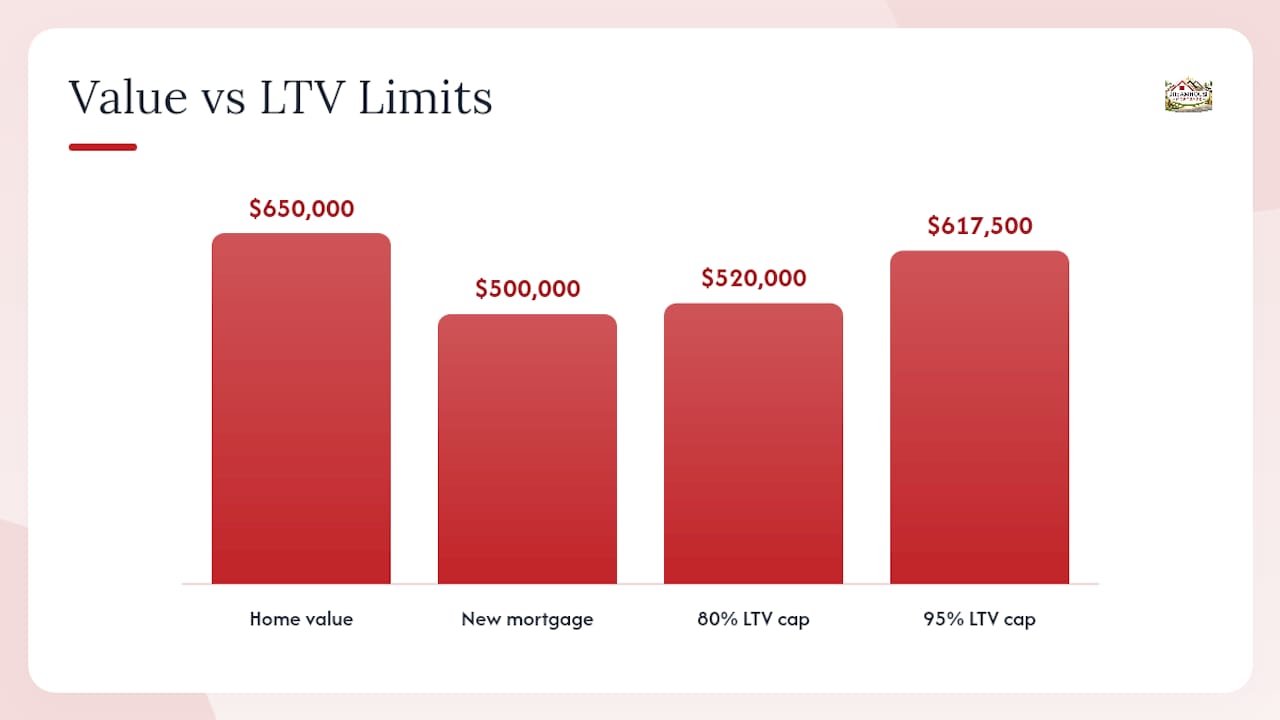
Here’s a simplified example: a Cochrane home appraises at $650,000 with a $350,000 mortgage remaining. Total equity is $300,000. On a 50/50 split, the departing spouse is owed $150,000. The remaining spouse now needs a new mortgage of $500,000 ($350,000 existing balance plus $150,000 payout) to complete the buyout.
Whether that $500,000 mortgage fits within a standard 80% LTV refinance or requires an insured buyout program depends entirely on the home’s value relative to that new loan amount. If the new mortgage pushes past 80% LTV, that’s when the insured buyout exception, and the mortgage default insurance premium that comes with it, enters the picture.
What Does a Spousal Buyout Cost at Closing?
Beyond the mortgage itself, a spousal buyout carries several closing costs that catch people off guard if they haven’t budgeted for them.
- Mortgage default insurance premium. Required whenever the new mortgage exceeds 80% LTV, calculated as a percentage of the loan amount and set within CMHC’s general qualification framework for insured mortgages.
- Provincial tax on the insurance premium. Some provinces apply sales tax to the premium itself, adding to upfront cash requirements at closing.
- Legal fees. A real estate lawyer manages the title transfer and mortgage discharge, typically running a few hundred to over a thousand dollars depending on complexity.
- Appraisal fee. Usually a few hundred dollars, and non-negotiable since the lender needs a current value.
- Potential penalties for breaking the existing mortgage early, especially if you’re mid-term on a fixed rate.
Most lenders add the insurance premium directly onto the mortgage balance rather than requiring it as cash at closing, which softens the immediate hit. Still, insurance premiums on high-ratio purchases typically increase the total mortgage cost and, in provinces that tax the premium, the cash needed at closing. Budget for legal and appraisal fees as out-of-pocket cash regardless of how the premium gets handled.
What Are the Steps to Complete a Spousal Buyout?
A spousal buyout mortgage moves through a fairly predictable sequence, and knowing the order helps you avoid stalling out partway through.
- Sign a separation agreement. This has to name the buyout amount, the equity split, and a target closing date before a lender will touch the file.
- Order the appraisal and gather documentation. Pull together income statements, support payment records, and the signed agreement.
- Contact a mortgage broker. A broker identifies which lenders currently offer spousal buyout exceptions and which insurer program fits your numbers, since combining legal clarity with the right mortgage product is what actually makes these deals work.
- Submit the lender application. Underwriting reviews GDS/TDS ratios, income, and credit, then issues conditional approval.
- Close with a real estate lawyer. The lender funds the new mortgage, the departing spouse receives their payout, and title is updated to reflect sole ownership.
Pro Tip: Line up your lawyer and broker at the same time, not sequentially. A lawyer who knows the mortgage is coming can draft the separation agreement with language lenders actually accept, which saves weeks of back and forth.
The timeline from signed agreement to funded mortgage typically runs four to eight weeks in Alberta, depending on how quickly documentation comes together and how busy the lender’s underwriting desk is at the time.
What If You Don’t Qualify for a Spousal Buyout?
Not everyone qualifies for a buyout on the first attempt, and there are legitimate fallback paths worth knowing before you assume the house is off the table.
- Sell the home and split the proceeds. The cleanest option financially, though it means moving and depends on Calgary or Airdrie market timing working in your favor.
- Offset with other assets. Trading RRSPs or investment accounts for home equity avoids a buyout mortgage entirely, though it carries its own tax and liquidity considerations worth reviewing with an accountant.
- Use a second mortgage or HELOC. These alternate financing routes carry different qualification rules and usually higher rates than a standard buyout refinance.
- Co-own or defer the sale temporarily. A formal legal agreement can keep both names on title for a set period, buying time until one spouse can qualify alone.
None of these are second-best by default. For some couples, selling is genuinely the right call, and for others, a temporary co-ownership agreement buys the breathing room needed to rebuild credit or income before refinancing.
Why a Local Alberta Broker Changes the Outcome
Spousal buyout programs aren’t offered by every lender, and finding the right one is largely a matchmaking problem. As broker and Broker of Record at Dreamhouse Mortgage, Guriqbal Chahal, MBA, PMP, works with banks, credit unions, and monoline lenders across Calgary, Edmonton, Airdrie, Cochrane, and Red Deer to identify which institutions currently run buyout exceptions and how to document support income so it actually counts toward qualification.
Bring your separation agreement draft, recent pay stubs, and any support payment records to a consultation. That documentation, paired with knowing which lenders quietly support buyouts above standard refinance limits, is usually what separates an approved file from a declined one.
How Dreamhouse Mortgage Helps You Complete a Spousal Buyout
Dreamhouse Mortgage is the alternative to going lender-by-lender on your own for a spousal buyout in Calgary, Cochrane, or Airdrie: one application, access to multiple banks, credit unions, and monoline lenders, and someone who already knows which insurer programs accept buyout exceptions before you waste weeks getting declined by the wrong one.

If you’re weighing a buyout against refinancing more broadly, that conversation happens in the same consultation.
An initial consult covers a document checklist specific to your situation, a realistic timeline estimate, and a shortlist of lenders likely to approve your file based on income and credit. There’s no cost to find out where you stand.
Call Guriqbal Chahal, MBA, PMP, Mortgage Broker, at 403-966-6072, or start with a mortgage broker consultation to see how rate negotiation on your new mortgage could lower your buyout costs. You can also find Dreamhouse Mortgage on its Google Business Profile to check reviews before you call.
Why the Legal Piece Gets Underestimated
Most people researching a spousal buyout focus almost entirely on the mortgage math and skip past the legal groundwork until it stalls their application. That’s backwards. A lender won’t even open a file without a signed separation agreement, yet couples often start calling banks before they’ve finalized that document with a lawyer.
The bigger misconception is treating a spousal buyout like a rate-shopping exercise. It isn’t. It’s an underwriting exercise wrapped around a legal document, and the two have to move together. Combining legal clarity with the right mortgage product is what actually makes these deals feasible, not finding the lowest advertised rate. A broker’s real value here isn’t negotiating a slightly better rate, it’s knowing which lenders even run a buyout exception program in the first place, since most don’t advertise it openly.
If there’s one thing worth pushing back on, it’s the assumption that a spousal buyout is a niche, difficult product reserved for complicated financial situations. For a huge number of Alberta homeowners with steady income and reasonable credit, it’s a normal refinance with one extra legal document attached. The complexity people fear is usually just unfamiliarity, not actual difficulty.
— Guriqbal Chahal, MBA, PMP
This article is general information, not a substitute for advice from a qualified financial advisor. Consult a qualified financial professional about your own circumstances before acting on anything here.
Sources
The qualification rules referenced throughout this article come from CMHC’s general requirements for mortgage loan insurance, which governs high-ratio lending across Canada including buyout exceptions. For the legal side of separation, Justice Canada’s family law overview explains how separation agreements fit into property division nationally.
The mechanics of how a buyout transaction actually closes, and how it differs from a standard refinance, are laid out in Financial Post’s coverage of spousal buyouts and in 360Lending’s explanation of Canada’s buyout mortgage programs. Documentation requirements for support income are detailed in RE/MAX’s breakdown of how spousal buyouts work.
- Spousal buyout can let you keep the family home while untying the knot | Financial Post
- How spousal buyouts work | RE/MAX blog
FAQ
Can I Buy Out My Spouse’s Share of a Mortgage in Canada?
Yes. Canadian lenders offer spousal buyout programs that let you refinance the home, pay your spouse their equity share, and take over the mortgage solely in your name, provided you qualify on your own income and have a signed separation agreement.
How Do You Calculate a Spousal Buyout?
Get a current appraisal, subtract the outstanding mortgage balance to find total equity, then apply the equity split from your separation agreement to determine the payout owed to the departing spouse.
Can My Spouse Take My House If I Bought It Before Marriage?
Property owned before marriage is generally treated differently under Alberta family law than property acquired during the relationship, but rules vary by circumstance. Speak with a family lawyer to understand how your specific situation is classified before assuming either way.
How Does a Buyout Work With an Existing Mortgage?
The new mortgage pays off the existing mortgage balance in full and provides additional funds to pay the departing spouse their equity share, all in a single closing where the old mortgage is discharged and the new one registered.
Do I Need a Separation Agreement for a Spousal Buyout Mortgage?
Yes, lenders require a fully executed separation agreement stating the buyout amount, equity split, and closing timeline before they will process a spousal buyout application.