
A HELOC works best when you need flexible, ongoing access to smaller amounts of equity, like funding a kitchen renovation in stages. A second mortgage or home equity loan suits a fixed lump-sum need, such as debt consolidation, especially when you want to keep your existing first mortgage’s rate intact. Cash-out refinance makes sense when you’re replacing the whole mortgage anyway. All three are bound by the same 80% combined loan-to-value ceiling set by federal regulators.
TL;DR:
- HELOCs offer flexible, revolving borrowing with interest-only payments, but rates are variable and capped at 65% of home value, with total debt limited by an 80% LTV cap.
- Second mortgages are fixed-lump loans with higher rates, registered as subordinate charges behind the primary mortgage, and always require full repayment over a set schedule.
- Refinancing discharges your current mortgage to replace it with a larger one, potentially cutting costs if rates are better or if you need to consolidate, but penalties may apply if your current rate is favorable.
- Borrowing limits depend on recent appraisals and remaining room within the 80% total debt ceiling, making up-to-date appraisals crucial for maximum borrowing.
- Qualification requires proof of income, a clean title, recent appraisals, and passing mortgage stress tests, with process times ranging from two to four weeks depending on the product.
Table of Contents
- HELOC vs. Second Mortgage: A Quick Comparison
- How Do HELOCs and Second Mortgages Actually Work?
- What Will a HELOC or Second Mortgage Actually Cost You?
- How Do You Qualify for a HELOC or Second Mortgage in Alberta?
- How Do You Decide Between a HELOC and a Second Mortgage?
- A Note From DreamHouse Mortgage
- Our Take: Why the “Cheapest Rate” Advice Falls Short
- Ready to Access Your Home Equity? Call DreamHouse Mortgage
- Sources
- FAQ
HELOC vs. Second Mortgage: A Quick Comparison
Before you call a lender, it helps to see how these three tools actually stack up against each other. Each one gets you to the same destination, your home’s equity, but the route, the cost, and the risk look different depending on which one you pick.
A HELOC gives you a revolving credit line secured against your home, similar in spirit to a credit card but with a much lower rate and a much bigger limit. You draw what you need, pay interest only on the amount outstanding, and repay it on your own schedule within the terms your lender sets. A second mortgage, often called a home equity loan when structured as a lump sum, hands you the entire approved amount up front and locks you into a fixed or variable repayment schedule from day one. A cash-out refinance is different again: it replaces your existing first mortgage entirely with a new, larger one, and you walk away with the difference in cash.
Here’s how the three compare on the factors that matter most to Calgary homeowners:
- Access to funds: HELOC offers draw flexibility as needed; second mortgage provides one lump sum at closing; cash-out refinance replaces the entire mortgage with a larger new one.
- Repayment style: HELOC allows interest-only payments on the drawn balance; second mortgages are typically fully amortizing with fixed payments; refinance resets your amortization on the whole balance.
- Rate type: HELOC rates are variable and tied to prime; second mortgage rates run higher, whether fixed or variable, because the lender holds a subordinate position; refinance rates track standard first-mortgage pricing.
- LTV limits: The non-amortizing HELOC portion caps at 65% of your home’s value, while your combined mortgage debt, first mortgage plus HELOC or second mortgage, cannot exceed 80% LTV under OSFI Guideline B-20.
- Best use case: HELOC suits ongoing or uncertain costs; second mortgage suits a known, one-time need; refinance suits borrowers who also want to change their first mortgage’s rate or term.
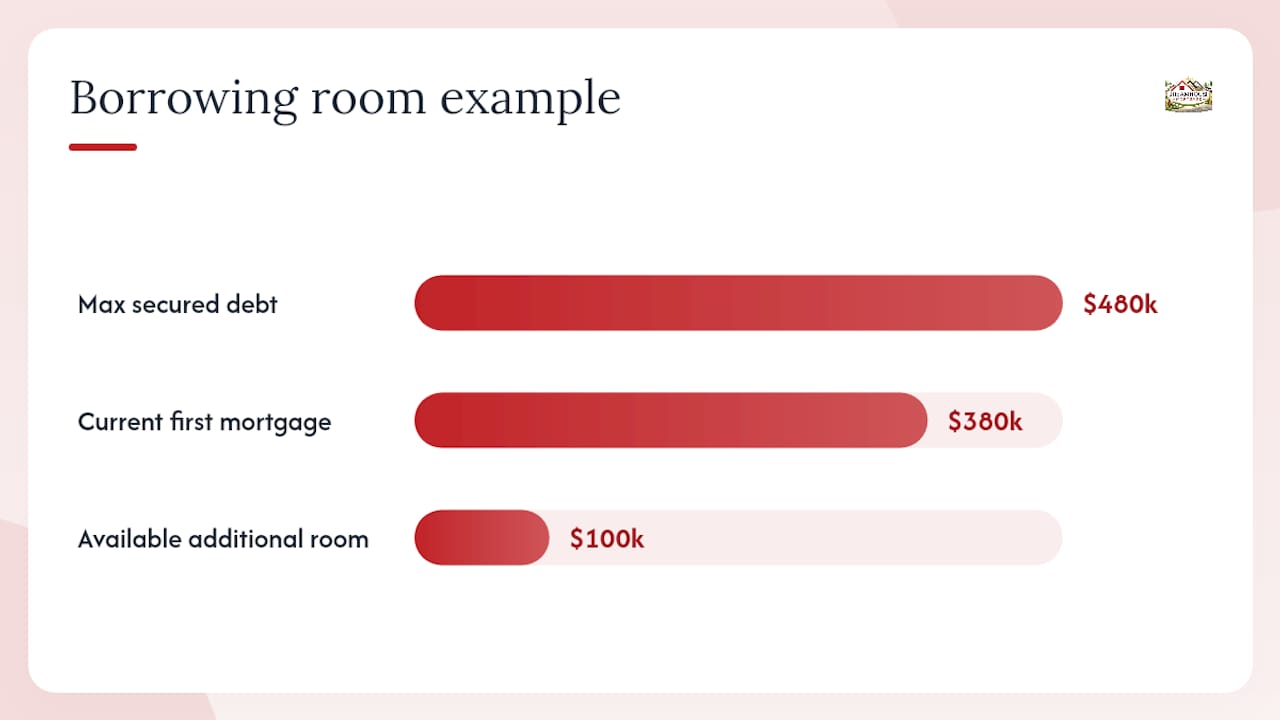
That 80% combined ceiling is worth sitting with for a moment. On a home appraised at $600,000, your total secured debt, first mortgage included, tops out around $480,000. If you already owe $380,000 on your first mortgage, you have roughly $100,000 of additional borrowing room before you hit the OSFI cap, regardless of which product you choose.
Refinancing becomes the smarter structural choice when your first mortgage is up for renewal anyway, when you want to consolidate everything into one payment, or when today’s rates are meaningfully better than what you’re currently locked into. If your existing mortgage carries a great rate with years left on the term, breaking it to refinance usually costs more in penalties than it saves, which is exactly when a HELOC or second mortgage in Calgary becomes the better move.
How Do HELOCs and Second Mortgages Actually Work?
The mechanics behind these products explain why they carry different rates and different risks, and why your lender treats them so differently on paper.
- HELOC registration and draws. A HELOC gets registered against your title as a revolving credit facility. The non-amortizing portion is capped at 65% of your appraised value under federal guidance, and you can draw and repay funds repeatedly within your approved limit, much like a very large line of credit. Interest accrues only on what you’ve drawn, and rates float with prime.
- Second mortgage and home equity loan structure. A second mortgage is registered as a distinct charge behind your first mortgage, which is why lenders call it a “subordinate” position. Functionally, a home equity loan is a second mortgage structured as a lump sum with a fixed or variable amortization schedule, rather than a revolving line. You get the full amount at closing and pay it down over a set term.
- Cash-out refinance mechanics. This approach discharges your current first mortgage and registers a new, larger one in its place. You get the excess equity as cash at closing, and your entire mortgage, old balance plus the new draw, now sits under one set of terms and one renewal date.
- Priority on title and pricing. Whoever holds the first-position charge gets paid first if a property is ever sold under distress. A HELOC held by the same lender as your first mortgage often occupies a similarly favorable position, while an independent second mortgage sits strictly behind it. That subordinate exposure is exactly why second mortgage lenders charge more for the risk they’re carrying.
What Will a HELOC or Second Mortgage Actually Cost You?
Expect HELOC rates to track prime closely, since lenders price the revolving portion off the Bank of Canada’s benchmark rate with a modest spread on top. Second mortgages price meaningfully higher, whether fixed or variable, because the lender is accepting subordinate risk on title. That gap is the trade-off for the lump-sum certainty a second mortgage gives you.
Beyond the interest rate itself, budget for these standard closing costs:
- A professional appraisal to confirm current market value, since your borrowing limit is calculated directly off that number.
- A title search and, in most cases, title insurance to confirm no competing claims exist against the property.
- Legal fees to register the new charge and review terms before you sign.
- A potential mortgage-break penalty if you’re discharging an existing mortgage early to refinance instead.
Statistic Callout: A shift of just a few percentage points in your home’s appraised value can change your available borrowing room by tens of thousands of dollars at the 80% combined LTV threshold. A property appraised at $550,000 instead of $600,000 lowers your combined borrowing ceiling by $40,000, which is why a recent, accurate appraisal matters as much as the interest rate you’re quoted.
If you choose a HELOC, resist the temptation to treat interest-only payments as the permanent plan. Continually redrawing without paying down principal keeps your balance high indefinitely and can make lenders nervous at renewal time. Budgeting extra payments toward principal, even occasionally, reduces total interest cost and keeps your equity position healthier over the years you hold the line open.
How Do You Qualify for a HELOC or Second Mortgage in Alberta?
Lenders verify four things before approving either product: your available equity based on a fresh appraisal, your credit history and score, your income and existing debt load, and clean title confirmed through a search. Federally regulated lenders also apply the mortgage stress test under OSFI Guideline B-20 to HELOCs and second mortgages, qualifying you at a higher rate than you’ll actually pay, to confirm you can service the debt if rates climb.
From application to funding, expect roughly two to four weeks for a HELOC through a traditional lender, and often faster for a straightforward second mortgage through an alternative lender, assuming your documents are ready and the appraisal comes back clean.
Have these ready before you apply:
- Recent pay stubs or, if self-employed, two years of tax returns and financial statements.
- Your current mortgage statement showing outstanding balance and rate.
- Property tax assessment or recent appraisal, if you have one.
- Government-issued ID and confirmation of homeowner’s insurance.
Pro Tip: Order your own appraisal comparison before applying anywhere. Calgary’s neighborhood values, from Tuscany to Mahogany to the inner-city communities near Kensington, can shift enough between appraisers that it changes which LTV bracket you actually qualify under.
How Do You Decide Between a HELOC and a Second Mortgage?
Match the product to the goal, not the other way around. A renovation with staged costs, a home addition in phases, or an emergency cash cushion all favor a HELOC’s draw-as-needed structure. A one-time debt consolidation, a down payment for an investment property, or a defined business expense favors a second mortgage or refinance, since you know the exact amount you need.
- Home renovation in stages: choose a HELOC so you only pay interest on what’s drawn as each phase completes.
- Consolidating high-interest debt into one payment: choose a second mortgage or home equity loan for predictable, amortizing payments.
- Building an emergency fund: choose a HELOC, since an unused line costs you nothing until you draw on it.
- Funding a business or investment opportunity: choose whichever product keeps your first mortgage’s favorable rate intact, usually a second mortgage.
Ask your broker directly: What’s my appraised value based on, and how recent is it? What happens to my rate at renewal if I choose a HELOC? Would breaking my current mortgage to refinance cost more than keeping it and adding a second charge?
A Note From DreamHouse Mortgage
Guriqbal Chahal, MBA, PMP, is the Broker of Record at DreamHouse Mortgage in Calgary, helping Alberta homeowners navigate HELOCs, second mortgages, and refinances since 2013. DreamHouse Mortgage works with banks, credit unions, and alternative lenders across Calgary, Airdrie, and Cochrane to match each client’s equity goals with the right structure. Because registering a second charge affects title priority, consulting a real estate lawyer alongside your broker is worth doing before you sign.
Our Take: Why the “Cheapest Rate” Advice Falls Short
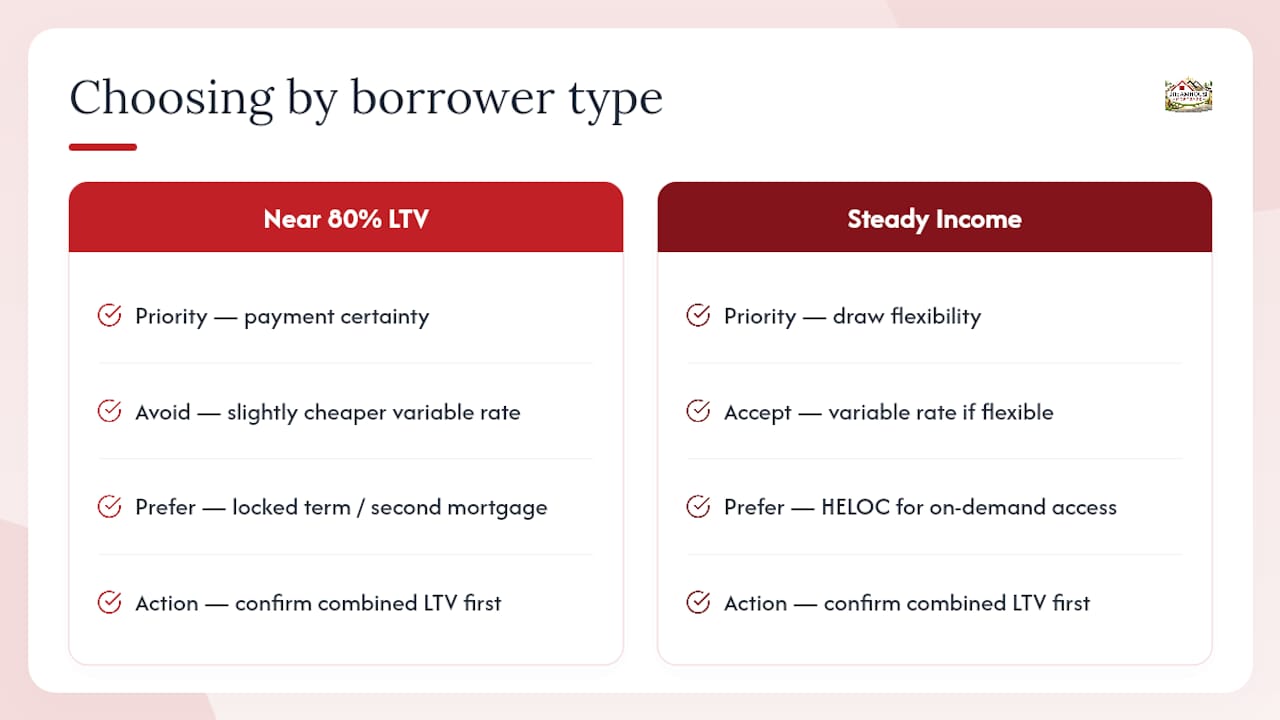
Most articles rank HELOC against second mortgage purely on rate, and that’s where the conventional advice misses the point. The real decision hinges on your OSFI-defined borrowing room and how predictable you need your payments to be, not just which product quotes the lower number today.
A homeowner near the 80% combined LTV ceiling with an adjustable income should prioritize payment certainty over a slightly cheaper variable rate. A homeowner with steady income and a genuinely flexible need should prioritize draw flexibility over locking in a lump sum they don’t need yet. The stress test exists precisely because low current rates have convinced too many borrowers to size their debt around today’s payment rather than tomorrow’s possibility. Get your appraisal and your combined LTV number first. Everything else, product choice, rate type, term length, follows from that one figure.
— Guriqbal Chahal, MBA, PMP
Ready to Access Your Home Equity? Call DreamHouse Mortgage
Comparing lenders, LTV brackets, and stress-test math on your own eats up time you’d rather spend planning your renovation or paying down debt. DreamHouse Mortgage shops your HELOC, second mortgage, or refinance option across multiple banks, credit unions, and alternative lenders at once, so you see real comparative offers instead of a single quote from one branch. That’s the practical difference between calling one bank and calling a broker who works with dozens of them.

Serving homeowners across Calgary, Airdrie, Cochrane, Chestermere, and Okotoks, DreamHouse Mortgage helps you figure out whether a HELOC, a second mortgage, or a full refinance actually fits your numbers, before you commit to anything. Guriqbal Chahal, MBA, PMP, personally walks Calgary clients through rate negotiation and appraisal strategy so you borrow against your equity with confidence, not guesswork. Call 403-966-6072 today, or visit the DreamHouse Mortgage Google Business Profile to book a consultation and get your combined LTV number calculated before you talk to a single bank.
This article is general information, not a substitute for advice from a qualified financial advisor. Consult a qualified financial professional about your own circumstances before acting on anything here.
Sources
- Clarification on treatment of innovative real estate-secured lending products under Guideline B-20
- Borrowing against home equity (Financial Consumer Agency of Canada)
- HELOC vs. Second Mortgage Canada: 2026 Complete Comparison Guide | Ratellow
FAQ
Is It Better to Get a Second Mortgage or a HELOC?
Neither is universally better. A HELOC suits flexible, ongoing borrowing needs, while a second mortgage suits a fixed lump-sum need or situations where preserving your first mortgage’s terms matters most.
What Is the Monthly Payment on a $50,000 HELOC in Canada?
It depends entirely on your rate and whether you’re paying interest-only or including principal, since HELOC rates float with prime and payments scale with your outstanding drawn balance, not the full credit limit.
What Are the Rules for Getting a Second Mortgage in Canada?
Your combined mortgage debt, first mortgage plus second charge, cannot exceed 80% of your home’s appraised value, and lenders will verify equity, credit, income, and clear title before approving funds.
Is a Second Mortgage Considered a HELOC?
No. A second mortgage is typically a lump-sum loan with fixed or amortizing payments, while a HELOC is revolving credit you draw against as needed, though both are registered as subordinate charges behind your first mortgage.