Title insurance is available in Alberta, is not legally required, but it provides one-time, long-term protection against hidden title risks that Alberta’s land title system and a Real Property Report do not always catch. Lenders financing Calgary, Cochrane, and Airdrie purchases almost always require a lender’s policy as a funding condition, and many buyers add an owner’s policy for their own protection. Expect a one-time premium, not an annual bill.
TL;DR:
- Title insurance in Alberta usually costs between $200 and $500 as a one-time premium, with higher prices for larger or more complex properties.
- It protects against risks like title fraud, undisclosed liens, encroachments, missing permits, and zoning violations that a property search might not reveal.
- A lender’s policy covers only the mortgage holder’s interests and is typically mandatory, while an owner’s policy protects the homeowner’s equity and remains in effect indefinitely.
- Buying title insurance early during the closing process can prevent last-minute surprises and is more cost-effective than purchasing coverage afterwards.
- The policy is usually arranged through your lawyer at closing, and it continues to provide coverage as long as you own the property.
Table of Contents
- Understanding Title Insurance Alberta Coverage Within the Torrens System
- What Does an Owner’s or Lender’s Policy Actually Cover?
- Owner’s Policy vs. Lender’s Policy: Who Pays and Who’s Protected
- What Title Insurance Costs in Alberta and What Drives the Price
- RPR vs. Title Insurance: Which One Does Your Calgary Purchase Need?
- Is Title Insurance Right for You? A Quick Decision Checklist
- How to Buy Title Insurance in Alberta, Step by Step
- How Claims Work and Where Coverage Stops
- How Calgary Mortgage Brokers Help You Get Title Requirements Right
- Why I Push Buyers to Talk Title Insurance Before They Even Offer
- Get Your Mortgage and Title Questions Answered Before You Offer
- Sources
- FAQ
Understanding Title Insurance Alberta Coverage Within the Torrens System
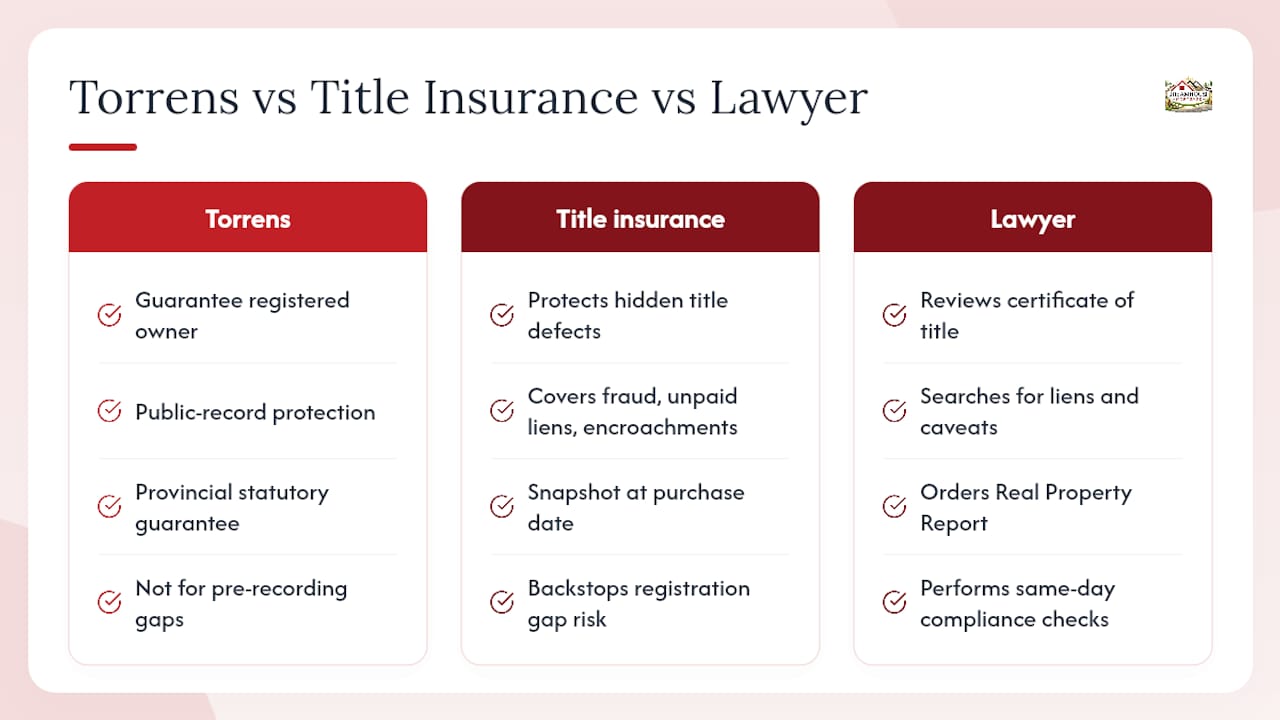
Alberta runs on a Torrens land titles system, meaning the province guarantees whoever is registered on title. That guarantee is powerful, but it does not protect against everything that can go wrong between the sale agreement and the day the deed is recorded, or against fraud and defects that never make it onto the public record.
Title insurance fills that gap. It works like a “frozen in time” snapshot: the policy protects against title defects, encroachments, or registration problems that existed at the time of purchase but stayed hidden, whether from title fraud, an old unpaid lien, or a permit that was never closed out. It does not cover new problems you create after closing, like a fence you build over the property line next year.
Lawyers play the central role in making this work. During closing, an Alberta real estate lawyer reviews the certificate of title, searches for registered liens or caveats, and orders any Real Property Report the transaction needs. Title insurance does not replace that legal review. It backstops it, particularly for what conveyancers call the “registration gap,” the narrow window between when funds change hands and when the new title is officially registered at Alberta’s Land Titles Office. Anything that slips into the system during that window, from a spousal claim to a last-minute judgment, is exactly the kind of risk title insurance helps Alberta lawyers manage when a same-day compliance check isn’t possible.
What Does an Owner’s or Lender’s Policy Actually Cover?
A standard Alberta owner’s policy is built around off-title risks, the kind of problems a title search alone won’t reveal. Coverage typically includes:
- Title fraud — someone forging documents to claim ownership or register a fraudulent mortgage against your home.
- Undisclosed liens or judgments — a contractor’s unpaid invoice or a prior owner’s court judgment registered against the property.
- Encroachments — a neighbor’s shed or fence line that crosses onto your legally surveyed lot.
- Missing building permits — a previous owner’s basement renovation or deck that was never permitted or inspected by the municipality.
- Zoning violations — a secondary suite or home business that doesn’t comply with Calgary’s or Airdrie’s zoning bylaws.
- Registration-gap exposure — a claim that surfaces after closing but before your new title is officially recorded.
Coverage remains in place as long as you own the property, and many policies extend automatically to your heirs if the home passes through an estate. A lender’s policy protects only the mortgage holder’s financial interest, up to the loan balance, and typically shrinks or disappears as you pay down the mortgage. It won’t cover your equity, your legal fees, or your peace of mind if a dispute over ownership ever lands in court.
Owner’s Policy vs. Lender’s Policy: Who Pays and Who’s Protected
The two policies serve different people, and mixing them up is one of the most common misunderstandings among first-time buyers.
- Lender’s policy: protects the bank or lender’s security interest in the mortgage; often mandatory as a condition of funding; does not protect the homeowner’s equity at all.
- Owner’s policy: protects your equity, your legal defense costs, and your right to the property itself; entirely optional but recommended in many situations.
- Who pays: in most Calgary-area closings, the buyer pays for both policies as part of closing costs, usually arranged through their real estate lawyer.
Buying both together at closing is standard practice and usually cheaper than adding an owner’s policy later. It becomes especially worth considering on older homes with a long ownership history, properties without a current Real Property Report, or any title with a complicated chain of past owners, easements, or estate transfers.
What Title Insurance Costs in Alberta and What Drives the Price
Pro Tip: Ask your lawyer to bundle the title insurance quote into your closing cost estimate before you sign your purchase contract. It avoids a surprise line item during your final walkthrough week.
Alberta title insurance is a one-time premium, not a recurring cost. Typical residential premiums commonly fall between roughly $200 and $500, and homes valued under $500,000 often land closer to $250 to $350. Higher-value properties, larger mortgage amounts, and rural or acreage properties near Rocky View County or Cochrane tend to push premiums toward the higher end of that range, since insurers price in more complex survey and title histories.
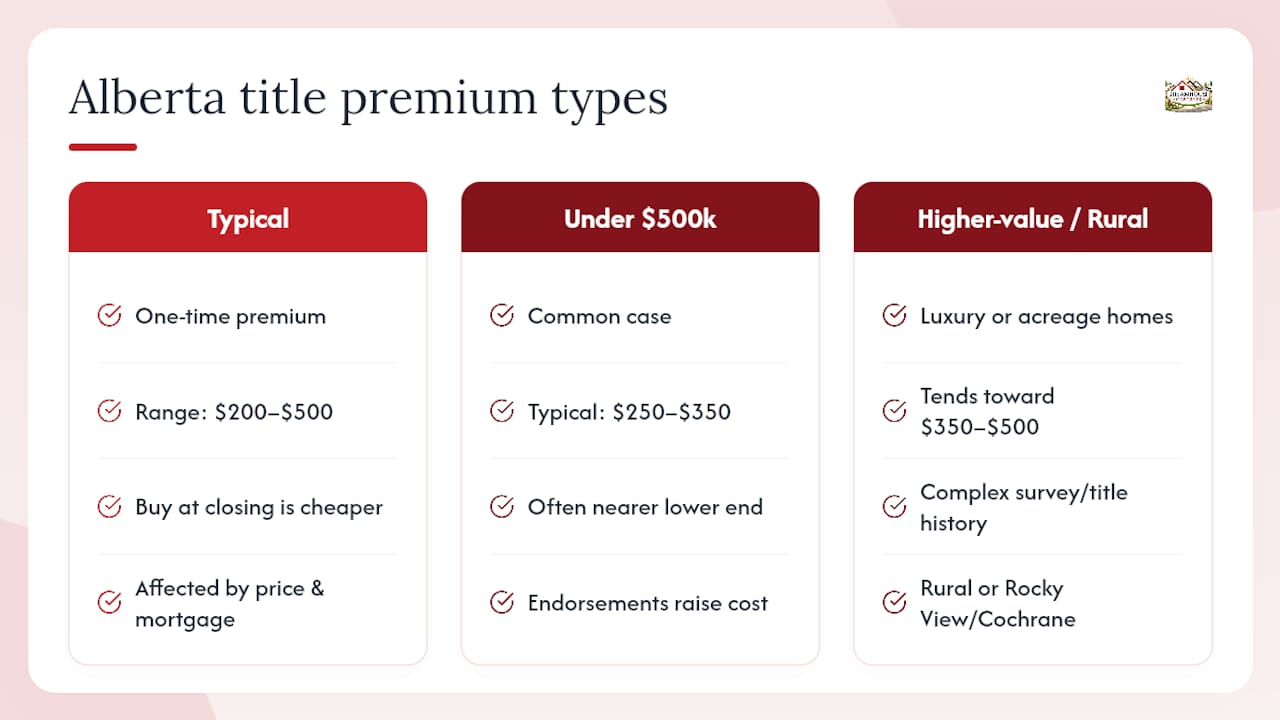
A few factors move the number: your purchase price, the size of your mortgage, any endorsements you add for a condo unit or unique property risk, and whether the property sits on unusual terrain that complicates boundary certainty. Ordering your policy at closing, through your lawyer, is almost always less expensive than trying to buy coverage after the fact, since post-closing policies can involve additional underwriting.
RPR vs. Title Insurance: Which One Does Your Calgary Purchase Need?
A Real Property Report is a legal survey document showing exactly where your home, garage, deck, and fences sit on your lot, along with written confirmation from the municipality that everything complies with local zoning and setback rules. It is the tool that proves compliance. Title insurance is the tool that protects you when compliance can’t be proven in time, or when a defect exists that no survey would catch anyway, like fraud or a hidden lien.
- An RPR with municipal compliance is often what lenders and lawyers prefer to see before closing, especially for freehold properties in Calgary neighborhoods like Auburn Bay or Evanston.
- Sellers sometimes offer a title insurance policy instead of paying for a fresh RPR, particularly when a recent survey doesn’t exist or an old one is outdated. This can save time and money, but it means boundary and compliance issues stay unverified rather than confirmed.
- Lawyers frequently use title insurance to bridge the gap when there’s no time to order a new RPR before an agreed closing date, letting the deal close on schedule while still protecting the buyer.
Neither tool fully replaces the other. A current RPR gives you certainty; title insurance gives you a financial backstop when certainty isn’t available on the timeline you’re working with.
Is Title Insurance Right for You? A Quick Decision Checklist
Run through this before you finalize your offer:
- How old is the property? Older homes carry more history and more chance of undocumented work.
- Is there a current Real Property Report? No RPR, or an outdated one, raises the case for title insurance.
- Is it a condo or freehold? Condo purchases may need specific endorsements for common-expense arrears or special assessments.
- Have there been recent renovations? A finished basement or new deck without permits is a common hidden risk.
- What does your lender require? Confirm this with your mortgage broker before you’re deep into closing week.
Bring these answers to your lawyer and your mortgage broker together so the decision is part of your overall closing plan, not an afterthought.
How to Buy Title Insurance in Alberta, Step by Step
- Request a quote through your real estate lawyer or directly through an insurer once you’re under contract.
- Confirm lender requirements so your lawyer orders a policy that satisfies both the lender’s condition and your own coverage preferences.
- Pay the one-time premium as part of your closing costs, typically settled through your lawyer’s trust account.
- Receive your policy documents at closing and keep them permanently, since coverage lasts as long as you own the home.
Existing homeowners who skipped title insurance at purchase can still buy a policy later, usually through a lawyer or directly from an insurer, though it’s less common and typically pricier than buying it at closing.
How Claims Work and Where Coverage Stops
When a covered issue surfaces, you notify the insurer, who then either defends your title in court or pays out your loss directly, depending on the nature of the claim. Response timelines vary by insurer and complexity, so keep your policy documents and closing paperwork accessible in case you ever need to file.
Exclusions matter as much as coverage. Policies generally exclude known defects the buyer was already aware of before closing, First Nations land claims, and problems that only a brand-new survey or physical inspection would reveal. If you suspected a boundary dispute before you bought the home and didn’t disclose it, don’t expect the claim to be honored later. Condo buyers should also confirm whether their policy includes endorsements for common-expense arrears, since standard policies don’t always include that automatically.
How Calgary Mortgage Brokers Help You Get Title Requirements Right
At Dreamhouse Mortgage, we raise title insurance early, during pre-approval, not after you’re already scrambling before closing. Confirming your lender’s specific title requirements up front means your lawyer can order the right policy without last-minute delays. Guriqbal Chahal, MBA, PMP, and the Dreamhouse Mortgage team coordinate directly with Alberta lawyers on behalf of Calgary, Cochrane, and Airdrie buyers so lender conditions and RPR timing don’t collide during a tight closing window.
Pro Tip: If your closing date is tight, tell your mortgage broker about the RPR situation as soon as you know it, so lender and lawyer expectations can be aligned before your financing condition deadline.
Why I Push Buyers to Talk Title Insurance Before They Even Offer
I’ve seen too many closings get stressful in the final week because title insurance and RPR questions came up too late. My recommendation is simple: raise it during pre-approval, before you write an offer on a Calgary or Cochrane home, so your lawyer and lender are aligned from day one. It’s a small conversation early that saves a lot of scrambling later. Call us and we’ll walk through it together.
— Guriqbal Chahal, MBA, PMP
Get Your Mortgage and Title Questions Answered Before You Offer
Dreamhouse Mortgage exists to take the guesswork out of Calgary-area financing, and that includes making sure lender title requirements never blindside you mid-closing. Where a bank might hand you a checklist and leave you to sort out what an RPR gap or a missing endorsement means, we walk Calgary, Cochrane, and Airdrie buyers through exactly what their lender expects, then coordinate directly with your lawyer so title insurance decisions are part of your financing plan, not a last-minute scramble.

Whether you’re a first-time buyer trying to understand pre-approval timing or a homeowner considering a refinance that could trigger new lender title checks, getting ahead of these questions saves real time at closing. Call Guriqbal Chahal, MBA, PMP, Mortgage Broker, at 403-966-6072, or find us on Google Business Profile to book a consultation and start your mortgage broker rate negotiation conversation today.
Sources
- What Is Title Insurance in Alberta? | DLegal Law Office
- How title insurance helps Alberta lawyers manage hidden risks, RPR gaps and post-closing exposure – LESA
- The importance of title insurance | CREBNow
- What Does Title Insurance Cover in Alberta: Costs and Exclusions – LegalClarity
This article is general information, not a substitute for advice from a qualified financial advisor. Consult a qualified financial professional about your own circumstances before acting on anything here.
FAQ
What is the average cost of title insurance in Alberta?
Most residential policies run between roughly $200 and $500 as a one-time premium, with homes under $500,000 often costing $250 to $350.
Is title insurance necessary in Alberta?
It’s not legally required, but lenders commonly require a lender’s policy to fund your mortgage, and an owner’s policy is worth strong consideration for older homes, missing RPRs, or complex title histories.
How do I get my title after paying off my mortgage in Alberta?
Once your mortgage is discharged, your lawyer or the lender registers a discharge at Alberta’s Land Titles Office, and your title insurance policy remains valid as long as you continue to own the property.
Where do I buy title insurance in Alberta?
You typically order it through your real estate lawyer at closing, who arranges the policy through a title insurance provider as part of your standard closing paperwork. If you’re mid-mortgage process, ask your mortgage broker about first-time buyer resources so title insurance gets folded into your closing plan early.
Recommended
- Mortgage Checklist Calgary: The Ultimate Proven Guide — Everything You Need Before Applying (2026)
- A First-Time Home Buyer’s Guide to Getting a Mortgage in Alberta
- Ultimate Guide to Mortgage Documents Required Alberta (2026 Checklist That Gets You Approved Faster)
- Mortgage Terms Explained Alberta Mortgage Glossary: 60 Essential Terms Every Calgary Buyer Must Know (2026)