
For most Calgary first-time buyers who want flexibility and market-wide pricing, comparing RBC and TD through a licensed broker like Dreamhouse Mortgage beats walking into either branch alone. Both banks offer solid fixed and variable products, but the deciding factor usually isn’t the headline rate. It’s whether you qualify under the OSFI stress test and whether someone is negotiating on your behalf.
TL;DR:
- A broker can access a wider range of lenders and often secure rates 0.10% to 0.30% below posted bank offers, saving thousands over the mortgage term.
- Small rate differences of 0.20% to 0.30% can change monthly payments by around $50 and add several thousand dollars in interest over five years.
- Prepayment flexibility and portability vary between RBC and TD, so matching these features to your plans can influence your overall mortgage cost.
- The OSFI stress test requires borrowers to qualify at the higher of the contract rate plus 2.00% or 5.25%, impacting borrowing power, especially for renewal or refinancing.
- Using an experienced broker streamlines documentation, negotiation, and comparison, particularly benefiting self-employed borrowers and complex financial profiles.
Table of Contents
- RBC vs TD Mortgage Comparison: Rates, Fees, and Flexibility
- How Much Do Rate and Fee Differences Actually Cost You?
- How to Choose Between RBC and TD: A Step-by-Step Checklist
- Why Work With a Local Calgary Mortgage Broker
- Special Offers and Loyalty Programs at RBC and TD
- Comparing Renewal and Refinance Options at RBC and TD
- Does Your Mortgage Choice Affect Your Credit Score?
- Customer Service and Support at RBC vs TD
- Digital Tools for Managing Your Mortgage at RBC and TD
- When Bank Direct Makes Sense and When a Broker Helps
- Get a Free Mortgage Comparison in Calgary
- Sources
- FAQ
RBC vs TD Mortgage Comparison: Rates, Fees, and Flexibility
RBC and TD both sit among Canada’s largest mortgage lenders, and both post competitive rates that shift week to week with bond yields and the Bank of Canada’s policy rate. Neither bank publishes a rate that stays fixed for long, so treat any number you see today as a starting point for negotiation, not a final offer.
RBC tends to lean on its Homeline Plan, a readvanceable mortgage that bundles a fixed-term mortgage with a home equity line of credit, appealing to homeowners who want to access equity without refinancing later. TD is often recognized for flexible prepayment options and competitive variable-rate promotions, which suit borrowers who expect to pay down their mortgage aggressively or who want more room to maneuver if their income changes.
Mortgage brokers shop your file across multiple lenders, including major banks, monoline lenders, credit unions, and alternative options, then bring back options with competitive rates and terms for your specific situation. Because brokers typically access 30 to 50 or more lenders and often land pricing 0.10% to 0.30% below a single branch’s posted deal, that comparison step alone can be worth thousands over the term of a typical mortgage.
Here’s how the three stack up on the dimensions that actually affect your closing costs and monthly payment:
| Lender | Typical 5-Year Fixed/Variable Band | Prepayment & Portability | Standout Product | Fees & Penalties | Best For | Broker-Submitted Deals |
|---|---|---|---|---|---|---|
| RBC Royal Bank mortgage | Competitive fixed and variable rates, adjusted with market conditions | Standard annual lump-sum and payment-increase privileges; Homeline Plan adds HELOC access | Homeline Plan (readvanceable mortgage plus HELOC) | Discharge and prepayment penalties calculated per RBC’s standard formulas | Borrowers who want branch access and an integrated banking relationship | Selectively accepts broker-submitted files depending on product |
| TD Bank mortgage | Competitive fixed and variable rates, frequent variable-rate promotions | Flexible prepayment privileges, often more generous lump-sum allowances | Flexible payment features paired with variable-rate offers | Discharge and prepayment penalties calculated per TD’s standard formulas | Borrowers prioritizing prepayment flexibility and variable-rate value | Selectively accepts broker-submitted files depending on product |
A few things to keep in mind as you read that table. Advertised rates change constantly, sometimes within the same week, so the numbers you see on a bank’s website today may not match what you’re quoted at your appointment.
For a first-time buyer in Airdrie shopping a $450,000 purchase, the practical question isn’t just “who has the lower rate this week.” It’s whether RBC’s Homeline structure fits your plan to renovate in three years, or whether TD’s prepayment terms match your bonus-heavy income. That’s exactly the kind of fit question a broker walks through with you before you pick a lender, rather than after you’ve already signed.
How Much Do Rate and Fee Differences Actually Cost You?
A rate gap that looks tiny on paper often isn’t tiny in dollars. On a $500,000 mortgage amortized over 25 years, a difference of even 0.20% between two offers can shift your monthly payment by roughly $50 to $55 and add several thousand dollars in interest paid over a five-year term. That’s real money, and it’s exactly why comparing RBC and TD side by side, rather than accepting whichever bank you already do your banking with, matters more than most buyers assume going in.
Prepayment privileges and portability. Both banks allow standard annual lump-sum payments and payment increases, but the exact percentages and how often you can use them vary by product and term. TD is often noted for more generous prepayment allowances on certain fixed products, while RBC’s Homeline Plan gives you a different kind of flexibility: ongoing access to home equity as you pay down your mortgage. Portability, the ability to move your mortgage to a new property without breaking your term, matters if you expect to move within Calgary, to Cochrane, or out to Chestermere within your term. Confirm the exact portability window (usually 30 to 120 days) with whichever lender you choose, because missing that window can force you into a full discharge penalty.
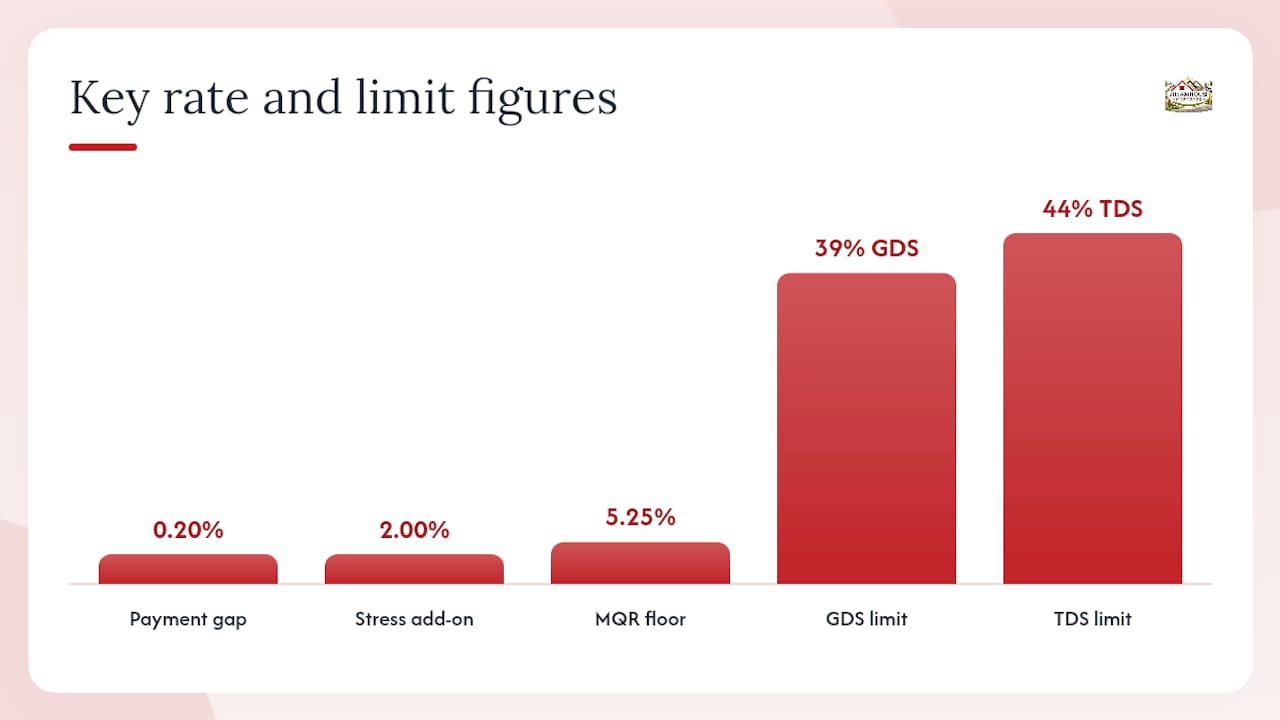
How the stress test changes your real borrowing power. OSFI’s minimum qualifying rate requires you to qualify at whichever is higher: your contract rate plus 2.00%, or a floor of 5.25%. Lenders also cap your Gross Debt Service ratio at 39% and your Total Debt Service ratio at 44%. If you’re renewing an existing uninsured mortgage as a straight switch, with the same balance, the same or shorter amortization, and no new money advanced, OSFI’s clarification exempts that transaction from the MQR, which opens real opportunities for renewal shoppers to move lenders without requalifying at the higher rate.
Quick fact: Under current CMHC guidelines, insured mortgages are available up to a purchase price of $1,500,000, and eligible first-time buyers and new-construction purchases can access 30-year amortizations with a CMHC premium surcharge. That extra five years of amortization compared to the old 25-year standard can meaningfully lower your monthly payment on a first purchase in Calgary or Airdrie.
Product types worth understanding before you compare. RBC and TD both offer fixed, variable, and cashback mortgage products, and RBC’s Homeline Plan bundles a HELOC into your mortgage structure for future equity access. TD frequently promotes variable-rate specials tied to prime rate movements. Neither bank’s cashback product is usually your cheapest option over five years once you account for the higher rate typically attached to it, so read the fine print carefully if a cashback offer looks tempting on move-in costs.
Fees, penalties, and the real cost of switching. Both banks calculate prepayment penalties using either three months’ interest or an interest rate differential (IRD), whichever is greater, for fixed-rate mortgages broken early. Variable-rate mortgages at both banks typically charge only three months’ interest, which is one reason some borrowers prefer variable products even when the rate itself is close. Before switching lenders at renewal or refinancing early, ask for the exact penalty calculation in writing. It’s the single most common surprise in the entire mortgage process.
- Confirm whether your product allows blend-and-extend if you want to break early without a full penalty.
- Ask what your discharge fee is if you switch lenders at the end of your term (usually $200 to $400).
- Get the exact IRD formula in writing, not just a verbal estimate, if you’re considering breaking a fixed term.
- Check whether refinancing (rather than a straight switch) triggers the higher OSFI stress test rate.
Pro Tip: Bring a written broker quote, complete with the product code, posted rate, and any lender fee credits, to your bank’s retention team before you renew. Retention teams will often match or come within 5 to 15 basis points of a competing offer just to keep your business, but only if you show them a real, specific comparison.
How to Choose Between RBC and TD: A Step-by-Step Checklist
Deciding between RBC, TD, and a broker-negotiated option doesn’t have to feel complicated if you work through it in order. Here’s the sequence that gets Calgary-area buyers to a confident decision fastest.
- Identify your borrower profile first. A first-time buyer in Cochrane with a stable T4 income has different priorities than a self-employed contractor in Calgary’s Beltline or an investor buying a second property in Airdrie. Your profile determines which lender’s underwriting style fits you best.
- Gather your documents before you ask for a rate. You’ll need two years of Notices of Assessment, recent pay stubs or, for self-employed applicants, financial statements and business registration, a down payment proof of funds, and a photo ID. Having these ready speeds up pre-approval by days.
- Get pre-approved with at least two sources. Approach RBC, TD, or both, and get a full-underwrite pre-approval quote from Dreamhouse Mortgage at the same time. A full-underwrite pre-approval checks your actual documents up front, not just a soft credit estimate, so there are fewer surprises at closing.
- Ask the right questions. Confirm the exact prepayment percentage, the portability window, whether the rate is truly locked or subject to change before closing, and what the penalty formula looks like if you break the term early.
- Use your broker quote to negotiate. If a bank’s posted rate is higher than what Dreamhouse Mortgage has sourced across its lender panel, bring that quote to the bank’s retention or mortgage specialist team. Comparing a bank’s best offer against a broker-sourced quote is standard practice, and it routinely results in a better final rate than accepting the first number offered.
- Confirm your closing timeline. Expect roughly 30 to 45 days from a signed purchase agreement to funding, though renewals can move faster since there’s no property transfer involved. Build in extra time if you’re self-employed or if your file needs additional underwriting.
The most common pitfall Calgary buyers run into isn’t a bad rate. It’s waiting until the last minute to gather documents, which forces a rushed decision instead of a compared one. Start the pre-approval conversation the moment you’re seriously house hunting, not after you’ve already found the property.
Why Work With a Local Calgary Mortgage Broker
Guriqbal Chahal leads the brokerage as Broker of Record, ensuring all files go through a licensed, accountable process. The brokerage serves Calgary, Airdrie, Cochrane, Chestermere, Okotoks, and surrounding Alberta communities, working across a lender panel that includes major banks, credit unions, monoline lenders, and alternative lenders.
The brokerage’s process centers on full-underwrite pre-approval, meaning your documents get reviewed thoroughly before you shop — not after an offer falls through. That approach matters most for:
- First-time buyers who want certainty on their maximum purchase price before they start touring homes.
- Self-employed professionals whose income documentation needs careful presentation to qualify at the best available rate.
- Renewal shoppers who want to know whether a straight-switch exemption applies before committing to their current bank’s renewal offer.
- Investors financing rental or second properties who need a lender comfortable with more complex debt-servicing calculations.
Because brokers negotiate directly with lender underwriting and retention teams, clients may get access to pricing and terms that aren’t always visible from a single bank’s branch counter. For a deeper look at how that negotiation process works, see how mortgage broker rate negotiation plays out step by step.
Special Offers and Loyalty Programs at RBC and TD
Both RBC and TD periodically run promotional pricing on variable-rate mortgages, cashback incentives for new purchases, and bundled offers for clients who hold multiple products, chequing accounts, credit cards, or investment accounts with the bank. These offers can look attractive on the surface, particularly cashback amounts that help cover closing costs on a first purchase.
The catch is that promotional pricing and loyalty perks are usually tied to a specific product structure, and the underlying rate on a cashback mortgage tends to run higher than a comparable no-frills fixed or variable product. Relationship pricing, where a bank offers a small rate discount for holding your day-to-day banking with them, can also be worth a modest amount, but it rarely outweighs a genuinely competitive rate sourced from a wider lender panel.
If you’re weighing whether a loyalty discount from your existing bank beats a market-wide comparison, ask for the exact numbers in writing and compare the total cost, not just the promotional headline, over your full term. A broker can run that comparison for you in a single conversation, which is often faster than tracking down the fine print on a bank’s promotional terms yourself.
Comparing Renewal and Refinance Options at RBC and TD
Renewal notices from RBC and TD typically arrive four to six months before your term ends, and the rate on that first notice is rarely the bank’s best offer. Both banks expect a portion of renewing clients to accept the number on the page without shopping around, which is exactly why comparing before you sign matters.
If you’re doing a straight-switch renewal, moving your existing balance to a new lender with the same or shorter amortization and no new money, you may qualify without requalifying at OSFI’s stress-test rate, provided the transaction meets the no-new-money and amortization conditions exactly. Refinancing, by contrast, involves increasing your balance or extending your amortization, and that pushes you back into full MQR qualification at both RBC and TD, along with any other lender.
Timelines differ slightly by transaction type. A straight-switch renewal often closes faster since there’s no new property to register, while a refinance involves a full re-registration of the mortgage and can take several weeks longer. For a full breakdown of what qualifies as a straight switch versus a refinance, the role of a mortgage broker at renewal is worth understanding before your renewal notice arrives.
Does Your Mortgage Choice Affect Your Credit Score?
Applying for a mortgage with RBC or TD triggers a hard credit inquiry, and multiple hard inquiries within a short window can cause a modest, temporary dip in your credit score. Most credit scoring models treat mortgage-related inquiries made within a 14 to 45 day window as a single inquiry for scoring purposes, which is designed specifically to let you rate-shop without being penalized repeatedly.
Once your mortgage is funded, both banks report your payment history to Canada’s credit bureaus every month, and consistent on-time payments generally help build your credit profile over time. Missed payments, by contrast, can affect your score significantly and stay on your credit file for years. Neither bank’s mortgage policies differ meaningfully in how they report to credit bureaus. The bigger factor is simply staying current on payments regardless of which lender you choose.
If you’re comparing RBC and TD alongside a broker-sourced quote, ask your broker how the applications will be submitted. A well-organized submission, using the rate-shopping window correctly, keeps your credit impact minimal while still letting you compare real offers.
Customer Service and Support at RBC vs TD
RBC and TD both operate extensive branch networks across Calgary and surrounding communities, along with phone support and mortgage specialist teams who can walk you through your application. Branch access matters if you prefer face-to-face conversations, particularly for a first mortgage where you have a lot of questions.
Response times and the depth of guidance you get can vary depending on which specialist you’re assigned to and how busy that branch is during peak home-buying season, typically spring and early summer in Calgary. Both banks also offer dedicated mortgage specialists who can meet outside branch hours in some cases, which helps buyers juggling work schedules.
Where a broker channel differs is continuity. At Dreamhouse Mortgage, one point of contact manages your file from application through funding, coordinating directly with whichever lender ultimately wins your business. That continuity can reduce the back-and-forth of being transferred between departments, particularly for self-employed files or purchases with tighter closing timelines.
Digital Tools for Managing Your Mortgage at RBC and TD
Both RBC and TD offer online banking platforms and mobile apps that let you view your mortgage balance, track your amortization schedule, make lump-sum prepayments, and adjust payment frequency without visiting a branch. These tools have become a standard expectation for most Canadian borrowers, and both banks have invested in making mortgage management accessible from a phone.
Where the platforms differ slightly is in how they present prepayment options and payment-increase tools. Some borrowers find one bank’s app more intuitive for tracking exactly how much of their annual prepayment allowance they’ve used. If digital self-service matters to you, ask to see a demo of the mortgage management screens before you commit, since screenshots on a bank’s marketing site don’t always reflect the live app experience.
For Calgary borrowers weighing fixed versus variable products and wanting to model different payment scenarios before choosing, a fixed versus variable decision guide can help you understand how your bank’s digital tools will actually be used month to month.
When Bank Direct Makes Sense and When a Broker Helps
If you have a straightforward file, a stable T4 income, a strong credit score, and a simple purchase or renewal with no new money, going directly to RBC or TD can work perfectly well. Simple files close quickly at both banks, and there’s little to negotiate when your numbers are already strong.
Where a broker adds real, measurable value is on complex files: self-employed applicants in Calgary whose income needs careful documentation, investors financing a second property in Airdrie, and renewal shoppers deciding whether a straight-switch exemption applies to their situation. I’ve seen the difference full underwriting makes before submission, not after a decline. For those borrowers, comparing RBC and TD through a broker isn’t extra effort. It’s the step that determines whether you qualify at all, and at what rate.
— Guriqbal Chahal, MBA, PMP
Get a Free Mortgage Comparison in Calgary
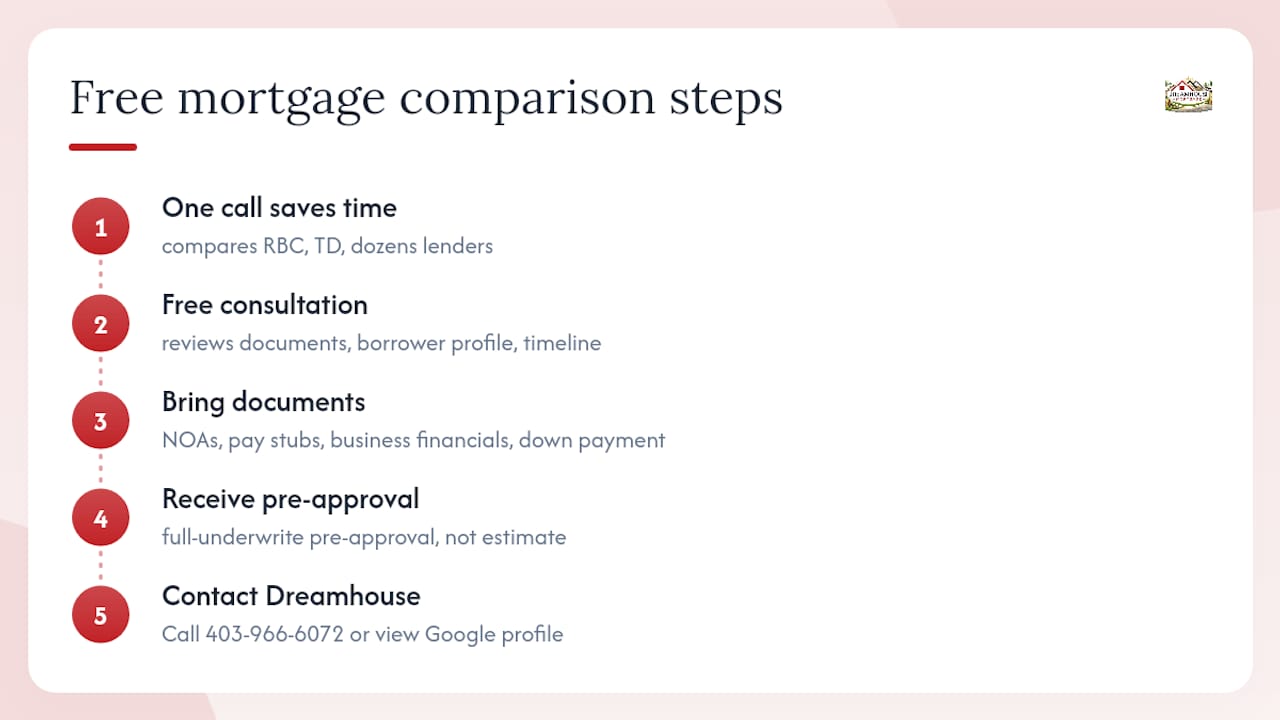
Comparing RBC and TD on your own means calling two branches, waiting on two separate pre-approvals, and hoping you asked the right questions each time. Dreamhouse Mortgage does that comparison for you in one conversation, checking RBC, TD, and dozens of other lenders against your actual file, then bringing back the strongest combination of rate, prepayment terms, and portability for your specific situation in Calgary, Airdrie, or Cochrane.

A free consultation with Guriqbal Chahal reviews your documents, borrower profile, and timeline, and can result in a full-underwrite pre-approval rather than a rough estimate. Bring your last two years of Notices of Assessment, recent pay stubs or business financials, and proof of your down payment, and the process moves quickly from there. If you already have a rate quote from RBC or TD, bring that too. It’s often the fastest way to see whether broker rate negotiation can improve on what you’ve already been offered.
Call Guriqbal Chahal, MBA, PMP, Mortgage Broker, at 403-966-6072, or visit the Dreamhouse Mortgage Google Business Profile to see local reviews and get directions. Whether you’re buying your first home in Calgary or renewing a mortgage in Cochrane, a quick call today can save you from signing the first offer you see.
Sources
The regulatory and rate context in this article draws on the following government and Bank of Canada sources:
Rates and program details change frequently. Always confirm current terms directly with a lender or broker before making a decision.
This article is general information, not a substitute for advice from a qualified financial advisor. Consult a qualified financial professional about your own circumstances before acting on anything here.
FAQ
Which Canadian bank is best for mortgages?
There’s no single best bank for every borrower. RBC suits buyers who want an integrated banking relationship and strong fixed-rate products, TD suits those prioritizing prepayment flexibility, and a broker comparison suits anyone who wants both options weighed against the wider market.
Which Canadian bank is better, RBC or TD Bank?
Both are strong, well-established lenders with competitive products, and the better choice depends on your borrower profile, whether you value branch access and Homeline-style equity products (RBC) or prepayment flexibility and variable-rate promotions (TD).
Who is offering the best mortgage rate in Canada?
The lowest available rate shifts constantly with the Bank of Canada’s policy rate and bond yields, and it varies by lender and product type. Comparing a live quote from Dreamhouse Mortgage against RBC and TD’s current offers is the most reliable way to see who has the best rate for your specific file today.
Is RBC a good bank for mortgages?
Yes, RBC is one of Canada’s largest mortgage lenders, with an established fixed-rate lineup and the Homeline Plan for borrowers who want ongoing equity access. Whether it’s the right fit still depends on comparing its terms against TD and broker-sourced alternatives for your specific situation.
Does a mortgage broker cost more than going directly to RBC or TD?
No. Mortgage brokers in Canada are typically paid a commission by the lender once your mortgage funds, so there’s usually no direct cost to you for using a broker like Dreamhouse Mortgage to compare RBC, TD, and other lenders.