
A co-signer is legally liable for a mortgage from the day it funds, with their name registered on title alongside the borrower’s. A guarantor is meant to serve as a backup who only pays if the primary borrower defaults, but many Canadian lender contracts blur that line, making a guarantor’s liability nearly as immediate as a co-signer’s. Read the exact wording before you sign anything, and get independent legal advice first.
TL;DR:
- Co-signers are registered on title and can be pursued immediately after missed payments, affecting their own credit and borrowing capacity.
- Guarantors are not usually on title and are meant to pay only if the primary borrower defaults, but many bank forms enable quick lender pursuit without proper sequencing.
- Lenders typically run full credit and financial checks on both roles, with co-signers’ debts impacting their debt ratios immediately upon signing.
- Protect yourself by obtaining the exact wording of liability agreements, legal advice, and written lender promises before you co-sign or guarantee.
- Adding a co-signer on title can influence provincial rebate eligibility and create tax or ownership complications down the line.
Table of Contents
- Co-Signer vs Guarantor: The Key Differences at a Glance
- What Does a Co-Signer Actually Do in Canada?
- What Does a Guarantor Actually Do in a Mortgage?
- How Much Can a Missed Payment Actually Cost a Co-Signer or Guarantor?
- How Do Canadian Lenders Decide Between a Co-Signer and a Guarantor?
- How to Protect Yourself Before You Co-Sign or Guarantee a Mortgage
- What Calgary and Alberta Buyers Should Watch For
- Why the Standard Advice on Co-Signing Falls Short
- Get Local Guidance Before You Sign as a Co-Signer or Guarantor
- Where to Check Canadian Rules Before You Sign
- Sources
- FAQ
Co-Signer vs Guarantor: The Key Differences at a Glance
The core distinction comes down to timing of liability and whether your name lands on the property title. A co-signer is a full co-borrower: the lender can pursue them for payment the moment a mortgage payment is missed, no questions asked. A guarantor, on paper, is only supposed to pay if the borrower and the lender’s other recovery efforts fail, but Canadian bank guarantee forms often skip that sequencing and allow the lender to demand payment right away.
Here’s how the two roles typically break down for Alberta mortgages:
- Document signed: Co-signers sign the mortgage and mortgage note directly; guarantors sign a separate guarantee agreement.
- Title/ownership: Co-signers are almost always registered on title; guarantors typically are not.
- Credit reporting: Both appear on credit bureau files as obligations, but co-signed debt usually shows as a joint account immediately, affecting the helper’s debt service ratios right away.
- Common use case: Parents co-sign so a child can qualify for a first home; a guarantor arrangement shows up when an applicant is close to qualifying on their own but needs a small income boost.
- Lender pursuit timing: Co-signers can be pursued alongside the borrower from the first missed payment; guarantors are contractually a step behind, though many bank forms narrow that gap significantly.
What Does a Co-Signer Actually Do in Canada?
A co-signer isn’t a helper on paper only. Lenders underwrite them as a full co-borrower, which means their income, debts, and credit score get folded into the mortgage qualification calculation the same way the primary applicant’s would be. In Alberta, that usually means the co-signer’s name goes on both the mortgage and the property title.
Here’s what that involves in practice:
- Underwriting: The lender pulls the co-signer’s credit bureau file, verifies income, and calculates combined debt service ratios for the household.
- Title registration: Most Alberta lenders require the co-signer to be registered on title, which can trigger tax and ownership questions down the road, especially if the co-signer already owns property elsewhere.
- Credit impact: The mortgage shows up on the co-signer’s credit report immediately and reduces how much they can borrow for their own home or vehicle.
- Removal: Getting off the mortgage usually means the primary borrower refinances solo once they qualify independently, or the co-signer is released at renewal if the lender agrees.
Pro Tip: Ask the lender in writing, before you sign, what specific steps and credit criteria the primary borrower needs to hit to have you released. Verbal promises from a loan officer mean nothing once the mortgage is funded.
What Does a Guarantor Actually Do in a Mortgage?
A guarantor’s job is supposed to be simple: promise to pay if the primary borrower can’t, without owning any part of the property or appearing on title. That’s the textbook version. In real Canadian mortgage practice, the guarantee agreement itself often gives the lender the right to demand payment from the guarantor as soon as the borrower defaults, not after exhausting other options first.
A few things every prospective guarantor should understand:
- Lenders still run a full credit and income check on a guarantor, and that guarantee shows up as a contingent liability on the guarantor’s own credit file.
- Because a guarantor carries risk without the security of title, major chartered banks use this structure less often than co-signer arrangements, per guidance from the Financial Consumer Agency of Canada.
- Guarantor arrangements still appear with credit unions, alternative lenders, and in rental housing situations, particularly for newcomers to Canada building a credit history, as Settlement explains.
- Some legal analyses note that bank-drafted guarantee wording frequently removes the “secondary” protection guarantors assume they have, so reading the actual clause matters more than the label on the form.
How Much Can a Missed Payment Actually Cost a Co-Signer or Guarantor?
Missed payments don’t stay contained to the primary borrower’s file. When a mortgage payment goes 30, 60, or 90 days late, that delinquency reports on every party attached to the loan, including a co-signer, and often a guarantor too, once the lender formally calls on the guarantee.
That contingent liability follows the supporter into their own financial life. A co-signer who applies for a car loan or a mortgage on their own home will have that co-signed debt is counted against their debt service ratio, even if they’ve never made a payment on it themselves. That can shrink how much they qualify to borrow, sometimes enough to derail their own home purchase timeline.
Statistic Callout: The Financial Consumer Agency of Canada confirms lenders assess a borrower’s total debt obligations, including co-signed debt, when calculating qualification. That single fact is why a co-signer’s own borrowing power drops the moment they sign.
If the account goes into default and stays there, the lender can pursue collections or a court judgment against a co-signer or a triggered guarantor under joint and several liability. That means the lender doesn’t have to split the claim proportionally. It can seek the full outstanding balance from whichever party is easiest to collect from.
How Do Canadian Lenders Decide Between a Co-Signer and a Guarantor?
Chartered banks generally lean toward co-signer structures because registering a helper on title gives the lender clearer, more enforceable security. Credit unions and alternative or private lenders tend to have more flexibility, and are more often willing to work with a pure guarantor arrangement, particularly when the primary borrower’s income is strong but slightly short of the qualifying line.
Mortgage insurers also factor into this. When a deal requires high-ratio insured financing, down payment and qualification rules can shape whether a guarantor’s income counts the same way a co-signer’s would. This is one of the more overlooked details of Alberta mortgage shopping, and it’s part of why comparing stated income lenders matters when a straightforward salaried co-signer isn’t available.
Before agreeing to either role, ask the lender directly:
- Will the guarantor or co-signer be on title, and does that change based on lender or insurer?
- What is the lender’s written policy for releasing a co-signer or guarantor after a set number of on-time payments?
- Does the guarantee agreement allow the lender to pursue the guarantor immediately, or only after exhausting recovery from the borrower?
- How will this arrangement show up on the supporter’s credit bureau file?
How to Protect Yourself Before You Co-Sign or Guarantee a Mortgage
Protecting yourself starts well before you pick up a pen. Treat the request the same way you’d treat applying for your own mortgage, because in every practical sense, you are.
- Request the exact wording on joint and several liability and the lender’s release policy, and read it in full rather than relying on a summary from the loan officer.
- Get independent legal advice from a lawyer who isn’t representing the borrower or the lender, since provincial rules on suretyship and liability can vary.
- Get lender promises in writing, including any timeline for release or refinance eligibility.
- Map out an exit plan covering legal fees, appraisal costs, and potential penalties if the primary borrower needs to refinance you off the mortgage later.
Pro Tip: Before agreeing, ask your mortgage broker to run a “what if” scenario showing how the co-signed or guaranteed debt would affect your own borrowing capacity for the next five years. Most people are surprised by the number.
What Calgary and Alberta Buyers Should Watch For
As an experienced mortgage broker, Guriqbal Chahal has guided Calgary, Airdrie, and Cochrane families through exactly these decisions. One recurring issue: adding a co-signer to title can affect a first-time buyer’s provincial rebate eligibility, since ownership history and proportions factor into that determination. A broker can also identify credit unions or lenders more open to guarantor structures and help plan a timed release at renewal, once the primary borrower qualifies alone.

Why the Standard Advice on Co-Signing Falls Short
Most articles on this topic treat “co-signer vs guarantor” as a tidy legal distinction, and then move on. That’s not how it plays out for Calgary families. The real risk isn’t the label on the form. It’s whether the specific lender’s paperwork actually honors the theoretical protection a guarantor is supposed to have.
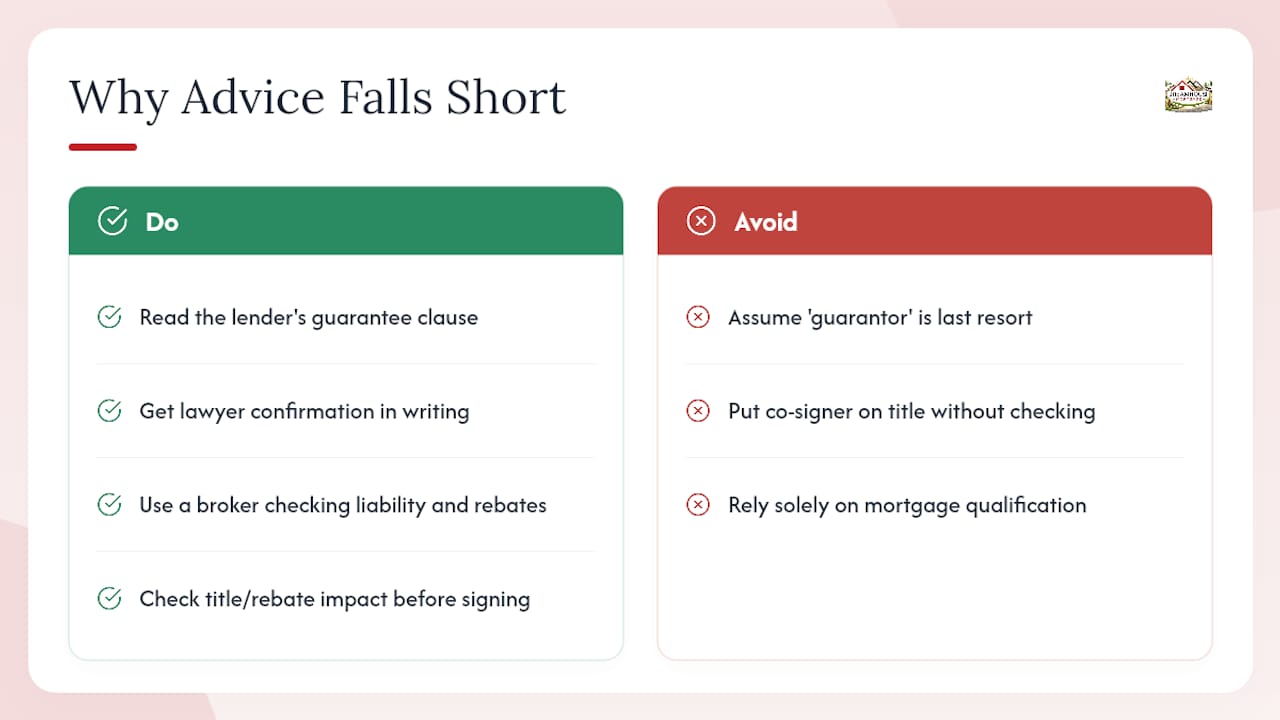
I’ve seen the assumption trip up well-meaning parents more than once: they agree to “just guarantee” a child’s first mortgage, believing they’re a last resort, only to discover the bank’s guarantee clause lets the lender come after them the same week as a missed payment. That’s not a rare loophole. It’s common enough in standard bank documentation that I tell every client to assume guarantor means co-signer in practice unless their lawyer confirms otherwise in writing.
The other blind spot is title and rebate impact. Buyers focus on qualifying for the mortgage and forget that putting a co-signer on title can quietly affect a first-time buyer’s provincial rebate eligibility down the line. If you’re helping a Calgary or Cochrane buyer get into their first home, structure the deal with a broker who checks both boxes: the lender’s real liability terms and the long-term ownership consequences, before you sign anything.
— Guriqbal Chahal, MBA, PMP
Get Local Guidance Before You Sign as a Co-Signer or Guarantor
Reading bank guarantee wording on your own, or hoping a bank branch employee explains the fine print clearly, leaves too much to chance. We provide Calgary, Airdrie, and Cochrane families with mortgage broker services that include reviewing the actual lender contract with you before you agree to anything.

Whether you’re a parent helping a child with a first-time home buyer mortgage, a partner considering a co-borrower structure, or a supporter trying to understand your exposure, Our service includes walking through mortgage pre-approval, comparing lenders more willing to work with guarantor arrangements, and mapping out release or refinance plans to help avoid remaining on someone else’s mortgage longer than necessary. We also help structure exit timing through mortgage refinancing in Calgary once the primary borrower is ready to qualify solo.
Call Guriqbal Chahal, MBA, PMP, Mortgage Broker, at 403-966-6072, or find Dreamhouse Mortgage on Google Business Profile to book a consultation. Get the lender’s real terms explained before you commit to helping someone else buy a home.
Where to Check Canadian Rules Before You Sign
Before agreeing to co-sign or guarantee any Canadian mortgage or loan, review the government sources that explain the underwriting and qualification rules lenders actually follow:
- Financial Consumer Agency of Canada — Pre-approval and mortgage qualification
- Canada Revenue Agency — First Home Savings Account (FHSA)
- Settlement
These are starting points, not a substitute for independent legal advice on your specific situation.
Sources
- Financial Consumer Agency of Canada — Pre-approval and mortgage qualification
- Canada Revenue Agency — First Home Savings Account (FHSA)
- Settlement
FAQ
Which Is Better, a Co-Signer or a Guarantor?
Neither is universally better. A co-signer suits situations where the lender wants full security through title registration, while a guarantor arrangement can work when the borrower is close to qualifying alone and only needs a modest backstop.
Who Cannot Be Your Guarantor?
Lenders generally won’t accept a guarantor with insufficient income, a weak credit history, or an existing financial tie to the borrower that creates a conflict, such as a spouse who is also on the mortgage application.
What Is the Disadvantage of Being a Co-Signer?
The main disadvantage is that the co-signed debt counts fully against your own debt service ratios immediately, which can reduce how much you qualify to borrow for your own home, vehicle, or other financing.
Can Someone With a 500 Credit Score Cosign?
Most Canadian lenders require a co-signer with a strong credit score, since the lender is relying on that person’s creditworthiness to strengthen the application, not weaken it.
Do I Need a Co-Signer or Guarantor for My First Mortgage in Calgary?
Not always. Many first-time buyers in Calgary, Airdrie, and Cochrane qualify independently once a broker reviews their income and down payment against current lender requirements, which is worth confirming before assuming you need help.
Recommended
- Mortgage Checklist Calgary: The Ultimate Proven Guide — Everything You Need Before Applying (2026)
- Avoid Ongoing Liability: Broker Guided Assumable Mortgages in Calgary
- Mortgage Terms Explained Alberta Mortgage Glossary: 60 Essential Terms Every Calgary Buyer Must Know (2026)
- First Time Homebuyer Mortgage Calgary: The Complete 2026 Guide