Yes, some Canadian lenders and insurers, including CMHC, allow a borrowed down payment, but the rules narrow your options fast. The Government of Canada’s own qualification standards require that any loan repayment tied to your down payment gets counted against your debt ratios, which typically reduces your maximum mortgage approval. Disclosure of borrowed funds is mandatory, not optional, and skipping it can sink your application entirely. For most Calgary buyers, borrowing to close the gap is workable in narrow cases, but it rarely comes without trade-offs.
TL;DR:
- Borrowed down payments are only accepted under specific conditions and must be fully documented, with lenders requiring loan agreements and proof of funds.
- Including borrowed funds in your down payment increases your debt service ratios, often significantly reducing your maximum mortgage amount.
- Using borrowed funds can push you into higher mortgage insurance premium brackets, especially at higher loan-to-value ratios near 95 percent.
- Borrowed down payments from private sources or lines of credit are scrutinized for conflicts of interest and can be classified as mortgage fraud if undisclosed or misrepresented.
- Alternatives like the First Home Savings Account or gift funds usually do not impact your debt ratios and are preferable first steps for buyers with short-term savings gaps.
Table of Contents
- What Counts as a Borrowed Down Payment in Canada
- Which Lenders and Insurers Accept Borrowed Down Payments
- How Borrowed Funds Change Your Mortgage Math
- What Documentation Lenders Expect, and Why Hidden Loans Backfire
- Alternatives Calgary Buyers Should Weigh First
- Beyond TDS: The Wider Debt Picture Lenders Weigh
- Long-Term Financial Stability and Your Credit Score
- Real Scenarios: How Borrowing Changes What You Qualify For
- The Legal and Ethical Line Around Borrowed Funds
- A Calgary Broker’s View on When Borrowing Makes Sense
- Get a Down Payment Strategy Built for Your Calgary Purchase
- Sources
- FAQ
What Counts as a Borrowed Down Payment in Canada
A borrowed down payment is money you use toward your purchase that comes from a loan, line of credit, or other repayable source, rather than from your own savings or a true gift. Lenders draw a hard line between the three: saved funds you’ve accumulated, gift funds from an immediate family member with no repayment expected, and borrowed funds that create a new monthly obligation. That distinction changes how your file gets underwritten.
Canada’s minimum down payment thresholds set the floor everyone works from:
- 5% on the portion of the purchase price up to $500,000
- 10% on the portion between $500,000 and $1.5 million
- 20% on any amount at or above $1.5 million
These figures come directly from the Financial Consumer Agency of Canada’s down payment rules, and they apply whether your down payment is saved, gifted, or borrowed. Anything under 20% down triggers mandatory mortgage default insurance, and that insurance requirement is exactly where borrowed-fund scrutiny gets tightest, because insurers want to know the source of every dollar backing a high-ratio loan.
Which Lenders and Insurers Accept Borrowed Down Payments
CMHC’s Purchase program permits flexible down payment sources, including certain non-traditional or “homeowner loan” arrangements, but the flexibility comes with conditions rather than a blanket yes. Not every lender treats borrowed funds the same way, and insurer rules shift depending on property type and loan-to-value.
Here’s what typically shapes eligibility:
- CMHC Purchase program: allows non-traditional down payment sources under specific criteria, detailed on the CMHC Purchase program page.
- Insured mortgage ceiling: default insurance is only available on homes priced under $1.5 million, so borrowed-fund flexibility disappears above that threshold.
- Property type: owner-occupied properties with one or two units generally see the most lender openness; rental and multi-unit properties face tighter restrictions.
- Credit expectations: lenders reviewing non-traditional sources want a strong, well-documented credit history, since the file already carries extra debt-service risk.
Not every lender on the market will underwrite a file built on borrowed funds, which is part of why shopping across banks, credit unions, and monoline lenders matters. A mortgage pre-approval run early tells you which of those doors are actually open before you get attached to a listing.
How Borrowed Funds Change Your Mortgage Math
Every insured mortgage in Canada is qualified against two ratios: Gross Debt Service (GDS), capped at 39%, and Total Debt Service (TDS), capped at 44%. The Financial Consumer Agency’s mortgage qualification guidance confirms that any monthly repayment tied to your borrowed down payment must be folded into that TDS number.
The multiplier effect: because lenders divide your income into a fixed ratio, a modest monthly loan payment can shrink your maximum mortgage by several times the amount you actually borrowed. Borrowing $15,000 at a $300 monthly repayment doesn’t just remove $15,000 from your buying power. It can remove $40,000 to $60,000 or more from your approved mortgage amount, depending on your income and existing debt load.
That’s the part most first-time buyers never see coming.
Two more consequences worth flagging:
- Higher loan-to-value ratios (meaning a smaller effective down payment once you account for what you owe) can push you into a higher mortgage default insurance premium band, sometimes as high as the top premium band for non-traditional down payments near the maximum 95% loan-to-value ratio, per CMHC’s premium schedule.
- A borrowed down payment doesn’t reduce the insurance premium calculation itself, since insurers price based on LTV, not on the source of your funds, but it does affect the debt ratios that decide whether you qualify at all.
What Documentation Lenders Expect, and Why Hidden Loans Backfire
Lenders and insurers accept a defined list of down payment sources, and borrowed funds sit on that list only when they’re fully documented. Expect a paper trail request the moment anything looks like new money.
- Loan agreements. If you’re using a personal loan or line of credit, the lender wants the agreement, the interest rate, the repayment term, and the exact monthly payment.
- Transaction history. Most underwriters review 90 days of bank statements, watching for deposits that don’t match your normal income pattern.
- Source confirmation. Large or unusual deposits need a plausible, provable explanation, whether that’s a loan disbursement, an asset sale, or a gift.
- Arm’s-length declarations. Where a lender allows borrowed funds from a private source, they’ll often require confirmation the lender isn’t connected to the deal in a way that creates conflict.
Undisclosed borrowed funds are treated as a serious problem, not a paperwork oversight. CMHC’s mortgage fraud guidance is direct about this: hiding the source of a down payment, or disguising a loan as a gift, can be classified as mortgage fraud and can result in application denial or worse.
Pro Tip: Pull your own bank statements 90 days before you apply and look at them the way an underwriter would. Any deposit you can’t explain in one sentence is a deposit that will slow down your approval.
Alternatives Calgary Buyers Should Weigh First
Borrowing isn’t the only lever available to Alberta buyers who are short on their down payment, and in most cases it isn’t the first one worth pulling. A few routes preserve your buying power instead of eating into it.
- The First Home Savings Account (FHSA) lets you contribute and grow funds tax-free specifically for a home purchase, with no repayment obligation attached to the money once you use it.
- The RRSP Home Buyers’ Plan allows a withdrawal from your RRSP for a down payment, repayable over time back into your own RRSP rather than to a lender at interest.
- Gifted funds from an immediate family member carry no monthly repayment and no TDS impact, which is why they remain the cleanest alternative to a loan.
- Selling an asset or staging your purchase, such as buying a smaller property first and moving up later, avoids new debt altogether.
- A structured savings plan timed against your target purchase date often closes the same gap without touching your qualifying ratios.
Short-term borrowing can still make sense in specific situations, such as a bridge between a home sale closing and a purchase closing, but that’s a decision worth modeling with a broker before you sign anything. The mortgage down payment guide for Calgary and Alberta buyers walks through how each source is classified.
Beyond TDS: The Wider Debt Picture Lenders Weigh
TDS is the ratio that decides your approval, but it’s not the only signal a lender reads when you’re using borrowed money for your down payment. A new loan changes your credit utilization the moment it’s disbursed, and credit bureaus factor utilization into your score independently of anything a mortgage underwriter calculates.
If the borrowed amount comes from a line of credit rather than a fixed-term loan, your utilization on that account can spike overnight, which sometimes dents your credit score in the weeks before your mortgage application gets reviewed. That’s a bad time for a dip, since most lenders pull credit again close to closing.
There’s also the question of total leverage. A buyer who borrows for a down payment is, by definition, entering homeownership with two debts instead of one: the mortgage and the down payment loan. Lenders qualify you against a ceiling, but your household budget doesn’t stop caring once you’re past that number. Every dollar going to a down payment loan is a dollar not going to furniture, moving costs, property tax adjustments, or the maintenance reserve every new Calgary homeowner eventually needs.
Some buyers also carry the borrowed amount alongside existing obligations like a car loan or student debt, and stacking a third repayment on top changes the household’s flexibility to absorb a rate renewal down the road. It’s rarely just about clearing today’s ratio. It’s about what your finances look like the day your mortgage comes up for renewal in three or five years.
Long-Term Financial Stability and Your Credit Score
A borrowed down payment doesn’t just affect the approval decision on day one. It shapes your financial position for years afterward, in ways that are easy to underestimate when you’re focused on getting the keys.
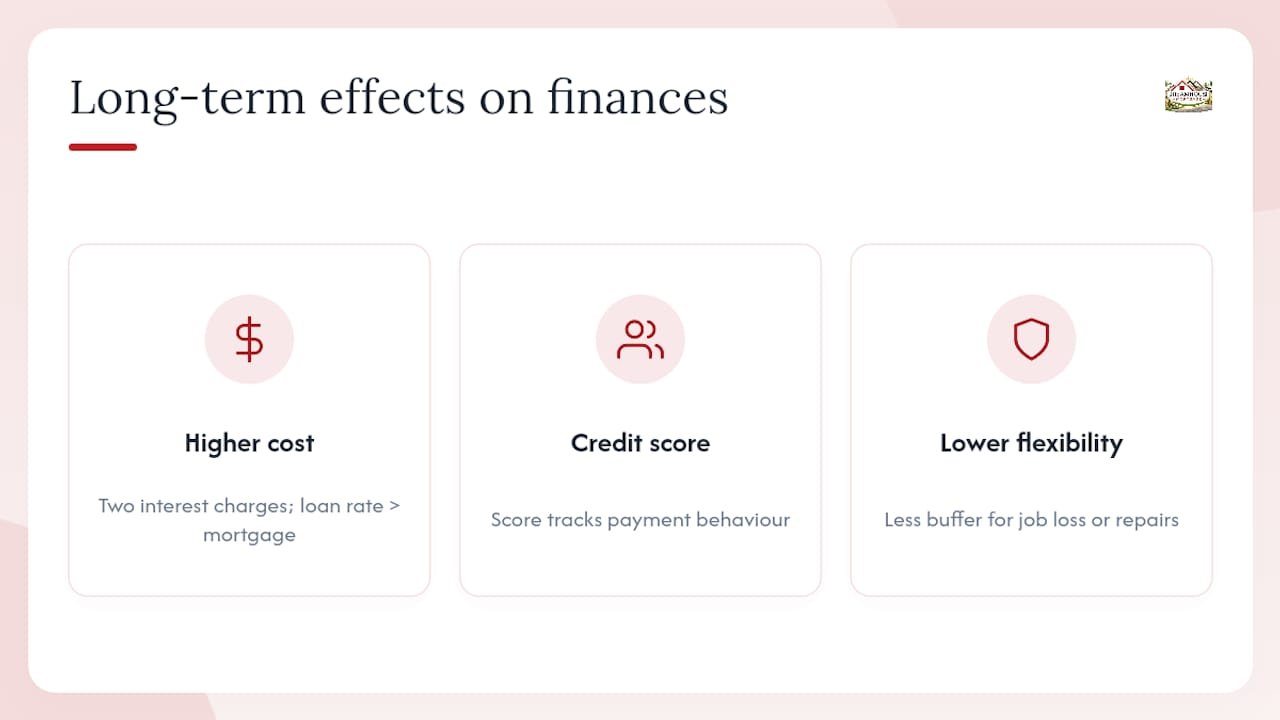
Carrying a down payment loan alongside a new mortgage means two sets of interest charges instead of one, on top of property tax, insurance, and the ordinary costs of owning a home in a Calgary winter. If the loan’s interest rate is higher than your mortgage rate, which is common with unsecured personal loans, you’re paying more for that borrowed capital than you would if it were folded into the mortgage itself. That gap compounds over the loan’s term.
Your credit score responds to how you manage the new debt, not to the fact that you borrowed it. On-time payments on a personal loan or line of credit used for a down payment build payment history just like any other credit product, and Canadian credit scoring models reward that consistency. But a missed payment in year one, when your household budget is tightest, does more damage to a thin credit file than the same missed payment does years later once your score has more history behind it.
The bigger long-term risk is reduced flexibility. A buyer with no down payment loan enters homeownership with more room to handle a job loss, a rate increase at renewal, or an unexpected repair. A buyer still repaying a down payment loan has less of that room, at exactly the point in life when unexpected costs are most likely to show up. That’s the trade-off worth weighing honestly before signing.
Real Scenarios: How Borrowing Changes What You Qualify For
Consider a Calgary buyer earning $85,000 a year with no other debt, targeting a $450,000 first home.
Now change one variable: that same buyer borrows $15,000 of the down payment through a personal loan at a $310 monthly payment over five years. That $310 gets added directly into their TDS calculation. Depending on their existing housing costs, that single addition can lower their maximum approved mortgage by tens of thousands of dollars, sometimes enough to push a $450,000 purchase out of reach entirely.
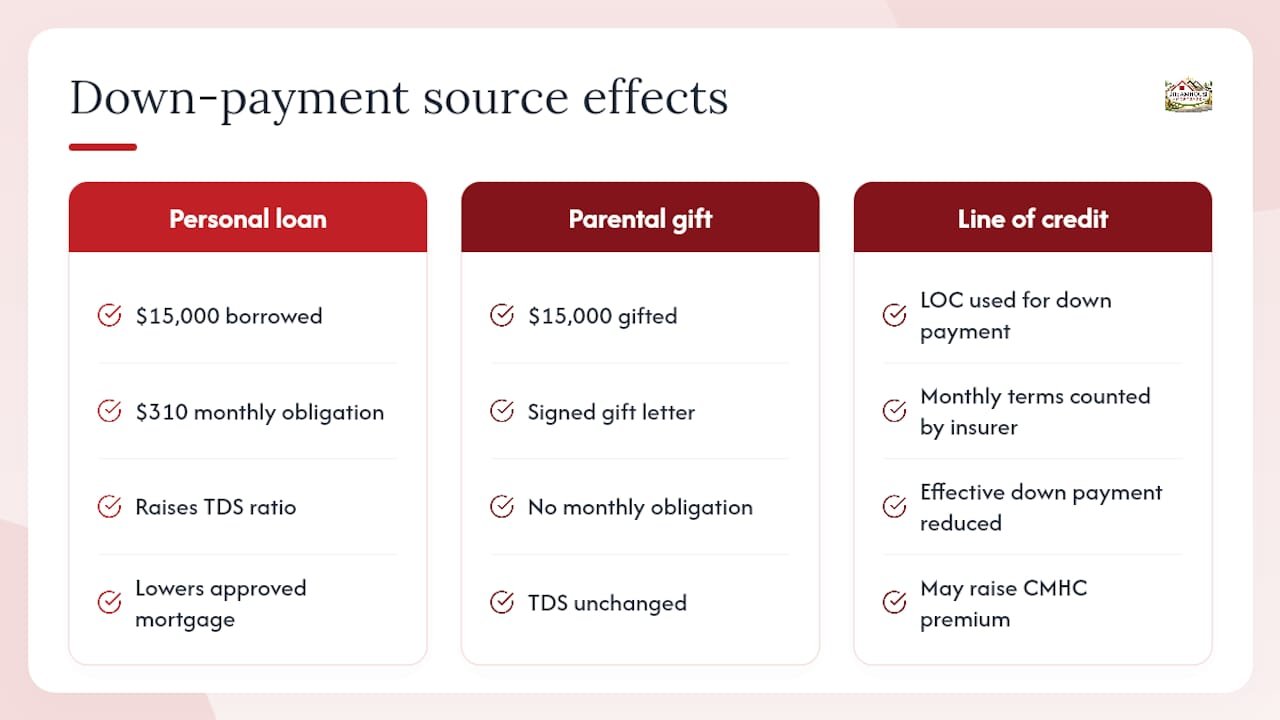
Compare that to a buyer in Airdrie who receives the same $15,000 as a gift from a parent, with a signed gift letter confirming no repayment is expected. That buyer’s TDS ratio never moves, because there’s no new monthly obligation to count. Same dollar amount, dramatically different outcome on paper.
A third scenario: a Cochrane buyer with strong income but a thin credit file borrows against a line of credit for part of their down payment, then applies for a CMHC-insured mortgage at 95% LTV. Because their effective down payment is smaller once the insurer accounts for the loan’s terms, they land in a higher premium band, adding cost on top of the reduced approval amount. Three buyers, three outcomes, and the difference in every case comes down to how the down payment was sourced.
The Legal and Ethical Line Around Borrowed Funds
Borrowing for a down payment is legal in Canada when it’s disclosed, documented, and structured within the terms your lender and insurer actually permit. The line gets crossed the moment funds are misrepresented, whether that means labeling a loan as a gift, hiding a new line of credit from your application, or asking a friend to “gift” money with a private understanding it’ll be repaid.
CMHC’s own fraud guidance treats concealment of a borrowed down payment as a form of mortgage fraud, not a gray area. Underwriters cross-reference bank statements, credit bureau data, and application disclosures specifically to catch this kind of mismatch, and the consequences run from a declined application to a rescinded approval after closing. In more serious cases, misrepresentation on a federally regulated mortgage application can carry legal exposure beyond the immediate deal.
The ethical piece runs alongside the legal one. A gift letter that isn’t actually a gift undermines the debt-ratio math the entire system relies on to keep insured mortgages affordable and sustainable, both for the individual buyer and for the broader insured-lending pool that CMHC and other insurers manage. Full disclosure protects you as much as it protects the lender: an approval built on an accurate picture of your finances is one you can actually sustain after closing, without a hidden repayment quietly straining your budget every month.
A Calgary Broker’s View on When Borrowing Makes Sense
When a client tells me they’re considering a borrowed down payment, the first thing a mortgage broker does is run the actual numbers, not the general rule. We model GDS and TDS with the new repayment included, price out the insurance premium band that repayment triggers, and lay that side by side against what FHSA or Home Buyers’ Plan funds would do to the same file. Most of the time, that comparison alone answers the question.
Borrowing tends to make sense only in narrow situations: strong credit, a short and clearly defined repayment plan, and a property type that fits insurer criteria for owner-occupied one or two unit homes. Outside those conditions, we typically steer clients toward alternatives that protect their approved amount.
Mortgage brokers have worked through this exact trade-off with buyers across Calgary, Airdrie, Cochrane, Edmonton, and Red Deer, and the math rarely lies.
— Guriqbal Chahal, MBA, PMP
Get a Down Payment Strategy Built for Your Calgary Purchase
A borrowed down payment might look like the fastest way to close a shortfall, but the real question is what it does to your approved amount once TDS accounts for the repayment, and that’s a calculation worth running before you commit to a loan. Mortgage brokers model GDS and TDS scenarios against FHSA and Home Buyers’ Plan alternatives side by side, so you see the actual trade-off in dollars, not general rules.

Whether you’re buying your first home in Calgary, Airdrie, or Cochrane, our team compares lenders across banks, credit unions, monoline, and alternative sources to find where your down payment plan actually fits, then builds a mortgage pre-approval around it. We also help with debt-service modeling if you’re weighing a borrowed amount against saving longer or exploring a first-time buyer mortgage strategy suited to Alberta’s rules.
Call Guriqbal Chahal, MBA, PMP, Mortgage Broker, at 403-966-6072, or find DreamHouse Mortgage on our Google Business Profile to book a conversation about your down payment options before you make an offer.
This article is general information, not a substitute for advice from a qualified financial advisor. Consult a qualified financial professional about your own circumstances before acting on anything here.
Sources
FAQ
Can I borrow money for a down payment in Canada?
Yes, in limited circumstances, some lenders and insurers, including CMHC’s Purchase program, allow borrowed down payment sources. The catch is that the loan repayment gets added to your TDS calculation, which usually lowers the mortgage amount you qualify for.
What are the new down payment rules in Canada?
The current thresholds require 5% down on the first $500,000 of a purchase price, 10% on the portion between $500,000 and $1.5 million, and 20% on anything at or above $1.5 million, per Canada.ca.
What is the minimum salary required to afford a $500,000 house in Calgary?
There’s no single fixed salary figure, because it depends on your down payment size, interest rate, property taxes, and existing debt. The reliable way to find your own number is running a GDS/TDS calculation through a mortgage pre-approval, which applies the 39% and 44% ratio ceilings to your actual finances.
What is the CMHC borrowed down payment program?
CMHC’s Purchase program permits certain non-traditional down payment sources, including specific homeowner loan arrangements, under defined eligibility criteria covering property type and loan-to-value. It isn’t a blanket approval for any borrowed source; details are outlined on the CMHC Purchase program page.
Is a borrowed down payment always disclosed to my lender?
Yes, disclosure is mandatory, not optional. Lenders and insurers require documentation of every down payment source, and undisclosed borrowed funds can be treated as mortgage fraud, leading to denial or a rescinded approval.