
A mortgage rate buydown lowers your monthly payments by paying extra money upfront, either at closing or through a lender-specific pricing adjustment. In Canada, it’s usually worth considering only when your breakeven period is shorter than how long you plan to hold the mortgage, or when a builder or seller covers the cost. If you’re financing the buydown yourself, run the numbers before you sign anything. A mortgage broker can model this against your actual lender quotes so you’re not guessing.
TL;DR:
- A mortgage buydown may be worthwhile only if you plan to hold the mortgage longer than the breakeven period, which typically ranges from three to seven years for Canadian loans.
- The cost of a buydown varies significantly across lenders, and most are funded by the buyer, builder, seller, or broker, with no standardized pricing system in Canada.
- Temporary buydowns lower payments for a few years but have little impact on total interest paid over the loan’s life unless held long-term, whereas permanent buydowns can reduce total interest but require carefully assessing if the upfront cost is justified.
- Running personalized breakeven calculations is essential since a buydown that costs $4,000 and saves $51 monthly takes about 78 months to break even, often exceeding typical mortgage terms.
- Borrowers who expect to sell or refinance within a few years, or who need payment reductions solely for qualifying, should generally avoid paying for a buydown, especially if it exceeds their planned holding period.
Table of Contents
- What Is a Mortgage Rate Buydown and What Types Exist?
- How Do Mortgage Buydowns Work in Canada?
- Cost and Breakeven Calculation: Is a Rate Buydown Worth It?
- Who Benefits From a Buydown, and Who Should Skip It?
- How to Negotiate a Mortgage Buydown in Canada
- Worked Examples: Three Canadian Buydown Scenarios
- An Alberta Broker’s View on Buydown Math
- Effect of Buydowns on Total Interest Paid Over the Life of Your Loan
- Tax Implications of a Mortgage Rate Buydown
- When Does Market Timing Make a Buydown Worth Considering?
- Editorial Take: Buydown Math, Not Buydown Hype
- Get a Personalized Buydown Analysis From Dreamhouse Mortgage
- Sources
- FAQ
What Is a Mortgage Rate Buydown and What Types Exist?
A buydown reduces your interest rate, either temporarily or for the full term, in exchange for a fee paid at closing. The mechanism sounds simple. The details vary enormously depending on who’s paying and which lender is offering it.
Temporary buydowns step your payment up gradually over the first few years of the mortgage:
- 1-0 buydown: rate is reduced by 1% in year one, then reverts to the contract rate.
- 2-1 buydown: rate drops 2% in year one, 1% in year two, then reverts.
- 3-2-1 buydown: rate drops 3% in year one, 2% in year two, 1% in year three, then reverts.
Permanent buydowns work differently. You pay an upfront fee to reduce the contract rate for the entire term, similar to discount points used in some U.S. mortgage programs. Here’s the catch for Canadian borrowers: there’s no standardized point system here. American conventions where one point equals 1% of the loan for roughly a 0.25% rate cut simply don’t translate north of the border. Every Canadian lender prices its own buydown, which means the cost for the identical rate reduction can differ meaningfully from one institution to the next.
How Do Mortgage Buydowns Work in Canada?
Canadian buydown pricing is negotiated lender by lender rather than governed by a published points table. That’s the single biggest difference from what you’ll read in American mortgage guides, and it’s why comparison shopping matters so much when evaluating a rate reduction.
Several parties can fund a buydown, and who pays changes the risk profile entirely:
- You (the buyer): pay cash at closing for a permanent or temporary reduction.
- The builder: common in new-construction deals across Calgary, often tied to a preferred lender partnership.
- The seller: occasionally offered as a concession in a softer resale market.
- The lender or broker: sometimes uses commission credit to shave a fraction off your rate.
Fairstone notes that lenders structure these subsidies differently, and the specific mechanics differ by institution. Eligibility also matters. Owner-occupied properties generally see more buydown offers than rental units, since lenders view investment financing as higher risk to begin with.
Builder-funded buydowns in Calgary new-build communities are frequently tied to a specific lender partnership on that project, so the incentive may not transfer if you switch lenders. Always confirm this before you count on it.
Cost and Breakeven Calculation: Is a Rate Buydown Worth It?
The breakeven formula is straightforward: upfront cost ÷ monthly payment savings = months to break even. If your breakeven period exceeds how long you’ll actually hold the mortgage, the buydown likely costs you more than it saves.
Here’s how to run the numbers yourself:
- Get your mortgage amount and contract rate from your lender’s pricing sheet, along with the buydown rate they’re offering.
- Calculate your monthly payment at the contract rate, then recalculate it at the buydown rate using your amortization schedule and payment frequency.
- Subtract the two payments to find your monthly savings.
- Divide the upfront buydown cost by that monthly savings figure to get your breakeven point in months.
- Compare that number to your expected holding period, factoring in your mortgage term length and any plans to move, sell, or refinance.
A commonly cited example: a $4,000 upfront cost against $51 in monthly savings works out to roughly 78 months, or about 6.5 years, to break even. That’s longer than most 5-year fixed terms in Canada, meaning the buydown might not pay off before your term expires and you’re back to negotiating a new rate anyway.
Breakeven ranges across Canadian mortgages commonly span three to seven years depending on the size of the rate reduction and the fee charged. There’s no universal number, because there’s no standardized point value here. That’s precisely why you need your own inputs, not a generic rule of thumb, before deciding.
Who Benefits From a Buydown, and Who Should Skip It?
A buydown tends to make sense for a specific type of borrower, and it tends to backfire for another.
Good fits include:
- Long-term holders who plan to stay in the home well past the breakeven point.
- Buyers whose builder or seller is funding the buydown at no cost to them.
- Borrowers with strong cash reserves and stable, predictable income plans.
Red flags include:
- Anyone expecting to sell or refinance within the next few years.
- Borrowers who need the reduced payment just to qualify under the mortgage stress test.
- Buyers with thin emergency savings who’d be stretched by the reverted rate later.
If a buydown doesn’t fit your situation, you still have options. A larger down payment reduces your loan-to-value ratio and can unlock better pricing outright. Negotiating your base rate with multiple lenders, rather than paying to lower one lender’s offer, often gets you further. Improving your credit score before you apply can also move your starting rate more than any buydown fee would.
Pro Tip: Before agreeing to a temporary buydown to help you qualify, ask your broker to run your approval at the reverted rate, not the introductory one. If you can’t comfortably afford the payment once the subsidy expires, the buydown is masking an affordability problem rather than solving it.
How to Negotiate a Mortgage Buydown in Canada
Getting a fair buydown quote takes more than accepting the first number a lender offers. Work through this checklist before you commit:
- Ask your lender for a written pricing sheet showing the buydown cost against multiple rate-reduction scenarios, not just one option.
- Confirm who is actually funding the subsidy — you, the builder, the seller, or the lender through a commission credit.
- Ask about refund treatment on early refinance or sale. Escrowed temporary buydowns are often applied to your payout or returned; buyer-paid permanent buydowns typically are not refundable.
- If a builder is offering the incentive, confirm the lender partnership and whether it applies to your specific lot or unit.
- Ask your mortgage broker to model the breakeven against your realistic holding period, not the lender’s marketing example.
This is where working with a broker who has access to multiple lenders pays off. A single bank can only quote its own buydown pricing. A broker can lay several lenders’ numbers side by side and show you which one actually clears breakeven fastest for your situation.
Worked Examples: Three Canadian Buydown Scenarios
Example A: Buyer-paid permanent buydown. You pay $4,000 upfront to reduce your rate for the full term, saving $51 a month. That’s a breakeven of roughly 78 months. If you’re on a 5-year fixed term, you likely renew before recovering your cost.
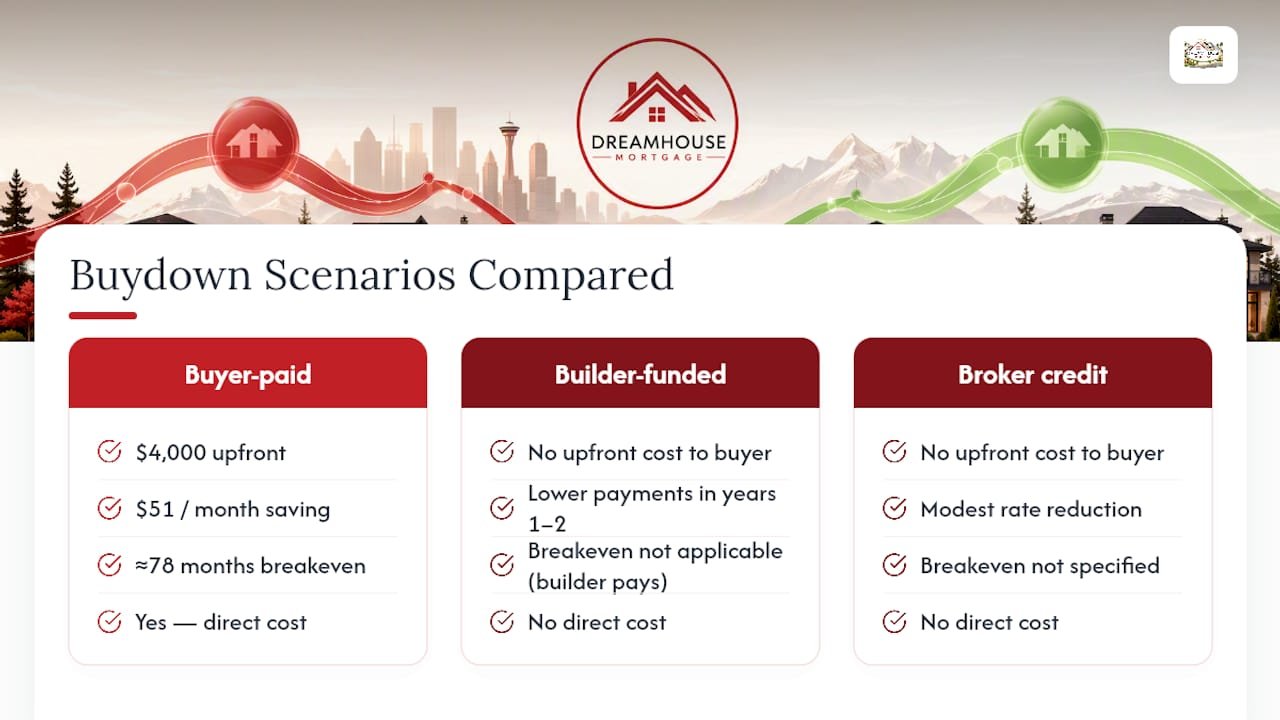
Example B: Builder-funded temporary 2-1 buydown. A Calgary builder covers the subsidy through an escrow account tied to their preferred lender. Your payment drops in years one and two, then reverts. Because the builder is paying, there’s no cost to you, and unused escrow funds are commonly refunded on early refinance or sale.
Example C: Broker commission credit. Your broker applies part of their commission to shave a small amount off your rate. It’s a modest reduction, but it costs you nothing directly and stacks on top of whatever rate you’ve already negotiated.
When you use an online buydown calculator, or a broker-side tool like the Commission & Buydown Calculator, treat the output as a starting estimate. Confirm the final numbers against your actual lender quote, since amortization, payment frequency, and fees all shift the real breakeven.
An Alberta Broker’s View on Buydown Math
Guriqbal Chahal, MBA, PMP, is the Broker of Record at Dreamhouse Mortgage, based in Calgary and serving buyers across Airdrie, Cochrane, and the surrounding Alberta communities. When Calgary clients ask about buydowns, the first step is running side-by-side pricing from several lenders rather than accepting one institution’s offer at face value, since buydown costs in Canada aren’t standardized the way they might assume from American mortgage articles.
Breakeven modeling against a client’s realistic holding period, not the lender’s example, is what usually determines whether a buydown makes sense for that specific buyer.
Effect of Buydowns on Total Interest Paid Over the Life of Your Loan
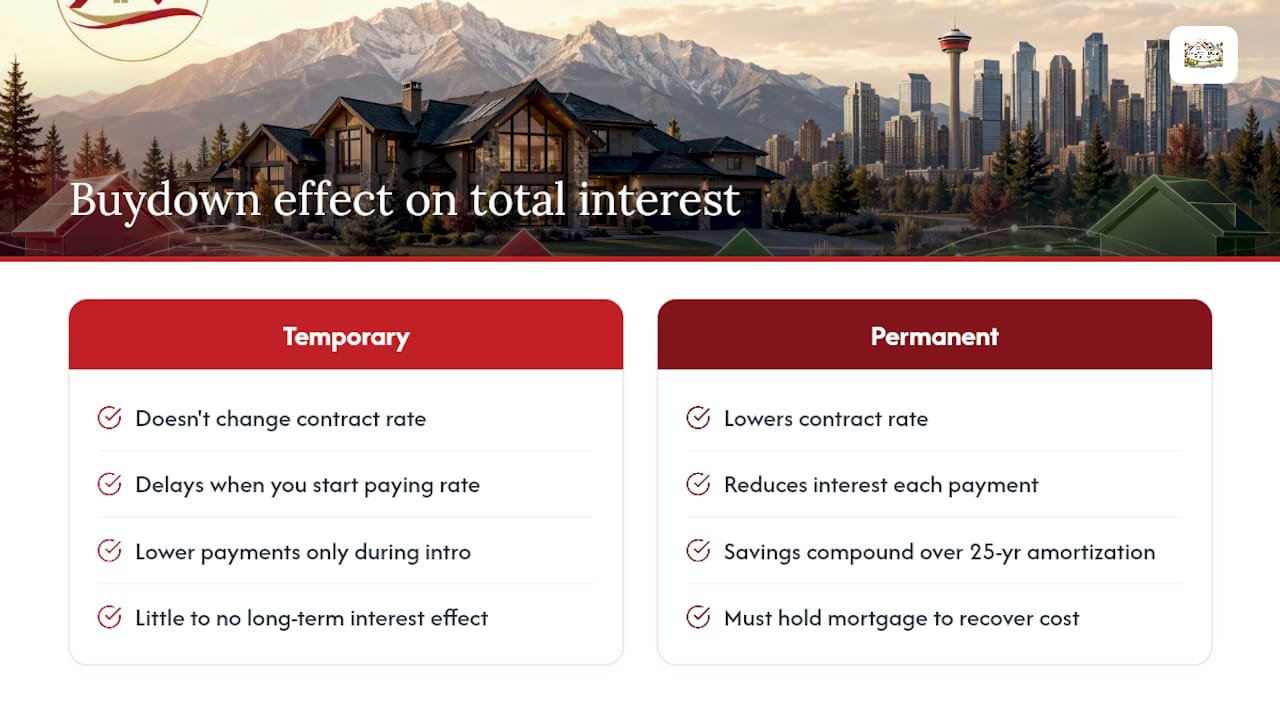
A temporary buydown doesn’t change your contract rate. It only delays when you start paying it, which means it has little to no effect on total interest paid over the life of the mortgage once the introductory period ends. You get lower payments for a year or two, then you’re back to the same rate you would have had anyway.
A permanent buydown is different. Because it genuinely lowers your rate for the term, it reduces the interest portion of every payment for as long as that rate applies. Over a full 25-year amortization, even a modest permanent rate reduction compounds into meaningful interest savings, provided you hold the mortgage long enough to recover the upfront cost first.
Here’s the nuance that catches people off guard: if you refinance or renew before the buydown’s benefit has fully materialized, you reset the clock. A permanent buydown paid on your current term doesn’t carry forward automatically to your next lender or your next renewal negotiation. You’re essentially buying a discount that only pays dividends if your circumstances stay stable.
This is why the breakeven number matters more than the headline rate reduction. A buydown that saves you $40 a month sounds appealing in isolation. Measured against a $3,500 upfront cost and a five-year term, it may never generate net interest savings before you’re renegotiating anyway. Run the total-interest comparison across your full amortization schedule, not just the introductory period, before deciding whether the reduced rate justifies the cost.
Tax Implications of a Mortgage Rate Buydown
For most Canadian homeowners buying a primary residence, a mortgage rate buydown carries no direct personal tax consequence. Mortgage interest on a principal residence generally isn’t tax-deductible in Canada the way it can be in some other countries, so lowering your rate through a buydown simply reduces your carrying cost. It doesn’t create a deduction, a credit, or a taxable event on your personal return.
The picture changes for rental and investment properties. If you’re buying down the rate on a mortgage tied to an income-producing property, the interest you pay remains deductible against rental income, and a lower rate means a smaller deductible expense going forward. The upfront buydown fee itself may be treated as a financing cost that gets amortized over the term rather than deducted in full the year you pay it. This is a detail worth confirming with an accountant familiar with Canadian rental property rules, since treatment can vary based on how the fee is structured and who’s paying it.
For sellers or builders funding a buydown as a sales incentive, the cost is typically treated as a selling expense or a reduction in the effective sale price, rather than a gift to the buyer. It’s a business cost of moving the property, not a taxable benefit to the person receiving the lower rate. None of this replaces professional tax advice specific to your situation, but knowing the general shape of it helps you ask the right questions before you commit to a buydown structure.
When Does Market Timing Make a Buydown Worth Considering?
Buydowns tend to make the most sense when rates are elevated relative to where you expect them to settle, and you need a bridge to more comfortable payments without betting your qualification on a rate cut that hasn’t happened yet. If you believe rates will drop meaningfully within your term, a temporary buydown funded by someone else can smooth the transition at no real cost to you.
The calculation flips when rates are already low or trending downward on their own. Paying for a buydown in that environment often means spending money to solve a problem the market is about to solve for you through a future renewal at a better rate. Keeping cash in reserve, rather than locking it into an upfront fee, tends to serve you better in a falling-rate cycle.
New-construction timing adds another layer. Builder-funded buydowns in Calgary developments are frequently offered during softer sales periods, when builders need an incentive to move inventory. If you’re shopping new builds during one of these windows, the buydown may already be baked into the deal at no extra cost, which changes the calculus entirely compared with paying for one yourself on a resale purchase. Checking current Canadian mortgage rate trends before you commit to either path gives you a clearer read on which direction the math is likely to move.
Editorial Take: Buydown Math, Not Buydown Hype
The conventional pitch around mortgage buydowns focuses on the payment relief, and that’s exactly where it goes wrong. A lower payment in year one feels good. It tells you nothing about whether the deal actually saves you money once you account for who’s paying, how long you’ll hold the mortgage, and what happens when the rate reverts or your term expires.
What the math in this guide actually supports is a narrower conclusion: buydowns are excellent when someone else is paying for them, and they’re a coin flip at best when you’re funding them yourself on a standard five-year term. The breakeven calculation isn’t a nice-to-have step. It’s the entire decision.
Canadian buyers get an added complication that American guides don’t cover well, because there’s no standardized point system here to lean on. Every quote needs its own math, run against your own timeline. That’s the piece most advice skips, and it’s the piece that actually determines whether you come out ahead.
— Guriqbal Chahal, MBA, PMP
Get a Personalized Buydown Analysis From Dreamhouse Mortgage
Running breakeven math on a spreadsheet only gets you so far when Canadian buydown pricing changes from lender to lender. A mortgage brokerage can compare live pricing across banks, credit unions, and monoline lenders, then model your actual breakeven against your real holding period, not a generic example.

Whether you’re a first-time buyer in Calgary weighing a builder incentive, a family in Airdrie comparing lender quotes, or a homeowner in Cochrane deciding between a buydown and a bigger down payment, Dreamhouse Mortgage can walk through the numbers with you before you commit any money. This includes mortgage pre-approval support so you know exactly where you stand before you start comparing rate structures.
Call Guriqbal Chahal, MBA, PMP, Mortgage Broker, at 403-966-6072, or visit the Dreamhouse Mortgage consultation page to book a breakeven review. You can also find Dreamhouse Mortgage on its Google Business Profile to see local client reviews before you call.
Sources
This guide draws on Canadian mortgage pricing analysis from Credit Resources, Fairstone, and the CMLS Buydown Calculator. For a personalized breakeven review, book a consultation with Dreamhouse Mortgage.
This article is general information, not a substitute for advice from a qualified financial advisor. Consult a qualified financial professional about your own circumstances before acting on anything here.
- Mortgage Points and Rate Buydowns in Canada: Are They Worth It? – Credit Resources
- Interest Rate Buydowns | Fairstone
- Commission & Buydown Calculator — CMLS
FAQ
Can You Buy Down a Mortgage Rate in Canada?
Yes. Canadian lenders offer both temporary and permanent buydowns, but pricing is set individually by each lender rather than through a standardized points system like American conventions use. That’s why comparing quotes from several lenders matters before you pay for one.
Is a Mortgage Buydown Worth It?
It depends entirely on your breakeven calculation and how long you’ll hold the mortgage. A buydown funded by a builder or seller usually makes sense since it costs you nothing, while a buyer-paid buydown can take five to seven years to break even, often longer than a typical mortgage term.
Is 3.75% a Good Mortgage Rate?
Whether 3.75% is a good rate depends on current market conditions, your down payment size, your credit profile, and the type of mortgage you’re getting. Rather than judging a single number in isolation, compare it against live quotes from multiple lenders, since Dreamhouse Mortgage can show you how it stacks up against current Canadian mortgage rate trends.
Will Mortgage Rates Drop to 3% Again?
No one can predict future rate movements with certainty, and this article won’t speculate on specific future levels. What matters for your buydown decision is your own breakeven math against your realistic holding period, not a guess about where rates will land next.
Recommended
- Why Calgary Buyers Overestimate Home Mortgage Affordability (And How to Fix It)
- Calgary Mortgage Calculators 2026: Avoid Costly Payment Mistakes & Estimate Your Monthly Mortgage Accurately
- Minimum Down Payment Calgary 2026: Lowest Amount You Need to Buy a Home
- Mortgage Amortization Calculator: How Amortization Affects Your Calgary Mortgage Payment (20 vs 25 vs 30 Years)