
The typical minimum down payment for a non-owner-occupied investment property in Canada is 20%, available through CMHC’s Income Property program for qualifying 2 to 4 unit rental buildings. That figure is not universal. Unit count, property condition, occupancy status, and your own credit and income profile can all push the requirement higher, sometimes well past 20%.
TL;DR:
- Investment properties in Canada typically require at least a 20% down payment through CMHC’s Income Property program for 2 to 4 unit rentals, but this can increase based on property type and profile.
- Properties with more than four units, commercial zoning, or exceeding program value limits generally demand higher down payments and different financing structures.
- Lenders may recognize some rental income for qualification purposes, but they apply strict documentation and stress testing, which can limit mortgage size.
- Borrowed funds, gift money, and reserves significantly influence overall cash-to-close and must be carefully documented to avoid delays or disqualification.
- Larger down payments can improve interest rates and loan terms, while credit score and property characteristics determine eligibility and required equity.
Table of Contents
- What Is the Minimum Investment Property Down Payment in Canada?
- Why the 20% Rule Exists: CMHC’s Income Property Program
- Common Exceptions: When You’ll Need More Than 20%
- How Rental Income and the Mortgage Stress Test Affect Qualification
- Budgeting Cash-to-Close: What Investors Actually Need on Hand
- Action Checklist: Confirm Your Down Payment and Get Ready to Buy
- Why This Matters Locally: A Calgary-Area Perspective
- Effect of Down Payment Size on Mortgage Insurance Necessity and Cost
- How the Down Payment Amount Influences Interest Rates and Loan Terms
- Strategies for Saving or Gathering the Down Payment for a Rental Property
- Potential Tax Implications Related to the Down Payment
- Impact of Credit Score on Down Payment Requirements and Approval
- Down Payment Differences: Single-Family vs. Multi-Unit Investment Properties
- An Editorial Take on Calgary-Area Investment Financing
- Get Investment Property Financing Guidance From Dreamhouse Mortgage
- Sources
- FAQ
What Is the Minimum Investment Property Down Payment in Canada?
Canada doesn’t offer mortgage default insurance on non-owner-occupied properties the way it does for owner-occupied homes, so the 5% and 10% minimums you may have heard about for a primary residence simply don’t apply here. The Financial Consumer Agency of Canada confirms that standard schedule (5% up to $500,000, 10% on the portion above that to $1.5 million, 20% beyond) is built for owner-occupied purchases, not rentals.
For an investment property, 20% is the number most Calgary, Airdrie, and Cochrane investors work toward, and it’s grounded in a specific federal program rather than a general rule. Understanding why that number exists, and where it breaks down, is the difference between a smooth closing and a financing scramble two weeks before possession.
Why the 20% Rule Exists: CMHC’s Income Property Program
The 20% figure traces back to a specific insurance product. CMHC’s Income Property offering allows financing up to 80% loan-to-value on qualifying 2 to 4 unit rental properties, which mathematically requires a minimum 20% down payment from the borrower. This isn’t an arbitrary lender preference. It’s the structural ceiling CMHC built into the product itself.
The program comes with real conditions attached. The property needs to sit in Canada, be suitable for year-round occupancy, and meet condition standards a lender’s appraiser will verify. Amortization under this product typically maxes out at 25 years, shorter than the 30-year terms some owner-occupied buyers stretch into, which affects your monthly payment and your qualifying debt ratios.
Miss any of those eligibility boxes and you’re no longer working inside the CMHC framework. A fifth unit, a commercial-zoned parcel, or a cottage with no winter road access can knock a deal out of Income Property territory entirely. When that happens, lenders typically restructure the deal, often with a higher down payment requirement, a different rate, or both.
Common Exceptions: When You’ll Need More Than 20%
Several deal characteristics push the equity requirement above the CMHC baseline:
- Five or more units. Once a property exceeds four units, it typically shifts into commercial or multi-residential financing, which usually demands larger down payments and different underwriting entirely.
- Commercial or mixed-use zoning. A property zoned for retail on the main floor with apartments above rarely qualifies under residential rental programs.
- Properties above program value limits. High-value purchases can exceed what a given lender or insurer will support at 80% LTV.
- Seasonal or limited-occupancy properties. A lake property near Ghost Lake that isn’t winterized, for example, won’t meet the year-round occupancy standard.
Your own financial profile matters just as much as the property.
When a deal falls outside conventional or CMHC-backed parameters, alternatives exist: private lending, portfolio lending through a single institution holding multiple mortgages, or higher-deposit conventional financing. Each trades flexibility for cost, typically through higher rates or shorter terms, so it’s worth having a broker map out the numbers before committing.
How Rental Income and the Mortgage Stress Test Affect Qualification
Lenders don’t simply add your expected rent to your income and call it done. Under CMHC guidance, lenders may recognize up to a portion of gross rental income, or apply a net-rental calculation, and either approach comes with scrutiny attached. OSFI clarified in 2025 that rental income can still be used in underwriting, but institutions must apply rigorous due diligence when doing so, which in practice means more documentation, not less.
Then there’s the qualifying rate itself. Guideline B-20 requires lenders to qualify uninsured borrowers at whichever is higher: the contract rate plus 2 percentage points, or the five-year benchmark rate. That stress test shrinks the maximum mortgage you’ll qualify for compared to what the actual rate on your loan would suggest.
Your Gross Debt Service and Total Debt Service ratios still apply on top of that. Bring solid rent documentation, signed leases, or credible market comparables for the neighborhood, whether that’s a bungalow in Airdrie’s Meadowbrook or a duplex in Cochrane Heights. Weak rent evidence is one of the most common reasons a file gets delayed at underwriting.
Budgeting Cash-to-Close: What Investors Actually Need on Hand
Your down payment is rarely the only cash you’ll need at closing. Budget for these on top of it:
- Alberta land transfer costs and registration fees
- Legal fees for closing
- Property appraisal, typically ordered by the lender
- Home inspection
- Lender or broker administration fees where applicable
- Prepaid property tax and insurance adjustments
- A reserve for immediate repairs or vacancy between tenants
Pro Tip: The CRA treats certain acquisition costs, including transfer-related fees, as part of the property’s capital cost rather than a deductible expense in the year you buy. That distinction affects your future capital gains calculation, so keep every closing statement on file.
Here’s how this adds up in practice: on a $450,000 duplex with 20% down, a buyer might reasonably budget additional amounts for legal fees, appraisal, inspection, and initial reserves, which can push total cash-to-close significantly higher before a single tenant moves in.
Action Checklist: Confirm Your Down Payment and Get Ready to Buy
Start with a mortgage pre-approval that tests your proposed rent figures, existing debts, and documentation against real lender criteria, not a rough online calculator.
Gather these before you make an offer:
- Signed purchase agreement or draft offer
- Lease or rent comparables for the property or neighborhood
- Two years of tax returns, especially if self-employed
- Recent mortgage statements on any existing properties
- Bank statements showing your down payment source
- Gift letter, if any portion of funds is gifted
Pro Tip: A broker who reviews your file early can tell you within days whether your deal fits a CMHC-eligible route or needs an alternative structure, which saves weeks compared to finding out from a bank after a rejected application.
A broker also compares options across banks, credit unions, monoline lenders, and private lenders in one conversation, something Rocky View County and Calgary-area investors increasingly rely on given how much rental underwriting has tightened.
Why This Matters Locally: A Calgary-Area Perspective
Guriqbal Chahal, MBA, PMP, Broker of Record at Dreamhouse Mortgage, has guided investment property files across Calgary, Airdrie, and Cochrane long enough to see where deals stall. The recurring issue isn’t the down payment percentage. It’s timing.
Investors who wait until they have an accepted offer to gather rent comparables or explain a self-employment income structure routinely lose days they don’t have during a tight closing window. Early document review, before you’re competing for a specific Cochrane bungalow or a Chestermere duplex, catches problems while there’s still time to fix them.
Local knowledge also matters more than generic online guides suggest. A rental comparable that looks strong in one Calgary quadrant may not carry weight with an underwriter reviewing a property in a different community. That’s where matching your file to the right lender policy, rather than the first lender who says yes, makes the actual difference in approval speed.
Effect of Down Payment Size on Mortgage Insurance Necessity and Cost
Mortgage default insurance largely isn’t part of the investment property conversation the way it is for owner-occupied homes.
Below that threshold, you’re generally outside conventional rental financing altogether, and lenders will look at alternative structures rather than a standard insured mortgage.
It also improves your debt service ratios immediately, since a smaller mortgage balance means smaller carrying costs relative to your rental income.
Building in an extra 5% to 10% of equity cushion, where your savings allow it, tends to smooth the underwriting process considerably and gives you room to negotiate rate and term.
How the Down Payment Amount Influences Interest Rates and Loan Terms
A larger down payment changes your risk profile in a lender’s eyes, and that shows up directly in the rate and terms you’re offered. Rental property mortgages already carry a rate premium over owner-occupied mortgages in most cases, since lenders treat non-owner-occupied risk more conservatively across the board.
Within that rental category, the loan-to-value ratio still moves the needle. Lower leverage generally means better pricing, sometimes access to lenders who don’t compete aggressively for higher-LTV rental deals at all.
Amortization length ties into this too. The 25-year maximum typical of the CMHC Income Property product shapes your monthly payment regardless of your down payment size, but a bigger down payment reduces the principal you’re amortizing, which softens the cash-flow squeeze that shorter amortizations create.
The qualifying rate under Guideline B-20 applies regardless of how much you put down, since it’s a stress test on affordability rather than a reward for equity. But a larger down payment means you’re stress-testing a smaller mortgage amount, which is often what pushes a marginal file from decline to approval.
Strategies for Saving or Gathering the Down Payment for a Rental Property
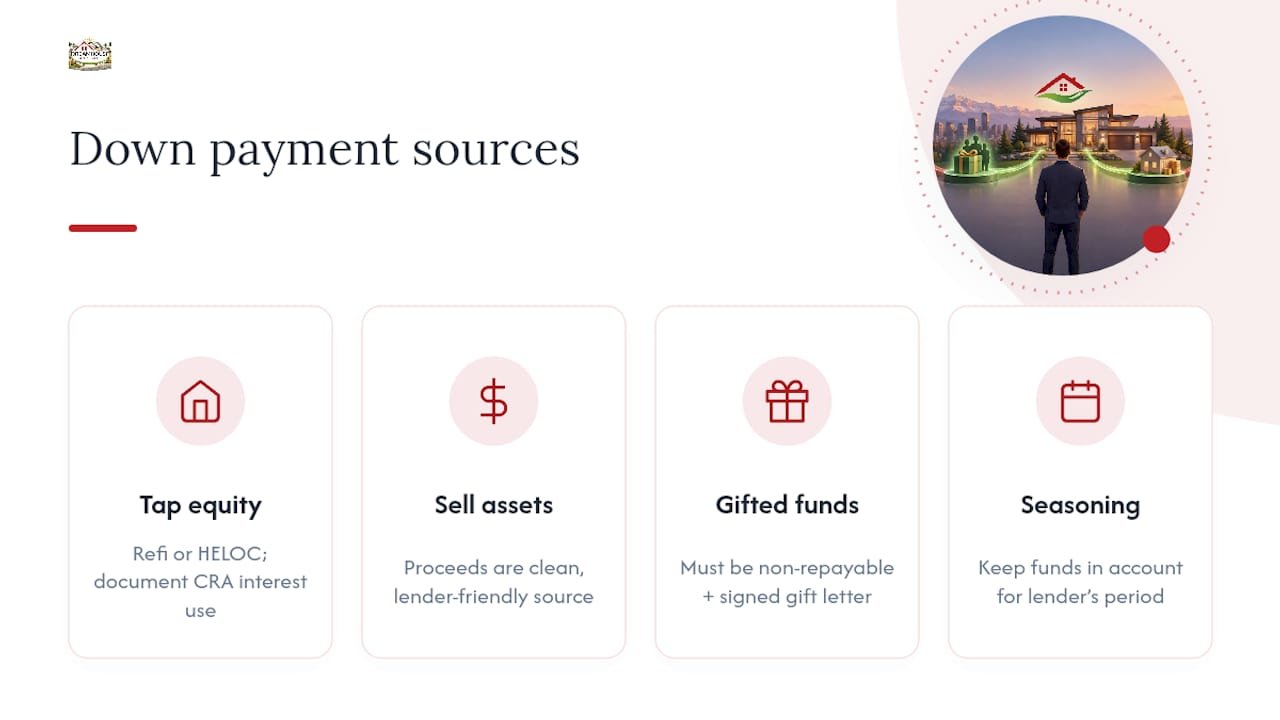
Building a rental down payment differs from saving for your first home, mostly because the tools designed for owner-occupied buyers, like the First Home Savings Account, aren’t built with investment properties in mind. Most investors rely on a combination of approaches instead.
Tapping equity from an existing property is common among repeat investors in Calgary and Cochrane. If you own your primary residence with meaningful equity built up, a refinance or home equity line can fund a rental down payment, though the CRA’s rules on interest deductibility mean you need to document exactly how those borrowed funds are used.
Selling an underperforming asset, whether that’s a vehicle, a secondary property, or an investment portfolio, is another straightforward route, since sale proceeds are a clean, well-documented source that lenders accept without hesitation.
Gifted funds from immediate family remain a legitimate path too, provided the gift is genuinely non-repayable and accompanied by a signed letter confirming that.
Whichever method you choose, seasoning matters. Funds sitting in your account for the period your lender specifies, rather than appearing as a sudden lump sum right before your application, avoid the extra scrutiny that unexplained deposits attract.
Potential Tax Implications Related to the Down Payment
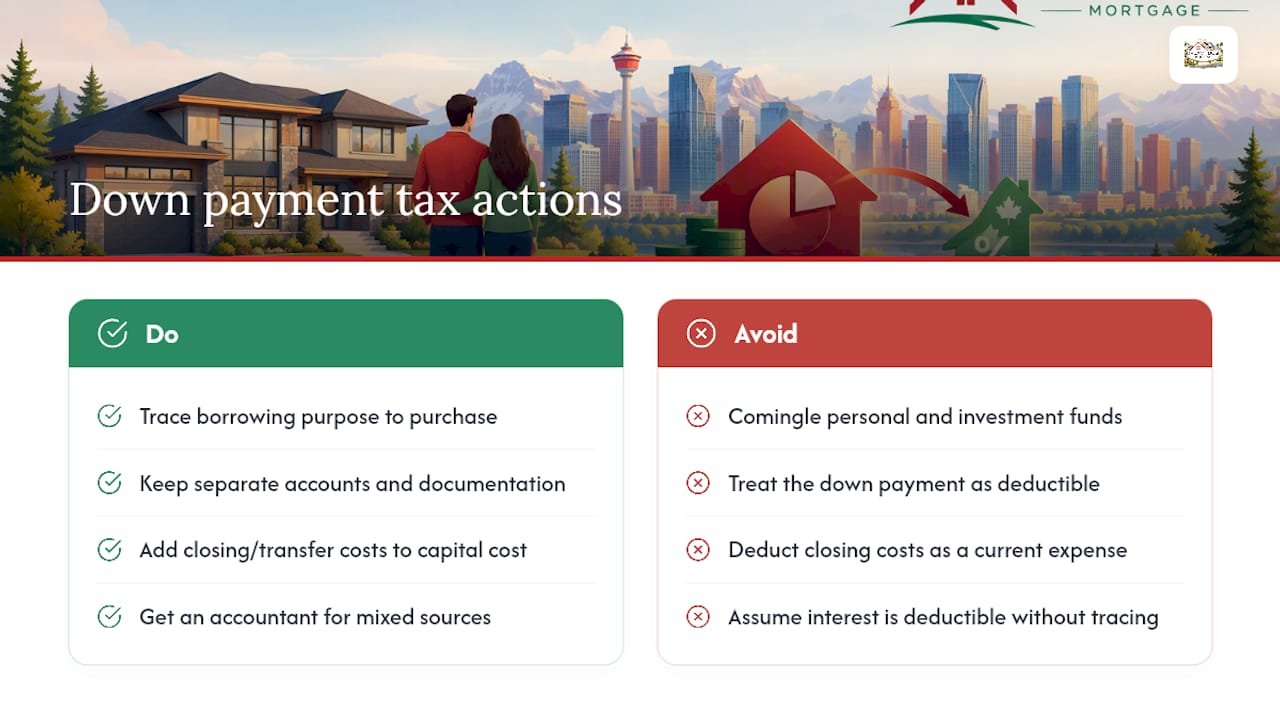
The down payment itself isn’t a taxable event and it isn’t deductible. What matters more for tax purposes is where the money came from and how the property is used afterward.
If you’re using borrowed funds, whether from a home equity line or another source, for part of your down payment, the CRA requires you to trace the purpose of that borrowing to determine whether the interest on it is deductible against rental income. Funds borrowed specifically to purchase an income-producing rental property generally support interest deductibility, but the paper trail needs to hold up, meaning separate accounts and clear documentation, not commingled funds that blur personal and investment use.
Closing costs connected to the purchase, including land transfer costs, typically get added to the property’s capital cost rather than deducted as a current-year expense. That affects your adjusted cost base and, eventually, your capital gains calculation when you sell.
None of this replaces advice from an accountant familiar with rental property taxation in your province, particularly if you’re combining a refinance, a gift, and sale proceeds into one down payment. But knowing the general framework, borrowing purpose matters, capital costs aren’t current deductions, helps you keep records that will actually hold up if CRA asks questions later.
Impact of Credit Score on Down Payment Requirements and Approval
Your credit score doesn’t set the CMHC 20% baseline, but it strongly influences whether a lender will approve you at that baseline or ask for more.
Lenders see less risk and are often willing to work within standard program guidelines without pushing back.
Thinner credit files change the equation. This isn’t a penalty so much as a risk offset. More equity in the deal compensates for less certainty in the borrower’s repayment history.
Credit issues don’t automatically disqualify you from rental financing in Alberta. Alternative and private lenders exist specifically for these situations, though typically at higher rates and with larger down payment expectations in exchange for more flexible qualifying criteria. If your credit needs work before you apply, addressing it ahead of time, rather than after a decline, saves both time and money.
Down Payment Differences: Single-Family vs. Multi-Unit Investment Properties
Not every rental property is treated the same by lenders, and unit count is one of the biggest variables.
These are the most straightforward files from an underwriting standpoint.
Rental income across multiple units can sometimes work in your favor here, spreading vacancy risk across tenants rather than depending on one.
Once you cross into five or more units, the picture changes substantially. These properties usually shift into commercial or multi-residential financing categories entirely, with down payment requirements that commonly run higher than the residential rental threshold, along with different amortization structures and underwriting criteria altogether.
Condo units purchased as rentals add another layer: some lenders apply rental-specific condo policies, and building-level factors like reserve fund health or the percentage of units already rented can affect financing availability regardless of your own down payment size.
An Editorial Take on Calgary-Area Investment Financing
It isn’t. It’s the output of one specific CMHC program with specific eligibility conditions, and treating it as universal is how investors end up blindsided mid-transaction when their fourplex turns out to be a fiveplex, or their “year-round” cabin near Cochrane Lake doesn’t actually meet occupancy standards.
What the research here actually supports is a shift in priority: confirm program eligibility before you fall in love with a property, not after you’ve written an offer. Rental income recognition and the B-20 stress test do more damage to a file than the down payment percentage itself, since they determine the mortgage size you can actually carry, not just the equity you bring to the table.
If I had to tell a Calgary investor one thing, it’s this: get your documents and rent evidence organized before you shop, not after. A broker conversation two weeks earlier than you planned is almost always cheaper than a financing condition that falls through.
— Guriqbal Chahal, MBA, PMP
Get Investment Property Financing Guidance From Dreamhouse Mortgage
Every scenario in this article, program eligibility, rental income recognition, credit-driven equity requirements, plays out differently depending on your specific property and financial picture. A mortgage brokerage reviews your proposed rent, documentation, and property type against real lender policy, rather than a general online rule, and compares options across banks, credit unions, monoline lenders, and private lenders in one conversation.

Whether you’re eyeing a duplex in Cochrane, a fourplex in Airdrie, or your second rental in Calgary’s Killarney, getting a proper pre-approval before you shop protects you from late-stage surprises. Explore investment property mortgage options in Calgary or the broader Alberta investment property guide for more detail on lender-specific requirements.
Ready to find out exactly what your down payment requirement looks like? Call Guriqbal Chahal, MBA, PMP, Mortgage Broker, at 403-966-6072, or visit the Dreamhouse Mortgage Google Business Profile to get started. You can also request a consultation directly at Dreamhousemortgage.
This article is general information, not a substitute for advice from a qualified financial advisor. Consult a qualified financial professional about your own circumstances before acting on anything here.
Sources
CMHC-accepted down payment sources for investment properties generally include:
- CMHC — Income Property
- OSFI — Clarifying guidance on rental income and mortgage classification
- Financial Consumer Agency of Canada — Down payment
Borrowed funds used as a down payment draw far more scrutiny, and some lenders won’t accept them at all for a rental purchase. Expect your lender to ask for bank statements covering several months, closing documents from any property sale, gift letters where applicable, and statements confirming reserve funds beyond the down payment itself.
Keep your funds traceable. Money that moves between accounts repeatedly, or arrives in a lump sum with no paper trail, tends to trigger extra questions. Our guide to down payment types in Canada breaks down source rules in more detail. Keep reserve cash for closing costs separate from your down payment figure so you’re not caught short at the lawyer’s office.
FAQ
What is the minimum down payment on an investment property in Canada?
The typical minimum is 20% under CMHC’s Income Property program for qualifying 2 to 4 unit rentals. Properties outside program eligibility, or borrowers with weaker credit, often need more.
What income do you need for a $1,000,000 mortgage in Canada?
Required income depends on your interest rate, the B-20 qualifying rate applied, your existing debts, and, for rental properties, how much of your projected rent a lender allows in the calculation. A mortgage broker can run these numbers against your actual file and rental documentation, which is far more accurate than a generic estimate.
How much is a down payment on a $500,000 investment property?
That figure assumes the property fits CMHC Income Property eligibility and doesn’t yet include closing costs like legal fees, appraisal, or land transfer costs.
How much of a down payment do you need for a $600,000 investment property?
If the property exceeds program limits or your credit profile requires a larger cushion, the requirement can rise above 20% and require more equity, sometimes significantly higher than the baseline.
Can I use gifted funds for an investment property down payment?
Yes, non-repayable gifted funds from immediate family are generally accepted, provided they come with a signed gift letter confirming the money doesn’t need to be repaid. Lenders will also want to see the funds sitting in your account for a period before closing.
Recommended
- Investment Property Mortgage Calgary 2026: Best Rates, Down Payment & Qualification Guide
- Ultimate Investment Property Mortgage Alberta Guide: Down Payment, Rates & Secrets to Maximize Profit
- How a Borrowed Down Payment Can Shrink Your Calgary Mortgage Approval
- Investing in Rental Properties for Long-Term Wealth: The Ultimate Step-by-Step Guide