A non-prime mortgage, also called an alternative or B-lender mortgage, is home financing for Alberta borrowers who do not fit a bank’s standard approval box. That may be because of bruised credit, self-employed income, newcomer status or a higher debt load. If you are a first-time home buyer in Calgary, Cochrane or Airdrie and a bank has declined you or offered less than you need, a non-prime mortgage can still get you into a home. It is usually built as a shorter-term bridge, with a plan to move to a conventional mortgage later.
This guide explains who qualifies, how the lender types differ, what the cost looks like, which documents you need and how to plan the move back to a bank rate.
TL;DR
- A non-prime mortgage is for borrowers with poor or unconventional credit, non-traditional income, newcomer status or higher debt who do not fit a bank’s rules.
- Expect a shorter term, commonly one to three years, and generally at least 20% down with a B-lender.
- Pricing is higher than bank pricing and often carries a lender fee, so the plan for the exit matters as much as the approval.
- A licensed Alberta mortgage broker can compare banks, credit unions, monoline, alternative and private lenders in one application.
- Call Guriqbal Chahal, MBA, PMP, at 403-966-6072 to find out which lender tier fits your file.
Table of Contents
- What a non-prime mortgage is
- A lenders, B lenders and private lenders compared
- How lenders assess a non-prime application
- What a non-prime mortgage costs
- Non-prime mortgages for Calgary first-time buyers
- Documents to prepare
- How to apply, step by step
- Why you want a licensed broker handling a non-prime file
- Moving from non-prime to a conventional mortgage
- Our perspective
- Talk to a Calgary mortgage broker about your options
- FAQ
- Sources
What a non-prime mortgage is
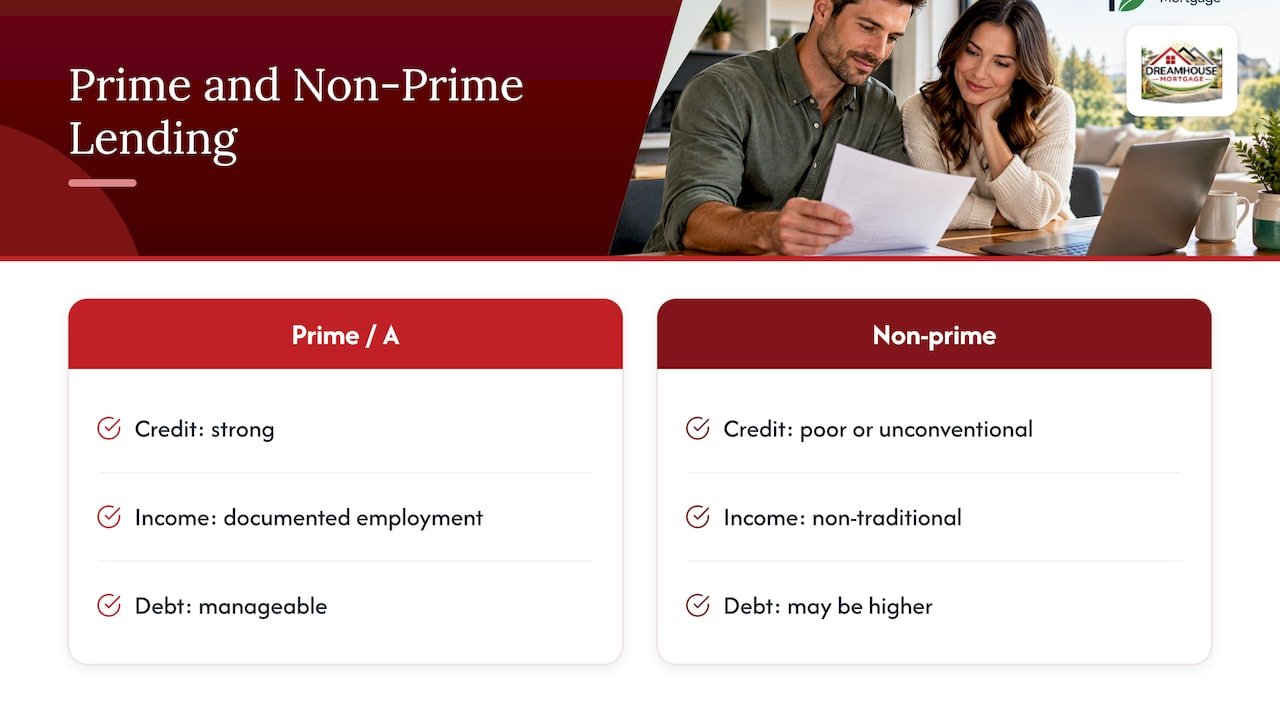
Canadian lenders sort borrowers by risk. “Prime” or “A” lending is what the big banks and most credit unions offer to borrowers with strong credit, documented employment income and manageable debt. A non-prime mortgage serves the people just outside that line. WOWA describes the typical B-lender applicant as someone with poor or unconventional credit, non-traditional income, newcomer status or higher debt, and notes that some alternative programs will consider credit scores below 580.
Non-prime does not mean unregulated, and it does not mean a bad deal by default. It means the lender is pricing risk that a bank’s automated rules would not accept. For many Calgary buyers the real question is not “prime or non-prime” but “which lender will approve my file today, and what is my path to a better rate?”
Who typically ends up here
In our experience with Alberta files, non-prime applications tend to come from a few recurring situations:
- Credit setbacks. Missed payments, a consumer proposal, collections or high card balances that have pushed a score down.
- Self-employed and commission income. Business owners, contractors and tradespeople whose net income after write-offs looks low on paper. Our guide to self-employed mortgages in Calgary covers this in detail.
- Newcomers. People who have arrived recently and have little or no Canadian credit history. See our page on no credit history mortgages in Alberta.
- Higher debt ratios. Buyers whose car loans, student loans and credit lines push total debt service beyond a bank’s limit.
- Unusual properties or locations. Acreages in Rocky View County, rural homes and some investment properties, which can fall outside bank guidelines.
A lenders, B lenders and private lenders compared
Across Canada there are three broad lender tiers, and a broker can place a file in any of them. The differences matter because each tier sets its own rules, cost and term.
| Feature | A lender (bank, credit union, monoline) | B lender (alternative) | Private lender |
|---|---|---|---|
| Typical borrower | Strong credit, documented income | Credit or income outside bank rules | Significant credit problems, urgent timelines or unusual property |
| Qualifying focus | Credit score, income, debt ratios | Equity in the property, plus a story the file can support | Mostly the property and the equity in it |
| Typical term | Up to five years or more | Often one to three years | Often short, with a clear exit plan |
| Cost | Lowest | Higher rate, and often a lender fee | Highest |
| Best used for | Long-term financing | A bridge while you rebuild or document income | Short-term solutions |
WOWA characterizes Canadian B-lender mortgages as generally shorter term, often one to three years, usually requiring at least 20% down, and meant in many cases as a bridge toward improved finances and eventual A-lender financing. Terms and requirements vary by lender, so treat these as typical patterns and not promises.
Because DreamHouse Mortgage works with banks, credit unions, monoline lenders, alternative lenders and private lenders, we can start by testing whether your file fits a bank, and only step down a tier when it needs to. For a closer look at how a broker reaches these lenders, read about mortgage broker lender access in Alberta.
Pro Tip: Do not apply to several lenders yourself to “see who says yes.” Each application can trigger a credit inquiry. A broker can pre-screen your file against lender guidelines before any credit pull.
How lenders assess a non-prime application
Alternative lenders still underwrite carefully. They simply weigh different things.
Equity and the property
B lenders and private lenders lean heavily on the home. A larger down payment or equity position makes the loan safer for them, which is why 20% or more is the common starting point. A marketable property in a Calgary community with consistent resale demand is easier to place than a unique or remote one.
Income that is real but not standard
Some alternative lenders will consider part-time, gig or contract income if it can be documented. Financial Post reported that these lenders look for a consistent, documentable pattern of income over periods such as three, six, nine or 12 months. In practice that means bank statements showing regular deposits, contracts, invoices and tax filings that line up.
The stress test
Federally regulated lenders must qualify uninsured mortgages at a higher rate than the one you will pay. OSFI’s minimum qualifying rate for uninsured mortgages is the greater of your contract rate plus 2% or 5.25%, a rule designed to test whether borrowers could absorb shocks to income, expenses or interest rates. OSFI also states that it generally applies to newly underwritten uninsured mortgages at federally regulated lenders, and not to an uninsured straight switch at renewal when neither the loan amount nor the amortization increases.
That is one reason some borrowers find alternative lenders workable: their underwriting is not built around the same bank-style qualifying framework. A broker can explain which rules apply to which lender before you commit.
For the full bank-side math, see our guide to Canadian mortgage qualification rules for Alberta buyers.
What a non-prime mortgage costs
Rate is only one piece. A realistic budget includes the rate, the lender fee, legal costs and the cost of the exit.
- Rate premium. Financial Post reported in August 2024 that alternative lenders commonly charged otherwise-qualified borrowers at least 1 to 1.5 percentage points above non-alternative pricing, plus a 1% fee, where the borrower had solid credit, at least 20% equity and a marketable home.
- Risk adjustments. The same report noted that weaker equity can add 30 to 50 basis points, while missed payments, rural homes, mortgages well over $1 million and investment properties can mean materially higher pricing.
- Lender or broker fees. Fees vary by lender and by file. Ask for every fee in writing before you sign.
- Insurance. Mortgages with less than 20% down are generally insured, and B-lender products usually require at least 20% down, so most non-prime loans are uninsured.
Those figures are from 2024 and market pricing moves, so use them to understand the shape of the cost, not as a quote. Current rates depend on your file, and we do not publish a fixed price list.
A simple way to compare
Suppose a lender offers a one-year term at a higher rate with a fee. The question is not only “what is the monthly payment?” but “what will I have saved or improved by the time this term ends?” If the answer is a better credit score, two years of tax returns or a lower debt balance, the premium is buying you time and access. If there is no plan, the premium is just cost. That is why we map the exit before we recommend the entry.
Non-prime mortgages for Calgary first-time buyers
Most first-time buyers assume a bank decline means they must wait years. Often it does not. Here are common Calgary-area scenarios.
The self-employed buyer in Airdrie. You have run your business for three years and your income is strong, but your tax returns show heavy write-offs. A bank sees low income. An alternative lender may be able to work with your bank deposits and contracts, which lets you buy now and reposition your tax filing for a bank renewal later.
The newcomer in northeast Calgary. You arrived last year with a good job offer but a thin credit file. Some lenders look at your employment, savings and down payment, and others do not. We outline options on our newcomer mortgage page for Calgary.
The buyer with a recent credit hit in Cochrane. You had a rough stretch, caught up on the payments and now have a stable job and 20% saved. A B-lender term gives you time to rebuild while you own, not rent.
The investor or second-home buyer. Properties outside bank guidelines may need alternative financing. Our pages on investment property mortgages in Calgary and second homes with 5% down explain how those files differ.
If you are earlier in the process, start with our first-time homebuyer mortgage guide for Calgary and then return here if your file needs a different path.
Documents to prepare
Alternative lenders move quickly when a file arrives complete. Prepare these before you meet with a broker:
- Two pieces of government photo ID, and your immigration documents if you are a newcomer.
- Recent pay stubs and an employment letter, or, if self-employed, your Notices of Assessment and T1 Generals for the last two years where available.
- Three to twelve months of bank statements showing regular deposits.
- Proof of down payment and its source, such as savings statements, an RRSP withdrawal record or a gift letter.
- A list of debts with balances and monthly payments.
- An explanation letter for any credit event, covering what happened, when it was resolved and what has changed.
- For a purchase, the accepted offer and the listing details.
Pro Tip: Keep large unexplained deposits out of your accounts in the months before applying. Lenders ask for the source of funds, and a clear paper trail avoids delays.
How to apply, step by step
- Free up your timeline. Tell your broker when you want to take possession so the lender tier and term fit the calendar.
- Review your credit and income picture. Your broker looks at your file honestly, identifies the obstacle and tells you which lender tier it points to.
- Pre-approval. Where the file allows it, a pre-approval sets your price range before you shop. Read our mortgage pre-approval guide for Calgary for what to expect. Remember that an appraisal in Calgary can still change the deal, as explained in preapproval vs approval.
- Lender selection. Your broker matches your file to one lender and submits it. Our application process steps for Alberta lay out the full sequence.
- Approval conditions and appraisal. You provide remaining documents and the lender values the property.
- Legal work and funding. Your lawyer registers the mortgage and funds are released on possession day.
Why you want a licensed broker handling a non-prime file
In Alberta, RECA states that anyone dealing in mortgages for another person for compensation, including soliciting, negotiating or administering mortgage transactions, generally needs a mortgage-broker licence, while an individual lending their own money does not. Before you share documents with anyone arranging a non-bank mortgage, confirm the person is licensed.
RECA also explains that a borrower represented by a brokerage is a client, and the brokerage owes duties including loyalty, confidentiality, full disclosure, reasonable care and skill, and accounting. That is the standard you should expect on a higher-stakes file. For more, see our explainers on mortgage broker fiduciary duty in Alberta, the role of the Broker of Record and how brokers are paid.
What to check before you accept an offer
- The term length and the date it ends.
- The full rate, every fee, and the total cost over the term.
- Prepayment and renewal conditions, including whether you can refinance or switch to a bank lender at maturity.
- Whether the lender is federally regulated, provincially regulated or a private lender, which affects the rules that apply.
- That your broker has explained each item in plain language and given you time to review it.
Moving from non-prime to a conventional mortgage
WOWA describes B-lender mortgages as a stepping stone for borrowers to improve their situation and eventually qualify for an A-lender mortgage. A good non-prime plan treats the term as a project with milestones.
- Credit. Pay every account on time, reduce card balances below roughly a third of limits, and avoid new credit during the term.
- Income documentation. If you are self-employed, work with your accountant so your filed income reflects your real earnings. Banks generally rely on what your tax returns show.
- Debt. Pay down or eliminate loans that crowd your debt ratios. Our guide on debt consolidation options can help you decide whether restructuring makes sense.
- Equity. Regular payments and, where allowed, prepayments build equity and widen your options.
- Review early. Talk to your broker well before maturity, ideally several months out, so you can line up an A lender or a renewal with plenty of time. Our Renew or Switch service is built for this stage.
If you want to understand how amortization shapes your payment during the bridge, read mortgage amortization options in Canada.
Our perspective
We believe a non-prime mortgage is a tool, not a verdict. At DreamHouse Mortgage we meet many Calgary, Airdrie and Cochrane buyers who were told “no” at a branch and assumed the answer was final. Usually the file simply needed a different lender and a clearer story.
Our approach is to start from the exit. Before we place a client with an alternative lender, we map what must change for them to qualify for a bank rate, and we build the term around that. Access to banks, credit unions, monoline, alternative and private lenders is what makes that possible, because we are not limited to one product shelf.
We also think borrowers deserve plain explanations. You should know what every fee is, why a lender is pricing the file as it is and what your next three steps are. That education is part of the service, and it is why many of our clients come back for renewals and refinances.
Guriqbal Chahal, MBA, PMP
Talk to a Calgary mortgage broker about your options
DreamHouse Mortgage is a Calgary-based brokerage, founded in 2013, led by Broker of Record Guriqbal Chahal. We help first-time buyers, self-employed professionals, newcomers and investors across Calgary, Airdrie, Cochrane, Chestermere, Okotoks and the rest of Alberta compare lenders and build a plan, from pre-approval to renewal.

If your file does not fit a bank, we will tell you which lender tier it points to and how to move toward lower-cost financing over time. See our full list of mortgage services, or call Guriqbal Chahal, MBA, PMP, Mortgage Broker, at 403-966-6072. You can also find us on our Google Business Profile.
FAQ
Is a non-prime mortgage the same as a private mortgage?
No. A non-prime mortgage usually comes from an alternative or B lender that is a regulated financial institution, while private lenders are individuals or investment pools that lend against property equity. Private loans are generally shorter and priced higher. A broker can tell you which tier your file fits.
How much down payment do I need for a non-prime mortgage in Alberta?
WOWA notes that B-lender mortgages usually require at least 20% down, although individual lenders set their own rules. A larger down payment or more equity can also improve your pricing. Your broker will confirm the minimum for the specific lender and property.
Can a first-time buyer in Calgary get a non-prime mortgage?
Yes, first-time buyers can be approved by alternative lenders when the file has enough equity and documented income. Self-employed buyers, newcomers and people recovering from credit problems are common examples. Approval depends on the lender, the property and your documents.
How long do I stay in a non-prime mortgage?
The term is often one to three years, according to WOWA. Many borrowers use that time to rebuild credit, document income or reduce debt, then move to a bank or credit union at renewal. Start planning with your broker several months before the term ends.
Sources
- B Lender Mortgages in Canada, WOWA.ca
- Minimum qualifying rate for uninsured mortgages, OSFI
- How to qualify for a mortgage when your income doesn’t cut it, Financial Post
- Working With a Mortgage Broker, Real Estate Council of Alberta
- Licence Types, Real Estate Council of Alberta
- DreamHouse Mortgage, Google Business Profile