A completion mortgage in Alberta is a loan that funds in one lump sum on the day you take possession of a finished new home. You buy from a builder, the builder pays for construction, and your lender releases the mortgage money at closing. You make no interest payments during the build. If you are a first-time buyer in Calgary, Airdrie or Cochrane looking at a new build in a suburban community, this is the mortgage structure you will most likely meet. The steps below explain how to prepare for it.
TL;DR
- A completion mortgage funds once, on possession day, after the builder finishes the home. A construction (draw) mortgage releases money in stages as work is inspected.
- You still need a pre-approval before you sign a new-build contract, and you should ask how long your rate hold lasts compared with the builder’s timeline.
- Lenders often re-check your employment and credit before funding, so keep your finances stable between approval and possession.
- Under 20% down, the mortgage must be insured. Insured new-build financing in Alberta requires enrolment in a recognized new home warranty program.
- We can arrange a completion mortgage for you across banks, credit unions and monoline lenders. Call Guriqbal Chahal at 403-966-6072.
Table of Contents
- What a Completion Mortgage Is
- Completion Mortgage vs Construction (Draw) Mortgage
- When the Money Actually Moves
- Qualifying for a Completion Mortgage
- A Worked Example for a Calgary Suburb Purchase
- Costs and Risks to Plan For
- Fixed or Variable on a Long Build Timeline
- Step-by-Step: Getting Ready for a Completion Mortgage
- How We Help Buyers Across Calgary, Airdrie and Cochrane
- Talk to a Calgary Mortgage Broker Before You Sign
- FAQ
- Sources
What a Completion Mortgage Is
When you buy a resale home, the mortgage funds on the closing date and you move in. A new build adds a gap: the contract is signed months before the home exists. A completion mortgage is the financing built for that gap when the builder carries the construction costs.
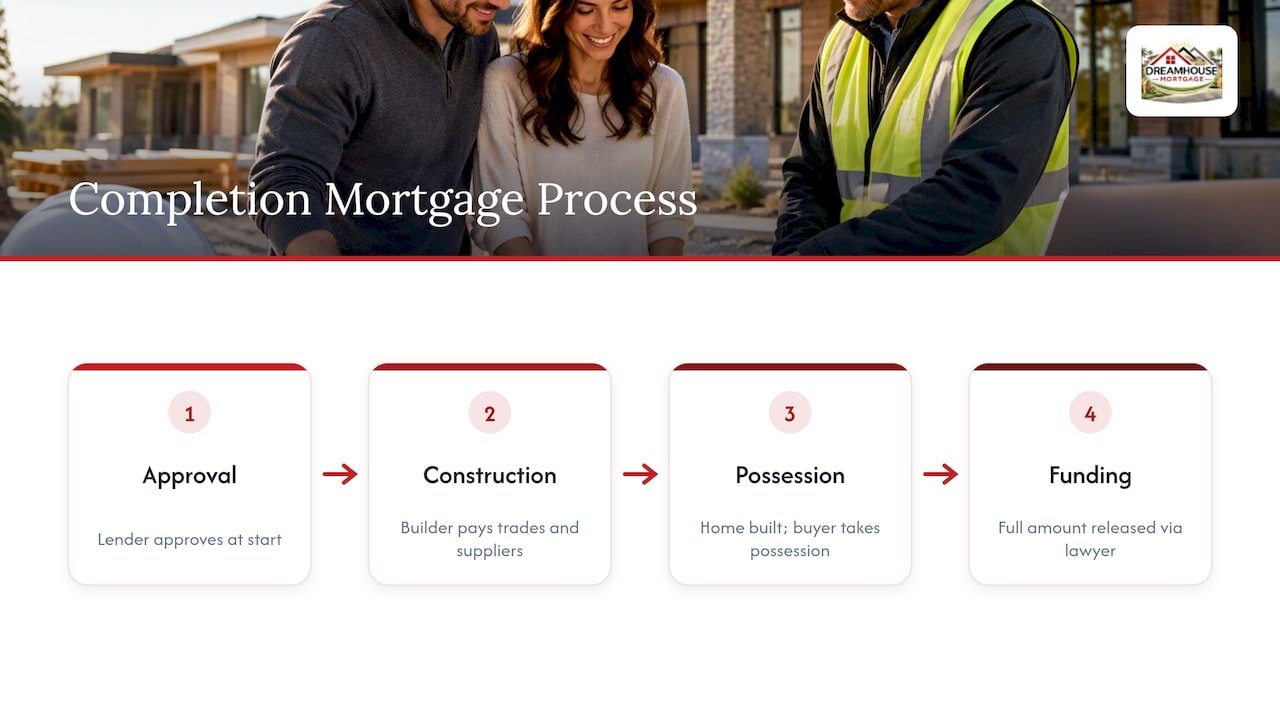
The lender approves you at the start, then funds the full amount only when the home is fully built and you take possession. The builder, not you, is responsible for paying trades and suppliers during construction. Your money is released to the builder through your lawyer on possession day.
The approach is common in Calgary and Edmonton. Large volume builders in suburban developments tend to sell homes on completion terms, while smaller or custom builders more often ask for a draw mortgage. Think of communities on the edges of Calgary such as Seton, Cranston, Livingston, Walden, Cityscape, Rangeview and Mahogany, or newer neighbourhoods in Airdrie such as Windsong and Cooper’s Crossing, and Cochrane areas such as Sunset Ridge and Heartland. Many sales there follow a builder’s standard purchase agreement with a fixed possession window.
Why buyers like the structure
A completion mortgage often simplifies the process because there is one closing and no interest payments during construction. For a first-time buyer, that means you can keep paying your rent and saving your down payment until the keys are ready. There are no staged inspections for you to coordinate and no draw requests to submit.
Completion Mortgage vs Construction (Draw) Mortgage
The two products solve different problems. A construction mortgage releases funds in instalments as building milestones are reached and verified by inspections. A completion mortgage waits until the end.
| Feature | Completion mortgage | Construction (draw) mortgage |
|---|---|---|
| Who builds | A builder who sells you a finished home | You hire a builder or act as owner-builder |
| When funds release | One lump sum on possession day | In stages as milestones are inspected |
| Interest during build | None on the mortgage | Interest on the amounts drawn so far |
| Typical buyer | Buyer of a new home in a builder’s development | Custom home or infill project |
| Closings | One | Often more than one step |
If you are planning your own build, our guide to mortgage draws for Alberta home builders and our page on Alberta construction mortgages cover that route in detail. This article stays with the buyer who purchases a finished home from a builder.
Pro Tip: Ask the builder in writing which financing structure they require before you pay a deposit. It decides which lender products fit your purchase.
When the Money Actually Moves
The possession date is the trigger. A completion mortgage funds in a single transaction on the day you take possession. Before that, the timeline usually looks like this:
- Contract signing. You sign the builder’s purchase agreement and pay deposits as set out in it.
- Mortgage approval and rate hold. Your broker secures an approval and holds a rate for as long as the lender allows.
- Construction. The builder completes the home. You may select finishes and attend walkthroughs.
- Final mortgage documents. Completion mortgages are finalized about 30 days before completion.
- Possession and funding. Your lawyer registers the transfer and mortgage, funds go to the builder, and you receive the keys.
Because you may sign 6 to 18 months before possession, timing the rate is the biggest strategic decision. In 2026, many Alberta institutions offer rate holds of up to 18 months on new construction, which protects you if rates rise during the build. Hold lengths differ by lender and product, and a longer hold can come with a different rate than a shorter one. Comparing those options across lenders is exactly what a broker does.
What if the completion date moves?
Builders adjust possession dates, and a delay can outlast your rate hold or your approval. Raise it with your broker as soon as the builder gives you a revised date, not at the last minute. Depending on the lender, you may need to extend the hold or re-confirm the file. Ask whether your lender charges for an extension and whether the rate would reset to the then-current rate.
Qualifying for a Completion Mortgage
A lender looks at the same core factors as for any purchase: income, debts, credit, down payment and the property. On a new build, there are two additional steps. The lender checks you at approval and again before funding.
Income, debts and credit
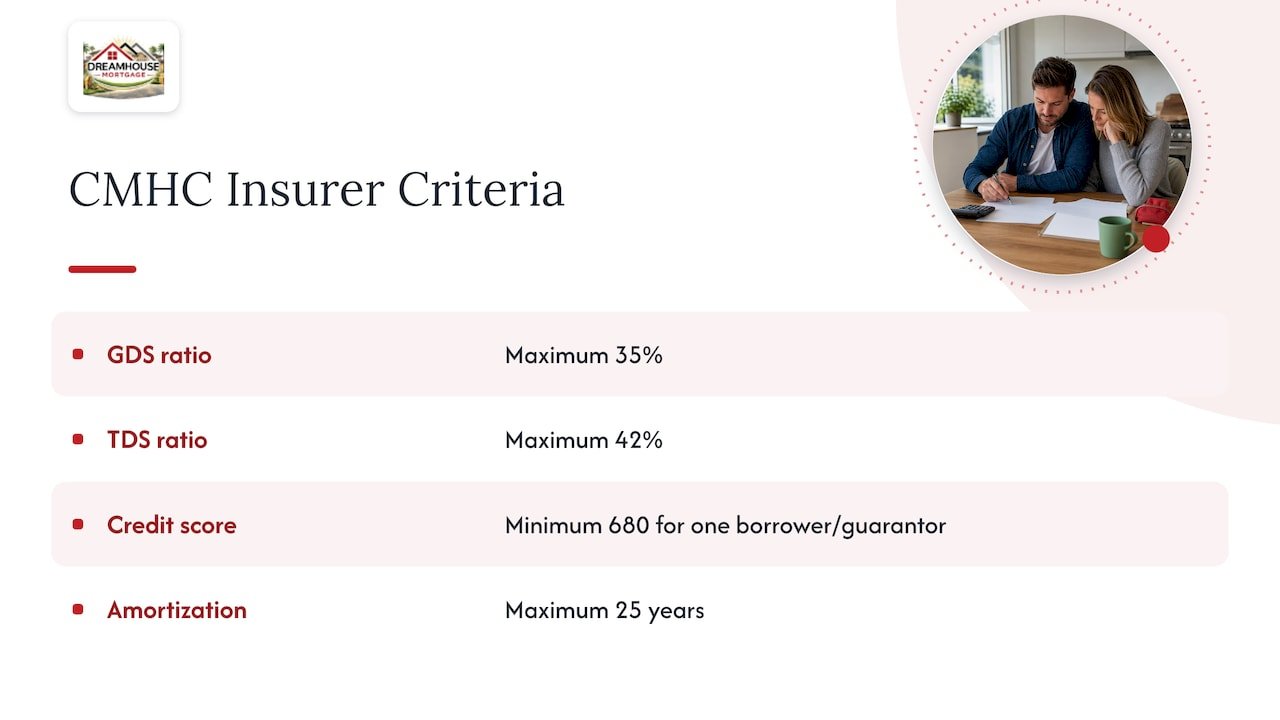
For CMHC-insured new-construction financing, the CMHC Improvement fact sheet sets maximum debt service ratios of 35% gross debt service and 42% total debt service, with a minimum credit score of 680 for at least one borrower or guarantor, and a maximum 25-year amortization. Those are CMHC insurer criteria for that program, and individual lenders apply their own policies on top. Some lenders accept different profiles through uninsured or alternative products, so a score under 680 does not end the conversation. If you want to understand the numbers behind your own file, read our mortgage pre-approval process guide for Alberta buyers.
Down payment
In Canada, a down payment under 20% means the mortgage must be insured, and the insurance is not available when the home costs $1.5 million or more. Insured purchases can start as low as 5% down on the first $500,000 of the price. Most new builds in Calgary’s suburban communities fall well under that cap, so many first-time buyers qualify for an insured completion mortgage. If you want a clear explanation of how the cap affects your options, CMHC insurance and the $1.5M cap is worth reading before you compare homes.
First-time buyers can also draw on federal programs such as the First Home Savings Account and the Home Buyers’ Plan. We cover them in our guide to first-time home buyer benefits in Canada.
The warranty requirement
CMHC-insured new-construction financing requires enrolment in a recognized new home warranty program in provinces where one exists, which includes Alberta. Ask your builder for the warranty details in writing and give them to your broker and lawyer early. A missing warranty certificate is a common cause of last-minute lender questions.
Employment and credit re-checks
Completion approvals quite often come subject to an employment and credit re-check. When you lock in the rate near the end, the lender may ask for updated paystubs and a new credit report. For you, this has practical consequences:
- Do not change jobs or move from salaried to commission between approval and possession without speaking to us first.
- Avoid new credit: a car loan, a store card or a large furniture financing plan can shift your ratios.
- Keep your down payment funds in the account that was documented, and keep statements ready. Large unexplained deposits raise questions.
- Pay existing debts on time, and keep balances low.
Pro Tip: If you are self-employed, your income is documented differently, usually through Notices of Assessment and business financials. Tell us before you sign the builder’s contract so we can pick lenders suited to your file. Our first-time home buyer mortgage guide for Alberta walks through the documents.
A Worked Example for a Calgary Suburb Purchase
This example uses illustrative numbers only, not a quote or a lender offer. Say a couple is buying a $480,000 townhome from a builder in a Calgary-edge community with possession expected in about 12 months. They have saved 5% for the down payment.
- Purchase price: $480,000
- Minimum down payment for an insured purchase at this price: 5% of $480,000, which is $24,000
- Mortgage before insurance premium: $456,000
- Required: CMHC or another insurer’s premium, which is added to the mortgage in most cases
Since the price is under $500,000, the 5% minimum applies to the whole amount. The premium depends on the loan-to-value ratio, so your broker will confirm the figure from the insurer’s current schedule. The couple would want to know before signing: Does the lender offer a rate hold that covers 12 months plus a buffer? What happens if possession slips? And are closing costs, legal fees and GST implications for new homes budgeted? Those are the questions we work through with you ahead of time.
Costs and Risks to Plan For
A new-build purchase has costs beyond the mortgage. Build a budget that includes:
- Deposits under the builder’s contract, which are paid before the mortgage funds.
- Legal fees for your lawyer’s review, title work and registration.
- Upgrades and extras the builder charges for outside the base price, such as appliances, blinds, landscaping and fencing. Confirm what the lender will count in the purchase price.
- Interim occupancy or possession-day costs if your contract has them.
- Moving and utility setup.
- GST on new homes. Ask your lawyer and the builder how it applies to your purchase, and read about the federal first-time buyer rebate options in our benefits guide.
Alberta’s government notes that buyers may choose to have a lawyer review the purchase agreement, and that lawyers can help confirm the home has warranty coverage and that the title is free of debts or liens. For a contract that sets possession dates, deposits and warranty terms, we recommend a real estate lawyer see it before you sign.
Appraisals
The lender will want the home to appraise at or above the purchase price. In a market where prices shift between signing and possession, an appraisal can differ from the contract price. We explain how this can change a deal in preapproval vs approval. Keep some extra cash beyond your minimum down payment if you can, so a small appraisal gap does not derail closing.
Owner-builders are a different case
If you are acting as your own builder, Alberta requires an Owner Builder Authorization. Warranty coverage is optional, but without it you cannot sell or offer the home for sale within the 10-year protection period. This situation usually calls for a draw mortgage rather than a completion mortgage.
Fixed or Variable on a Long Build Timeline
If your possession date is a year out, the question is not only which rate is lowest today, but how you want to be protected. A rate hold sets the rate you can get at funding. Whether you choose a fixed or a variable product at funding is still a decision about your budget and risk comfort. Our guide on fixed vs variable mortgage rates for new Alberta buyers lays out six points to weigh.
Ask each lender or your broker these questions:
- How long is the rate hold, and does it run from approval or from the date of the builder’s contract?
- If rates fall before funding, do I get the lower rate?
- What is the cost or process if I need to extend the hold?
- Does the product allow prepayments and what is the penalty method if I break the term?
- Is the amortization I want available at my down payment level?
Amortization limits depend on whether the mortgage is insured and on the lender. Our page on mortgage amortization options in Canada explains the choices.
Step-by-Step: Getting Ready for a Completion Mortgage
- Get a pre-approval first. Before touring show homes in Cochrane, Airdrie or Calgary, have a realistic budget. See our Calgary mortgage pre-approval guide.
- Review the builder’s contract with us and a lawyer. Look at possession window language, deposit schedule, upgrade pricing and warranty.
- Choose your lender and rate hold. We compare banks, credit unions, monoline lenders and others to match the hold length to the build timeline.
- Stay stable. Keep your job, credit and down payment funds as documented.
- Update us on every date change. Possession date adjustments affect your hold and your approval.
- Finalize about 30 days out. Expect to supply updated documents, and confirm the lawyer has the warranty and builder’s paperwork.
- Possession day. Funds release, you sign at the lawyer’s office or electronically, and collect your keys.
How We Help Buyers Across Calgary, Airdrie and Cochrane
DreamHouse Mortgage is a Calgary-based brokerage founded in 2013, and our work covers Calgary, Airdrie, Cochrane, Chestermere, Okotoks, High River, Rocky View County, Edmonton and Red Deer. Our focus on first-time buyers means we are used to the questions that come with a first purchase, including new builds.
For a completion mortgage, we typically do the following:
- Review your income, down payment and credit, then pre-approve you with a lender suited to your file.
- Line up a rate hold that fits the builder’s estimated possession date.
- Collect and organize documents so the re-check before funding is smooth.
- Coordinate with your lawyer and the builder’s sales team on the funding timeline.
Our Perspective
We see the same pattern each season with new-build buyers. The excitement of choosing a lot and finishes is real, but the mortgage is often an afterthought until the sales centre asks for proof of financing. By then, the buyer has less room to compare options.
Our advice is to start with the mortgage, not the show home. A pre-approval, a plain conversation about how long the build will take, and a rate hold that matches that timeline remove most of the stress. We also tell clients to keep their finances quiet between approval and possession, because lenders look again before funding.
Because we work with banks, credit unions, monoline lenders and alternative lenders, we can match the product to your situation instead of fitting you into one lender’s rules. That matters for self-employed buyers, newcomers to Canada and buyers with a smaller down payment. Our job is to explain each step in plain language so you know what happens on possession day before it arrives.
Guriqbal Chahal, MBA, PMP
Talk to a Calgary Mortgage Broker Before You Sign
If you are considering a new build in Calgary, Airdrie, Cochrane or nearby, a short conversation before you sign the builder’s contract can save you months of worry. We offer first-time buyer mortgages and pre-approvals through a network of lenders, with advice tailored to your income, your down payment and your build timeline.

Call Guriqbal Chahal, MBA, PMP, Mortgage Broker, at 403-966-6072, or find us on our Google Business Profile. If you want to read more first, start with our first-time homebuyer mortgage guide for Calgary.
FAQ
Is a completion mortgage the same as a construction mortgage?
No. A completion mortgage funds in one lump sum when the builder finishes the home and you take possession. A construction mortgage releases money in stages as inspected milestones are reached. Completion mortgages usually apply when you buy from a builder, while draw mortgages usually suit custom or owner-built homes.
Do I pay mortgage interest while my home is being built?
With a completion mortgage, you generally do not pay mortgage interest during the build because the mortgage funds at possession. You may still have deposits and other costs set out in your builder’s contract, so read the schedule carefully and have a lawyer review it.
Can I get a completion mortgage with a small down payment?
Often yes. In Canada, a down payment under 20% means the mortgage must be insured, and insured purchases can start at 5% on the first $500,000 of the price. Insured new-construction financing also requires a recognized new home warranty. A broker can confirm what your lender will accept.
What if my possession date changes?
Tell your broker right away. A new date may extend beyond your rate hold or your approval period, and the lender may re-check your employment and credit before funding. Your broker can ask the lender about an extension and explain the terms before you rely on it.
Sources
- Guide to Construction Mortgages in Canada, Forbes Advisor
- How to Buy a New Construction Home in Calgary
- Alberta New Home Construction Loan Process: 2026 Guide
- CMHC Improvement fact sheet
- Completion vs Draw Mortgages, Daytona Homes
- CMHC mortgage loan insurance explained
- Purchasing a new home, Alberta.ca
- New home warranty: Owner Builder Authorization, Alberta.ca