A completion mortgage pays out in one amount when your new home is finished and you take possession. A draw mortgage (also called a progress-draw or construction mortgage) pays out in stages while the home is being built. In most cases the way you are buying decides which one you need: a home bought from a builder is usually a completion mortgage, and a home built on land you own is a draw mortgage. For first-time buyers in Calgary, Airdrie, Cochrane and Chestermere, the real work is lining up the approval, the down payment and the timing before the build starts. Our team at DreamHouse Mortgage helps you do that, and you can call Guriqbal Chahal, MBA, PMP, Mortgage Broker, at 403-966-6072.
TL;DR
- Completion mortgage: one advance when the home is finished, usually for a house or townhome you buy from a builder. You typically make no mortgage payments before possession.
- Draw mortgage: the lender releases money in stages after inspections, usually for a home you build on your own lot. You pay interest only on what has been advanced.
- Down payment: draw mortgages usually need more cash up front. Forbes Advisor Canada puts it at about 25% to 30%, while insured completion purchases can follow the standard minimum.
- Alberta detail: a 10% builders’ lien holdback applies to each payment under Alberta’s lien legislation, and your lawyer manages it.
- Before you sign a build contract: get a pre-approval that fits the structure, because the wrong one can stall a build.
Table of Contents
- The Difference in Plain Terms
- Which One Do You Need? Your Build Decides
- How a Completion Mortgage Works
- How a Draw Mortgage Works
- Down Payment and Qualification
- Alberta Details That Affect Both Types
- How to Choose and Set Up Your Financing
- Common Mistakes First-Time Buyers Make
- Calgary, Airdrie and Cochrane: Local Planning Notes
- Work With a Calgary Mortgage Broker on Your New Build
- Our Perspective
- FAQ
- Sources
The Difference in Plain Terms
Both products finance a home that does not exist yet. What separates them is when the lender’s money moves and who is paying the builder while the work is under way.
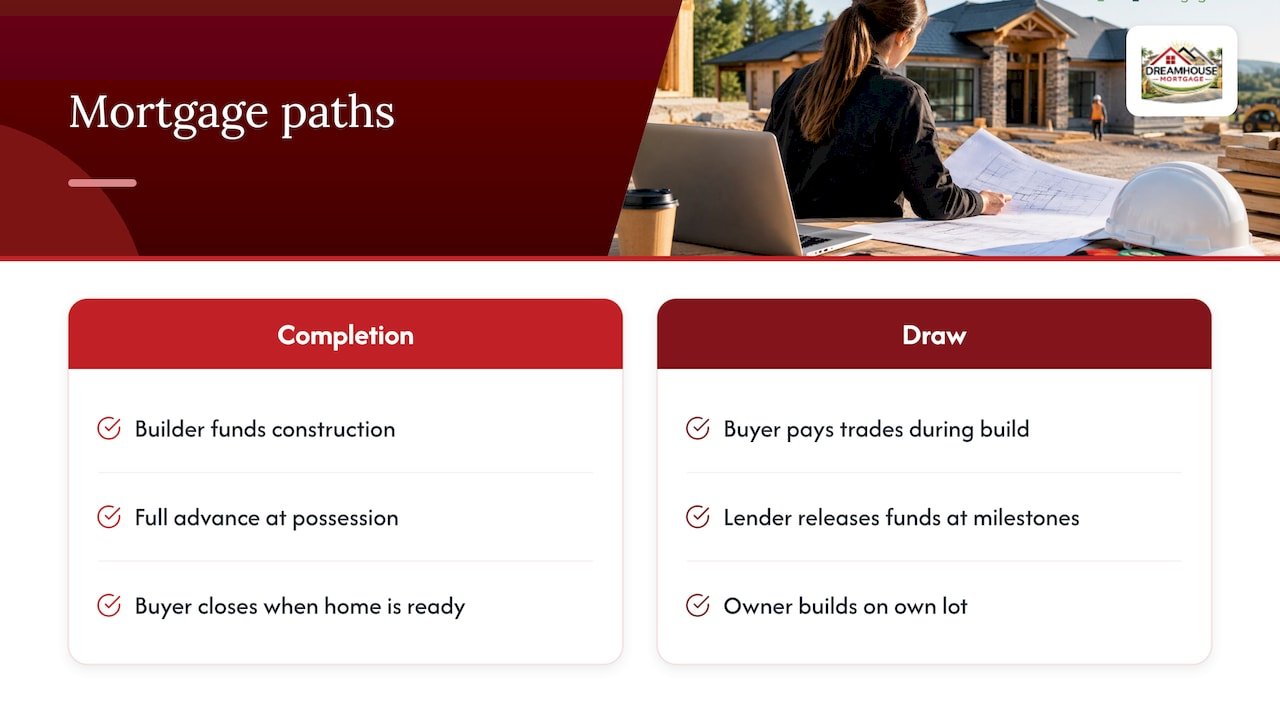
With a completion mortgage, the builder carries the construction costs and is paid when the home is done. The lender funds the full mortgage on the possession date, against a finished and appraised home. Forbes Advisor Canada describes it as typically not finalized until about 30 days before possession.
With a draw mortgage, you are the one paying the trades, so the lender releases funds in instalments as milestones are reached. An inspector confirms the progress before each instalment is paid, and interest is charged only on the amount advanced so far.
| Completion mortgage | Draw mortgage | |
|---|---|---|
| Typical purchase | Pre-sale or production home bought from a builder | Custom home built on your own lot, or a major build you manage |
| When funds are released | One advance on possession | Several advances at build milestones |
| Payments during the build | Typically none before possession | Interest-only payments on funds advanced |
| Inspections | Final appraisal and inspection at the end | Inspection before each draw |
| Down payment | Standard rules for the property and mortgage type | Usually larger, often 25% to 30% for conventional construction lending |
| Main risk | Rates and your finances can change over a long wait | Cash gaps between draws and what the trades need |
Which One Do You Need? Your Build Decides
Most buyers do not choose between the two. The contract in front of you decides it.
You are buying from a builder. If you sign a purchase agreement for a home in a new Calgary community, a townhome in Airdrie or a house in a new Cochrane development, the builder finances construction and you close when the home is ready. That is a completion mortgage. Our guide to a completion mortgage in Alberta for Calgary buyers walks through this path in more detail.
You own a lot and are hiring a builder. Someone has to fund the foundation, framing and mechanicals while the work happens, so this is a draw mortgage. The same applies if you act as your own general contractor. Our mortgage draws guide for Alberta home builders explains the stages, and our page on Alberta construction mortgages covers the planning side.
You are weighing a new build against a resale home. The financing path is only one part of that decision. Our comparison of new build vs resale mortgages in Calgary covers the rest.
Condos are a special case. CMHC’s guidance for new construction financing states that condominium construction financing and loan advances on vacant land are not permitted under its insured program. A condo purchased from a developer is therefore normally handled as a completion purchase.
How a Completion Mortgage Works
A completion mortgage has fewer moving parts during construction and more risk on the calendar.
- You sign the purchase agreement with the builder, often many months before the home is finished.
- You get a pre-approval and, ideally, a rate hold from the lender. Rate hold lengths differ by lender, so confirm the hold covers your expected possession date and ask what happens if the build runs late.
- The home is built with no mortgage advances. Typically no payments are due before possession, and the builder does not expect funds until then.
- About 30 days before possession, the lender finalizes the file. This is when it reviews your income, debts and the appraisal again.
- On possession day, the lender funds the full mortgage through your lawyer, and your regular principal-and-interest payments begin.
The Risk: Your File Must Still Qualify at the End
A pre-approval is not a final approval. If your job changes, you finance a vehicle or open new credit during a 12-month build, the lender sees that at the final review. Rates can also move during the wait, so a rate hold matters. We also explain the difference between a pre-approval and a final approval in preapproval vs approval in Calgary.
Pro Tip: Treat the build period like the weeks before any mortgage closing. Do not take on new debt, keep your down payment funds in the same account, and tell your broker before any change to your employment.
How a Draw Mortgage Works
A draw mortgage matches funding to construction progress. The details vary by lender, but the structure is consistent across Canadian banks.
RBC’s construction mortgage page is a clear example of how one major lender sets it up:
- Funds are released in multiple advances, called progress draws, at set stages.
- The first draw is limited to 65% of the appraised lot value and must happen within the rate commitment period.
- The second draw follows completion and inspection of the foundation and backfill, within 180 days of the first.
- Later draws follow framing and roof, mechanicals, and finally 100% completion.
- Each draw requires proof the milestone is complete, and a provincial lien holdback is applied.
- Monthly payments during construction are interest only, and the first principal-and-interest payment is due one month after the home is complete.
Its worked example uses $600,000 in approved financing: a first draw of $130,000, a second of $85,000 after the foundation, and a fifth and final draw of $45,000 at 100% completion. The numbers will differ with your lot value, lender and build cost, but the pattern is the same.
A Typical Draw Schedule
Forbes Advisor Canada shows another common layout, with an inspector assessing progress before every payment:
| Stage | Share of funds released | Build complete |
|---|---|---|
| Subfloor | 15% | 15% |
| Lock-up | 25% | 40% |
| Drywall | 25% | 65% |
| Finishing | 20% | 85% |
| Final completion | 15% | 100% |
A draw schedule is not something you negotiate with the builder. It is set by the lender’s lending rules, which depend on whether the loan is insured, who owns the lot and how much you are putting down. That is why the build budget has to be matched to the schedule before you sign anything.
Why Interest Costs Stay Lower Early On
Because you are charged only on the money advanced, your early carrying costs are small. On a $600,000 approval where only $130,000 has been drawn, interest runs on $130,000, not $600,000. This is the main way a draw mortgage keeps costs in line with the progress of the build.
Down Payment and Qualification
Here is where first-time buyers in Calgary and the surrounding towns most often get surprised.
Conventional Construction Lending
Forbes Advisor Canada reports that progress-draw mortgages typically need a larger down payment, often 25% to 30%, with lenders usually covering up to 75% of total construction cost. It also notes that approval is stricter than for a standard mortgage: proof of income, sufficient assets, a low debt-to-income ratio and a strong credit score.
NerdWallet Canada adds that inspections are required at each step before the next draw is approved, and the borrower is generally responsible for inspection costs. Some banks deduct progress and inspection fees from each draw, so ask how fees are handled.
Insured Progress Draw Options
Less than 20% down does not rule out a build. Canada Guaranty’s Progress Draw Advantage program, published in November 2025, lists the following requirements:
- Maximum 39% gross debt service (GDS) and 44% total debt service (TDS). GDS is the share of your income that goes to housing costs, and TDS adds all other debt payments.
- Maximum 95% loan-to-value for one- and two-unit purchases.
- A minimum 5% down payment on the first $500,000 of the purchase price, plus 10% on the amount above $500,000.
- For contractor-built purchases, title to the land in your name on or before closing.
- Registration of the contractor and home with an approved New Home Warranty program.
- Builder loans are not eligible, and a self-builder acting as general contractor must keep each sub-trade contract under 50% of total construction cost.
The down payment can come from your own resources, close family gifts or arm’s-length borrowing, though borrowed funds count in your TDS. For other down payment sources, see our guide to mortgage down payment types in Canada.
A Worked Example
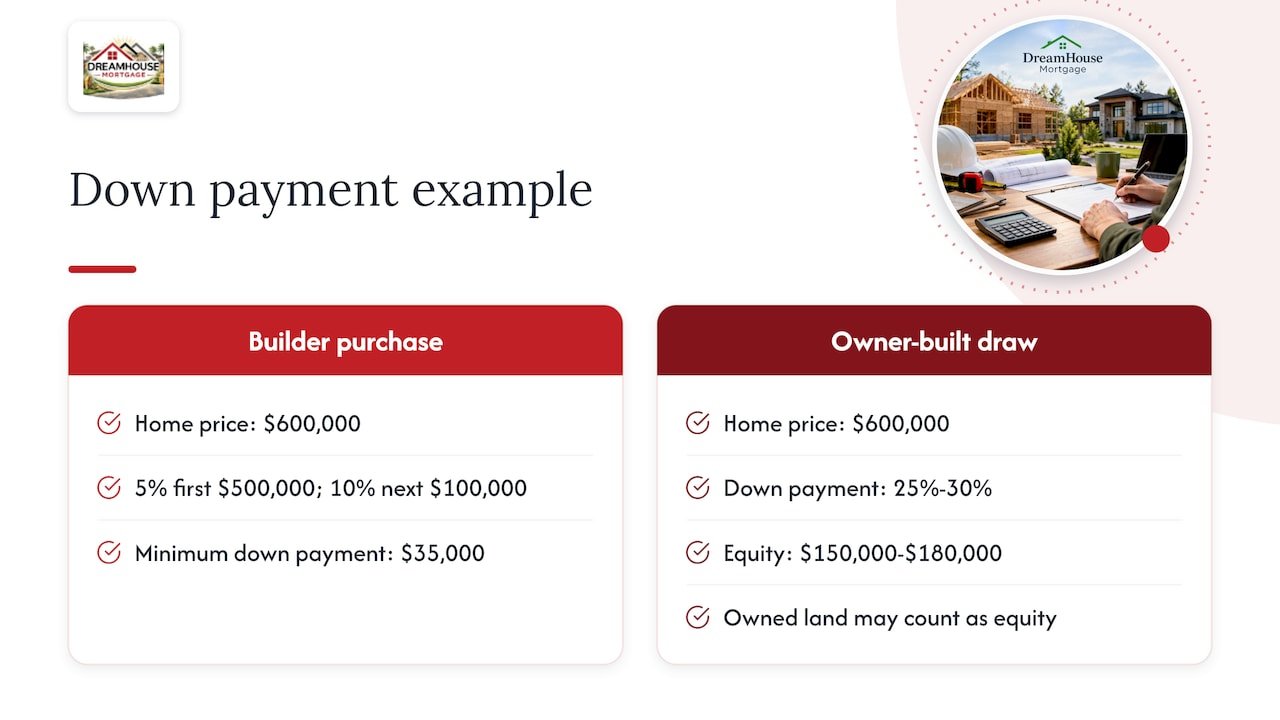
Say you are buying a $600,000 new home in a Calgary community from a builder. Applying the same 5% and 10% tiers as the insured program above, the minimum down payment would be $25,000 (5% of the first $500,000) plus $10,000 (10% of the remaining $100,000), for $35,000 in total. Programs and insurers differ, so this is an illustration of the calculation, not a quote. Closing costs, legal fees and any upgrades are in addition.
Build the same home on your own lot under a conventional draw mortgage and a 25% to 30% down payment would mean roughly $150,000 to $180,000 in equity, which can include the value of land you already own. That gap is why the structure has to be settled before you commit.
For the first-time buyer incentives that can add to your down payment, such as the FHSA and the Home Buyers’ Plan, see our first-time home buyer benefits guide.
Alberta Details That Affect Both Types
Builders’ Lien Holdback
Under Alberta’s lien legislation, owners must retain a 10% holdback from each payment under a construction contract. It is typically released 60 days after completion of the work if no liens were filed. In a draw mortgage, the lender sends each draw to your lawyer, and the lawyer pays the builder less the holdback. RBC’s legal instructions for construction advances also confirm a 10% statutory holdback in Alberta, held in the lawyer’s trust account.
The practical point: the holdback is money you are required to retain, so your cash-flow plan should show it.
New Home Warranty and Final Inspection
For newly constructed properties in Alberta, RBC’s instructions say the lender must obtain a satisfactory final inspection before the last advance. If the builder is a New Home Warranty member, a unit enrolment number and a certificate of possession signed by the builder and the owners must be in hand before the final advance is requested. A lender’s requirements vary, so your broker should confirm the paperwork list for the specific lender at the start.
Rules for Insured Construction
CMHC’s new construction guidance states that insured construction financing must be approved before construction starts or at an early stage, and that the lender must have control of the entire building during construction. Another reason to get your approval first and your contract second.
How to Choose and Set Up Your Financing
- Confirm your build type. Builder-sold home: completion. Own lot or self-managed build: draw. Ask the builder for the purchase agreement or contract before you go lender shopping.
- Calculate your total cash need. Down payment, closing costs, legal fees, upgrades and, for draw builds, the cash needed to bridge gaps between draws. Lenders want to see that you have a plan for these timing gaps, and a simple cash-flow worksheet showing when money comes in and goes out helps your file.
- Get a pre-approval that fits the structure. A regular resale pre-approval may not match a construction file. Our mortgage pre-approval process for Alberta buyers and pre-approval requirements checklist cover the documents you will need.
- Match the rate hold to the timeline. On a completion mortgage, the key question is how long the hold lasts compared with the builder’s possession estimate. On a draw mortgage, the first draw has to happen within the commitment period.
- Plan a contingency. Build budgets move. Keep a reserve for cost overruns and avoid any new credit.
- Line up your lawyer early. Lien holdbacks, title and each draw go through your lawyer, so the sooner they are involved, the fewer delays.
Pro Tip: Ask the builder for their expected possession window in writing, and share it with your mortgage broker so the rate hold and approval are built around it.
Common Mistakes First-Time Buyers Make
- Signing the build contract before the financing is confirmed. The structure, down payment and lender conditions all depend on the contract terms.
- Assuming the pre-approval is the final approval. On a completion mortgage, the lender reviews your file again close to possession.
- Taking on new debt during the build. A vehicle loan or new credit card limit can change your debt ratios at the last step.
- Underestimating cash needs on a draw build. The draw schedule is set by lending rules. If the trades need more money earlier than a draw provides, you cover the difference.
- Forgetting the lien holdback in the budget. It is a required 10% retention on each payment in Alberta.
- Leaving out the warranty. Insured programs require registration with an approved New Home Warranty program.
Calgary, Airdrie and Cochrane: Local Planning Notes
New communities on the edges of Calgary, along with growing towns such as Airdrie, Cochrane and Chestermere, are where many first-time buyers meet these products. Builders in those areas often sell homes years before possession, so rate holds and the final approval timing matter. Buyers with acreage or a lot in Rocky View County who plan to build are in draw mortgage territory.
Whichever you are, the three questions to settle with your broker are the same: what is my build type, what will the lender need at each stage, and what is my total cash requirement.
Work With a Calgary Mortgage Broker on Your New Build
DreamHouse Mortgage is a Calgary mortgage brokerage, founded in 2013, that works with banks, credit unions, monoline lenders, alternative lenders and private lenders. For a new build, that means we can compare lender options for your situation and help with qualification, document collection, lender selection and funding coordination. We serve first-time buyers across Calgary, Airdrie, Cochrane, Chestermere, Okotoks, High River and Rocky View County.
Start with a mortgage pre-approval in Calgary before you sign a purchase agreement or build contract, or explore our first-time buyer mortgage options.

Call Guriqbal Chahal, MBA, PMP, Mortgage Broker, at 403-966-6072, or find us on our Google Business Profile.
Our Perspective
Most first-time buyers we talk to about new builds start with the rate. The rate matters, but on a new build the structure and the timing matter just as much. A completion mortgage and a draw mortgage can both be the right answer. The wrong answer is signing a contract before you know which one your lender will approve and what it needs from you at each stage.
Our approach is to start from the contract and work backward. We look at the builder’s timeline, your down payment sources, your income and debts, and then compare lenders across banks, credit unions, monoline and alternative lenders. Our aim is that you understand every step before the first deposit goes down, and that your file is ready at the final review, not just at the pre-approval.
If you are planning a build in Calgary, Cochrane or Airdrie, talk to us first. It is easier to set the structure up correctly than to repair it mid-build.
Guriqbal Chahal, MBA, PMP
FAQ
Is a completion mortgage the same as a construction mortgage?
Not exactly. A construction mortgage usually means a progress-draw mortgage, where funds are released in stages during the build. A completion mortgage is funded in one advance when the home is finished, so it is used for homes bought from a builder. Both finance a home that is not yet complete, which is why the terms get mixed up.
Do I make mortgage payments during construction?
It depends on the type. On a completion mortgage, you typically make no mortgage payments before possession. On a draw mortgage, you usually pay interest only on the amount advanced so far, and RBC’s program starts principal-and-interest payments one month after the home is complete. Your lender’s terms are set out in your commitment letter.
How much down payment do I need for a new build in Alberta?
It depends on the structure and whether the mortgage is insured. An insured progress-draw program such as Canada Guaranty’s lists a minimum of 5% on the first $500,000 plus 10% on the rest. Conventional construction lending commonly asks for 25% to 30%. A broker can tell you which applies to your purchase.
Can I switch from one type to the other?
The type follows the way the home is being built and sold, not a preference. A builder-sold home is financed with a completion mortgage, and a home you build on your own land needs a draw structure. If your plan changes, talk to your broker before you sign anything.
What happens if my build is delayed?
On a completion mortgage, a delay can affect your rate hold and the timing of the lender’s final review. Tell your broker as soon as the builder revises the possession date so the approval and rate hold can be reviewed against the new timeline.
Sources
- Guide to Construction Mortgages in Canada, Forbes Advisor Canada
- Mortgages for Building Your Own Home, RBC Royal Bank
- RBC legal instructions for construction advances, Form 04176
- How a Construction Mortgage Works, NerdWallet Canada
- Progress Draw Advantage, Canada Guaranty
- CMHC Improvement and new construction guidance
- Alberta Builders’ Liens, OP Lawyers LLP