
The best mortgage calculator in Canada is the one that matches your question: CMHC’s official tools for payments and insurance, a budget-based affordability tool for “how much can I spend”, and a broker-run calculation for the number a lender will actually approve. For Calgary, Cochrane and Airdrie first-time buyers, we recommend running the free calculators below first, then bringing your numbers to Guriqbal Chahal, who can test them against real lender rules at 403-966-6072.
A calculator gives an estimate. A lender gives a decision. The gap between the two is where first-time buyers get surprised: a different compounding method, a mortgage insurance premium nobody added, closing costs left out, or a qualifying rate higher than the rate you were quoted. This guide compares the calculators Canadians use most, shows what each one needs from you, and explains how to read the result.
TL;DR
- For payments and default-insurance math, CMHC’s free mortgage payment calculator is the most reliable starting point, because it adds premiums automatically for down payments under 20% on homes priced below $1.5 million.
- For affordability, use a tool that asks for income, debts and living costs, then confirm the result through a pre-approval, since lenders apply a stress test.
- Calculators differ in what they leave out: taxes, insurance, closing costs, renewal rates and prepayments. Read the assumptions before you trust the figure.
- Alberta has no provincial land transfer tax, so Calgary buyers should budget for land titles registration fees and other closing costs instead.
- Bring your calculator results to a Calgary mortgage broker for a pre-approval that turns estimates into a rate hold and a real approval amount.
Table of Contents
- How We Compared the Calculators
- The Calculators Compared
- Why the Same Mortgage Gives Different Payments
- Affordability Calculators and the Stress Test
- Calgary, Cochrane and Airdrie: What to Add to Any Calculator
- Which Calculator for Which Decision
- From Estimate to Pre-Approval
- Where a Calculator Stops and a Broker Starts
- Our Perspective
- Ready to Turn Your Calculator Result Into a Pre-Approval?
- FAQ
- Sources
How We Compared the Calculators
We judged each tool on five things a first-time buyer in Alberta needs:
- Canadian method. Canadian fixed-rate mortgages are quoted with semi-annual compounding. A calculator built for another country’s rules will be off by a small but real amount.
- Mortgage default insurance. If your down payment is under 20%, insurance is added to your mortgage. A tool that ignores it understates your payment.
- Scenario comparison. You should be able to change amortization (the number of years to repay the whole mortgage) and payment frequency and see the effect.
- Inputs and clarity. The tool should say what it assumes and what it leaves out.
- Fit for your next decision. Payment, affordability, closing costs, prepayments or renewal each need a different tool.
The Calculators Compared
| Calculator | Best for | What it asks for | What to watch |
|---|---|---|---|
| CMHC mortgage payment calculator | Payments with insurance included | Loan amount, rate, amortization, payment frequency | Insurance applies only to down payments under 20% on homes below $1.5 million |
| CMHC affordability and debt-service calculators | How much you can afford, and debt ratios | Household income, debts, housing expenses | An estimate, not a lender approval |
| MoneySense calculator suite | Payment, affordability, down payment, insurance and land transfer tax in one place | Price, down payment, rate, amortization, income, expenses | Published in 2023, so check current rules |
| Wezual Canadian mortgage calculator | Seeing the semi-annual compounding method | Amount, rate, amortization | Assumes a constant rate for the whole amortization |
| Simple Canada Tools | Prepayment and early-payoff planning | Balance, rate, extra payments | Results are informational estimates |
| DreamHouse Mortgage calculators and guides | Calgary-specific payment, amortization and affordability planning | Your purchase price, down payment, income, debts | Built around Alberta buyers |
DreamHouse Mortgage: Calgary-focused calculators and guides
If you are buying in Calgary, Airdrie, Cochrane or Chestermere, start with our Calgary mortgage calculators guide, which explains how to estimate your monthly mortgage payment accurately and the payment mistakes that cost buyers money. Our mortgage affordability calculator guide for Calgary shows how to use an affordability tool properly, and our amortization calculator page compares 20, 25 and 30 year schedules on a Calgary mortgage. The step-by-step method behind them is in How to Calculate Mortgage Payment Alberta.
The advantage over a stand-alone tool is the next step. When your estimate looks right, we run it as a pre-approval with access to banks, credit unions, monoline lenders and alternative lenders, so the number you plan around is one a lender has reviewed.
CMHC: the official payment and insurance tools
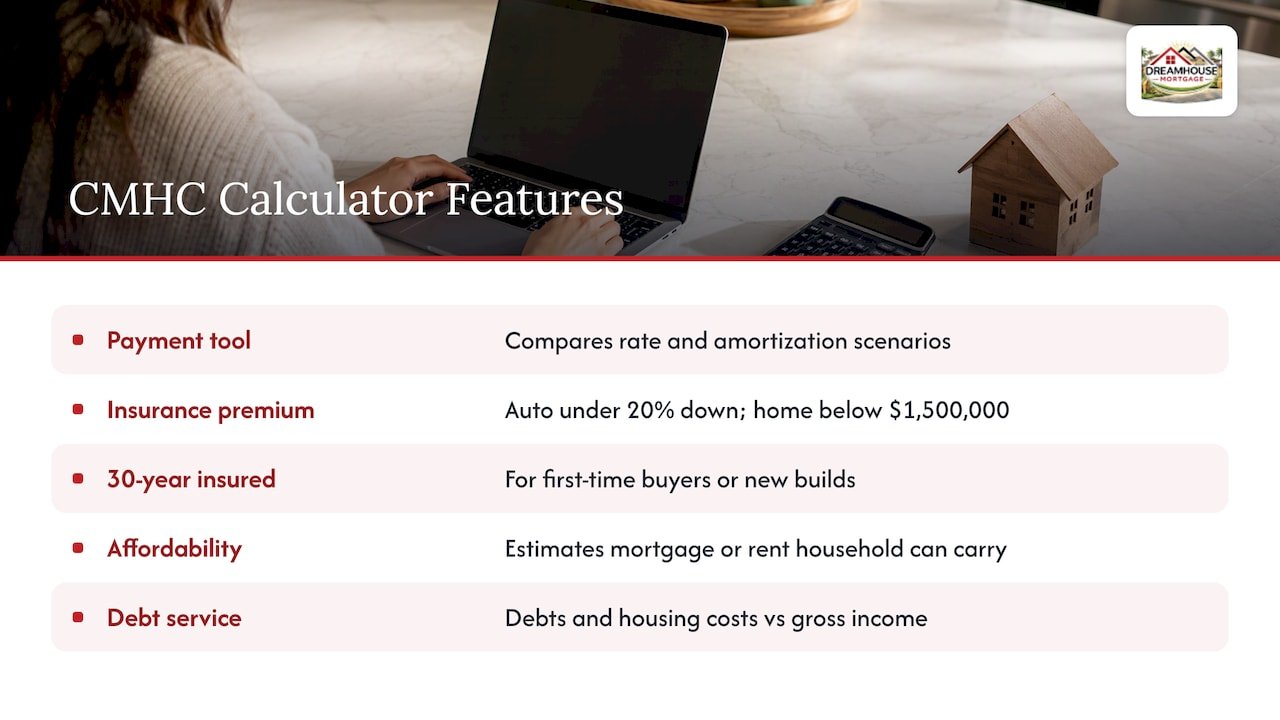
Canada Mortgage and Housing Corporation (CMHC) is the federal housing agency, and it publishes a set of homebuying calculators: mortgage payment, insurance premium, affordability and debt service. Its payment calculator uses your loan amount, interest rate, amortization and payment frequency, and it lets you compare rate and amortization scenarios side by side.
Two details matter for first-time buyers. The tool automatically includes insurance premiums when your down payment is under 20% and the home is priced below $1,500,000. And it notes that 30-year insured amortization is available if you are a first-time buyer or buying a new build. Both facts change your payment more than a quarter-point of interest.
The affordability calculator estimates how much mortgage or rent a household can carry, and the debt-service calculator compares your monthly debts and housing costs with gross household income. These two are the closest free equivalent to what a lender checks first.
MoneySense: several tools in one place
MoneySense, a Canadian personal finance publication, collects calculators for mortgage payments, affordability, down payment, mortgage insurance and land transfer tax. Its affordability tool asks for income, expenses, debt payments, living costs and down payment, which makes it a more realistic budget check than a tool that only needs a salary. Its payment tool also estimates cash needed at closing and monthly carrying costs.
The land transfer tax tool is useful in Ontario or British Columbia. In Alberta there is no provincial land transfer tax, so that tool will not describe your closing costs. See the Calgary section below.
Wezual: a transparent look at the Canadian formula
Wezual’s Canadian mortgage calculator converts a nominal annual rate compounded semi-annually into a monthly rate and states that it assumes the rate stays constant through the amortization. It does not forecast renewal rates or model accelerated payment frequencies, and it runs the calculation on your own device. That openness makes it a good tool for learning how the Canadian method works. Wezual’s general mortgage calculator estimates payments from price, down payment and rate, and it does not include property taxes or insurance, so treat that version as a partial picture.
Simple Canada Tools: prepayments and early payoff
Once you own a home, the question changes from “what is my payment” to “what happens if I pay extra”. Simple Canada Tools offers a Mortgage Prepayment Calculator and a Loan Early Payoff Calculator that use a Canadian fixed-rate, semi-annual compounding model and compare regular and extra payments in Canadian dollars. Its about page says each calculator documents its formulas, assumptions and rounding, and that results are informational estimates.
Why the Same Mortgage Gives Different Payments
If two calculators show different payments for the same mortgage, one of these is usually the cause.
Compounding
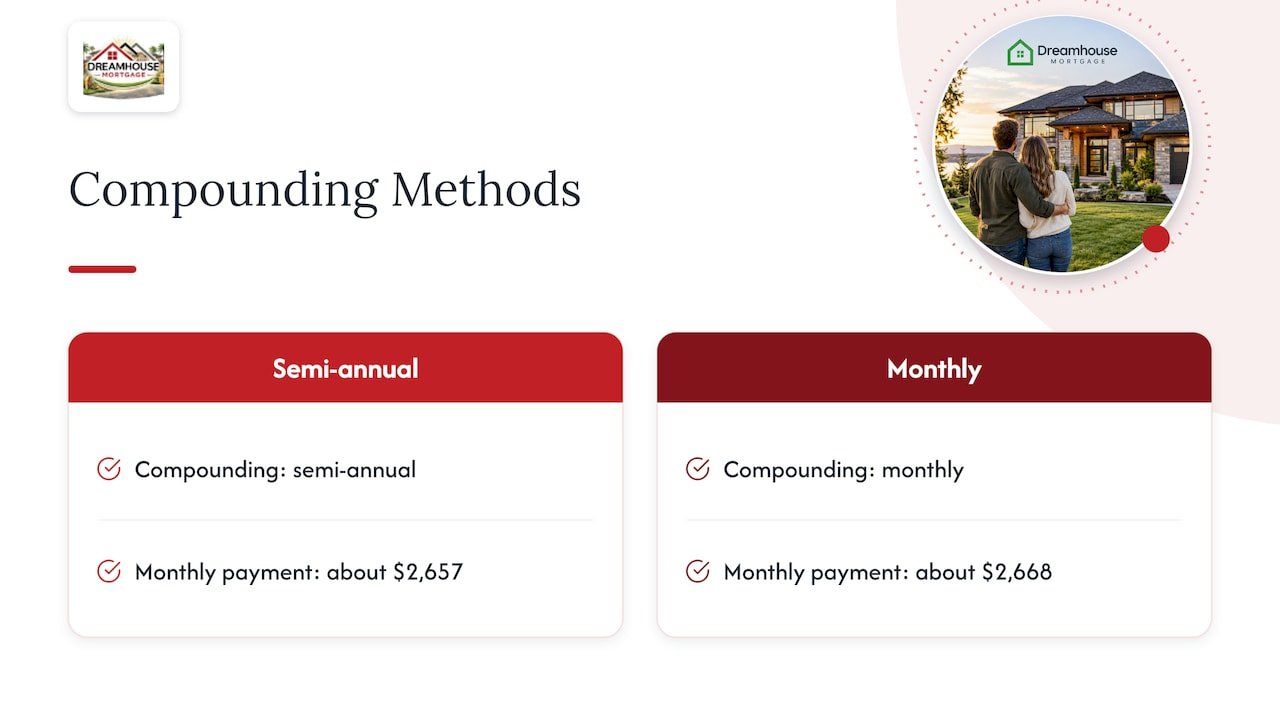
Fixed-rate mortgages in Canada are quoted with semi-annual compounding, while many general calculators compound monthly. The gap is small, but it is real. As a worked example, take a $480,000 mortgage at a 4.5% rate over 25 years. These figures are an illustration of the method, not a rate quote. With semi-annual compounding the monthly payment is about $2,657. With monthly compounding it is about $2,668. Neither is wrong; they answer different questions, and your lender uses its own contract method.
Amortization
Amortization changes your payment far more than compounding. On the same $480,000 at 4.5%, a 30-year schedule gives a payment near $2,420, about $237 less each month than 25 years. Over the full schedule, though, you would pay roughly $74,000 more in interest. Eligibility matters here: 30-year insured amortization is available to first-time buyers or buyers of new builds, and one summary of the 2024 federal changes notes that the insured-home price cap rose from $1 million to $1.5 million effective December 15, 2024. Our guide to amortization options in Canada walks through the trade-off.
Payment frequency
Monthly, bi-weekly and accelerated bi-weekly payments produce different totals over time. CMHC’s tool lets you compare payment frequencies and amortization lengths, which is the clearest way to see how your schedule changes what you repay.
Default insurance
A tool that ignores insurance will show a lower payment than your lender will, if you put down less than 20%. The premium is normally added to the mortgage, so your loan is larger than the price minus your down payment.
Affordability Calculators and the Stress Test
The most searched question on this topic is “how much mortgage can I get”. A calculator can estimate it, but a lender qualifies you with two ratios and a stress test.
- GDS (gross debt service): the share of gross income that goes to housing costs.
- TDS (total debt service): the share of gross income that goes to housing costs plus all other debts.
- Stress test: you must qualify at a higher rate than your contract rate.
One 2026 summary of federal rules reports that borrowers qualify at the higher of the contract rate plus 2 percentage points or 5.25%, with insured-mortgage limits of 39% GDS and 44% TDS, all unchanged. The same source reports that, since November 21, 2024, uninsured borrowers who switch lenders at renewal without increasing the loan or extending amortization are exempt from the stress test. For Calgary homeowners, that matters at renewal time, and our team can walk you through your options on Renew or Switch.
Here is how to read an affordability result:
- Enter all debts. Car loans, student loans, credit card minimums and lines of credit all count toward TDS.
- Use the qualifying rate, not your hoped-for rate. If a tool only uses today’s rate, your real approval can be lower.
- Treat the result as a ceiling, not a target. The most a lender will approve may be more than you want to pay monthly.
- Add the costs outside the mortgage. Property tax, home insurance, utilities and condo fees all affect your budget.
If you are also planning to buy a rental, a tool for estimating an affordable home price or maintenance budget based on your household finances can help you see the operating costs a mortgage payment leaves out.
Calgary, Cochrane and Airdrie: What to Add to Any Calculator
Most national calculators stop at the mortgage payment. If you buy in Calgary, Cochrane, Airdrie or Chestermere, add these.
No land transfer tax, but registration fees
Alberta does not charge a land transfer tax. Buyers pay land titles registration fees for the transfer and for the mortgage instead. A national calculator that asks for your province may show a zero or may not account for these fees, so add them to your closing budget.
Closing costs
CMHC advises buyers to prepare funds for closing costs, usually 1.5% to 4% of the home price. On a $600,000 Calgary home, that range is $9,000 to $24,000 on top of your down payment. Legal fees, title insurance, an appraisal where required, and adjustments for property taxes all sit here.
First-time buyer programs
Calculators rarely model federal first-time buyer programs. Our guide to first-time home buyer benefits in Canada explains the First Home Savings Account (FHSA), the GST rebate and the Home Buyers’ Plan (HBP), which can change how much down payment you bring. Our page on down payment types in Canada covers where the money can come from, including gift letters and seasoning of funds, so a lender will accept it.
Condo fees and community differences
A townhouse in Airdrie, a detached home in Cochrane and a condo in Beltline or Mission carry different monthly costs. Condo fees count in GDS for most lenders, so enter them as an expense in any affordability tool.
Which Calculator for Which Decision
| Your question | Start with | Then |
|---|---|---|
| What will my payment be with less than 20% down? | CMHC payment calculator | Confirm the insurance premium with a broker |
| How much can I afford? | CMHC affordability and debt-service tools, MoneySense affordability tool | Get a pre-approval |
| How much cash do I need at closing? | MoneySense payment tool, with Alberta fees added | Review a checklist of costs |
| Does a 30-year amortization make sense? | CMHC payment calculator, our amortization guide | Check eligibility |
| What if I make extra payments? | Simple Canada Tools prepayment calculator | Check your lender’s prepayment privileges |
| Is renewal or switching worth it? | A payment calculator at the new rate | Ask a broker to price lenders |
From Estimate to Pre-Approval
A calculator tells you what the arithmetic says. A mortgage pre-approval tells you what a lender will do. CMHC recommends that buyers get pre-approved and prepare identification, proof of employment and income, details of assets and debts, the source of the down payment and funds for closing costs. We set out the specifics for Alberta in our pre-approval requirements checklist and the pre-approval documents guide, which covers the 5.25% qualifying rule.
A short route that works for most first-time buyers in Calgary:
- Use CMHC’s payment calculator to set a target payment at a realistic rate and amortization.
- Use an affordability tool with all your debts included to find your ceiling.
- Add closing costs and Alberta registration fees to your cash plan.
- Gather documents using our Alberta mortgage documents checklist.
- Call us for a pre-approval across multiple lenders, so your numbers are tested against actual products.
Pro Tip: Run every calculator at three rates: your expected rate, that rate plus one percentage point, and the stress-test rate. If the middle payment is comfortable, your budget has room for a rate change at renewal.
Pro Tip: Self-employed buyers should expect lenders to read income differently than a calculator does. Our self-employed mortgage guide for Calgary explains how income is assessed.
Where a Calculator Stops and a Broker Starts
A calculator cannot tell you which lender will accept your income type, which product has the prepayment terms you need, or whether the appraisal on a Calgary home will support your offer. Our article on pre-approval versus approval explains how an appraisal can change the deal. These are broker questions, and they are the reason many Calgary buyers run their numbers with us before making an offer.
Our Perspective
We built our calculator guides because first-time buyers in Calgary, Airdrie and Cochrane keep asking the same question: why is my number different from the one the lender gave me?
Our answer is that a calculator is a map and a pre-approval is the route. The map is useful, and we encourage you to use CMHC’s tools and the others in this guide. But the inputs that decide the outcome are your income type, your debts, your down payment source and the lender you choose.
Because we work with banks, credit unions, monoline lenders, alternative lenders and private lenders, we can take the estimate you built and test it against several lenders instead of one. That is how we aim to put you in the right mortgage for your situation, with clear communication at every step.
If you are starting out, run the calculators, write down your target payment, and call us. We will tell you where your numbers hold up and where to adjust before you make an offer.
Guriqbal Chahal, MBA, PMP
Ready to Turn Your Calculator Result Into a Pre-Approval?
DreamHouse Mortgage is a Calgary-based Alberta mortgage brokerage, founded in 2013, helping first-time buyers, homeowners, investors, self-employed professionals and newcomers to Canada. Our First Time Buyer Mortgage and Pre-Approval service covers qualification, lender selection, document collection, approval and funding coordination.

Call Guriqbal Chahal, MBA, PMP, Mortgage Broker, at 403-966-6072. You can also find us on our Google Business Profile. We serve Calgary, Airdrie, Cochrane, Chestermere, Okotoks, High River, Rocky View County, Edmonton, Red Deer and surrounding Alberta communities.
FAQ
What is the best mortgage calculator in Canada?
For payments, CMHC’s mortgage payment calculator is the strongest free starting point because it includes insurance premiums for down payments under 20% and lets you compare amortization and payment frequency. For the total picture, pair it with an affordability tool and a closing-cost estimate, then confirm with a pre-approval.
How much mortgage can I get with a $70,000 salary in Canada?
There is no single figure, because lenders look at your debts, down payment, property taxes, heating and condo fees as well as income. Qualification uses GDS and TDS ratios at a stress-test rate, so a person with no other debts will qualify for much more than someone with car and student loan payments. A broker can run your exact numbers against several lenders.
Are online mortgage calculators accurate?
They are accurate for the arithmetic they perform, but results depend on the assumptions. Tools differ on compounding, insurance and what costs they include, and several say their results are estimates. Use them to plan, and use a pre-approval for the figure you rely on when making an offer.
Do I pay land transfer tax when I buy in Calgary?
No, Alberta does not charge a provincial land transfer tax. You will pay land titles registration fees for the transfer and your mortgage, along with legal fees and other closing costs, so include them in your cash budget.
What does the stress test mean for my calculator result?
Your lender qualifies you at a rate higher than your contract rate. A 2026 summary of the federal rules reports this as the higher of the contract rate plus 2 percentage points or 5.25%. Enter that rate in an affordability tool to see a realistic maximum.
Sources
- CMHC mortgage payment calculator
- CMHC homebuying calculators
- CMHC: Are You Financially Ready to Buy a Home?
- MoneySense: Tools to calculate your mortgage payments and costs
- Wezual Canadian mortgage calculator
- Wezual mortgage calculator
- Simple Canada Tools calculators
- About Simple Canada Tools
- What Changed in Mortgage Rules for 2026
- Mortgage Stress Test 2026
- Does Alberta Have Land Transfer Tax?
- Rental Maintenance Cost Calculator
Recommended
- Calgary Mortgage Calculators 2026: Avoid Costly Payment Mistakes & Estimate Your Monthly Mortgage Accurately
- Canadian Mortgage Rates 2026: What You Need to Know Before You Choose a Lender
- How to Calculate Mortgage Payment Alberta: The Complete Guide
- Calgary Mortgage Affordability Calculator (2026 Guide): How to Use It Right, Avoid Costly Mistakes & Buy With Confidence