
Mortgage portability lets you take your existing mortgage, with its current rate and remaining term, from the home you sell to the home you buy. In Calgary, it is worth a serious look whenever your rate is lower than what lenders offer today, because it can spare you a prepayment charge and keep that rate working for you. It is not automatic, though. Your lender must approve you, the new property and the timing, so the best time to plan a port is before you list your home. You can call Guriqbal Chahal, MBA, PMP, at 403-966-6072 to check whether your mortgage can be ported before you list.
TL;DR
- Porting means moving your current mortgage, rate and remaining term to a new property. RBC describes it as available when you buy a new home at the same time you sell the old one.
- A port is a new contract in the lender’s eyes. You are re-qualified on income, credit and the new property, and the stress test still applies.
- If you need a bigger mortgage, the extra money is lent at current rates, so you end up with a blended rate.
- Most lenders allow roughly 30 to 120 days between the sale and the purchase. The exact window is in your mortgage terms.
- Check portability before you list, and confirm with your lender in writing.
Table of Contents
- What mortgage portability means for a Calgary homeowner
- Which mortgages can be ported
- The four tests every port must pass
- What happens to your rate when the new home costs more or less
- What porting costs
- Timing: the window that decides everything
- Porting, assuming or breaking: which fits
- How to port your mortgage in Calgary, step by step
- When porting does not work out
- Perspective: why we plan the port before the listing
- Work with a Calgary broker on your port
- FAQ
- Sources
What mortgage portability means for a Calgary homeowner
A portable mortgage is one whose contract includes a privilege to move it to another property. You keep the interest rate, the lender and the time left on your term. Your balance moves with you, and the new home becomes the security. CIBC explains that porting means funding a new mortgage on a different property using the remaining term and rate of your existing one.
This matters in Calgary for a simple reason. Many owners move within the city or the region as their lives change: from a condo in Beltline or Mission to a house in Mahogany, Auburn Bay or Tuscany, from an inner-city infill in Bridgeland to a larger lot in Airdrie or Cochrane, or the other way around when kids leave home. If the mortgage you signed some years ago carries a rate below today’s market, the contract has real value, and porting is how you carry that value to the next address.
The key word is privilege. Portability is a term in your contract, not a right under Canadian law. That is why you read the mortgage documents, or have your broker read them, before you plan a sale.
For a broader look at the options, see our overview of mortgage portability options in Canada and our guide to mortgage portability in Alberta.
Which mortgages can be ported
Not every mortgage ports. The usual pattern in Canada is this:
- Fixed-rate closed mortgages are the most commonly portable. CIBC states that all of its mortgages except the CIBC Variable Flex Mortgage can be ported, provided you meet all the requirements.
- Variable-rate mortgages are usually not portable. Ratehub notes that most variable-rate mortgages can’t be ported, though some lenders let you convert to a fixed rate first, with fees that may apply.
- Construction and non-personal residential mortgages can be excluded. Scotiabank’s prepayment terms say its porting privilege may be used for one new mortgage and may not be used for construction mortgages or non-personal residential mortgages.
Those are examples of how individual lenders write their terms, and your own lender’s wording is what governs. Two mortgages with the same rate can behave very differently on porting, which is one reason a broker who works with banks, credit unions and monoline lenders reads the contract first.
Pro Tip: Check portability when you first shop
If you are buying now and may move within a few years, treat portability as a feature to compare, next to the rate and the prepayment terms. Our first-time home buyer mortgage guide for Calgary covers the other terms worth comparing before you sign.
The four tests every port must pass
Porting is not simply a transfer. Think of it as four tests the lender applies to your file.
- The contract test. Does your mortgage allow this kind of port, within the required timing and conditions? Some lenders require prior written approval. ICICI Bank Canada states that its mortgages are portable only with prior written approval, that the sale of the original property must be in good faith and at arm’s length, and that the new mortgage term must equal the remaining term of the original.
- The borrower test. You must re-qualify. MoneySense explains that a ported mortgage is a new contract with your lender, so the lender verifies your income, checks your credit history, assesses your ability to service the debt and may require an appraisal of the new property.
- The property test. The new home must be acceptable to the lender in value, condition, type and location. A rural acreage near Rocky View County, a condo with a weak reserve fund and a standard detached home in Chestermere can each be judged differently.
- The amount-and-timing test. The mortgage you need must fit the lender’s port rules, and the sale and purchase must close inside the window.
Passing the first test while failing the borrower test is the most common surprise. If your income changed, you moved to self-employment, or your debts grew, the old rate may be locked in a contract you no longer qualify to move. Owners in that spot often benefit from a look at self-employed mortgage options before listing.
The stress test still applies
Because you re-qualify, the federal mortgage stress test is part of the picture. Ratehub reports that you must qualify at the greater of your contract rate plus 2% or 5.25%, and that OSFI left that rule unchanged in January 2026. Your old rate may be low, but the qualifying rate is not. Run the numbers on the new price before you make an offer. The Calgary mortgage pre-approval guide shows how that check works in practice.
What happens to your rate when the new home costs more or less
The price of your next home decides how clean the port is. CIBC lists four port types for its fixed-rate closed mortgage, and the same logic appears across lenders with different names.
| Scenario | What happens to the mortgage |
|---|---|
| Straight port | The new mortgage has the same principal, rate and remaining term as the old one. |
| Port and increase | The new principal is larger. The rate becomes a blend of your original rate and the lender’s current rate on the additional funds. |
| Port and decrease | The new principal is smaller. A partial prepayment charge is waived or reimbursed, and the rate and remaining term stay the same. |
| Delayed or reverse port | The new mortgage is advanced up to 120 days before the old one is paid off. This can require bridge financing. |
The table summarizes CIBC’s description of its port types. Other lenders differ in detail, so treat it as a model and not a promise.
Moving up: the blended rate
Say you owe $400,000 at a rate below today’s market and the next home needs a $550,000 mortgage. The old rate does not stretch to cover the extra $150,000. That portion is financed at the lender’s current rate, and the two are blended. ICICI states that a blended rate may apply when the new principal is higher, provided the amortization stays the same and both mortgages are either insured or uninsured. Otherwise the additional funds are advanced as a second mortgage at the then-applicable rate.

The extra detail, insured versus uninsured, matters in Calgary. A buyer who put under 20% down originally has an insured mortgage, and the added funds may not match that structure. Our explainer on the blended mortgage rate walks through the arithmetic, and our amortization options guide shows why amortization needs to match.
Also keep in mind what MoneySense notes: you can’t port more than your current mortgage amount, and any additional funds are subject to current interest rates.
Moving down: keeping the rate
If you are downsizing from a family home in Signal Hill to a townhouse, or from Airdrie to a smaller place, the principal usually drops. Check the terms on the difference. Scotiabank’s terms say that if the new principal is smaller than what was outstanding at sale, you are responsible for the prepayment charge and any cashback owing on the difference. Other lenders may handle it differently, so confirm the treatment of the shortfall before you commit to a price.
What porting costs
The point of porting is usually to avoid the biggest cost in a mortgage move: the prepayment charge. For a fixed-rate closed mortgage, the Financial Consumer Agency of Canada’s sample agreement shows the charge as the greater of three months’ interest or the interest rate differential, calculated on your outstanding balance for the time left in your term. RBC’s Homeline Plan form states a similar structure, using 90 days’ interest or an interest differential calculation during the first five years.
When a port is approved, that charge is generally not the end result. First National states that if you qualify to port your mortgage to a new home, prepayment charges may not apply. Scotiabank’s terms say it will refund the prepayment charges and cashback amounts when it obtains the new mortgage, except discharge fees. ICICI says that if the new mortgage is advanced within 90 days of the payout, both prepayment charges and the reinvestment fee are refunded, unless the new principal is lower than what was outstanding.
In practice, budget for these items:
- Discharge and administration fees. These can remain even when the prepayment charge is refunded.
- Appraisal. The lender may want one on the new property, as MoneySense notes above.
- Legal fees and land title costs on the purchase, which apply to any move.
- Bridge financing costs, if your purchase closes before your sale.
Ask your lender for its current fee schedule in writing. Amounts differ and change.
Timing: the window that decides everything
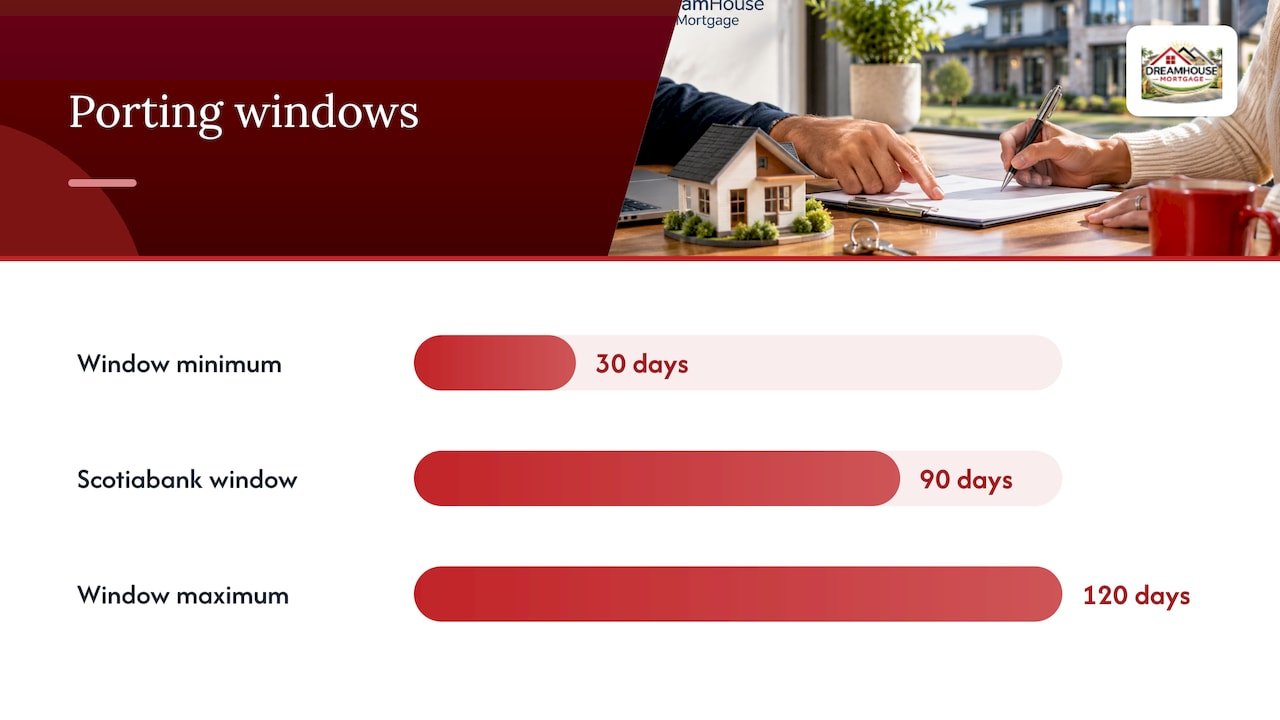
Porting works only if the sale and purchase fit within the lender’s window. MoneySense reports that you usually need to buy within 30 to 120 days of selling, depending on the lender, and Ratehub gives the same range. Scotiabank’s terms use 90 days. There is no single number that applies everywhere, so read your own contract.
Three timing patterns come up in Calgary:
- Sale first, purchase later. You sell, close, rent or stay with family, and buy within the window. If the purchase falls through, the window may expire before you find another home, and the port can be lost.
- Purchase first, sale later. You close on the new home while the old one is still yours. MoneySense notes that you may need temporary bridge financing, particularly because the down payment often comes from your sale proceeds. See our guide to bridge financing for Calgary buyers.
- Same-day closings. The cleanest case, but it depends on both sides of two deals holding together.
Pro Tip: Put the port on your calendar before you list
Write down your lender’s window, your possession date and the earliest date you could realistically close on a replacement. In a busy spring market, a 30-day window leaves little room for a rejected offer. If the numbers look tight, ask your broker to contact the lender before you sign a listing agreement.
Porting, assuming or breaking: which fits
Porting is one of three ways to handle an existing mortgage when you sell.
| Option | What it means | When it tends to fit |
|---|---|---|
| Port | You keep your mortgage and move it to the new property. | Your rate is below the market and you are buying another home within the lender’s window. |
| Assume | The buyer takes over your mortgage. | Uncommon in Canada and subject to lender approval, as Zolo explains. |
| Break | You pay off the mortgage, including any prepayment charge, and take a new one. | Your rate is above the market, or the mortgage is not portable. |
Porting tends to make the most sense when your rate is lower than what lenders offer now, because the blended rate on a bigger mortgage will come out lower than a fresh mortgage at today’s rate, as Ratehub explains. If your rate is higher than the market, a new mortgage may serve you better.
Ratehub also notes that the penalty to break a variable-rate mortgage is usually three months’ interest, which is often lower than the penalty on a fixed-rate mortgage. That is useful to know if your mortgage is variable and not portable. Our Renew or Switch and Calgary mortgage refinancing pages cover the other routes.
How to port your mortgage in Calgary, step by step
- Read your mortgage commitment and terms. Look for the portability clause, the window, whether prior written approval is required, and how a larger or smaller mortgage is handled. A broker can read these with you.
- Compare your rate with the market. Your rate against the current offers shows how valuable the port is. If you are unsure how the Bank of Canada affects pricing, see how the Bank of Canada rate affects a Calgary mortgage.
- Estimate the new mortgage. Decide the price range of the next home and the mortgage you will need after your sale proceeds. Include the stress test.
- Get lender approval before listing. Ask the lender to confirm in writing that you can port and on what conditions. Several lenders require this, as ICICI’s terms show.
- Gather documents. Income documents, a credit report, the listing and sale agreements, and details of the new property. Our mortgage checklist for Calgary lists them.
- Plan the bridge. If closings do not line up, line up bridge financing before you write offers.
- Make offers with conditions that fit the window. Possession dates are part of the plan, not an afterthought.
- Close and confirm. Your lawyer registers the new mortgage on the new title, and you confirm that fees and charges were handled as agreed.
Our team handles the lender-side coordination: lender selection, document collection and funding coordination are part of how DreamHouse Mortgage supports clients through a mortgage.
When porting does not work out
Sometimes the port fails. The usual causes are a sale that closes but a purchase that falls through, a new property the lender will not accept, or a borrower profile that has changed. If so, you still have choices: a new mortgage at current rates, or a different lender. The cost depends on the prepayment charge, which for a fixed-rate mortgage can be large if the interest rate differential applies. That is why we suggest working out the break cost alongside the port plan, never after it.
Perspective: why we plan the port before the listing
In our experience as a brokerage, the best ports begin with a plain question: does this mortgage still do its job for the next home? We start with the contract, because the rate is only one part of it. The window, the approval requirements and the way a bigger mortgage is blended all decide whether the low rate actually travels.
Because we work with banks, credit unions, monoline lenders, alternative lenders and private lenders, we can compare the port against the other routes: a renewal, a switch or a refinance. Sometimes the port is clearly right. Sometimes a new mortgage with a different lender makes more sense. Either way, you see the numbers side by side before you list.
Our approach is built around clear communication and education, so that you know what you are signing before the sale. If you are moving within Calgary, or to Airdrie, Cochrane or Chestermere, call us before you list.
Guriqbal Chahal, MBA, PMP
Work with a Calgary broker on your port
DreamHouse Mortgage offers mortgage portability as one of its services, alongside mortgage renewal, refinancing, pre-approval and first-time buyer mortgages for clients in Calgary, Airdrie, Cochrane, Chestermere, Okotoks and surrounding Alberta communities. We can review your current mortgage terms, compare the port with a new mortgage, and coordinate with the lender, the lawyer and your realtor.

If you are also buying your first home, our first-time buyer mortgage page explains how we help, and our pre-approval service is the natural step before you make offers. Call Guriqbal Chahal, MBA, PMP, Mortgage Broker, at 403-966-6072, or find us on our Google Business Profile.
FAQ
Can I port a variable-rate mortgage in Calgary?
Usually not. Most variable-rate mortgages can’t be ported, according to Ratehub, although some lenders let you convert to a fixed rate first, and fees may apply. Your own contract decides, so ask your broker to read it before you plan your move.
How long do I have to buy after I sell?
It depends on the lender. MoneySense reports a typical range of 30 to 120 days, and Scotiabank’s terms use 90 days. Get the exact window in writing before you list.
Do I pay a prepayment charge when I port?
Often it is refunded or does not apply if the port is approved, but the details vary. First National states that prepayment charges may not apply when you qualify to port. Discharge fees can remain, and a smaller new mortgage can trigger a charge on the difference.
Can I borrow more when I port?
Yes, in many cases, but the extra amount is lent at current rates. The result is a blended rate, as CIBC describes for its port and increase option. The new total must also pass the stress test and the lender’s property review.
Do I need to re-qualify to port?
Yes. A ported mortgage is a new contract, so the lender reviews your income, credit and the new property. Getting a pre-approval review done before you list shows where you stand.
Sources
- Porting A Mortgage, RBC Royal Bank
- How to Port or Replace Your Mortgage, CIBC
- Porting Your Mortgage to a New Home, ICICI Bank Canada
- Schedule of Prepayment Terms and Conditions, Scotiabank
- Porting or transferring your mortgage, Ratehub.ca
- What is porting a mortgage in Canada, MoneySense
- Credit agreement for a fixed interest loan, Financial Consumer Agency of Canada
- Prepaying without a prepayment charge, First National
- Homeline Plan, RBC Royal Bank
- Can You Sell a House With a Mortgage, Zolo