
A port and increase lets you move your existing mortgage rate and remaining term to a more expensive home, while borrowing the extra money at today’s rates. Your lender blends the old rate on your current balance with its current rate on the new money, so your final rate usually lands between the two. Whether it saves you money depends on your rate, your penalty, your lender’s rules and your closing dates.
If you are a Calgary, Airdrie or Cochrane homeowner moving up from a starter home, this guide walks you through each step. It also shows when a port and increase makes sense and when another route may serve you better.
TL;DR
- A port and increase moves your current rate and term to a new property and adds extra funds, usually priced at the lender’s current rate and blended with your existing rate.
- Most portability is offered on fixed-rate closed mortgages. Most variable-rate mortgages cannot be ported without converting first.
- You must re-qualify. The lender reviews your income, credit and the new property, and the stress test applies.
- Timing windows vary by lender, commonly between 30 and 120 days between selling and buying.
- A broker can compare how your lender’s port terms stack up against your other options before you list your home. Call Guriqbal Chahal at 403-966-6072.
Table of Contents
- What a Port and Increase Means
- How the Blended Rate Is Calculated
- When Porting Makes Sense
- Fixed vs. Variable: Which Mortgages Can Port
- Qualifying: You Are Re-Approved, Not Just Transferred
- Timing: The Sale and Purchase Windows
- Insured Mortgages and CMHC Portability
- Costs to Budget For
- Port and Increase vs. Refinancing or a New Mortgage
- Step-by-Step: How to Port and Increase
- Our Perspective
- Plan Your Move With DreamHouse Mortgage
- FAQ
- Sources
What a Port and Increase Means
Porting a mortgage means funding a new mortgage on a different property using the remaining term and rate of your existing mortgage. CIBC describes porting as exactly that, and notes it can apply to a newly purchased property or to a property you already own that has no mortgage or line of credit, provided you meet all requirements.
A straight port works when your new mortgage is the same size as the balance you owe. In practice, most people moving up need more. That is the port and increase. RBC explains that with a portable mortgage you may transfer the rate and existing terms to a new home purchase, and that with a port increase you can borrow additional funds.
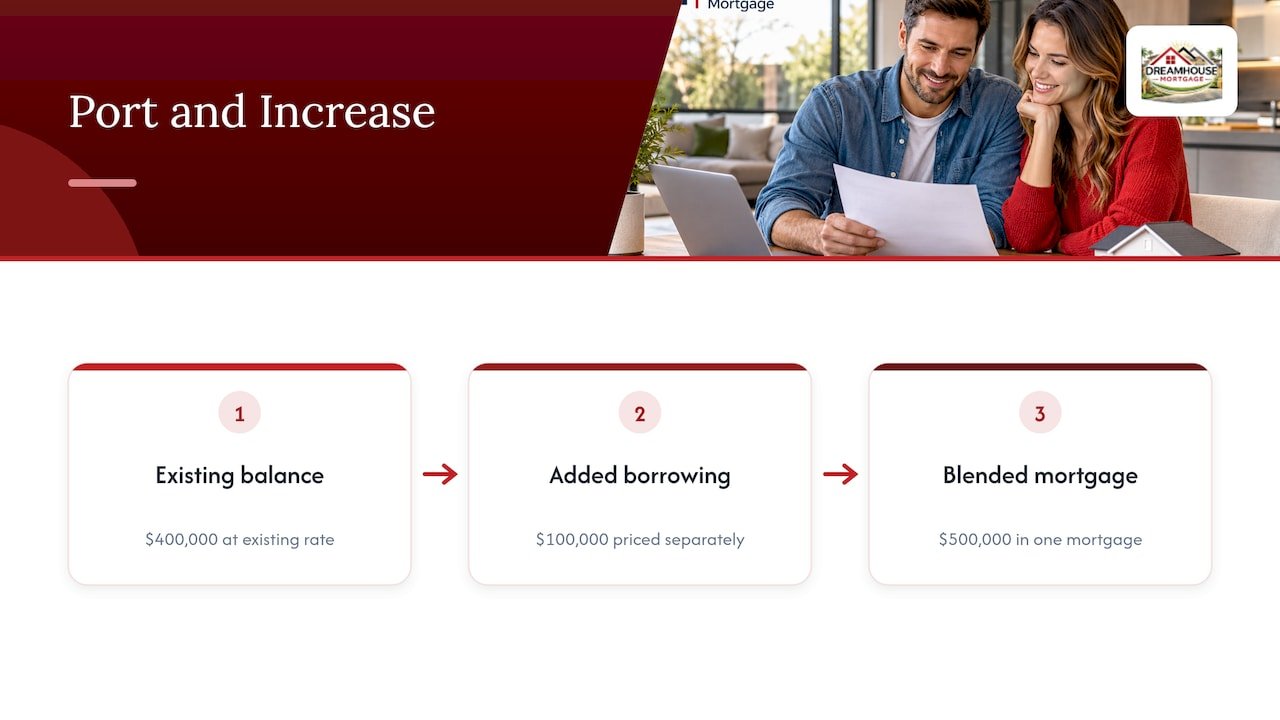
Picture a family selling a townhome in Cranston and buying a detached home in Mahogany. Their balance is $400,000, and the new home needs a $500,000 mortgage. A port and increase keeps their rate on the first $400,000 and prices the extra $100,000 separately. The two pieces are then combined into one blended rate on a single mortgage.
How the Blended Rate Is Calculated
The lender takes a weighted average of your existing rate and its current rate on the new money. CIBC states that the new rate is a blend of the rate on your remaining balance and its current rate for a product with a term similar to your old one, applied to the additional funds. TD describes the same approach: the existing rate and term transfer for the existing principal, and additional funds are priced at current rates for the term closest to what remains.
A simple illustration
The numbers below are an example only, not a quote or an offer from any lender.
| Piece | Amount | Rate | Weight |
|---|---|---|---|
| Existing balance ported | $400,000 | 3.19% | 80% |
| Additional funds | $100,000 | 5.00% | 20% |
| Blended mortgage | $500,000 | 3.55% (approx.) | 100% |
The math: (400,000 × 3.19% + 100,000 × 5.00%) ÷ 500,000 = about 3.55%. Lenders may also factor in the remaining term and may use different methods, so your actual figure will differ. We explain the concept further in our guide to the blended mortgage rate.
Pro Tip: Ask your lender what rate it will use on the additional funds before you commit to an offer on a home. The rate on the extra money is the part you cannot see from your current mortgage statement.
When the blend does not apply
Blending has conditions. ICICI Bank Canada states that a blended rate may apply when the new mortgage is larger than the principal still owing, provided the amortization remains the same and both mortgages are either insured or uninsured. Otherwise, the additional funds may be advanced as a second mortgage at the then-applicable rate. Read your own mortgage agreement for the exact wording, because every lender differs.
When Porting Makes Sense
Porting tends to be most attractive when your current rate is lower than what lenders offer today. In that case the blended rate will usually come out lower than starting a new mortgage from scratch. If today’s available rates are lower than yours, a new mortgage or a refinance may be the better path, and you would weigh that against the penalty to break your current term.
Three questions help you decide:
- How does your rate compare with today’s rates? If yours is lower, a port protects it.
- How much extra do you need? A small increase means the blended rate stays close to your existing rate. A large increase pulls it toward the current rate.
- How much time is left on your term? The lender usually applies the remaining term to the new mortgage. A short remaining term means you will face renewal soon anyway.
You can run these comparisons yourself with the free mortgage calculators for Canadian brokers, which help you test your rate against breaking costs. Our team can also run the comparison for your exact situation. See our overview of mortgage portability options in Canada for the wider picture.
Fixed vs. Variable: Which Mortgages Can Port
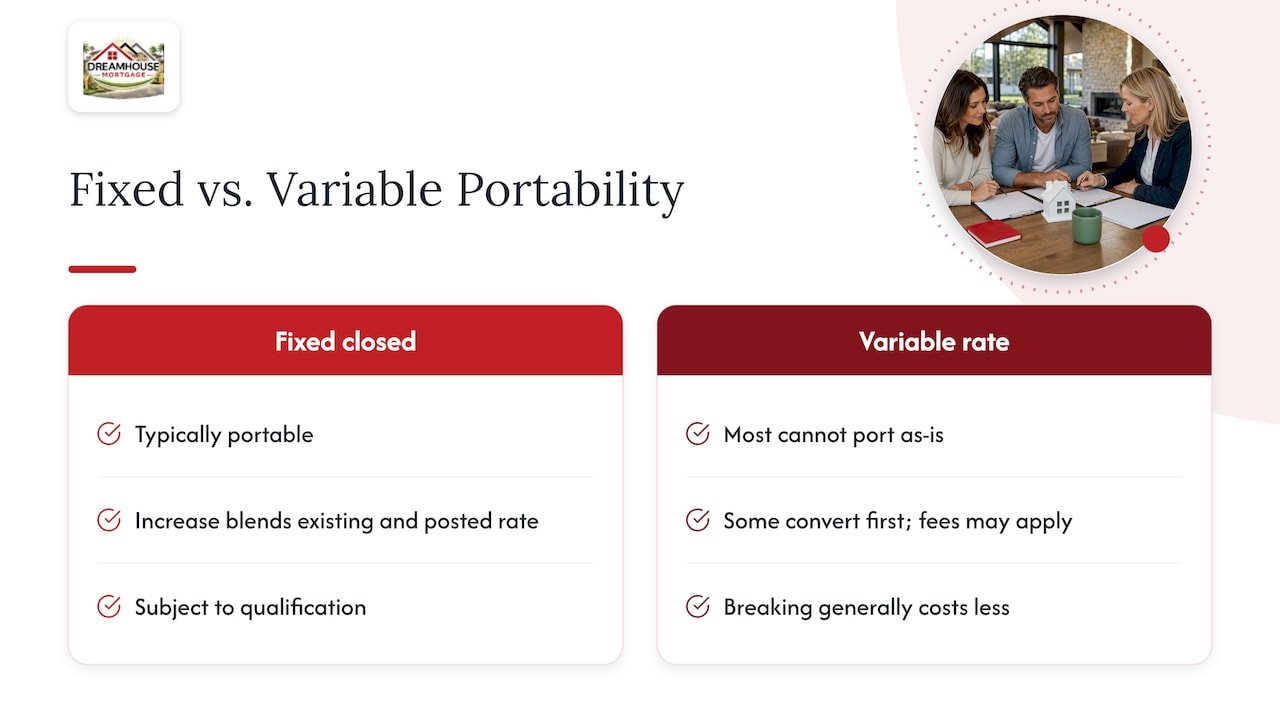
Portability is typically attached to fixed-rate closed mortgages. BMO states that you can transfer the terms of a fixed-rate closed mortgage to a new mortgage of the same type, and that when the amount needs to increase, the existing fixed rate is blended with the current posted fixed rate for the additional amount, subject to qualification.
If you hold a variable rate, the picture changes. Most variable-rate mortgages cannot be ported as they stand. Some lenders let you convert to a fixed rate first so that you can port, but fees may apply. Breaking a variable-rate mortgage is generally cheaper than breaking a fixed one, so the question becomes whether breaking and starting fresh costs less than the value of preserving your rate.
Some lenders handle variable products differently. CIBC notes that on its Variable Flex Mortgage, if you sell and purchase another property within 120 days and meet the requirements, it may finance the purchase and refund all or part of the prepayment charge. That is one lender’s rule, and your own contract controls what applies to you.
To understand how penalties are calculated before you decide, read our guide on mortgage penalty types and the payout inputs to ask about, and our comparison of open and closed mortgage types.
Qualifying: You Are Re-Approved, Not Just Transferred
A port is not automatic. ICICI Bank Canada states that mortgages are portable only with prior written approval, that you must meet its approval criteria at the time of the application, including any insurer requirements, and that the sale of the original property must be in good faith and at arm’s length.
First National states that porting is subject to approval and requires a new credit application. Its list of documents is a useful template for what most lenders will want:
- Government-issued ID
- Proof of income and employment
- Documentation of assets and liabilities
- The sale agreement for your existing home
- The purchase agreement and MLS listing for the new home
- Any waivers
The stress test still applies
Insured and many other mortgages are qualified at the greater of your contract rate plus 2% or 5.25%. Canada Guaranty’s product sheet states this qualifying rule for its Flex 95 product. Ask your broker or lender which qualifying rate applies to your mortgage today, as rules can be updated by regulators.
In plain terms: your income, debts and credit are reviewed again, and the larger payment on the increased amount must still fit. If your income has changed since you bought, or you are self-employed, speak to us before you list. Strong documentation makes this step smoother.
Pro Tip: Do not wait for an accepted offer to find out whether you qualify for the larger amount. A pre-approval for your target price range tells you how much you can afford before you shop in Tuscany, Airdrie or Cochrane. See our mortgage pre-approval process and pre-approval requirements checklist.
Timing: The Sale and Purchase Windows
Lenders set how long you have between closing one property and closing the other. The window is commonly between 30 and 120 days, and some lenders allow only 30 days. Scotiabank’s prepayment terms, published in 2014 for Quebec, give 90 days as an example of a window: the borrower sells, buys another property within 90 days, is not in default and has the lender’s written agreement. Those terms also limit the privilege to one new mortgage and exclude construction mortgages. Your own lender’s current rules govern your situation.
Here is how this affects planning in the Calgary area:
- Possession dates rarely line up. If you sell first and your new home in Chestermere or Okotoks is not ready, you need a lender whose window covers the gap.
- A short window is a risk. If you miss it, you may pay the penalty and lose the rate.
- Bridge financing can fill the gap. If your closings overlap, see our guide to bridge financing in Canada, which explains why buyers generally need a firm sale to close.
The risk of a lender saying no is real. A lender can refuse a port because your circumstances have changed, as Canadian Mortgage Trends reported in 2016. If that happens on a closed mortgage, you may have to pay a penalty and arrange new financing. This is why we review your lender’s port terms and your qualification before you list.
Insured Mortgages and CMHC Portability
If you put down less than 20% on your current home, your mortgage was likely insured. CMHC has specific portability rules, and they matter when you increase the loan. According to CMHC’s portability page:
- The request must be received within 6 months of the original property’s closing date.
- The loan on the original property must be in good standing and not in arrears.
- At least one borrower on the new loan must come from the original insured mortgage.
- The new property must have the same intended use as the original.
- With an increase, the maximum amortization is the greater of the remaining amortization from the original loan (up to a maximum of 25 years, or 30 years through CMHC Home Start) or a blended amortization. A blended amortization carries a 0.60% surcharge on the increase to loan amount.
CMHC also provides a premium credit when an insured mortgage is ported within 2 years of the original closing: 100% of the premium previously paid if within 6 months, and 50% if within 12 months. These are CMHC’s own terms, so confirm which apply to your file. For background on the premiums themselves, see CMHC mortgage insurance premiums in Alberta.
Costs to Budget For
A port avoids some costs, but not all. Plan for these:
- Processing fee. RBC states that a processing fee, which includes the costs of determining property value, is charged when porting. Your lawyer’s fees to register the new mortgage are separate, and additional default insurance premiums may apply.
- Other costs. First National lists legal fees, home inspection and appraisal fees, prepayment charges, administrative fees, moving costs and property tax adjustments among the potential costs of moving.
- Servicing fees. Servicers publish their own schedules. For example, the CMLS fee table from July 2023 lists a $200 fee for refinances and ports. Fees change, so ask for the current figure.
- Prepayment charges. Your old mortgage is paid out when the original property sells. ICICI states that if the new mortgage is advanced within 90 days of payout, the prepayment charge and reinvestment fee are refunded, unless the new mortgage principal is lower than the outstanding principal at payout.
Putting numbers on each line before you make an offer avoids surprises on closing day. Our team can build a full cost sheet with you.
Port and Increase vs. Refinancing or a New Mortgage
RBC explains that refinancing means a new loan, so you requalify and pay many of the same fees as on your first mortgage, in addition to normal closing costs. That does not make it the wrong choice. If current rates are below yours, or you want to access equity and restructure your debt, a new mortgage can be the stronger move.
| Factor | Port and increase | Break and start new |
|---|---|---|
| Rate on existing balance | Keeps your current rate | New rate at today’s pricing |
| Rate on added funds | Current lender rate, blended | New rate across the whole amount |
| Term | Remaining term continues | New term of your choice |
| Penalty | Often avoided if rules are met | May apply |
| Lender choice | Same lender | Any lender, including through a broker |
| Best when | Your rate is below today’s market | Today’s rates are below yours |
A broker is useful here because you can compare across banks, credit unions and monoline lenders rather than only your current lender. If your term is nearly done, a renewal or a switch may be simpler. See negotiating a better renewal rate in Alberta, and refinancing after you buy. If you want a longer repayment period on the added amount, our guide to extending your mortgage amortization covers the rules and costs.
Step-by-Step: How to Port and Increase
- Read your mortgage agreement. Find the portability clause, the time window, the rate approach for increases and the penalty terms. Boutin, quoted by Canadian Mortgage Trends, suggests checking whether you meet the lender’s criteria, including property type, location and the income types it accepts.
- Call your broker before listing. We review your lender’s terms and your qualification, and we price alternatives.
- Get a pre-approval for the new price range. It confirms the larger payment fits.
- List and sell, then make the offer. Match closing dates with the lender’s window, or arrange bridge financing.
- Submit the port application. Provide the documents listed earlier, including your sale and purchase agreements.
- Review the blended rate and commitment. Confirm the rate, term, amortization and fees in writing.
- Complete the legal work. Your lawyer registers the new mortgage and handles funds on closing.
Pro Tip: Ask your lender to confirm in writing that your port will be approved, subject to the conditions it lists, before you remove your own conditions on the purchase.
Our Perspective
We see port and increase decisions at the exact moment a family is stretching for a bigger home in Calgary, Airdrie or Cochrane. The rate on the old mortgage is the thing people are afraid to lose, so they often assume that porting is the only sensible move.
Our view is that porting is a strong tool, and it is one of several. The right answer comes from comparing your lender’s blend, your penalty, your term and your qualifying position side by side. Because we work with banks, credit unions, monoline lenders, alternative lenders and private lenders, we can show you what each route would look like before you commit.
Our approach is client-first: clear numbers, plain explanations and no pressure. We want you to understand the amortization, the fees and the renewal that follows, so the mortgage you choose still makes sense years from now.
Guriqbal Chahal, MBA, PMP
Plan Your Move With DreamHouse Mortgage
DreamHouse Mortgage is a Calgary-based brokerage, founded in 2013, serving Calgary, Airdrie, Cochrane, Chestermere, Okotoks, High River, Rocky View County, Edmonton, Red Deer and surrounding Alberta communities. We help with mortgage portability, pre-approvals, renewals, refinancing and first-time buyer mortgages, and we explain each option in plain terms.

Before you list your home, call Guriqbal Chahal, MBA, PMP, Mortgage Broker, at 403-966-6072. We will review your current mortgage terms, estimate a blended rate and compare it with other routes. You can also read our Alberta portability guide, see our full range of mortgage services, or find us on our Google Business Profile.
If you are buying your first home instead, start with our First Time Homebuyer Mortgage Calgary guide.
FAQ
Can I port my mortgage if I need more money?
Often, yes, subject to your lender’s approval. This is called a port and increase, and the extra funds are normally priced at the lender’s current rate and blended with your existing rate. You will need to qualify for the larger amount.
Is the blended rate always lower than a new mortgage?
Not always. It tends to be lower when your existing rate is below today’s rates, because the old rate applies to part of the balance. If current rates are lower than yours, a new mortgage or refinance may cost less, so compare both before deciding.
Can I port a variable-rate mortgage?
Most variable-rate mortgages cannot be ported as they are. Some lenders let you convert to a fixed rate first so you can port, and fees may apply. Check your agreement and speak to your broker before listing your home.
How long do I have between selling and buying?
It depends on your lender, and windows commonly run between 30 and 120 days. A 30-day window can be tight if your possession dates do not line up. Confirm your exact window in writing before you sign the purchase contract.
What happens if the lender refuses the port?
On a closed mortgage you may have to pay the penalty to discharge it and arrange new financing. This is why we check your qualification and lender terms before you list. A broker can then place you with another lender if needed.
Sources
- How to Port or Replace Your Mortgage, CIBC
- Mortgage Options for Your Next Home, RBC Royal Bank
- The truth behind three common mortgage myths, TD Stories
- Port Your Mortgage, ICICI Bank Canada
- Paying Off Your Mortgage Faster, BMO Canada
- Buying Your Next Home | Mortgage Portability, First National
- CMHC Portability, CMHC
- Flex 95 Advantage product sheet, Canada Guaranty
- Schedule of Prepayment Terms and Conditions, Scotiabank
- Three Big Mortgage Complaints, Canadian Mortgage Trends
- Free mortgage calculators for Canadian brokers