
If you own an incorporated business in Alberta, a lender will usually start with the salary and dividends you pay yourself and report on your personal tax return. Some lenders can also look at an eligible share of the corporation’s after-tax profit, but only under their own rules and only with documents to back it up. Which lender reads your file, and by which method, often matters more than how much the business earns. That is why incorporated buyers in Calgary, Airdrie and Cochrane tend to get better results when a broker matches the file to the right lender before applying.
TL;DR
- Most lenders qualify an incorporated owner on salary and dividends actually drawn and reported personally. Retained earnings stay corporate money until they are paid out.
- Some lenders have a corporate-income method that counts a documented share of net income after tax. It is lender-specific, not a universal Canadian rule.
- Expect to provide Notices of Assessment, T1 Generals, business documents and often financial statements. Two years of history is the common benchmark.
- Personal debts and the 39% GDS and 44% TDS limits still apply, and the stress test applies to insured and many other mortgages.
- Buying your first home in Calgary with a corporation? Call Guriqbal Chahal at 403-966-6072 before you change how you pay yourself.
Table of Contents
- Why Corporate Income Is Different From Employment Income
- How Lenders Count Corporation Income
- Can Retained Earnings Help If Your Salary Is Low?
- What Documents Incorporated Borrowers Usually Provide
- How Long Must the Business Operate?
- Debts, Ratios and the Stress Test
- How Taxes Shape the Income Lenders See
- First-Time Home Buyers With a Corporation in Calgary, Airdrie and Cochrane
- When a B-Lender or Alternative Option Makes Sense
- Our Perspective
- Talk to a Calgary Mortgage Broker About Your Corporation
- FAQ
- Sources
Why Corporate Income Is Different From Employment Income
An employee hands the lender a letter of employment and pay stubs. An incorporated owner hands over something more layered: a personal return, a corporate return, financial statements and sometimes shareholder loan balances. The lender’s question is simple. How much of this money is reliably yours to spend on a mortgage payment?
A corporation is a separate legal entity. Profit sitting in the company belongs to the company until it is distributed to you. Canadian underwriting guidance from Treadstone Associates describes an incorporated borrower’s personal qualifying income as generally the salary and dividends actually drawn and reported on the T1 and Notice of Assessment. The same guidance notes that a low personal T1 can limit traditional qualification even when the business is profitable, unless the lender has an accepted corporate-income method.
This catches many Alberta owners off guard. A common tax plan is to draw a modest salary or dividend and leave the rest in the company. That can be efficient from a tax point of view. On a mortgage application it can make your qualifying income look smaller than your real earning power.
We cover the broader picture for business owners on our self-employed mortgage page for Alberta. This article focuses on the corporate side.

How Lenders Count Corporation Income
Lenders in Canada generally use one of three approaches. Knowing which one applies to you is the single most useful piece of preparation.
Method 1: Personal salary and dividends
This is the traditional approach. The lender looks at the income you report personally, usually over two years, and qualifies you on that figure. Canada Guaranty’s published underwriting guidance treats a borrower with at least 25% business ownership as self-employed, generally seeks two years of Notices of Assessment and T1 Generals, and uses the lesser of the most recent year’s income or the two-year average for provable-income qualification. You can read the wording in its November 2025 underwriting guidelines.
The key phrase is “the lesser of.” If your income rose sharply last year, a lender using this method may not credit the whole increase right away.
Method 2: Gross-up or add-backs
For sole proprietorships and partnerships, CMHC allows a 15% gross-up or eligible-expense add-back. Its Self-Employed program page states this for those structures but does not say the 15% gross-up applies to corporate retained earnings. Do not assume it applies to your corporation. Canada Guaranty’s guidance likewise describes the 15% gross-up for sole-proprietorship and partnership income, or specified add-backs such as capital cost allowance, business-use-of-home and motor-vehicle expense.
Method 3: Corporate net income after tax
Some lenders will consider an eligible share of the corporation’s net income after tax (NIAT), or retained earnings, in addition to what you pay yourself. According to HopeWell Mortgages, the lender still has to reconcile salary, dividends, ownership, trend, liquidity and business obligations, and has to avoid double-counting the same dollars. A second HopeWell page on NIAT and add-backs explains that corporate NIAT can be used only under a lender-defined methodology, with permitted inclusion percentages, ownership tests and evidence requirements.
The practical consequence is that the same corporation can produce very different qualifying numbers at different lenders. One lender may read only salary and dividends. Another may accept a documented corporate-income approach, as Mudrick Mortgages describes. This is exactly where access to many lenders matters. We work with banks, credit unions, monoline lenders, alternative lenders and private lenders, so your file can be placed where the method suits your tax structure.
Pro Tip: Do not ask “what is the best rate?” first. Ask “which lender reads my income best?” A slightly higher rate that gets you approved for the right amount beats a lower rate that qualifies you for too little.
Can Retained Earnings Help If Your Salary Is Low?
Sometimes, but not automatically. Traditional underwriting counts salary and dividends actually drawn and reported personally. Retained earnings are not personal income. Some lender programs may consider an eligible, documented share of corporate NIAT or retained earnings, subject to ownership, trend, liquidity, business-obligation and no-double-counting tests.
HopeWell’s analysis adds an important nuance. Retained earnings more commonly support the assessment of business strength, reserves and distribution capacity than function as recurring annual income. In plain terms, a lender wants to see that the business could pay you more on a sustainable basis, not that it happened to have a good year.
Corporate profit is also not always free cash. HopeWell notes that NIAT can be tied up in receivables, inventory or equipment, and that the business may need cash for payroll, HST, corporate tax, debt payments and working capital. An underwriter can reduce or decline the corporate-income amount if taking it out would weaken the operation.
One item to be careful about is the shareholder loan. A draw taken as a shareholder loan is not income on a tax return until the loan is cleared, so a lender cannot count it, as Concept Accounting explains.
A simple worked example
This illustration uses made-up numbers to show the logic and is not a quote or a promise of approval.
Suppose a Calgary consultant owns 100% of her corporation. She pays herself a salary of $60,000 and no dividends. The company keeps additional after-tax profit each year.
- Salary and dividends method: the lender starts from $60,000 of personal income, subject to the two-year review.
- Corporate-income method: a lender with an accepted NIAT approach may add an eligible percentage of documented after-tax profit to the $60,000, provided the business can show it is stable and can spare the cash.
The difference between those two outcomes can be the difference between qualifying for one price range in Calgary and another. The numbers depend entirely on the lender’s rules, which is why we review your statements before choosing where to apply.
What Documents Incorporated Borrowers Usually Provide
CMHC’s self-employed documentation list gives a good picture of what lenders look for. The CMHC page lists a Notice of Assessment with a T1 General, proof of income, recent account statements, business documentation and signed contracts. Other possible evidence includes income tax returns, business credit reports, GST returns, active business account statements, review-engagement or audited financial statements, and a business licence or articles of incorporation.
CMHC also says the documentation depends on the borrower’s circumstances, and that its program allows alternative documentation that demonstrates business operation, financial stability and income. In practice, start gathering:
- Two years of personal T1 Generals and Notices of Assessment (log in to your CRA account to download them).
- Two years of corporate financial statements, ideally prepared by your accountant.
- Articles of incorporation and proof of your ownership percentage.
- Recent personal and business bank statements.
- Your most recent corporate tax filing and any GST/HST returns.
- Details of any shareholder loan balances and corporate debts.
- Your down payment source, with the history of the funds.
We go deeper on this in our guide to self-employed mortgage income proof in Alberta and on how business financials support mortgage qualification.
Pro Tip: Confirm that your Notices of Assessment show no balance owing to the CRA. Lenders look closely at tax arrears, and clearing one before you apply keeps the file simple.
How Long Must the Business Operate?
CMHC’s Self-Employed program applies to incorporated companies as well as sole proprietorships and partnerships. It recommends 24 months of business operation or relevant experience, while allowing flexible options for recently self-employed borrowers. Lenders using their own programs set their own thresholds, and Canada Guaranty separately requires evidence of business tenure and ownership.
If you incorporated recently but worked in the same field before, say so. Industry experience and a continuing client base can matter. A short corporate history is not the end of the road, but it means the choice of lender matters even more.
Debts, Ratios and the Stress Test
Corporate income is only half of the calculation. The other half is what you owe and what the new home will cost.
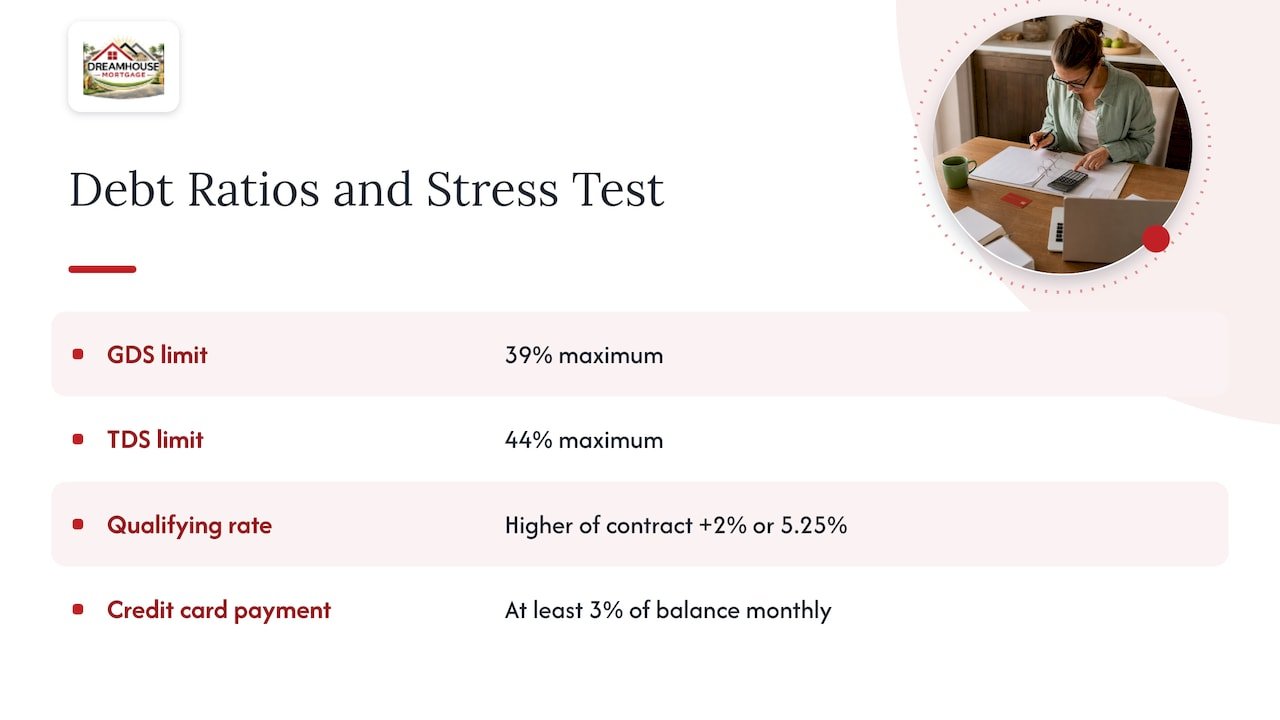
For CMHC-insured qualification, CMHC restricts gross debt service (GDS) to 39% and total debt service (TDS) to 44%. Housing costs include principal, interest, property taxes, heating and, where applicable, 50% of condominium fees. The Financial Consumer Agency of Canada gives the same 39% and 44% as the usual guidelines, notes that lenders review before-tax income, expenses, debts, credit and amortization, and says federally regulated lenders require a stress test.
CMHC’s guidance sets the qualifying rate at the greater of the contract rate plus 2% or 5.25%. It also counts revolving credit, personal loans and car loans in your debts, and generally assigns unsecured credit cards and lines of credit a monthly payment of at least 3% of the outstanding balance.
What about corporate debts? A business loan the corporation pays on its own is treated differently from a loan you guarantee personally, and lenders assess it as part of the review of business obligations. Bring your loan statements so we can show the lender exactly who is responsible for each payment.
For a full walk-through, see our GDS and TDS guide for Calgary and our overview of Canadian mortgage qualification rules.
How Taxes Shape the Income Lenders See
Corporate tax planning and mortgage qualification pull in opposite directions. Lower personal income means lower personal tax, but also lower qualifying income under the traditional method.
The Canada Revenue Agency states that the federal net tax rate is 9% for Canadian-controlled private corporations claiming the small business deduction, and 15% after the general tax reduction. Those rates affect how much after-tax profit is left in the corporation, which is the figure a NIAT-based lender starts from. Provincial tax in Alberta applies as well, and your accountant can tell you your combined position.
An important point on timing: your accountant and your mortgage broker should talk before the year-end salary and dividend decision, not after. If you plan to buy in the next 12 to 24 months, ask whether a modest increase in drawn income, or a documented corporate-income lender, fits your plan better. We do not give tax advice, and your accountant is the right person for the tax side.
First-Time Home Buyers With a Corporation in Calgary, Airdrie and Cochrane
Buying your first home as an incorporated owner adds a few steps, but they are manageable. Whether you are looking at a condo near the Beltline, a townhome in a Calgary suburb like Mahogany or Seton, a detached home in Airdrie, or a family property in Cochrane, the process is the same.
- Review your income structure. Look at the last two years of salary and dividends against your corporate net income.
- Get a pre-approval. A pre-approval tells you the price range the lender is prepared to support, based on your documents. See our mortgage pre-approval requirements for Alberta for the checklist.
- Choose the lender by method. A broker can place you with a lender whose income method matches your structure.
- Document your down payment. Lenders review where the funds came from, and corporate money moved to you personally needs a paper trail.
- Shop with confidence. Make offers inside the range you were pre-approved for, and keep your finances stable until closing.
Our separate first-time homebuyer mortgage guide for Calgary covers programs and costs for new buyers in more detail. If an appraisal or a change in your file worries you, read about why pre-approval and final approval can differ.
Pro Tip: Avoid large, unexplained transfers between your corporate and personal accounts in the months before you apply. Clean, labelled transactions make the file easier to review.
When a B-Lender or Alternative Option Makes Sense
If your personal income is low because of your tax strategy, a mainstream lender may not credit your corporate earnings. Alternative (B-lender) and private options can sometimes bridge that gap, usually with a higher rate and often a larger down payment, and typically as a stepping stone before moving to a mainstream lender later. We explain the trade-offs in our Alberta corporate income mortgage power guide and in self-employed mortgage lender types in Canada. If you want to compare stated-income lenders, see our page on top lenders for stated income mortgages.
The right choice depends on your numbers, your timeline and your plan for renewal. A short-term alternative mortgage may be reasonable if you plan to restructure your income and renew with a mainstream lender in a couple of years.
Our Perspective
We see the same pattern with incorporated clients across Calgary, Airdrie and Cochrane: strong businesses, careful accountants, and mortgage applications that look weaker on paper than the owner’s real situation.
Our approach is to read your tax structure first and then choose the lender, not the other way around. Because we work with banks, credit unions, monoline lenders, alternative lenders and private lenders, we can look for the method that fits how you are paid.
We also believe in planning ahead. A conversation a year before you buy often gives you more options than one the week you find a house. We are happy to coordinate with your accountant so the mortgage plan and the tax plan point in the same direction.
Guriqbal Chahal, MBA, PMP
Talk to a Calgary Mortgage Broker About Your Corporation
DreamHouse Mortgage is a Calgary-based brokerage founded in 2013, serving Calgary, Airdrie, Cochrane, Chestermere, Okotons, High River, Rocky View County, Edmonton, Red Deer and nearby communities. We help first-time buyers, business owners and newcomers with pre-approvals, purchases, refinancing and renewals.

If you own a corporation and want to buy a home, start with a conversation. Call Guriqbal Chahal, MBA, PMP, Mortgage Broker, at 403-966-6072, or find us on our Google Business Profile. You can also see our full range of mortgage services and pre-approval options or learn how we handle self-employed mortgages in Calgary.
FAQ
Can I use my corporation’s income to qualify for a personal mortgage in Alberta?
Yes, but how it counts depends on the lender. Most start from salary and dividends you report personally. Some lenders also consider an eligible share of corporate net income after tax under their own rules, with documents to support it.
Do retained earnings count as income?
Not automatically. Retained earnings stay corporate money until distributed to you. Certain lender programs may consider them as evidence of business strength or, within set limits, as part of the qualifying income, but this is lender-specific.
How many years of history do I need?
Two years is the common benchmark. CMHC’s Self-Employed program recommends 24 months of business operation or relevant experience and allows flexible options for recently self-employed borrowers. Individual lenders set their own requirements.
What debt ratios apply to incorporated borrowers?
The same ratios apply as for other borrowers. For CMHC-insured mortgages, GDS is limited to 39% and TDS to 44%, and your qualifying payment is tested at the greater of your contract rate plus 2% or 5.25%.
Should I change how I pay myself before applying?
Talk to your accountant and your broker together before making changes. Any change has tax consequences, and lenders generally look at income history over two years, so timing matters.
Sources
- CMHC Self-Employed Mortgage Loan Insurance
- CMHC: Calculating GDS / TDS
- Financial Consumer Agency of Canada: Preparing to get a mortgage
- Canada Revenue Agency: Corporation tax rates
- Canada Guaranty underwriting guidelines, November 2025
- Treadstone Associates: Calculating self-employed income
- HopeWell Mortgages: Incorporated business owner income
- HopeWell Mortgages: NIAT and income add-backs
- Mudrick Mortgages: Incorporated business owner mortgage in Canada
- Concept Accounting: Your tax plan can shrink your mortgage approval