To qualify for a $600,000 mortgage in Calgary, plan on a gross household income of roughly $145,000 to $150,000 a year if you carry no other debts. Alberta Mortgage Calculator, last reviewed July 28, 2026, puts the figure at about $147,000 a year at a 5.49% stress-tested rate, and HomeCalc’s October 2026 table shows $149,900 at a 7.25% qualifying rate. The exact number depends on your rate, property tax, heating costs and every monthly debt you carry. If you are a first-time buyer in Calgary, Airdrie or Cochrane, we can run your own numbers before you start looking at homes.
TL;DR
- A $600,000 mortgage needs about $147,000 to $150,000 of gross household income with no other debts, according to 2026 published tables. Those figures are qualifying minimums, not a comfortable budget.
- Lenders test you against the greater of 5.25% or your contract rate plus 2%, then cap housing costs at 39% of gross income (GDS) and all debts at 44% (TDS).
- A $600,000 mortgage is not a $600,000 home. A $600,000 home with 10% down means a smaller loan plus a default insurance premium.
- A car loan, student loan or credit card balance can push your required income well above the table figure.
- Call Guriqbal Chahal at 403-966-6072 for a pre-approval based on your real income, debts and down payment.
Table of Contents
- How lenders decide your income: GDS, TDS and the stress test
- What a $600,000 mortgage requires: the published estimates
- Where the number comes from: a worked example
- A $600,000 mortgage is not a $600,000 home
- How your other debts change the income you need
- Salaried, self-employed and new to Canada: what counts as income
- Ways first-time buyers can lower the income they need
- Qualifying is not the same as affordable
- How to find your own number in five steps
- What changed in the rules and what did not
- Our perspective
- Start with a pre-approval built on your numbers
- FAQ
- Sources
How lenders decide your income: GDS, TDS and the stress test
Lenders do not ask whether you can afford the payment you will actually make. They ask whether you could still carry the loan if rates were higher. Two ratios and one qualifying rate decide the answer.
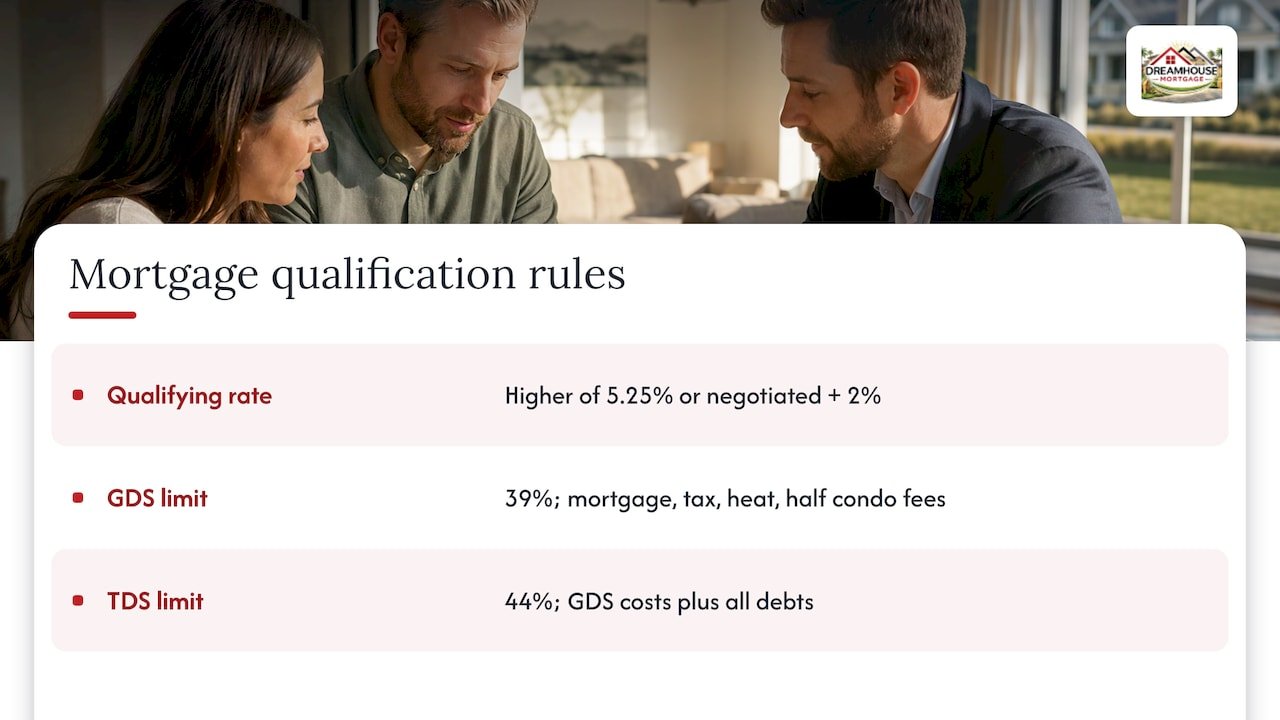
The stress test. The Financial Consumer Agency of Canada (FCAC), the federal body that explains consumer financial products, states that banks must use the higher of 5.25% or your negotiated rate plus 2% to test your mortgage. The same page notes that credit unions and other lenders that are not federally regulated do not need to apply the stress test.
GDS (gross debt service). This is your housing cost as a share of gross monthly income: the mortgage payment at the qualifying rate, property tax, heat and half of any condo fees. The guideline limit is 39%.
TDS (total debt service). This is the same housing cost plus every other monthly debt payment: car loans, credit cards, lines of credit and student loans. The guideline limit is 44%. Both limits appear in the FCAC mortgage qualifier tool.
Whichever ratio you hit first sets your maximum. With few other debts, GDS usually binds. With a large car loan or card balances, TDS binds, and that is when a table figure stops being accurate for you.
For a deeper walk-through of how these rules apply in our province, see our Alberta mortgage stress test guide and our Canadian mortgage qualification rules explainer.
What a $600,000 mortgage requires: the published estimates
Every calculator answers the question with slightly different assumptions, which is why you see a range instead of one number. Here is how the 2026 published figures compare for a $600,000 mortgage.
| Source and period | Income needed | Key assumptions |
|---|---|---|
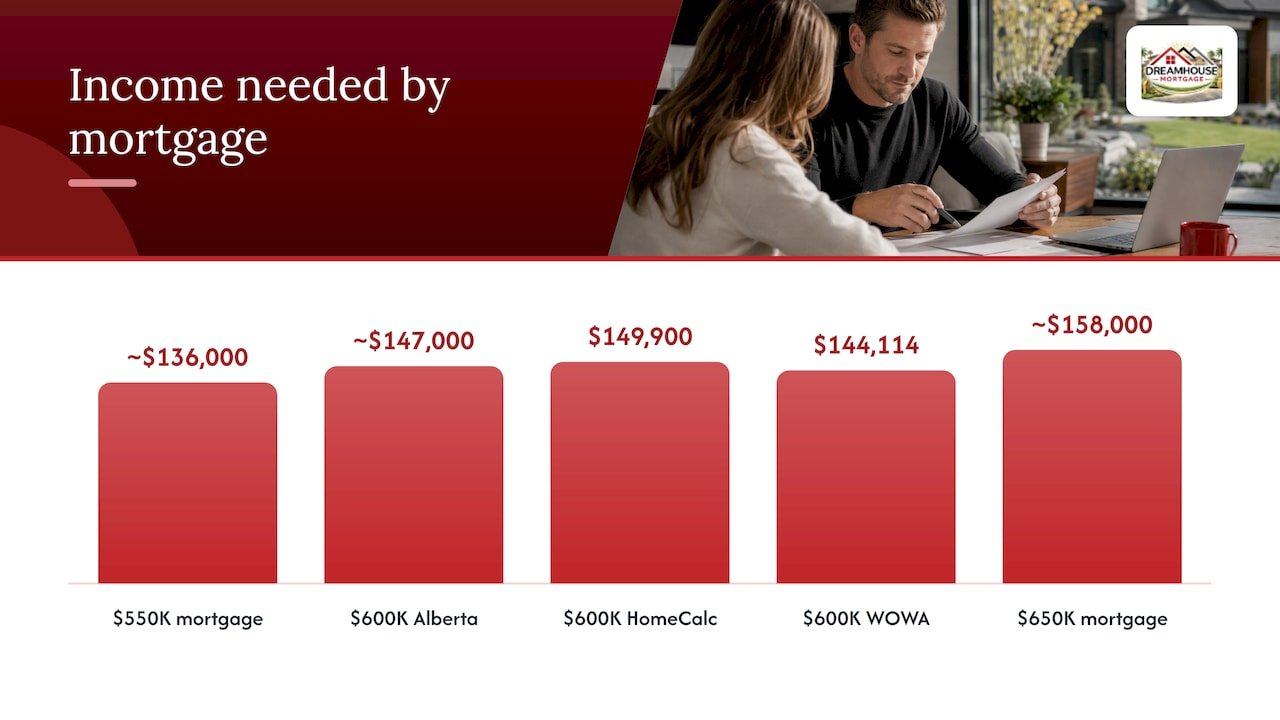
| Alberta Mortgage Calculator, reviewed July 28, 2026 | About $147,000 | 5.49% stress-tested rate, 39% GDS |
| HomeCalc, October 2026 | $149,900 | 5.25% contract rate, 7.25% qualifying rate, 25-year amortization, $4,800 yearly property tax, $175 monthly heat, no other debts |
| WOWA, 2026 | $144,114 | $660,000 home, $60,000 down, $2,952 yearly property tax, $200 monthly heat, $700 monthly car loan |
These are published figures for their period, and they move with the rate environment. Contract rates change as lenders reprice, and the qualifying rate follows them, so treat the table as a range to plan around and your own pre-approval as the real answer.
The same Alberta Mortgage Calculator page lists about $136,000 for a $550,000 mortgage and about $158,000 for a $650,000 mortgage. That gives you a rule of thumb: each extra $50,000 of mortgage adds roughly $11,000 to $12,000 of required income. If you are comparing, our guide to the income needed for a $500K mortgage in Alberta covers the step below.
Where the number comes from: a worked example
Using HomeCalc’s October 2026 assumptions, the arithmetic is easy to follow:
- The $600,000 mortgage at the 7.25% qualifying rate over 25 years has a stressed payment of $4,296 a month, compared with $3,576 at the 5.25% contract rate.
- Add $400 a month for property tax ($4,800 a year) and $175 for heat. Housing costs come to $4,871.
- Divide by 0.39 and you get about $12,490 of gross monthly income, which is roughly $149,900 a year.
Notice that you will pay $3,576 a month, but you qualify on $4,296. That $720 gap is the stress test at work, and it is why a household can feel comfortable with the real payment and still fall short on paper.
Why Calgary property tax and heating matter
Property tax and heat are part of GDS, so they change your required income even though they are not part of the mortgage. Calgary Mortgage Calculator’s stress-test page notes that on a $600,000 home, Calgary’s 2026 property tax adds $332 a month to GDS. Taxes differ by municipality, so a home in Airdrie, Cochrane or Chestermere will have its own figure. Use the tax amount on the listing or the seller’s tax notice, not a generic estimate.
A higher heating estimate for a larger home, or condo fees (lenders count half of them), has the same effect. Each $100 a month of extra housing cost adds about $3,100 to the income you need at a 39% limit ($100 divided by 0.39, times 12).
A $600,000 mortgage is not a $600,000 home
Most people searching this question are really asking about the home price, so separate the two before you plan.
According to Canada.ca, the lender deducts your down payment from the purchase price and the mortgage covers the rest. The minimum down payment is 5% of the first $500,000 plus 10% of the portion above that, which is $35,000 on a $600,000 home. A down payment under 20% typically requires mortgage loan insurance, with premiums of 0.6% to 4.5% of the mortgage, added to the loan or paid up front.
That creates three common scenarios:
| Scenario | Loan before premium | What changes |
|---|---|---|
| $600,000 home, 20% down ($120,000) | $480,000 | No mortgage insurance. HomeCalc’s Calgary example shows $6,330 in closing costs and $126,330 total cash to complete |
| $600,000 home, 10% down ($60,000) | $540,000 | A 3.10% premium for 10 to 14.99% down, about $16,740, added to the mortgage for roughly $556,740 |
| $600,000 home, minimum 5% down ($35,000) | $565,000 | A 4.00% premium for 5 to 9.99% down, $22,600, on a $565,000 insured mortgage |
The premium is calculated on the loan, then added to it, so the income you need rises with it. Premium bands also create thresholds: HomeCalc notes that a $60,000 down payment on $600,000 is exactly 90% loan-to-value and takes the 3.10% band, while at $610,000 the same down payment crosses into the 4.00% band. Putting even a little more down at that line can lower your premium. Our guide to CMHC mortgage insurance premiums in Alberta walks through each band.
If you want a loan near $600,000 with 20% down, the home would cost about $750,000. Because the mortgage is the same size, the income requirement is similar to the table above, apart from higher property tax and heat on the bigger home.
How your other debts change the income you need
The table figures assume no other debts. Real files rarely look like that.
MortgageCompareCalculator’s GDS and TDS guide gives a useful example. On $110,000 of household income, a $2,800 mortgage payment plus $350 property tax and $150 heat gives a 36.0% GDS, under the 39% cap. Adding a $450 car loan and a $300 student loan pushes TDS to 44.2%, just over the 44% ceiling. The housing numbers passed. The debts did not.
For a $600,000 mortgage, this shows up in two ways:
- Monthly payments count, not balances. Lenders use the minimum payment on credit cards, lines of credit and student loans, and the full payment on car loans and leases.
- Paying down one debt can help more than raising income. Clearing a $450 monthly car payment lowers TDS by the same amount as roughly $12,000 of extra annual income at a 44% limit ($450 divided by 0.44, times 12).
This is also why the 39% and 44% limits are described as guidelines. Some lenders apply tighter limits on uninsured mortgages, and a lender may weigh your credit score and employment history alongside the ratios.
Salaried, self-employed and new to Canada: what counts as income
The FCAC qualifier tool lists self-employment income, commissions, bonuses, tips, investments, rental income, spousal and child support and disability payments as possible qualifying sources. How much of each counts depends on the lender and how long you have received it.
Salaried borrowers typically provide pay stubs, T4 slips and an employment letter. Self-employed borrowers are assessed mostly on what they declared to the Canada Revenue Agency (CRA). True North Taxes notes that most lenders want two consecutive years of Notices of Assessment, sometimes three, and that a business owner who writes down heavily to reduce tax also reduces the income a lender can use. If that is you, read our self-employed mortgage income proof guide for Alberta before you apply.
Newcomers can often qualify with a shorter Canadian history. Loanscanada.ca lists a PR card or work permit, an employment letter, three months of Canadian bank statements and an international credit report if available, and notes that some lenders ask for 20% to 35% down from thin-file applicants. Our New to Canada mortgage page covers the programs in Alberta.
Ways first-time buyers can lower the income they need
If you are a few thousand dollars short of the figures above, you have more levers than you might expect.
Longer amortization. LoonieCalc explains that 30-year amortization, available to eligible first-time buyers and new builds, would raise the maximum principal to roughly $610,000, at the cost of about $170,000 in additional total interest. A lower payment means a lower qualifying payment, so less income is required. Compare the options in our mortgage amortization guide.
A larger down payment. Beyond avoiding insurance at 20%, a bigger down payment shrinks the loan directly. Our overview of first-time home buyer benefits in Canada covers the FHSA, the Home Buyers’ Plan and the GST rebate that can help build it.
A co-borrower. Adding a spouse, partner or family member with their own income can lift the household figure, provided their debts come with them.
Lower recurring debts. As shown above, removing a car payment before you apply often does more than a raise.
Choosing the right lender type. Since not every lender applies the same rules, the lender matters as much as the ratios. The FCAC points out that credit unions and other lenders outside federal regulation do not need to use the stress test, though each still sets its own policy.
Qualifying is not the same as affordable
HomeCalc cautions that its income figures are qualifying minimums, not a comfortable budget, because both ratios are calculated on the qualifying payment rather than the real one. A household at exactly $147,000 would be committing about 39% of gross income to housing before utilities, groceries, childcare, commuting from Cochrane or Airdrie, or saving for repairs.
Before you pick a price range, set your own comfortable payment first. Then work backward to the home price. A lender’s maximum is the ceiling, not the target.
How to find your own number in five steps
- List your gross household income. Use the amounts that appear on your Notice of Assessment or T4, not take-home pay. Our Calgary mortgage affordability calculator guide shows how to avoid common input mistakes.
- Add up every monthly debt payment. Use minimums on cards and lines of credit, full payments on loans and leases. Do not leave out a co-signed debt.
- Estimate property tax and heat for the actual home. Use the listing or tax notice. Condo fees count at half.
- Decide on a down payment. Include closing costs. HomeCalc’s Calgary example includes Alberta land titles fees of $650 for the transfer and $530 for the mortgage. Alberta has no land transfer tax.
- Get a pre-approval. A calculator gives a range. A pre-approval tests your documents and credit against real lenders. Our pre-approval requirements checklist for Alberta lists what to gather, and our pre-approval work includes document collection and lender selection from our network of banks, credit unions, monoline, alternative and private lenders.
One caution: a pre-approval is not a final approval. The home itself must appraise at the price, which is why we wrote Preapproval vs Approval: Calgary appraisals can change the deal.
What changed in the rules and what did not
The qualifying rate and the 39% and 44% limits are unchanged. Canadian Money Help reports that OSFI confirmed in January 2026 that the 5.25% floor stays. The two material federal changes it lists are the insured-mortgage price cap rising from $1,000,000 to $1,500,000 on December 15, 2024, and 30-year amortization for first-time buyers and new-construction insured purchases. For a $600,000 purchase, the amortization change is the one that matters most to you.
If you are renewing rather than buying, the same source notes that since November 21, 2024, uninsured borrowers switching lenders at renewal without increasing the loan or changing amortization do not need to re-qualify under the stress test. Our team handles renewal and switch files too.
Our perspective
The number that matters is not the one in a table. It is the one a lender will accept on your documents, with your debts, on the home you actually want.
When we sit down with first-time buyers in Calgary, Airdrie and Cochrane, we start with the income and debts on paper, then work toward a price range and a payment the household can live with. Because we work with banks, credit unions, monoline, alternative and private lenders, we can place a file with the lender whose rules fit the borrower’s income type, whether that is salary, commission, self-employment or a new-to-Canada file.
Our approach is built on clear communication and education. You should understand why your qualifying income is what it is, which ratio is holding you back and what could change it before you make an offer, not after.
Guriqbal Chahal, MBA, PMP
Start with a pre-approval built on your numbers
DreamHouse Mortgage is a Calgary brokerage founded in 2013 and led by Broker of Record Guriqbal Chahal. We serve first-time buyers across Calgary, Airdrie, Cochrane, Chestermere, Okotoks and High River, and our first-time buyer mortgage and pre-approval services cover qualification, lender selection, document collection and funding coordination. If you want to see what a $600,000 mortgage means on your income, call Guriqbal Chahal, MBA, PMP, Mortgage Broker, at 403-966-6072, or find us on our Google Business Profile.

You can also read our first-time home buyer guide for Alberta while you prepare your documents.
FAQ
How much income do I need for a $600,000 mortgage in Calgary?
Published 2026 tables show about $144,000 to $150,000 of gross household income with no other debts. Alberta Mortgage Calculator reports about $147,000 at a 5.49% stress-tested rate. Your own figure moves with property tax, heat, rate and any monthly debts, so a pre-approval gives you the real answer.
Can I get a $600,000 mortgage with a $120,000 income?
It is unlikely on a standard file with no other adjustments, since $120,000 is below the published range of roughly $144,000 to $150,000. A larger down payment that shrinks the loan, a co-borrower’s income or a 30-year amortization for an eligible first-time buyer could change the result. A broker can test those options against your documents.
Does the stress test apply to every lender?
No. The FCAC states that banks must use the higher of 5.25% or the contract rate plus 2%, while credit unions and other non-federally regulated lenders do not need to use the stress test. Each lender still sets its own qualification policy, which is one reason a broker with access to many lenders is useful.
How much down payment do I need on a $600,000 home?
The minimum is $35,000, which is 5% of the first $500,000 plus 10% of the remainder. With less than 20% down you need mortgage loan insurance, with premiums from 0.6% to 4.5% of the mortgage. At 20% down ($120,000) no insurance is required.
Sources
- Alberta Mortgage Calculator: Income Needed by Mortgage Amount
- HomeCalc: Income Needed for a Mortgage in Canada (2026)
- WOWA: Income Needed To Get A Mortgage In Canada
- Financial Consumer Agency of Canada: Mortgage Qualifier Tool
- Canada.ca: How much you need for a down payment
- Calgary Mortgage Calculator: Stress Test Calculator
- Canada Calculator: Mortgage Calculator Canada 2026
- HomeCalc: Home Buying Calculator Canada
- MortgageCompareCalculator: GDS and TDS in Canada
- True North Taxes: Notice of Assessment for a Mortgage
- Loanscanada.ca: Mortgage Documents Checklist Canada 2026
- LoonieCalc: Canadian Mortgage Affordability Calculator
- Canadian Money Help: Mortgage Stress Test 2026
- Canadian Money Help: What Changed in Mortgage Rules for 2026