
The main advantage of a reverse mortgage is simple: if you are 55 or older, you can turn part of your home’s value into tax-free cash and make no regular mortgage payments, while you keep owning and living in your home. Federal guidance lists six advantages, and they matter most to Calgary, Airdrie and Cochrane homeowners who have a lot of equity and little monthly cash flow. Those same rules also decide whether a reverse mortgage is the right way to reach your equity or whether a refinance or home equity line is. At DreamHouse Mortgage, we walk Alberta homeowners through those home equity options, so you can compare them side by side before you sign anything.
TL;DR
- A reverse mortgage is for homeowners usually aged 55 or older. You can borrow up to 55% of your home’s value, and the money is tax-free.
- No regular payments are required. Interest is added to the balance, and the loan is repaid when you sell, move out or pass away.
- The Government of Canada lists these advantages: continued ownership, flexible payout options, and no effect on OAS or GIS benefits.
- Rates are higher than on a regular mortgage or HELOC, so compare a refinance or home equity line first. Call Guriqbal Chahal at 403-966-6072 to run the numbers.
Table of Contents
- What a reverse mortgage is, in plain terms
- The six advantages, one by one
- Who gets the most from a reverse mortgage
- How to use a reverse mortgage well: costs and conditions
- Reverse mortgage, refinance or HELOC: compare before you decide
- Alberta details worth knowing
- Our perspective
- Talk through your home equity options
- FAQ
- Sources
What a reverse mortgage is, in plain terms
A reverse mortgage is a loan secured against your home. According to the Financial Consumer Agency of Canada (FCAC), it is designed for homeowners usually aged 55 or older, and it lets you borrow some of your home equity without selling. You typically borrow up to 55% of the home’s current value. The exact amount depends on your age, any other people on title, the condition and type of the home, its appraised value and the lender.
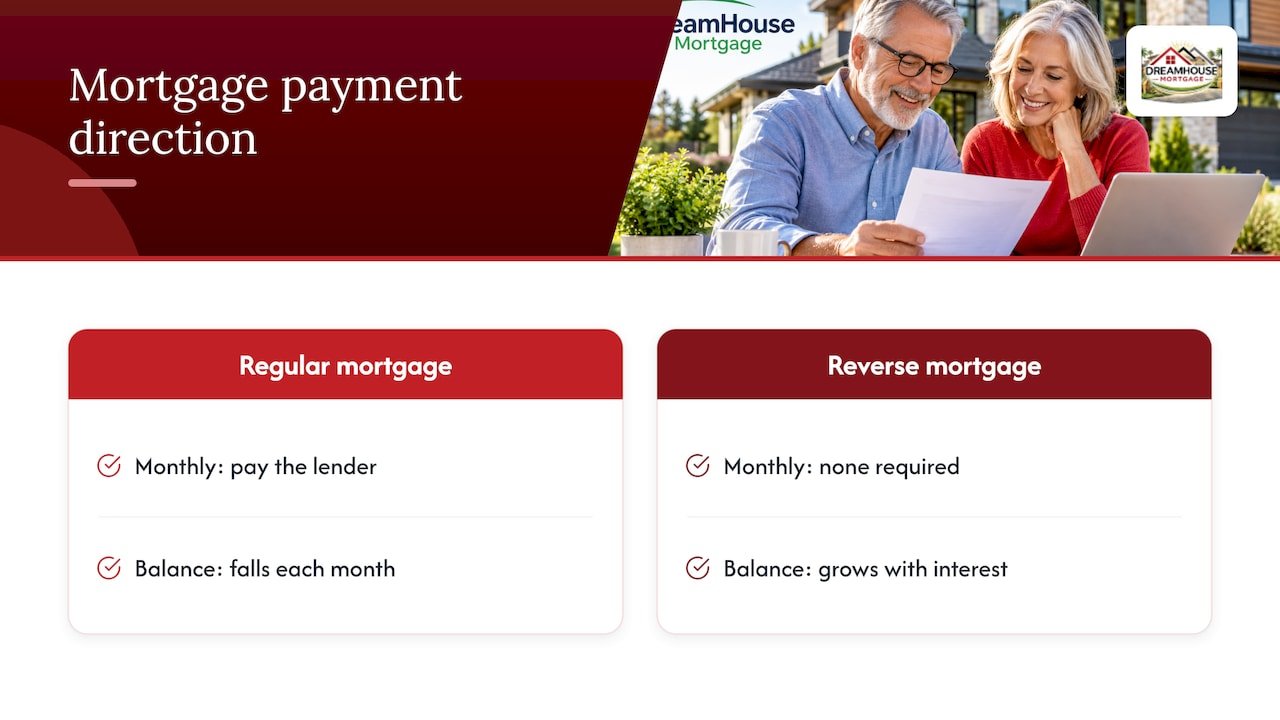
The word “reverse” refers to the payment direction. With a regular mortgage you pay the lender each month and your balance falls. Here, nothing is required monthly, interest is added to the balance, and the amount owed grows over time.
The loan comes due when you sell the home, move out, the last borrower dies, or you default on the terms. The home is normally your primary residence, lived in at least six months a year.
Equity is the part of the home you own outright: its value minus what you owe against it. In Calgary, where many long-time owners in communities like Marda Loop, Bowness, Forest Lawn or Dalhousie hold a house they bought decades ago, equity is often the largest asset they have.
The six advantages, one by one
The FCAC’s pros-and-cons summary names six advantages. Here is what each one means in practice for an Alberta homeowner.
1. No regular mortgage payments
This is the advantage most people ask about. If your income is a pension, CPP and OAS, and your monthly budget is tight, a payment-free loan removes a fixed obligation. You are still responsible for keeping up the property taxes and valid home insurance, and for maintaining the home, as MoneySense explains. So budget for those three items rather than for a loan payment.
2. Access to home value without selling
Many Calgary homeowners in their late fifties and beyond want to stay close to their neighbours, their doctor and their family. Selling means moving costs, a new home, and a market that may not suit your timing. A reverse mortgage converts part of the value into cash while you stay put.
3. You keep ownership
You remain the owner on title. A July 2026 MoneySense article states that the homeowner keeps title and cannot be forced out of the home, provided the conditions of the loan are met. The same piece notes that Canadian consumer protections prevent you from owing more than the home is worth.
Future growth in the home’s value also stays with you. MoneySense’s explanation is that if the home gains value, the gain is yours, and if it falls, the lender absorbs the loss, because the borrower never owes more than fair market value.
4. Flexible payout options
You can generally take the money as a lump sum or as regular payments. CMHC’s guide for people 55+ describes a lump sum or fixed monthly payments, and mentions annuity and line-of-credit styles as things to ask about. The FCAC adds that regular-payment options typically start at $1,000 per month or $3,000 every three months, often with an initial draw of around $20,000, while partial lump-sum setups typically start around $25,000.
The option you pick changes how fast the balance grows. Taking only what you need, when you need it, generally keeps less interest accumulating.
5. The money is tax-free
The FCAC states that borrowed money from a reverse mortgage is tax-free. It is a loan, not income. For anyone planning a retirement budget, this means the funds do not push you into a higher bracket the way an RRIF withdrawal can.
6. No effect on OAS or GIS
Because it is a loan, the FCAC lists no impact on Old Age Security or the Guaranteed Income Supplement as an advantage. If you receive income-tested benefits, that matters.
One more: no limits on how you use the money
MoneySense notes there are no restrictions on how you spend the funds. Typical uses include home accessibility changes, a new roof or furnace, helping family, or covering daily living costs. If your plan is repairs, a licensed trades team such as home renovation services in Alberta can price the work so you know the amount you need before you decide how much to draw.
Spouses are also protected in one important way. According to MoneySense, if one spouse dies, the surviving spouse is not required to repay, because these loans are not “callable” on that event, provided both are on the loan and the terms are met.
Who gets the most from a reverse mortgage
The pros are real for a specific profile. MoneySense’s Knoblach, quoted in the July 2026 Canadian Press piece, says the ideal client is someone who does not care much about preserving an estate, perhaps without children or heirs to leave one to, who wants to stay in the home and accepts that interest will consume equity over time.
In Calgary and the surrounding area that usually looks like one of these homeowners:
- A widowed homeowner in Calgary whose pension covers living costs but not a major repair, and who wants to remain in the house.
- A couple in Cochrane or Airdrie with a paid-off home who want extra monthly income in retirement without moving to a condo.
- A homeowner without heirs relying on the estate who sees the home’s value as a resource to be used during their lifetime.
- An owner on a fixed income who prefers not to qualify through a monthly-payment income test.
If you are just starting out and want to buy a first home instead, our guide to first-time home buyer mortgages in Calgary is the right place. This article is for the homeowners on the other side of the housing journey.
How to use a reverse mortgage well: costs and conditions
Getting the benefit means understanding what it costs, so the advantages above work for you instead of against your plans.
Rates. The FCAC says reverse mortgage rates are higher than regular mortgage or HELOC rates. The July 2026 MoneySense article puts the gap at usually 2% to 3% above a conventional mortgage. Because interest is added to the balance, the amount owed compounds over time. Rates move with the lending market, so ask for the current rate in writing from each lender you consider rather than relying on any published figure.
Fees. The FCAC lists possible home appraisal fees, set-up fees, prepayment penalties, legal fees and closing costs. Ask for every one up front.
Equity and your estate. As interest accumulates, your equity declines and less is left for beneficiaries. The FCAC notes that the estate has a limited window after death to repay, and settling an estate can take longer than that window. Tell your family about the loan and where the paperwork is kept, so they can act quickly.
Conditions. Keep the home as your principal residence, pay property taxes, keep insurance valid and maintain the property. Defaulting on those could lead to foreclosure, according to the FCAC. Treat them as fixed annual items in your budget.
Legal advice. CMHC recommends independent legal advice before you sign, because the contract is more complex than a regular mortgage. In Alberta, that means a lawyer who acts only for you, not for the lender.
Questions to ask before you choose
CMHC advises 55+ homeowners to settle these points before committing:
- Do I want a lump sum, monthly payments, an annuity or a line of credit?
- What happens if I sell later?
- How does the loan affect my spouse or children?
- What happens if the amount owed exceeds the home’s value?
- Are there penalties for paying off early?
- Is there a cooling-off period to cancel the agreement?
Write the answers down and compare them across lenders. A clear table of answers makes the cost of each option visible.
Reverse mortgage, refinance or HELOC: compare before you decide
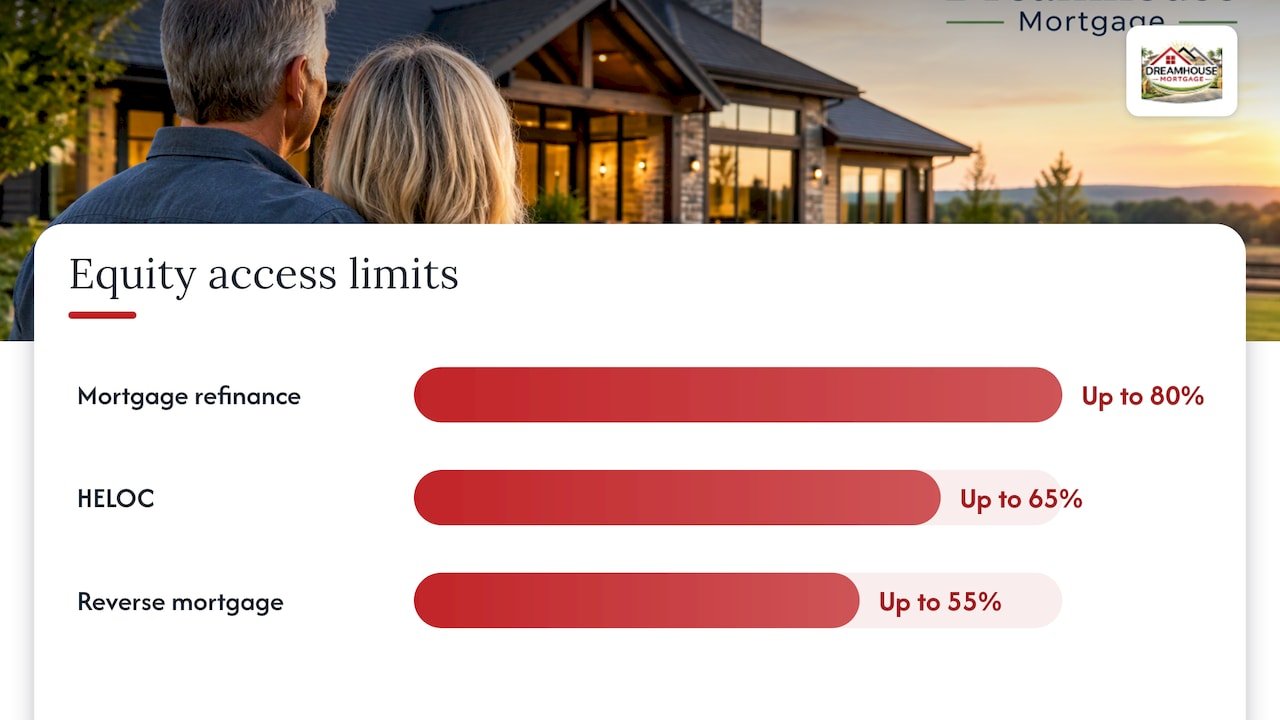
A reverse mortgage is one of three common ways to reach equity. The right one depends on whether you can carry monthly payments. CMHC’s guide says a reverse mortgage is ultimately more expensive than refinancing, which can reach up to 80% of your home’s value, or a HELOC, which can reach up to 65%.
| Option | How much you can access | Monthly payments | Who it suits |
|---|---|---|---|
| Mortgage refinance | Up to 80% of home value | Yes | Owners who can qualify and want the lowest cost of borrowing |
| HELOC | Up to 65% of home value | Interest payments on what you use | Owners who want flexible access to funds as they need them |
| Reverse mortgage | Up to 55% of home value | None required | Owners 55+ who want to stay in the home and prefer no payments |
If your income and credit support payments, a refinance usually gives you the most cash at the lowest cost. We explain how the 80% limit shapes the choice in our article on refinance or HELOC, and the cost side in Calgary refinance closing costs. If you want a revolving line, see home equity loan vs HELOC in Calgary and HELOC or second mortgage.
If your goal is a renovation, our home equity renovation mortgage page explains how equity can fund the work. And if your current mortgage is up for renewal, renewing or refinancing in Calgary lets you reset your terms and take out equity in one step. Interest rate changes also matter here, so read how the Bank of Canada rate affects your Calgary mortgage.
Alberta details worth knowing
One Alberta program interacts directly with a reverse mortgage. The Government of Alberta’s Seniors Home Adaptation and Repair Program (SHARP) guide, version July 2026, offers home-repair loans to registered owners aged 65 and over, provided at least 25% equity remains in the primary residence and all charges on title stay within 75% of assessed value. A registered reverse mortgage must be removed from title before a SHARP loan can be granted, so the two cannot sit on the same property at once. If you are considering both, decide the order first.
When you speak with a broker, mention your community, the home type and any other people on title. A detached house in Airdrie, a townhouse in Cochrane and a bungalow in Calgary’s inner city can all appraise differently, and that affects how much you can borrow.
Our perspective
Most homeowners we speak with in Calgary, Airdrie and Cochrane do not ask for a product. They ask how to stay in their home and still have the cash for what comes next. A reverse mortgage has real advantages for the right person: no regular payments, tax-free funds, ownership kept, and no effect on OAS or GIS.
What matters is the full picture. Home equity can be reached through a refinance, a home equity loan, a HELOC or a reverse mortgage, and each carries different payments, different limits and a different cost over time. We believe you should see these options compared with your own numbers before you choose one.
DreamHouse Mortgage works with banks, credit unions, monoline lenders, alternative lenders and private lenders, and our approach is built on education and long-term financial planning. For many Alberta homeowners that means starting with a conversation about equity, income, timing and what you want your home to do for you. We explain the terms plainly, we answer the questions you would otherwise face alone, and we help you plan the steps.
Guriqbal Chahal, MBA, PMP
Talk through your home equity options
If you own a home in Calgary, Cochrane, Airdrie, Chestermere or elsewhere in Alberta and want to access its equity, we can compare your options with you: refinancing, a home equity loan, debt consolidation, an equity renovation mortgage, or a renewal with better terms. DreamHouse Mortgage is a Calgary brokerage founded in 2013, led by Broker of Record Guriqbal Chahal.

Call Guriqbal Chahal, MBA, PMP, Mortgage Broker, at 403-966-6072, or start at our mortgage services page. You can also find us on our Google Business Profile.
FAQ
Who can get a reverse mortgage in Canada?
The FCAC says reverse mortgages are for homeowners usually aged 55 or older. The home is typically your primary residence, lived in at least six months a year. The amount you can borrow depends on your age, other title holders, the home’s condition, type and appraised value, and the lender.
How much can I borrow against my Calgary home?
Usually up to 55% of the home’s current value. The final figure depends on your age, the home and the lender. By comparison, CMHC says a refinance can reach up to 80% of value and a HELOC up to 65%.
Will a reverse mortgage affect my OAS or GIS?
The FCAC lists no impact on OAS or GIS as an advantage, because the money is a tax-free loan and not income. Confirm your own situation with Service Canada or your tax adviser before you sign.
What happens to the loan when I die or sell?
The balance, including added interest, becomes due when you sell, move out or the last borrower dies. The FCAC notes the estate has a limited time to repay, so tell your family and your executor about the loan. You never owe more than the home’s fair market value, according to MoneySense.
Do I need a lawyer?
Yes. CMHC recommends independent legal advice before signing, because the contract is more complex than a regular mortgage. In Alberta, choose a lawyer who represents only you.
Sources
- Reverse mortgages, Financial Consumer Agency of Canada
- Mortgage financing options for people 55+, CMHC
- What you need to know about reverse mortgages, MoneySense
- When a reverse mortgage might make sense, MoneySense
- Seniors Home Adaptation and Repair Program guide, Government of Alberta
Recommended
- Home Equity Renovation Mortgage Calgary | Unlock & Transform 2026
- Home Equity Loan vs HELOC in Calgary | Smart Borrowing Choices That Could Cost or Save You Thousands
- When Should You Refinance Mortgage Calgary? The Complete 2026 Guide
- Debt Consolidation Mortgage Calgary – Powerful Home Equity Strategy to Eliminate Debt