BMO vs TD mortgage
BMO and TD are both strong lenders, and the gap between them is smaller than most buyers expect. In the November 2026 comparison we reviewed, BMO’s 5-year fixed special sat at 5.14% against 5.39% at TD, but the rate is only one of five numbers that decide what a mortgage costs you: the rate hold, the prepayment limits, the break penalty, portability and how early you can renew. If you are buying your first home in Calgary, Airdrie or Cochrane, the most useful move is to line up both banks, plus ATB and RBC, against the same file before you choose. That comparison is what we do for our clients at DreamHouse Mortgage, and this guide shows you what to compare.
TL;DR
- As of November 2, 2026, BankMortgages.ca listed BMO’s 5-year special at 5.14% and TD’s at 5.39%, with 3-year specials at 4.94% and 5.24%. Rates move with bond yields and lender promotions, so confirm on the day you apply.
- BMO allows larger prepayments (20% lump sum, 20% payment increase on closed mortgages) and a longer rate guarantee. TD allows 15% lump sums, payment increases up to 100% once a year, and a lower break penalty in the worked example below.
- ATB and RBC are strong Alberta options too. ATB’s Alberta-only Rate First product and RBC’s first-time buyer cash back change the picture for some buyers.
- One broker file can compare BMO, TD, ATB, RBC, credit unions and monoline lenders side by side. Call Guriqbal Chahal at 403-966-6072.
Table of Contents
- Why a BMO vs TD mortgage comparison is really a five-part comparison
- BMO vs TD rates: what the published numbers show
- Rate holds and pre-approvals
- Prepayment privileges: BMO and TD side by side
- Breaking your mortgage: penalties with a worked example
- Portability and moving within your term
- Which one suits a first-time buyer?
- ATB vs RBC: the Alberta pair
- The four-bank snapshot
- How to compare two offers properly
- Perspective: what we tell first-time buyers about picking a bank
- Work with a Calgary mortgage broker on this decision
- FAQ
- Sources
Why a BMO vs TD comparison is really a five-part comparison
Most buyers start with the posted rate and stop there. The posted rate is the lender’s standard published rate. The discounted or “special” rate is what most borrowers actually get, and it changes often. Two mortgages with the same discounted rate can cost very different amounts if one has tighter prepayment limits or a bigger penalty when you sell early.
For a first-time buyer in Calgary, the things that matter most are:
- The rate and how long it is held. A rate hold protects you between pre-approval and closing.
- Prepayment privileges. How much extra you can pay each year without a charge.
- The penalty for breaking the mortgage. This is the cost if you sell, refinance or move before the term ends.
- Portability. Whether you can carry the mortgage to your next home.
- Early renewal. How soon before maturity you can lock in a new rate.
The sections below take each in turn.
BMO vs TD mortgage rates: what the published numbers show
Bank rates are published figures for a given date, not a promise. They move with Government of Canada bond yields for fixed rates and with each bank’s prime rate for variable rates, and the banks revise them often.
Here is what the sources we reviewed showed:
| Product | BMO | TD | Source date |
|---|---|---|---|
| 5-year fixed special | 5.14% (posted 6.09%) | 5.39% (posted 6.14%) | November 2, 2026 |
| 3-year fixed special | 4.94% | 5.24% | November 2, 2026 |
Those figures come from BankMortgages.ca’s TD vs BMO comparison. Separately, NerdWallet Canada’s BMO rates page, updated November 16, 2026, shows BMO’s 3-year fixed at 4.94% and its 5-year Smart Fixed at 5.14% uninsured and 4.99% insured, for amortizations of 25 years or less. Its 5-year variable closed rate is 4.35%, against a posted 4.70%.
An insured rate applies when your down payment is under 20% and the mortgage carries default insurance. That is the situation of most first-time buyers, so the insured column is often the one that applies to you. An uninsured (conventional) rate applies when you put 20% or more down.
The lesson for your own file: do not compare yesterday’s headline with today’s quote. Ask for the rate, the term, the amortization, whether it is insured, and the date the quote was issued. Then compare the same four items at each lender.
Rate holds and pre-approvals
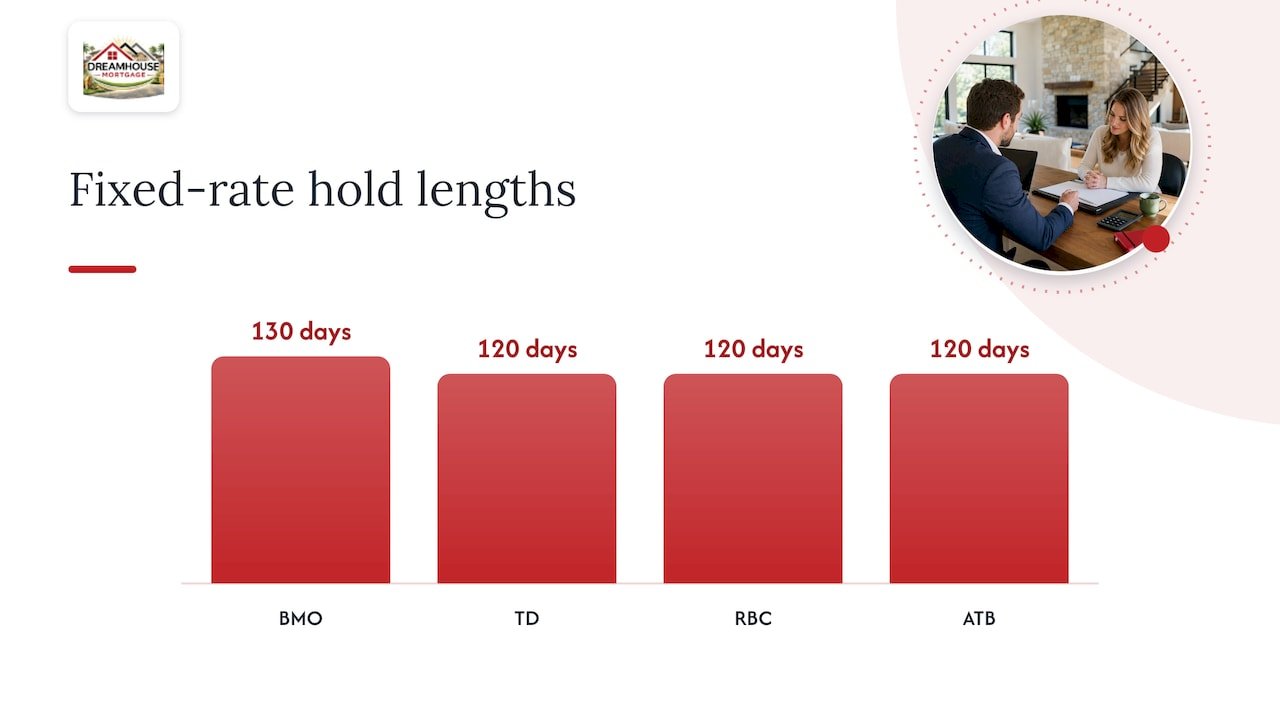
A pre-approval lets you shop for a home with a rate reserved. A bank’s pre-approval holds the fixed rate for a set number of days, subject to conditions. TD states that its pre-approval holds the fixed rate for 120 days, and that variable rates are not held because they move with TD Mortgage Prime. TD’s online pre-approval states it has no effect on your credit score when applied for online.
BMO publishes a 130-day rate guarantee on fixed rates, which is among the longer holds in the market. RBC and ATB each state 120 days. LatestMortgageRates.ca notes there is no federal rule on hold length, so the commitment in your own document is what counts: if it names a number of days, that is your hold, and if it names no date, it is not a hold.
Why this matters in Calgary: if you are shopping in Airdrie, Cochrane or Chestermere, a new-build can have a possession date many months after you sign. A longer hold, or a lender that lets you request a lower rate if the market drops during the hold, can matter more than a few hundredths of a percent. Ask each lender whether a lower rate is applied automatically or only on request.
Our pre-approval requirements checklist for Alberta lists the documents to gather first, and Preapproval vs Approval explains why a Calgary appraisal can still change the deal after you have a pre-approval.
Prepayment privileges: BMO vs TD Mortgage side by side
Prepayment privileges let you pay down principal faster without a charge. They are listed as a percentage of the original mortgage amount per year.
| Feature | BMO | TD |
|---|---|---|
| Annual lump-sum prepayment | 20% on closed mortgages (10% on Smart Fixed) | 15% of the original principal |
| Payment increase | 20% on closed mortgages (10% on Smart Fixed) | Up to 100%, once per calendar year |
| Early renewal | Up to 180 days early with no penalty | 120 days suggested |
The figures are from the BankMortgages.ca comparison. TD’s own product page also states the 15% lump-sum and 100% payment-increase limits, and lists fixed terms of 6 months and 1, 2, 3, 4, 5, 6, 7 or 10 years.
What this means in practice. If you expect a tax refund, a bonus or a gift from family each year, BMO’s 20% lump sum on a closed mortgage gives you the most room. On a $400,000 mortgage that is up to $80,000 a year at BMO against $60,000 at TD, based on original principal. If you would rather raise your payment sharply once, for example when a second income starts, TD’s 100% payment increase is the more flexible tool. Most first-time buyers will not reach either cap in their early years, so these limits are more a question of fit than of better or worse.
If you want a structured plan for paying your balance down, see seven ways to pay down your mortgage faster in Alberta.
Breaking your mortgage: penalties with a worked example
Life changes inside a five-year term. A job move, a growing family or a separation can mean selling a home sooner than planned. The break penalty is what you pay the lender for ending the term early.
Both banks use the same basic rule on closed fixed mortgages: the greater of three months’ interest or the interest rate differential (IRD), which compensates the lender for the lower rate it can now earn on your money. On variable mortgages, the penalty is typically three months’ interest. BMO’s own page adds that on a term longer than five years, the penalty after year five is three months’ interest.
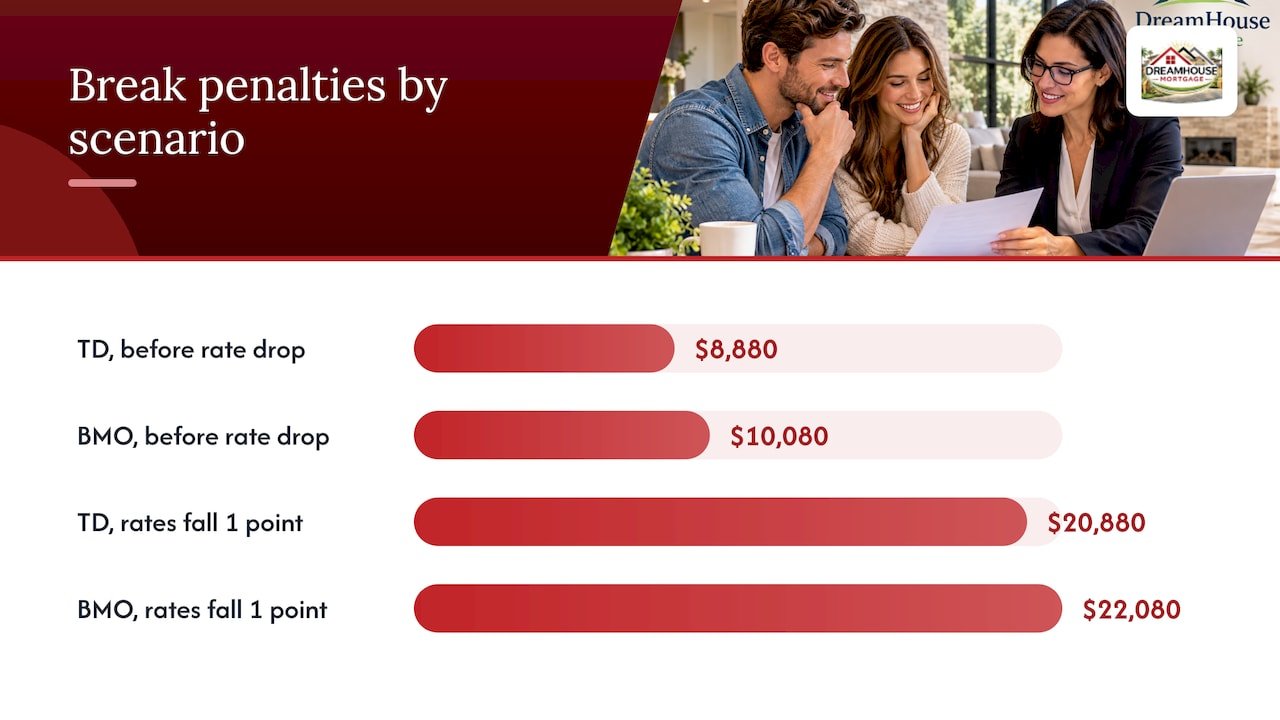
The IRD calculation differs between lenders, so the same mortgage can cost different amounts to break. BankMortgages.ca calculated a $480,000 mortgage with 30 months remaining at:
- TD: $8,880
- BMO: $10,080
If posted rates fell by a point first, the same example comes to $20,880 at TD and $22,080 at BMO. In both scenarios the gap is about $1,200, in TD’s favour. That is one example with specific inputs. Your own penalty depends on your rate, your balance, your remaining term and the lender’s posted rates on the day you break.
The practical point: penalty size is part of the price of the mortgage. A slightly lower rate can be worth more than a lower penalty if you will almost certainly stay for five years. If you may move within two or three years, the penalty and the portability terms deserve more weight than the rate.
Portability and moving within your term
Portability lets you take your existing mortgage and rate to a new property, which can avoid the penalty if you sell and buy at the same time.
- TD: ports a fixed-rate mortgage with no prepayment charge on an approved new application.
- BMO: its Portable Mortgage Option lets you transfer a fixed closed mortgage to a new mortgage of the same type without a prepayment charge. Any extra money you borrow is blended at the current fixed posted rate.
Portability is conditional. You still have to qualify for the new mortgage at today’s rules, and the new home has to be approved. If you plan to upgrade from a Calgary condo to a house in Cochrane within a few years, read our guides on mortgage portability in Calgary and porting and increasing your mortgage before you sign.
Which one suits a first-time buyer?
Both banks serve first-time buyers, and your documents will be similar at either one. TD’s first-time buyer page lists proof of identity, income confirmation (a pay stub or direct deposit, or for the self-employed the most recent two years of T1 Generals with Notices of Assessment) and proof of where your down payment is coming from, such as account statements or a gift confirmation.
The federal programs available to first-time buyers do not depend on which bank you choose. The Tax-Free First Home Savings Account (FHSA) combines features of an RRSP and a TFSA, and the Home Buyers’ Plan (HBP) lets you withdraw from your RRSP toward a first home. Check eligibility and limits on the Canada Revenue Agency’s pages before you withdraw anything.
Here is a plain way to match your situation to a lender’s strengths:
- You expect to make large annual lump-sum payments: BMO’s 20% closed-mortgage lump sum and 130-day rate guarantee stand out.
- You want flexible payment increases or may move within the term: TD’s 100% payment increase, its port terms and the lower break penalty in the worked example fit.
- You want the lowest rate in the market: neither bank may be the lowest. Credit unions, monoline lenders and ATB can price differently on the same day.
- You are self-employed, new to Canada or buying a rental: lender policies on income, residency status and rental income vary a lot. Ask for a broker comparison before you apply, because each application can leave a trace on your file.
We cover these buyer types in more detail in our Calgary first-time buyer guide, the newcomer mortgage guide for Calgary and investment property mortgages in Calgary.
ATB vs RBC: the Alberta pair
Alberta buyers often ask how ATB Financial and RBC compare, so here is the same framework applied to them.
ATB Financial. ATB’s rates page shows a 5-year fixed at 4.69% conventional and 4.44% high-ratio, and a 5-year variable at 4.05% conventional and 3.90% high-ratio. A high-ratio mortgage has a down payment of 5% to 19.99% and mandatory default insurance. A conventional mortgage has 20% or more down. ATB states a 120-day rate guarantee, early renewal up to 120 days, and prepayment of up to 20% per year on its Residential Mortgage. Its Rate First product is a 5-year fixed, offered only on Alberta properties, with 10% prepayment limits and 4.34% for high-ratio. ATB also lists a 0.15% per year premium for refinancing and 0.50% for rentals or amortizations over 25 years. Rates are as published on ATB’s pages and change.
RBC. RBC’s rates page, with an offer valid to December 31, 2026, shows RBC prime at 4.700%, a 3-year fixed closed special at 5.090% and a 5-year fixed closed at 5.140%. High-ratio 5-year fixed is 4.840%. RBC states a 120-day rate hold and a 10% annual lump sum with a 10% payment increase. Canadian Mortgage Trends reports (rates as of October 6, 2026) that RBC’s CashBack mortgage offers first-time homebuyers up to 7% cash back, capped at $20,000, on closed fixed terms of 1 to 10 years. A cash-back mortgage typically carries a higher rate, so weigh the cash against the rate over the whole term.
For a side-by-side with another big-bank pairing, see our RBC vs TD comparison for Calgary buyers, which looks at the stress test, and CIBC vs TD.
The four-bank snapshot
| BMO | TD | RBC | ATB | |
|---|---|---|---|---|
| 5-year fixed (published) | 5.14% | 5.39% | 5.14% | 4.69% (conventional) |
| Rate hold | 130 days | 120 days | 120 days | 120 days |
| Lump-sum prepayment | 20% (closed) | 15% | 10% | 20% (Residential) |
| Early renewal | Up to 180 days | 120 days suggested | n/a in our sources | Up to 120 days |
The dates differ by source: BMO and TD are November 2026 figures, RBC’s offer is valid to December 31, 2026, and ATB’s are from its current rates page. Treat the table as a map of where to look and confirm each number with a live quote. A broker can pull current quotes from all four at once.
How to compare two offers properly
When you have two written offers, whether BMO vs TD mortgage or any pair, follow this routine.
- Match the basics. Same term, same amortization, same insured or uninsured status, same payment frequency.
- Check the rate hold in days and whether a lower rate is applied automatically or on request.
- Ask how the penalty is calculated on the fixed rate, and run it on a sample balance with 30 months left.
- Read the prepayment limits against your own plans for a bonus, tax refund or gift.
- Confirm portability and the exact way extra borrowing is blended.
- Confirm the early-renewal window so you can plan your next rate decision.
- Look at the stress test. In Canada, federally regulated lenders qualify you at a higher rate than the one you will pay, so the same income can qualify for different amounts only if lender policies on income or debts differ.
Pro Tip: Ask for the lender’s offer in writing with the date on it. A rate quoted in a phone call is not a rate hold.
Perspective: what we tell first-time buyers about picking a bank
We meet buyers every week who have a pre-approval from one bank and want to know if it is the right one. Our answer is usually the same: the right mortgage is the one whose rate, hold, penalty and prepayment terms fit your plan for the next five years, and no single bank wins on all of those at once.
BMO may suit the buyer with big yearly lump sums. TD may suit the buyer who values payment-increase flexibility or may move. ATB and RBC each have products that suit particular Alberta buyers. As a brokerage with access to banks, credit unions, monoline lenders, alternative lenders and private lenders, we can set your file against all of them, so the choice is made on your numbers.
For first-time buyers in Calgary, Airdrie and Cochrane, we also explain the parts nobody puts on a rate sheet: what the appraisal can change, how the down payment is documented, and what the penalty will look like if you sell in year three. Our aim is that you sign knowing why you chose your lender, not just what the rate was.
Guriqbal Chahal, MBA, PMP
Work with a Calgary mortgage broker on this decision
DreamHouse Mortgage is a Calgary-based brokerage founded in 2013, serving Calgary, Airdrie, Cochrane, Chestermere, Okotoks, High River, Rocky View County, Edmonton and Red Deer. We assist with qualification, lender selection, document collection, rate comparisons and funding coordination for first-time buyer mortgages and pre-approvals, and we work with banks, credit unions, monoline, alternative and private lenders.

If you are weighing BMO against TD, or ATB against RBC, call Guriqbal Chahal, MBA, PMP, Mortgage Broker, at 403-966-6072. You can also find us on our Google Business Profile. For a first look at what to prepare, start with our Alberta first-time buyer mortgage guide.
FAQ
Is BMO or TD better for a first-time buyer?
Neither wins on every measure. BMO showed the lower 5-year special in the November 2026 comparison and the longer rate guarantee, while TD showed a lower break penalty in the worked example and larger payment-increase room. Your plans for prepayments and moving decide which suits you, and a broker can compare both against other lenders on your file.
Who has better mortgage rates in Calgary, the banks or a broker?
Bank rates are set nationally by each lender and change often, and Alberta-focused lenders such as ATB can price differently. A broker can request quotes from several lenders, including banks, credit unions and monoline lenders, for the same file. We compare rates on the day you apply because they move with bond yields and lender promotions.
How long is a mortgage rate hold in Canada?
There is no single federal rule. BMO publishes 130 days, while TD, RBC and ATB each state 120 days. Check the number of days written in your own pre-approval, and ask whether you can get a lower rate if the market falls during the hold.
Can I move my BMO or TD mortgage to a new home?
Yes, if your lender’s portability terms allow it. TD ports a fixed-rate mortgage with no prepayment charge on an approved new application. BMO’s Portable Mortgage Option moves a fixed closed mortgage to a new one of the same type, with extra borrowing blended at the current fixed posted rate. You must qualify again for the new purchase.
Sources
- TD vs BMO mortgages: rates, prepayment, penalties and more (BankMortgages.ca)
- BMO Mortgage Rates Today (NerdWallet Canada)
- Mortgage Rate Holds in Canada (LatestMortgageRates.ca)
- RBC mortgage rates: rates, features and products (Canadian Mortgage Trends)
Recommended
- Save Up to $22,500: CIBC vs TD Mortgages in Calgary via Broker
- RBC vs Scotiabank Mortgage: Compare Two Offers With a Calgary Broker
- Mortgage Terms Explained Alberta Mortgage Glossary: 60 Essential Terms Every Calgary Buyer Must Know (2026)
- 5-Year vs. 3-Year vs. 2-Year Mortgage Term Comparison Alberta: The Ultimate 2026 Winner