
Yes, you can buy a home in Canada with little or no Canadian credit history. Canada’s mortgage insurers have programs built for newcomers, and they accept alternatives to a Canadian credit report: an international credit report, a reference letter from your bank back home, or bank statements that show you pay your bills consistently. Which option a lender uses depends on the lender and on your down payment, and that is where a Calgary mortgage broker earns the file. At DreamHouse Mortgage, Guriqbal Chahal works with newcomers buying in Calgary, Cochrane, Airdrie and across Alberta, and this guide explains what the rules say and how to prepare.
TL;DR
- Canadian credit bureaus only record credit activity in Canada, so your foreign score does not transfer automatically. Some lenders will, however, look at a credit report from another country.
- CMHC’s Newcomers program has no minimum period of residency, a down payment starting at 5%, and a minimum credit score of 600 for at least one borrower or guarantor.
- Sagen and Canada Guaranty each list several ways to prove creditworthiness without a Canadian file: an international credit bureau report, bank statements, or a reference letter from your home bank.
- Debts you hold abroad count in your debt ratios, and rental income earned outside Canada does not count in the insurer programs described below.
- Buyers who are not Canadian citizens or permanent residents face the federal ban on purchasing residential property, so confirm your status before you make an offer.
Table of Contents
- Why Your Foreign Credit Score Does Not Simply Carry Over
- What the Insurers Accept in Place of a Canadian Credit File
- Down Payment, Ratios and the Qualifying Rate
- Foreign Debts and Foreign Income
- Moving Your Down Payment to Canada
- What About Non-Residents?
- How to Prepare Your File, Step by Step
- Where Calgary Newcomers Tend to Buy
- Our Perspective
- Talk to a Calgary Mortgage Broker About Your Foreign Credit
- FAQ
- Sources
Why Your Foreign Credit Score Does Not Simply Carry Over
Credit scores in Canada come from two bureaus, Equifax and TransUnion. The Financial Consumer Agency of Canada states that they only collect information about credit activity in Canada. A person who arrives with an excellent record from India, the Philippines, Nigeria or the United Kingdom therefore appears, on arrival, as someone with no file at all.
The same page adds that some lenders may look at your credit history from another country, and that you may need to provide that report and meet with a bank officer. In other words, foreign credit is not ignored, but it is not automatic. Immigration, Refugees and Citizenship Canada also advises newcomers that banks may not recognize credit history from another country and suggests building a Canadian score through regular payments on credit cards and other accounts.
That gap is the reason newcomer mortgage programs exist. A lender or insurer that has a written policy for foreign credit can approve you on documents rather than on a Canadian score you have not had time to build. If you want the broader picture for Alberta, our guide to a newcomer mortgage without credit history covers it from the credit side.
What the Insurers Accept in Place of a Canadian Credit File
When your down payment is under 20%, your mortgage must be insured, and the insurer sets the rules for how your credit is verified. Canada’s three mortgage insurers each publish a newcomer program. The details below come from their own pages.
CMHC Newcomers
The Canada Mortgage and Housing Corporation’s Newcomers program has no minimum residency requirement and is open to permanent and non-permanent residents. When Canadian credit history is limited, CMHC may consider an international credit report, a reference letter from your financial institution in your country of origin, or alternative methods. At least one borrower or guarantor must have a credit score of 600.
CMHC’s fact sheet describes alternative credit as 12 months of rent or room-and-board payments plus one other obligation or documented regular savings. If rent confirmation is unavailable, you verify three other obligations instead. For borrowers whose international credit cannot be verified, a home-country bank reference is the route.
Sagen New to Canada
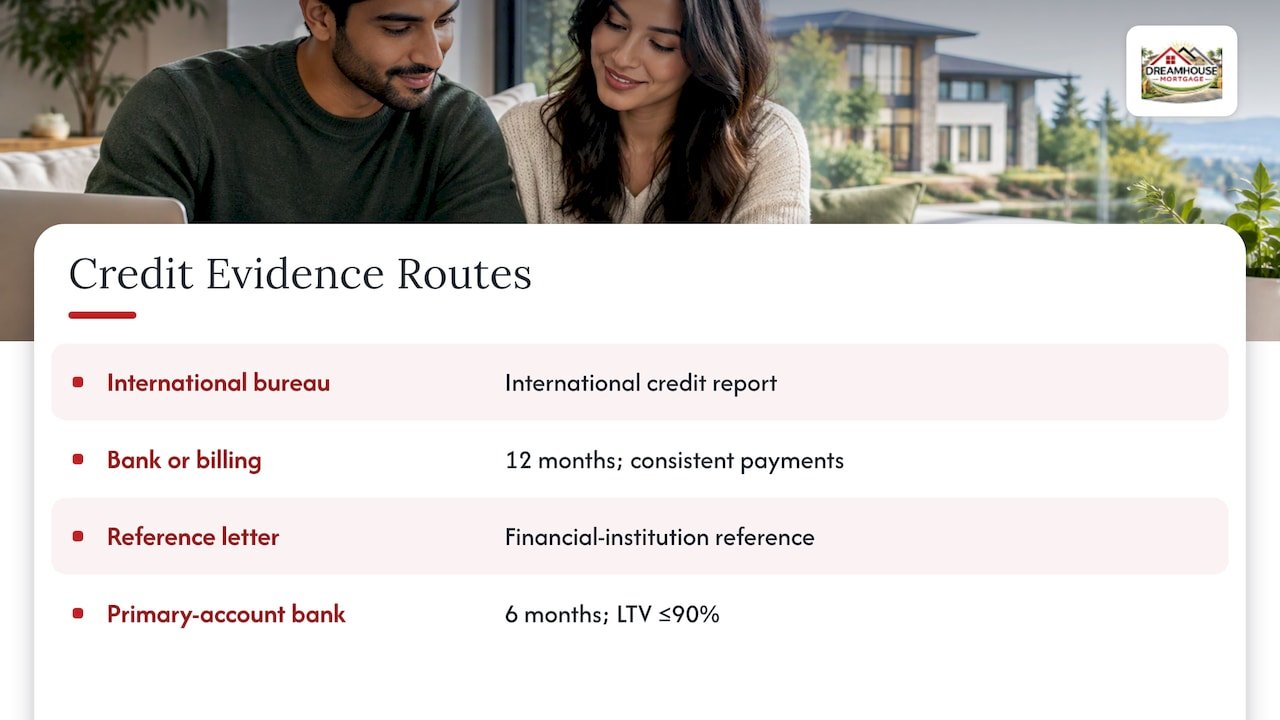
Sagen’s program lets qualified buyers who immigrated or relocated to Canada purchase with as little as 5% down. Without a sufficient Canadian credit report, creditworthiness can be established through an international credit bureau, 12 months of bank or billing statements showing consistent payments, a financial-institution reference letter, or, at 90% loan-to-value or less, six months of primary-account bank statements.
Canada Guaranty Maple Leaf Advantage
Canada Guaranty’s Maple Leaf Advantage (page updated November 2025) offers new immigrants with limited documented credit history a purchase with as little as 5% down on the first $500,000, plus 10% on the portion from $500,000 to $1,000,000. It requires permanent resident or landed immigrant status, or a valid work permit. It lists four credit options:
- An international credit bureau report.
- 12 months of Canadian rental history plus a Canadian utility.
- 12 months of verifiable bank statements from a Canadian or country-of-origin institution (six months at 90% loan-to-value or less).
- A country-of-origin bank reference letter confirming at least six months of satisfactory banking.
A February 2024 lender update widened the bank statement and reference letter options so they can be used at 95% loan-to-value, which means a 5% down payment.
Side by side
| CMHC Newcomers | Sagen New to Canada | Canada Guaranty Maple Leaf Advantage | |
|---|---|---|---|
| Minimum down payment | From 5% | As little as 5% | 5% on first $500,000, 10% up to $1,000,000 |
| Foreign credit options | International credit report, home-country bank reference letter, alternative methods | International bureau, 12 months of statements, bank reference letter, six months of statements at 90% LTV or less | International bureau, rent plus utility, bank statements, bank reference letter |
| Status | Permanent or non-permanent residents, no minimum residency | Work permit or permanent residency | Permanent resident, landed immigrant or valid work permit |
The programs overlap but do not match line for line. A document that satisfies one insurer’s policy may not be the one a particular lender submits, so the order in which your file is built matters.
Down Payment, Ratios and the Qualifying Rate
The credit question is only half of the approval. The numbers still have to work.
Down payment. The CMHC fact sheet sets minimum equity at 5% of the first $500,000 of lending value and 10% of the remainder for 1 to 2 unit purchases. It caps the purchase price at $1,000,000 if the loan-to-value is 80% or less, and $1,500,000 if it is above 80%.
Worked example. Suppose you are buying a $700,000 townhouse in Airdrie:
- 5% of the first $500,000 = $25,000
- 10% of the remaining $200,000 = $20,000
- Minimum down payment = $45,000
That is before closing costs, which you should plan for separately. For a closer look at how a down payment can be sourced and documented, see our guide to mortgage down payment types in Canada.
Debt ratios. Maximum gross debt service (GDS) and total debt service (TDS) ratios are 39% and 44%. GDS is the share of your gross income that goes to housing costs. TDS adds your other debts to that.
Qualifying rate. Insurers calculate those ratios at the greater of your contract rate plus 2%, or 5.25%. For illustration only, a contract rate of 4.00% would be tested at 6.00%, and any contract rate below 3.25% would be tested at 5.25%. Rates move constantly, so your own quote is the only number that counts.
Foreign Debts and Foreign Income
Two rules catch newcomers off guard. Sagen requires that all debts held outside Canada be included in your total debt servicing ratio, and Canada Guaranty includes foreign debts in its qualification ratios. Both exclude rental income earned outside Canada from the ratios. If you carry a student loan or a car loan in your home country, plan for it to count against you.
Both programs also require that every borrower be permitted to purchase under the federal Prohibition on the Purchase of Residential Property by Non-Canadians Act. Foreign diplomats and other foreign appointed individuals who do not pay Canadian income tax are not eligible.
If your income is paid from outside Canada, how it is documented and taxed matters a great deal. Our foreign income mortgage approval examples show how different income situations are presented to lenders in Alberta.
Moving Your Down Payment to Canada
A clean paper trail for the down payment is as important as the credit file. Lenders want to see where the money came from and how it arrived, and funds that appear in your account without a history raise questions. Keep statements from the sending account, the wire or transfer confirmation, and the exchange rate used. If you are converting a large sum, a Canadian currency exchange comparison shows rates, fees and registration status for providers across the country, which helps you choose a registered provider before you move the money.
Avoid moving funds in many small pieces over several weeks, and avoid cash deposits. Both make the source harder to document. Your broker can tell you which statements a lender will ask for before you send anything.
What About Non-Residents?
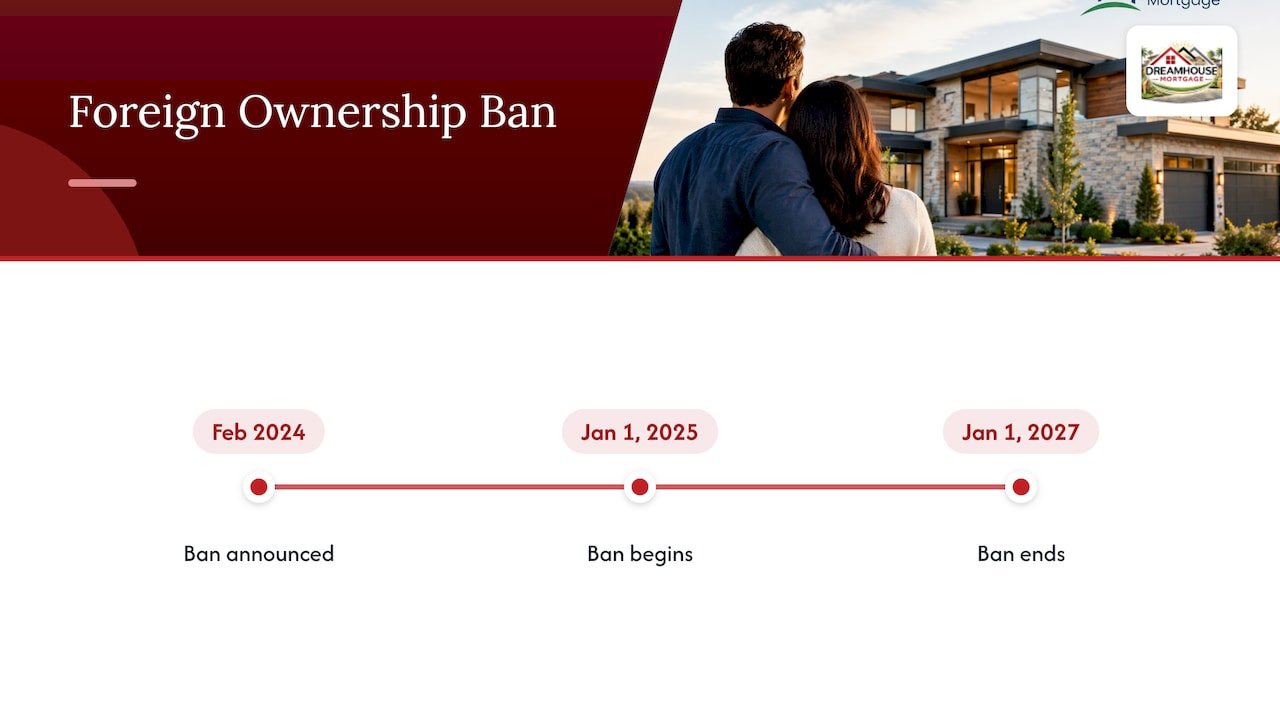
Being new to Canada is different from being a non-resident, and the difference is legal as well as financial. The federal government extended the ban on foreign ownership of Canadian housing, announcing in February 2024 that it would run from January 1, 2025 to January 1, 2027. Under it, people who are not Canadian citizens or permanent residents, and foreign commercial enterprises, are prohibited from purchasing residential property in Canada, subject to the exemptions in the regulations. Work permit holders are one of the groups with an exemption, which is why the insurer programs above name a valid work permit as an eligible status.
Because the rules can be amended or extended, confirm the current position with the Department of Finance and a lawyer before committing to a purchase. If you are planning to move and want to understand the mortgage side from abroad, our page on non-resident mortgages in Canada explains how we approach it.
How to Prepare Your File, Step by Step
1. Confirm your status and eligibility
Permanent residents, and people with a valid work permit, are the groups the insurer programs name. Know exactly which category you are in, and have your documents ready. Where the purchase restriction could apply to you, get legal advice first.
2. Request your home-country credit report
Ask your bank or the credit bureau in your country of origin for a current report, and a reference letter on the bank’s letterhead confirming how long you have held your account and that it has been satisfactory. Some institutions take weeks to issue these, so start early. Foreign-language documents generally need an English or French translation.
3. Start building Canadian credit immediately
Open a chequing account and a credit card, and pay on time. Canadian activity that shows 12 months of rent or utilities can also serve as alternative credit under some insurer options. Our guide to the credit bureau mortgage application explains how a Canadian file is read.
4. Gather your pre-approval documents
Expect to provide identification, immigration documents, proof of income, notices of assessment if you have filed in Canada, and down payment history. Our Alberta pre-approval requirements checklist lists them.
5. Get pre-approved before you shop
A pre-approval tells you the price range you can work in, whether Calgary, Cochrane or Airdrie fits your budget, and how the lender will treat your foreign credit. Because different lenders apply different policies to foreign credit, comparing them before you apply is worth more than applying to one and waiting. Our Calgary pre-approval page explains the process.
6. Make an offer with your numbers settled
Once you have an accepted offer, your lender orders the appraisal and the insurer confirms the file. In Calgary, an appraisal that comes in below the price can change the deal, which is covered in our note on preapproval versus approval.
Where Calgary Newcomers Tend to Buy
Newcomers to Alberta often look at a few areas first. Calgary offers condos, townhouses and detached homes across many communities. Airdrie and Cochrane draw buyers who want more space within commuting distance, and Chestermere appeals to those who want a lake-community setting. The insurer limits described above, including the price caps, apply regardless of city, so a quick check of your target price against the $1,000,000 and $1,500,000 limits tells you which programs fit. We serve all of these communities, as well as Okotoks, High River, Rocky View County, Edmonton and Red Deer.
If you are also a first-time buyer, federal programs such as the FHSA and Home Buyers’ Plan may apply to you. See our guide to first-time home buyer benefits in Canada for how they work.
Our Perspective
Newcomers often arrive with years of strong financial history that Canada’s bureaus cannot see. The most common mistake we see in that situation is applying to one bank, hearing that there is no file, and assuming the answer is no. It is not. Insurers publish clear alternatives, and the work is choosing the lender whose policy fits your documents.
As a Calgary brokerage, we work with banks, credit unions, monoline lenders, alternative lenders and private lenders. That access matters most when your file is not standard, because the same foreign credit record can be treated differently from one lender to the next. Our job is to match your documents to the right policy, prepare the file so that it is complete the first time, and explain each step so there are no surprises at funding.
We founded DreamHouse Mortgage in 2013 on a simple idea: clients should understand their mortgage, not just receive one. If you are new to Canada and buying in Calgary, Airdrie or Cochrane, bring us your documents and we will show you what is possible.
Guriqbal Chahal, MBA, PMP
Talk to a Calgary Mortgage Broker About Your Foreign Credit
If you are buying your first home in Calgary, Airdrie, Cochrane or Chestermere and your credit history is mostly outside Canada, we can review your documents, explain which insurer program fits and prepare a pre-approval. Our New to Canada mortgage service and first-time buyer mortgage support cover lender selection, document collection, approvals and funding coordination.

Call Guriqbal Chahal, MBA, PMP, Mortgage Broker, at 403-966-6072. You can also find us on our Google Business Profile, or start at dreamhousemortgage.ca.
FAQ
Can I get a mortgage in Canada with no Canadian credit history?
Yes. CMHC’s Newcomers program has no minimum residency requirement, and both Sagen and Canada Guaranty list alternatives to a Canadian credit report, such as international credit reports, bank statements and home-bank reference letters. Which documents work depends on the lender and your down payment.
How much down payment do I need as a newcomer?
The insurer programs start at 5% of the first $500,000 of the purchase price and 10% of the portion above that, up to the program’s price cap. On a $700,000 home, that is $45,000. Conventional mortgages without insurance need 20% down.
Does my foreign credit score count in Canada?
Not automatically. Canadian bureaus only hold Canadian activity, but some lenders will look at a credit report from another country. A broker can tell you which lenders and insurer options will use yours.
Do my debts back home affect my approval?
Yes. Sagen and Canada Guaranty both include debts held outside Canada in the debt ratios. Rental income earned outside Canada is excluded from those ratios.
Can I buy if I am not yet a permanent resident?
It depends on your status. Valid work permit holders are named as eligible in the insurer programs, but the federal ban on foreign purchases applies to people who are not citizens or permanent residents, with exemptions. Check your own situation with a lawyer before making an offer.
Sources
- Credit report and score basics, Financial Consumer Agency of Canada
- Newcomers: Buying a home in Canada, IRCC
- CMHC Newcomers program
- CMHC Newcomers fact sheet (2019)
- CMHC Newcomers fact sheet (2025)
- Sagen New to Canada Program
- Canada Guaranty Maple Leaf Advantage
- Canada Guaranty Lender Update, February 5, 2024
- Department of Finance Canada: extension of the foreign ownership ban
- Currency exchange in Canada by city