
A prepayment privilege is the amount you may put toward your mortgage on top of your regular payments each year without paying a penalty. If you are buying your first home in Calgary, Airdrie or Cochrane, the size and rules of that privilege vary from lender to lender, and they decide how cheaply you can pay the mortgage down or leave it later. Comparing them before you sign is part of choosing a mortgage, not an afterthought. At DreamHouse Mortgage we compare lender options for first-time buyers across Calgary and surrounding communities, and you can reach Guriqbal Chahal directly at 403-966-6072.
TL;DR
- A prepayment privilege lets you pay extra on a closed mortgage, through lump sums or higher regular payments, without a penalty, up to a limit set in your contract.
- Many lenders cap the yearly amount at a percentage of the original mortgage, often 10% to 25%, and unused room generally does not carry over to the next year.
- Going past the limit, breaking the mortgage or selling mid-term can trigger a penalty, usually the higher of three months’ interest or the interest rate differential (IRD).
- Compare the privilege terms as carefully as the rate, because a slightly lower rate with a tight privilege can cost more over a five-year term.
- Raising your payment is usually a one-way move: once you increase it, you generally cannot lower it again until the term ends.
Table of Contents
- What a prepayment privilege actually is
- The common types of privilege
- A worked example for a Calgary first-time buyer
- How extra payments cut interest
- When a prepayment penalty applies
- What lenders must tell you
- Prepayment privileges and your first-home plan
- How to compare privileges before you sign
- Is there a downside to prepaying early?
- Our perspective
- Get the terms compared for your purchase
- FAQ
- Sources
What a prepayment privilege actually is
A closed mortgage is a contract for a fixed term, commonly five years. In exchange for the lower rates closed mortgages tend to carry, the lender limits how much extra you can pay before a charge applies. The Financial Consumer Agency of Canada (FCAC) defines the prepayment privilege as the amount you can put toward your mortgage in addition to your regular payments, either by increasing payments by a set percentage or by making lump sums up to a set amount or percentage of the original mortgage, without a prepayment penalty.
Two things people mix up:
- Using your privilege is extra payment inside the allowed limit. It costs nothing in penalties and lowers your balance.
- Prepaying beyond it means paying more than the allowed amount, paying off the whole mortgage before the term ends (including when you sell), or breaking the contract. That is where a prepayment penalty can apply. An open mortgage is the exception: it can be prepaid or paid off without a penalty, though it normally carries a higher rate.
You can find the wording in your mortgage agreement. The FCAC explains that federally regulated lenders such as banks must set out prepayment privileges and charges in a single, prominently displayed information box, and explain how prepayment charges are calculated. Ask to see that box before you commit.
The common types of privilege
Most privileges come in two forms, and many mortgages offer both.
Lump-sum prepayments
A lump sum is a one-time extra payment applied straight to the principal. It might come from a tax refund, a bonus, a gift from family or savings you have built after closing. Lenders usually express the limit as a percentage of your original mortgage amount per year, and they may restrict when in the year you can make it, such as only on your payment date or only on the anniversary of your mortgage.
Payment increases
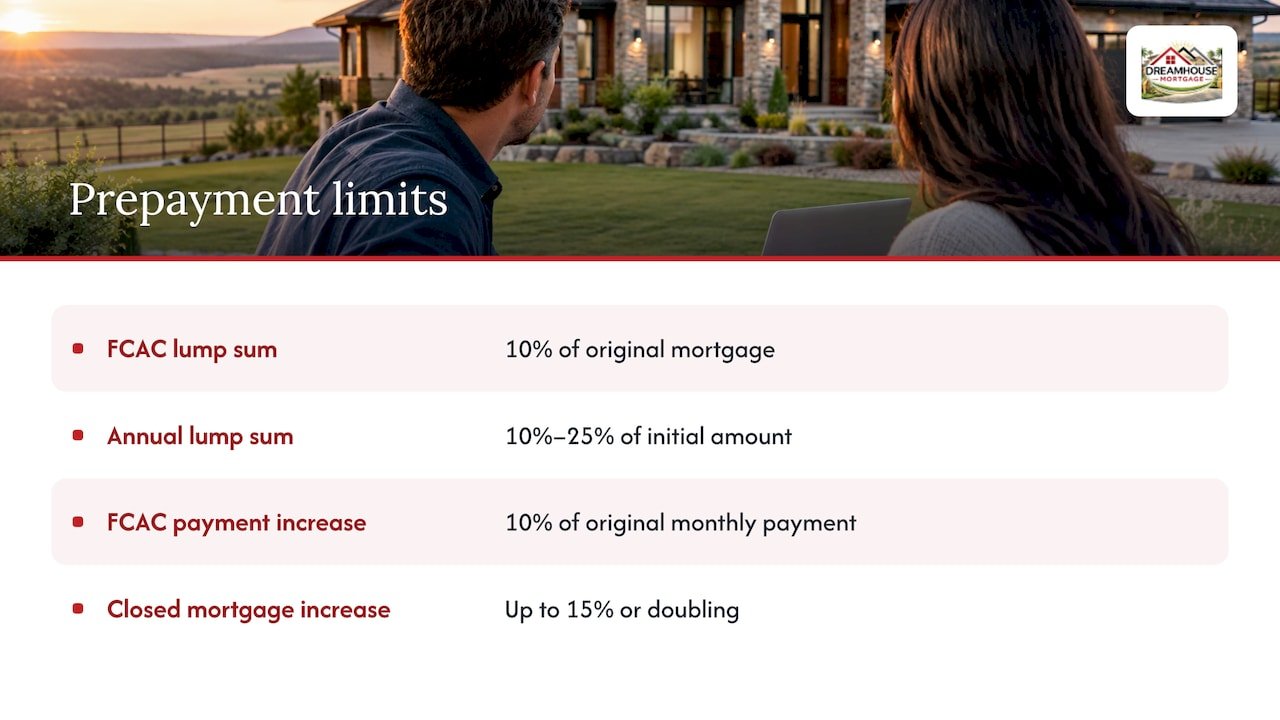
You can raise your regular payment by a set percentage. The FCAC’s example information box for a variable-rate, fixed-amount mortgage shows a “10+10” privilege: once per year, without penalty, you may increase your monthly payment by 10% of the original payment and also pay a lump sum of 10% of the original mortgage amount.
That is an example of the format, not a promise of what every lender offers. Quebec’s financial regulator, the AMF, notes that on closed mortgages some contracts allow payment increases of up to 15% or even doubling payments, and that institutions generally limit annual partial prepayments to between 10% and 25% of the initial amount borrowed, with penalties that can be quite high if exceeded. The figures are a useful range for the whole country, since the structure is similar in Alberta.
Rules that catch buyers out
The FCAC says most lenders limit the allowed prepayment per year, and you typically cannot carry unused room forward. If you skip a year, you do not get to double up the next. The FCAC’s “know your rights” page also tells borrowers to understand when and how many times they can prepay without penalty. Check these four points in every offer:
- The yearly lump-sum limit and what it is a percentage of (original amount or current balance).
- The payment-increase limit.
- The dates on which a lump sum is allowed.
- Whether a higher payment can be reduced later. Generally it cannot until the term ends.
Pro Tip: Ask whether the percentage applies to your original mortgage amount or your outstanding balance. On the same percentage, the original amount gives you more room every year.
A worked example for a Calgary first-time buyer
Here is a hypothetical purchase. A couple buys a home in Airdrie and takes a $450,000 mortgage with a lender whose privilege is 15% lump sum per year on the original amount, plus a 15% payment increase.
- Yearly lump-sum room: 15% of $450,000 is $67,500. That is the most they could add in a year without a penalty.
- What they actually do: they put their $3,000 tax refund and a $2,000 work bonus toward the principal each spring, $5,000 in total. That is far inside the limit.
- What a tighter privilege means: a 10% lump-sum limit gives $45,000 of room. Both are generous for most households, so the more important question is whether the dates and the payment-increase rules suit how you actually get your money.
This arithmetic shows why a first-time buyer rarely needs the largest privilege on the market. What matters is that the privilege fits your cash flow, and that the penalty rules are clear if your plans change.
How extra payments cut interest
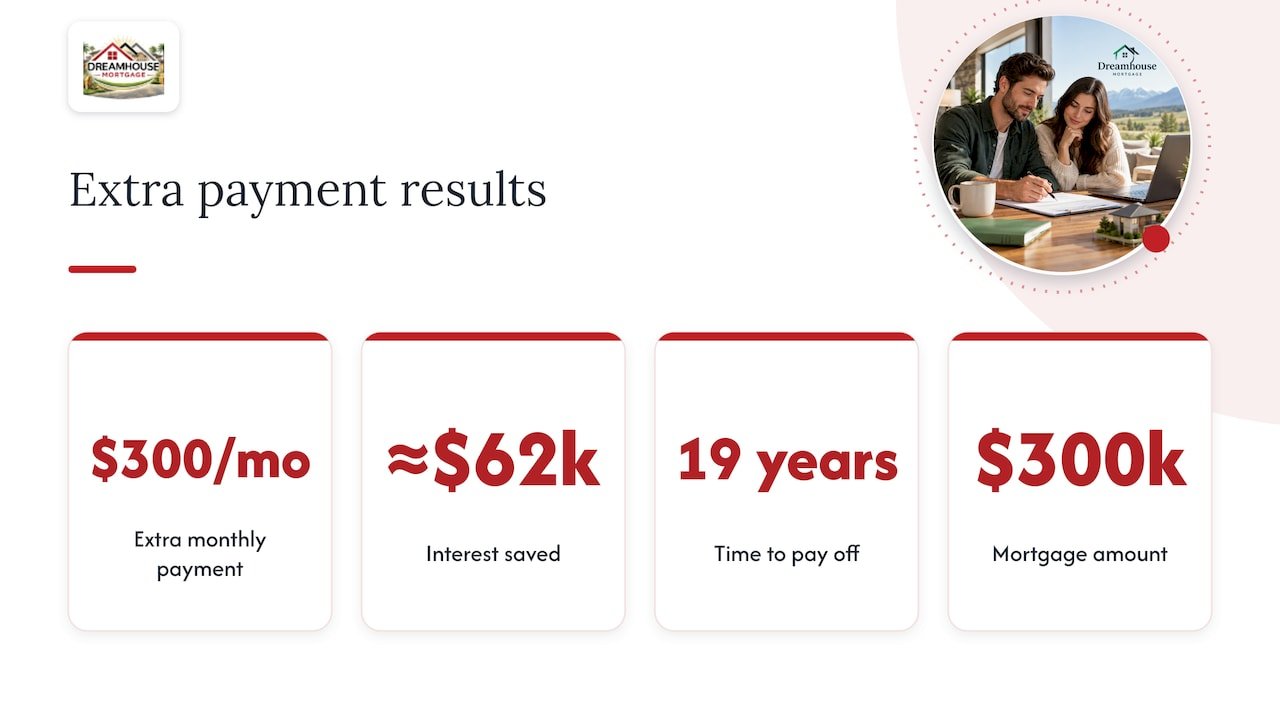
Every dollar you prepay reduces the balance on which future interest is calculated, so earlier prepayments save more. Forbes Advisor Canada’s calculation shows the scale: on a $300,000 mortgage at 4.5% over 25 years, an extra $300 a month saves almost $62,000 in interest and pays the home off in 19 years. Your numbers will differ with your rate and amortization, so run your own figures.
The same article is careful to say the pay-down-versus-invest decision depends on rates and personal goals. Extra mortgage payments give you a certain return equal to your mortgage rate, while investing is not certain. Many buyers split extra money between the mortgage and an emergency fund, and use the privilege in the years when cash is available.
If you want practical ways to organize extra payments, our guide on paying down your mortgage faster in Alberta covers the routines, and the comparison of bi-weekly and monthly payments in Alberta shows how payment frequency changes the picture. Amortization choices matter too: see mortgage amortization options in Canada.
When a prepayment penalty applies
The FCAC says a lender may charge a penalty if you pay more than the allowed additional amount, break the contract, transfer the mortgage to another lender before the term ends, or pay off the whole mortgage early, including when you sell. The penalty is usually the higher of three months’ interest or the interest rate differential. The IRD is typically used when your rate is higher than the current rate and you signed less than five years ago.
Here is a simple illustration with round numbers:
| Item | Figure |
|---|---|
| Balance owing | $200,000 |
| Your contract rate | 6% |
| Time left in term | 36 months |
| Lender’s current 36-month rate | 4% |
| Three months’ interest | about $3,000 |
| IRD (2% gap on $200,000 for 3 years) | about $12,000 |
| Penalty (the higher figure) | about $12,000 |
Lenders calculate the IRD in different ways, and some use their posted rates rather than the rate they actually offer, which can widen the gap. That is why the exact formula in the contract matters. We explain the mechanics in our guides on the IRD penalty in Canada and the five inputs to request in a Calgary payout statement.
Ways to reduce or avoid a penalty
The FCAC suggests three approaches:
- Use your full privilege every year, so any future penalty is based on a smaller balance.
- Make a lump-sum prepayment before breaking the mortgage, since some lenders restrict prepayments close to the break date.
- Wait until the end of the term to prepay if the penalty would be large.
If your renewal is coming up, start early. Our page on avoiding Calgary mortgage renewal penalties explains why four months ahead is a sensible starting point.
What lenders must tell you
You are entitled to clear information. The FCAC’s Code of Conduct page says federally regulated lenders must disclose prepayment privileges that let you pay faster without a charge, along with an explanation of how the prepayment charge is calculated. Provincially regulated lenders such as credit unions follow their own rules, so read their disclosure just as closely.
The FCAC also states that banks have had to show prepayment options in an information box at the start of the agreement since January 2010. When you receive a mortgage commitment, go straight to that box and compare it against the other offers you hold.
Prepayment privileges and your first-home plan
First-time buyers in Calgary often use their privilege differently from long-time owners. These are typical situations:
- Tight first years. After closing costs, furniture and moving, there is usually little spare cash. A mortgage with a flexible lump-sum date can be more useful than one with a huge limit you will not touch.
- Variable income or commission. If your pay arrives in bursts, a lump-sum privilege suits you better than a higher regular payment you cannot lower later. If you work for yourself, our self-employed mortgage guide for Calgary covers how lenders view your income.
- Planning to move within five years. Many buyers upgrade, which means selling mid-term. Ask about portability, which lets you take your mortgage and rate to a new property, and read the penalty calculation closely. Mortgage portability is one of the services we offer.
- Government savings. If you are using a First Home Savings Account, the Home Buyers’ Plan or the GST rebate, see our guide to first-time home buyer benefits in Canada. Your down payment source also shapes the mortgage; read about down payment types.
How to compare privileges before you sign
Here is a practical routine to follow with every quote.
- Ask for the privilege terms in writing alongside the rate. Rate, lump-sum limit, payment-increase limit and allowed dates should all sit on one page.
- Note the penalty formula. Ask how the IRD is calculated and which rate the lender uses as the comparison.
- Test the payment-increase limit against your budget. Because an increased payment generally cannot be reduced during the term, only raise it by an amount you can sustain.
- Match the terms to your five-year plan. A move, a renovation, a growing family or a change in income can all change which terms are valuable.
- Check portability and renewal terms. These shape what happens if you sell or switch lenders.
The work is easier when one broker compares several lenders for you. We have access to banks, credit unions, monoline lenders, alternative lenders and private lenders, and we help with lender selection and rate comparisons, so you see the privilege terms side by side rather than shopping one institution at a time.
For the buying process itself, start with the first-time homebuyer mortgage guide for Calgary and the pre-approval requirements checklist for Alberta.
Is there a downside to prepaying early?
The main cautions are practical. Money placed in your home is less accessible for emergencies, so most advisers suggest keeping an emergency fund before making large lump sums. Fidelity’s May 2026 article recommends a balanced approach between paying down the mortgage and investing, keeping some cash available. And Forbes Advisor Canada notes that the right balance depends on your rate and expected returns, so a blanket rule does not fit everyone.
The useful way to treat privileges: they are a flexible tool. Use them in years when cash is available, keep your reserve, and choose a mortgage whose terms support that approach.
Our perspective
When we sit down with first-time buyers in Calgary, Airdrie, Cochrane and Chestermere, the conversation usually starts with the rate. We think it should start with how you plan to live with the mortgage for the next five years.
A privilege is only valuable if it matches your life. If you expect bonuses, a tax refund or a family gift, a generous lump-sum limit helps. If your income is steady, a payment-increase option may fit better. If a move is possible, portability and the penalty formula deserve as much attention as the rate.
Because we work with banks, credit unions, monoline, alternative and private lenders, we can set these terms next to each other and explain them in plain language. Our approach is client-first: you should understand every term before you sign, and you should have a plan for using your privileges, not just a number on a page.
Guriqbal Chahal, MBA, PMP
Get the terms compared for your purchase
If you are preparing to buy in Calgary or the surrounding communities, we can start with a mortgage pre-approval and review the prepayment terms of the lenders that fit your situation. Our first-time buyer mortgage service covers qualification, lender selection, document collection and funding coordination.

Call Guriqbal Chahal, MBA, PMP, Mortgage Broker, at 403-966-6072. You can also find us on our Google Business Profile.
FAQ
What is a prepayment privilege on a Canadian mortgage?
It is the amount you can pay on top of your regular payments without a prepayment penalty, either as lump sums or through higher regular payments. The limits are set by your lender and written into your mortgage agreement. Federally regulated lenders must show them in an information box.
Can I carry over unused prepayment room to next year?
Generally no. The FCAC notes that most lenders limit the yearly amount and that unused room typically does not carry forward. If you skip a year, you cannot double the next year’s prepayment.
When does a prepayment penalty apply?
A lender may charge one if you pay beyond your allowed amount, break the contract, transfer to another lender before the term ends, or pay off the whole mortgage early, including when you sell. The charge is usually the higher of three months’ interest or the interest rate differential. An open mortgage can be paid off without a penalty.
Can I lower my payment after increasing it?
Usually not until the end of the term. The FCAC’s guidance notes that once you raise your regular payment, you normally cannot reduce it again during the term, so choose an increase you can keep up.
Is a bigger prepayment privilege always better?
Not necessarily. The best privilege is the one that fits when and how you will have extra money, and that comes with a clear penalty formula. Comparing the full terms with your broker helps you decide which combination of rate and flexibility suits your plans.
Sources
- Mortgage fees: Prepayment penalties, Financial Consumer Agency of Canada
- Mortgage prepayment: know your rights, Financial Consumer Agency of Canada
- Getting a mortgage: know your rights, Financial Consumer Agency of Canada
- Information box example for a variable-rate fixed-amount mortgage, Financial Consumer Agency of Canada
- Code of Conduct for Federally Regulated Financial Institutions: mortgage prepayment information, Financial Consumer Agency of Canada
- Mortgage features, Autorité des marchés financiers
- Pay Off Your Mortgage or Invest: What Does The Math Say?, Forbes Advisor Canada
- Why paying off your mortgage early might be a mistake, Fidelity Canada