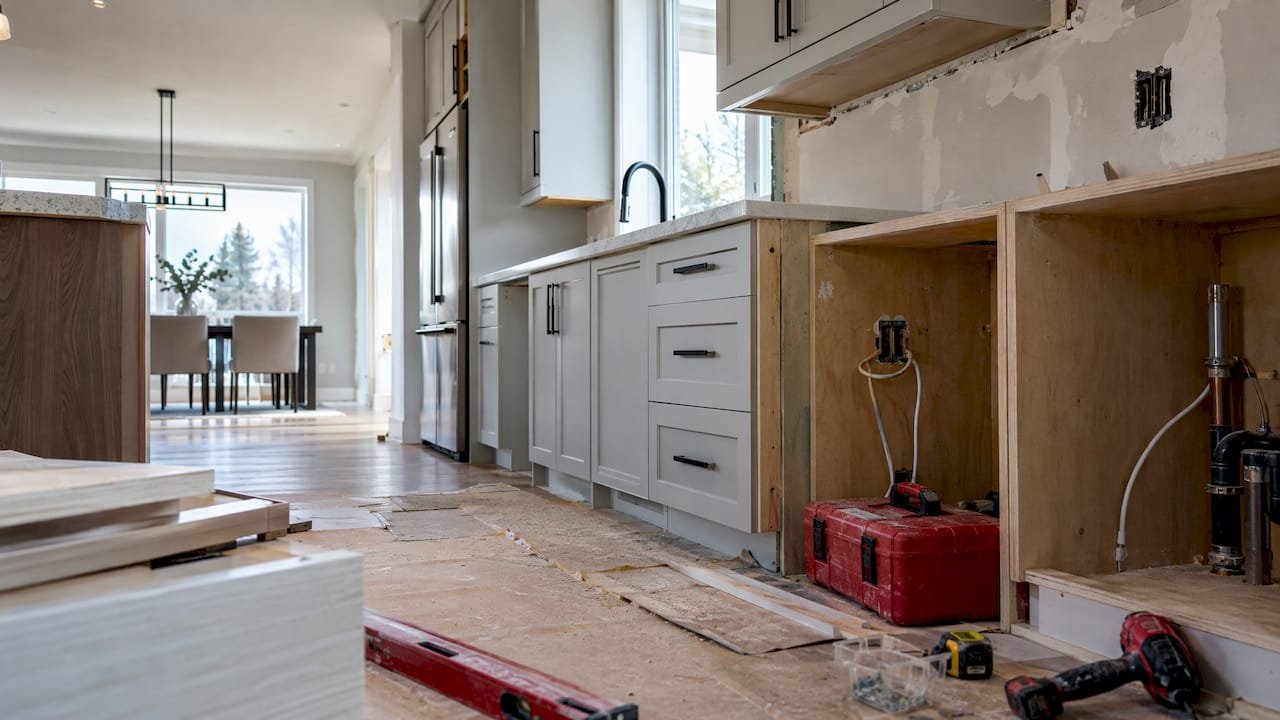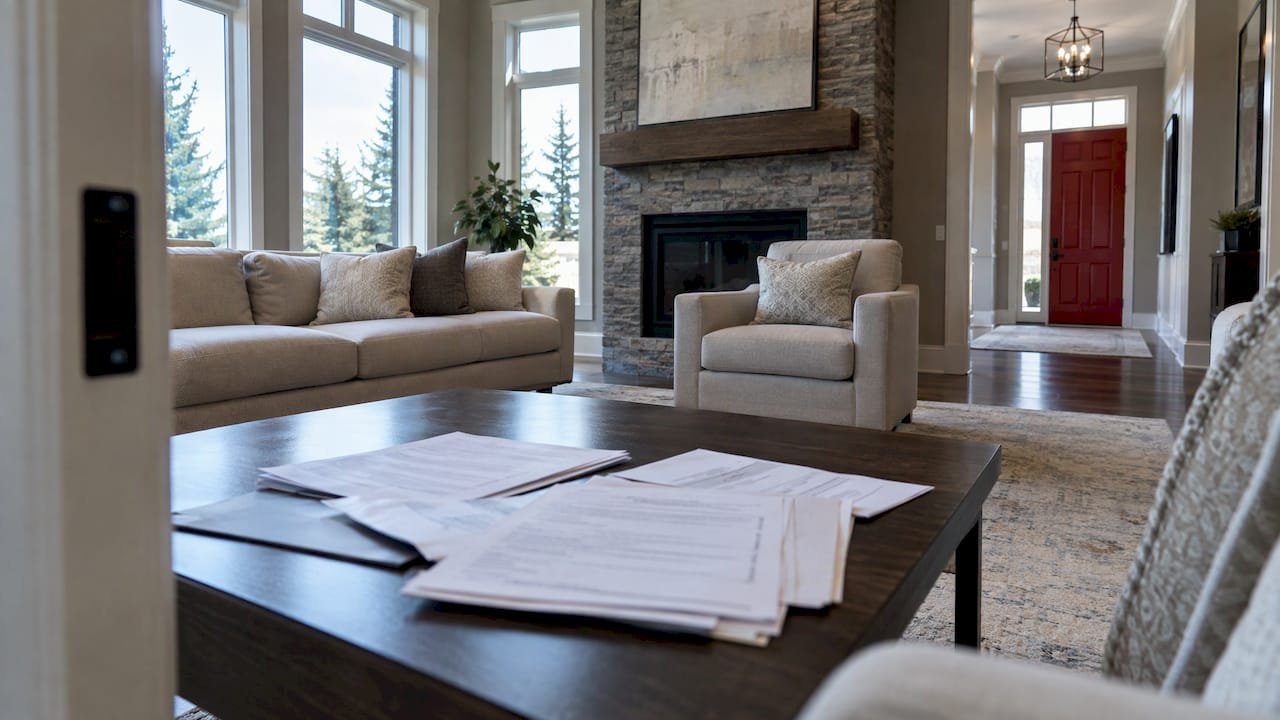
Refinancing for renovations in Alberta means replacing your current mortgage with a new, larger one and receiving the difference in cash to pay for the work. You borrow against the equity you have built, and the project is paid for at mortgage rates over a mortgage amortization, not on a credit card. For many homeowners in Calgary, Airdrie, Cochrane and Chestermere, it is the most structured way to fund a basement development, a kitchen or a full interior update. It only makes sense when the numbers hold up, so this guide walks through the math, the qualification rules, the costs and the steps.
TL;DR
- A renovation refinance replaces your existing mortgage with a new one for a higher amount, and the extra funds go toward your project.
- Uninsured refinances at federally regulated lenders generally cap at 80% of your home’s value, so the usable amount depends on your appraised value and what you still owe.
- Expect a stress test, debt service ratio limits, an appraisal, legal fees and possibly a prepayment penalty for breaking your term early.
- A refinance suits a defined, larger budget. A home equity line of credit (HELOC) or second mortgage can suit staged spending, so compare the total cost of each.
- A mortgage broker can compare banks, credit unions, monoline and alternative lenders for you. Call Guriqbal Chahal at 403-966-6072.
Table of Contents
- How Refinancing Pays for a Renovation
- How Much Equity You Can Access
- What Alberta Lenders Look For
- Fees and Penalties to Plan For
- Refinance, HELOC or Second Mortgage
- Renovations That Often Justify Refinancing
- How to Apply: Step by Step
- Calgary, Airdrie and Cochrane: Local Notes
- Is Refinancing Worth It for Your Budget?
- Our Perspective
- Talk to a Calgary Mortgage Broker About Your Renovation
- FAQ
- Sources
How Refinancing Pays for a Renovation
Your home equity is the difference between what the property is worth and what you owe on it. When you refinance, a lender appraises the home, sets a new mortgage amount against that value, pays out your existing mortgage and sends you the balance. That balance becomes your renovation fund.
CMHC, Canada’s national housing agency, notes that refinancing may offer advantages for major renovations, including access to a better interest rate than you would typically get on a credit card or personal loan. It also says set-up costs apply, which is why the comparison matters.
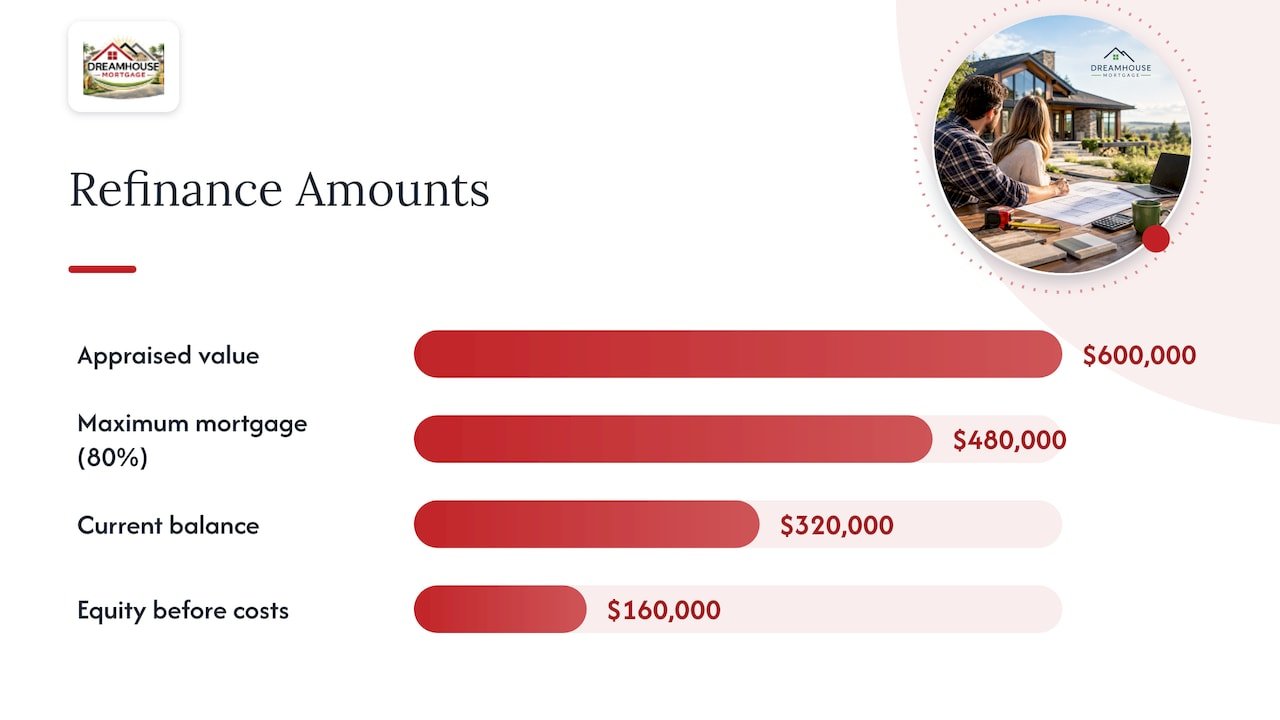
Here is a simplified example. Suppose a home in Calgary’s northwest appraises at $600,000 and you owe $320,000.
| Item | Amount |
|---|---|
| Appraised value | $600,000 |
| Maximum new mortgage at 80% | $480,000 |
| Current mortgage balance | $320,000 |
| Equity available before costs | $160,000 |
The $160,000 is a ceiling, not a promise. Your income, debts, credit history and the lender’s appraisal decide what you actually qualify for. The costs of refinancing also come out of the amount you receive or get added to the new mortgage.
Pro Tip: Get your contractor’s written quote before you apply. A lender and a broker can size the refinance to the real project cost plus a contingency, so you do not borrow too little and then need a second round of financing midway through the work.
How Much Equity You Can Access
For a standard refinance at federally regulated lenders, the maximum loan-to-value (LTV) is generally 80%. That means you keep at least 20% equity in the home. Three things move the number:
- Appraised value. Lenders rely on their own appraisal, which can differ from a listing price or a neighbour’s sale. Calgary communities such as Tuscany, Mahogany, Evergreen and Cranston can see different values from one street to the next.
- Remaining balance. The more you have paid down, the more room you have.
- Your qualifying profile. Even with equity, your income and debts must support the new payment.
Some private and alternative lenders will consider different LTV limits and flexible income documentation. Those options usually come with higher rates and fees, so they are best used with a plan to move back to a conventional lender later. Your broker can tell you which situations call for that.
If you want a closer look at how equity access works in the province, our page on home equity refinancing options for Alberta homeowners goes through the structures lenders offer.
What Alberta Lenders Look For
Lenders assess a renovation refinance the way they assess any mortgage: can you carry the new payment, and is the property enough security for the loan?
Stress test and debt ratios
Canada Guaranty, a mortgage insurer, publishes guidelines for its insured refinance-to-add-secondary-suites program. In that guide, borrowers must qualify at the greater of the contract rate plus 2%, or 5.25%. The same guide caps gross debt service (GDS) at 39% and total debt service (TDS) at 44%. Those figures describe that specific insured program, and conventional refinances at individual lenders can use their own policies, but they show the kind of ratios lenders work with.
In plain terms:
- GDS is the share of your gross income that goes to housing costs: mortgage payment, property tax and heating.
- TDS is GDS plus your other debt payments, such as car loans, credit cards and lines of credit.
- The stress test checks that you could still afford the payment if rates were higher than your actual contract rate.
Documents you should expect to provide
- Recent pay stubs and a letter of employment, or two years of Notices of Assessment if you are self-employed
- Your current mortgage statement and the most recent property tax bill
- Void cheque or banking information
- A written renovation quote or scope of work
- Photo ID and details of your debts
Self-employed homeowners in Calgary and Airdrie often qualify through lenders that look at stated or averaged income. Bring your documents early, because a complete file moves faster.
Pro Tip: Pay down or close unused credit cards before applying. A smaller reported balance lowers your TDS and can improve how lenders view your file.
Fees and Penalties to Plan For
This is where a refinance can look cheaper on paper than it is in practice. Budget for each of these.
Prepayment penalty
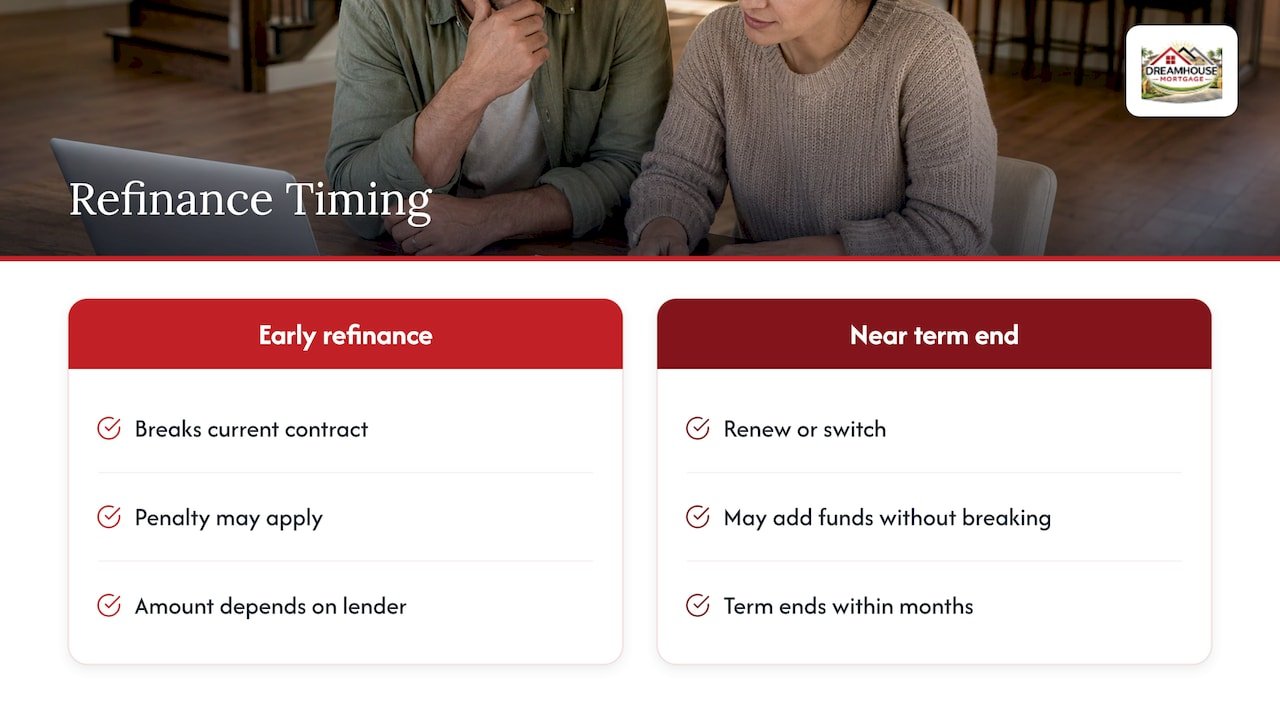
If you refinance before your term ends, you are breaking the current mortgage contract, and your lender may charge a penalty. The Financial Consumer Agency of Canada explains how mortgage prepayment penalties work and how to reduce them. Fixed-rate mortgages commonly carry larger penalties than variable-rate ones, and the amount depends on your lender’s contract. Ask your lender for a written payout statement before you commit.
One way to avoid the penalty is timing. If your term ends within the next few months, a renewal or switch may let you add funds without breaking anything. See our mortgage renewal page for how that works.
Appraisal, legal and other costs
Expect these typical items:
- Appraisal fee, which the lender may arrange or reimburse in some cases
- Lawyer or notary fees to register the new mortgage and discharge the old one
- Title insurance, if required
- Mortgage discharge and registration charges
- Possible lender or broker fees on non-conventional files
We break these down for the Calgary market in our guide to refinance closing costs. Treat any single dollar figure as an estimate, and ask for a full list in writing before you sign.
Interest over a longer period
Because the renovation money is spread across your mortgage amortization, a lower rate can still cost more in total interest if you pay it down slowly. Many homeowners handle this by making accelerated payments or lump sum prepayments when the lender allows. Our tips on how to pay down your mortgage faster cover practical ways to do it.
Refinance, HELOC or Second Mortgage
A refinance is one of three common ways to tap equity. Which fits depends on when you need the money and how you want to repay.
| Option | How you receive funds | Best suited to | Points to weigh |
|---|---|---|---|
| Refinance | One lump sum added to a new mortgage | A defined, larger project with a clear quote | Possible penalty and legal costs; resets your term and rate |
| HELOC | Revolving credit you draw as needed | Work done in stages | Variable rate; interest-only minimum payments can slow repayment |
| Second mortgage | Separate loan behind your first mortgage | Keeping a low-rate first mortgage intact | Usually a higher rate and fees than a first mortgage |
The general split is that a refinance gives a lump sum while a HELOC gives revolving, reusable access, so a refinance is typically used for a defined larger cost and a HELOC for staged spending. Whichever you consider, compare the total cost: the rate, the fees and the debt you carry afterward, rather than assuming one is always cheaper.
Our page on second mortgage versus refinance shows how this plays out for Alberta homeowners, and our home equity loan page explains what lenders require.
When a refinance tends to fit
- Your renovation is large, and the budget is already fixed by quotes.
- Your current mortgage rate is close to today’s rates, or higher, so replacing it costs little in interest.
- You also want to consolidate higher-interest debts into the same mortgage. See our debt consolidation mortgage guide.
- You want a fixed payment schedule rather than a revolving line.
When to look at other options
- If you are building a new home or doing a major structural addition on a lot, a construction mortgage with progress draws can be a better match than a lump-sum refinance.
- If you are adding a rental suite or want to keep your existing rate, your broker can review whether a second mortgage or a different structure works.
Renovations That Often Justify Refinancing
Lenders do not restrict what you spend the funds on in a standard refinance, but certain projects tend to be good candidates because they are costly, planned and can add to the home’s long-term value:
- Basement development. Common across Calgary, Airdrie and Cochrane, where many homes have unfinished lower levels.
- Kitchen and bathroom rebuilds. Larger scope, with quotes you can lock in.
- Roof, siding, windows and furnace replacements. Often urgent and costly.
- Legal secondary suites. Check with your municipality about permits and zoning before you budget. Insured programs exist for adding suites, as the Canada Guaranty guide above shows.
- Garage, deck or addition work. Permit costs and timelines matter here.
A permit, a licensed trade and a written scope also help the lender and protect you. Keep every invoice and permit document in one folder.
Pro Tip: Add 10% to 15% to the quote as a contingency. Renovations in older Calgary homes, such as those in Bowness, Forest Lawn or Killarney, can uncover wiring, plumbing or structural surprises.
How to Apply: Step by Step
- Gather your numbers. Know your current balance, rate, term end date and an estimated property value.
- Get renovation quotes. Two or three written quotes give you a realistic target.
- Request a payout statement. Your current lender can tell you the penalty if you break the term.
- Speak with a mortgage broker. A broker reviews your income, debts and equity, then compares lenders that suit your situation.
- Submit documents. A complete package avoids delays.
- Appraisal and approval. The lender confirms the value and issues the commitment, which sets your rate, amount and conditions.
- Legal work. Your lawyer registers the new mortgage, pays out the old one and handles the funds.
- Funding and the project. Funds are released by the lawyer. Some lenders advance money in stages tied to renovation progress, so ask your broker how your lender does it.
Timelines vary by lender and file. Our Alberta refinance timeline outlines what happens from application to funding.
Calgary, Airdrie and Cochrane: Local Notes
Alberta homeowners deal with a few local factors that a general Canadian guide may skip.
- Appraisals vary by community. Established Calgary neighbourhoods and newer communities in Airdrie, Cochrane and Chestermere can appraise differently, so a local broker’s read on current values is useful.
- Acreage and Rocky View County properties. Rural and acreage homes may be assessed under different lender policies than city lots, so tell your broker early.
- Permits. Calgary, Airdrie and Cochrane each have their own permitting process for basement suites and additions. Confirm with your municipality before you finalize the scope.
- Self-employed and energy-sector income. Many Alberta homeowners have variable or commission-based income. A broker can match you with lenders that accept it.
If you are a first-time buyer who plans to renovate a home you are about to buy, review our first-time home buyer mortgage guide for Calgary. CMHC notes that for major renovations on a home you are about to buy, you can consider adding the cost to your mortgage at purchase instead of refinancing later.
Is Refinancing Worth It for Your Budget?
Run through this checklist with your broker before you decide.
- Rate difference. Compare your current rate with the new blended rate on the full mortgage, not just the new money.
- Penalty. Add the penalty to the cost of the project.
- Total fees. Add legal, appraisal and any lender or broker costs.
- Payment change. Check the new monthly payment against your budget with a margin for rate changes at renewal.
- Amortization. Decide whether to keep your remaining amortization or extend it, and what that does to total interest.
- Alternatives. Compare against a HELOC, second mortgage or waiting until renewal.
A broker can model each path side by side, which is much faster than collecting quotes from individual lenders yourself.
Our Perspective
We see the same pattern across Calgary, Airdrie and Cochrane: homeowners decide on the kitchen or basement first and think about financing second. We recommend reversing that order. Start with the mortgage conversation, because the amount you can access, the penalty on your current term and the lender you choose shape what the project can be.
Our view is that a renovation refinance works best when it is planned like any other mortgage: a clear budget, a realistic contingency and a lender chosen for your income type, not just for the lowest advertised rate. Because we work with banks, credit unions, monoline lenders, alternative lenders and private lenders, we can compare structures such as a refinance, a second mortgage or a renewal with added funds, and explain the total cost of each in plain terms.
We also believe in education. You should know why a lender is asking for a document, how the stress test applies to you and what each fee is for. That is how you make a confident decision, whether you proceed with us or not.
Guriqbal Chahal, MBA, PMP
Talk to a Calgary Mortgage Broker About Your Renovation
DreamHouse Mortgage is a Calgary-based brokerage, founded in 2013, that serves homeowners across Calgary, Airdrie, Cochrane, Chestermere, Okotoks, High River, Rocky View County, Edmonton, Red Deer and surrounding communities. We help with refinancing, equity renovation mortgages, renewals, debt consolidation and portability, and we compare options across multiple lenders for your situation.

To see what your equity could support, explore our Equity Renovation Mortgage in Calgary page or our renovation financing services. Ready to talk? Call Guriqbal Chahal, MBA, PMP, Mortgage Broker, at 403-966-6072, and find us on our Google Business Profile.
FAQ
Can I refinance my mortgage in Alberta just to renovate?
Yes. Standard refinances do not require you to justify the use of funds, though a lender may ask for a renovation quote in some cases. You must still qualify on income, debts and equity. A broker can confirm what your lender will require.
How much can I borrow for renovations through a refinance?
For an uninsured refinance at a federally regulated lender, the new mortgage generally cannot exceed 80% of your home’s appraised value. Subtract your current balance and costs to estimate your available funds. The lender’s appraisal and your qualifying income set the final number.
Will I pay a penalty if I refinance mid-term?
Possibly. Breaking a mortgage before the end of your term can trigger a prepayment penalty, depending on your contract and rate type. Ask your current lender for a written payout statement. If your renewal is close, waiting or switching at renewal can reduce or avoid it.
Is a HELOC better than a refinance for a renovation?
Neither is better in every case. A refinance gives a lump sum with a set repayment schedule, which suits a fixed-cost project. A HELOC offers revolving access, which suits staged spending. Your broker can compare the total cost of both for your numbers.
How long does a renovation refinance take?
Timelines depend on the lender, how quickly you provide documents and the appraisal schedule. A complete file tends to move faster. Our refinance timeline guide walks through each stage.
Sources
- Financing Options for Home Renovations, CMHC
- Refinance to Add Secondary Suites, Canada Guaranty
- Mortgage fees: Prepayment penalties, Financial Consumer Agency of Canada
- How Much Equity Do I Need to Refinance? HopeWell Mortgages
- HELOC vs Refinance vs Second Mortgage, Mortgage Squad Advisors