
Add-back income mortgage for self-employed borrowers
- Add-back income adjusts self-employed borrowers’ net income by restoring non-cash deductions to reflect true borrowing power. Different lenders accept various add-back items, with documentation and consistency crucial to approval. Early preparation of accurate income records and understanding lender policies improve mortgage eligibility for Alberta self-employed borrowers.
Add-back income mortgage for self-employed borrowers is defined as the adjustment lenders make by restoring specific non-cash deductions and one-time expenses to your reported net income, producing a more accurate picture of your true borrowing power. If you run your own business in Calgary, Edmonton, Airdrie, Cochrane, or anywhere across Alberta, your tax return almost certainly understates what you actually earn. Legitimate deductions like depreciation, amortization, and business-use-of-home expenses reduce your taxable income on paper, but they do not reduce the cash sitting in your account. The add-back income mortgage process for self-employed borrowers corrects that gap. Understanding how lenders apply these adjustments, which items qualify, and how to document them properly is the difference between a declined application and a mortgage approval.
What add-back income items do alberta mortgage lenders accept?
Common add-backs include depreciation, amortization, depletion, business-use-of-home expenses, casualty losses, one-time legal fees, relocation costs, and interest on income-producing loans. Each of these items reduces your net income on your tax return without reducing your actual cash flow, which is exactly why lenders are willing to restore them.
Here is a breakdown of the most widely accepted add-back categories among Alberta mortgage lenders:
- Depreciation and amortization: These are non-cash accounting entries. Your equipment or vehicle loses value on paper, but no money leaves your bank account. Lenders add these amounts back because they do not affect your ability to make mortgage payments.
- Business-use-of-home expenses: A portion of your rent or mortgage interest, utilities, and maintenance claimed against your home office is added back, since it represents a shared personal and business cost rather than a pure business outflow.
- Depletion: Common for resource-based businesses in Alberta, depletion is treated the same as depreciation. It is a non-cash reduction that lenders restore to qualifying income.
- One-time non-recurring expenses: Legal fees from a business dispute, relocation costs when opening a new location, or extraordinary repair costs from a flood or fire are not expected to repeat. Lenders subtract these from the expense picture to normalize income.
- Interest on income-producing loans: If you borrowed money to generate business income, the interest paid on that loan may be added back, since the underlying asset continues to produce revenue.
Expenses that lenders typically do not add back include meals and entertainment, personal vehicle expenses beyond the business-use portion, and any costs that recur regularly as part of normal operations. These are considered genuine cash outflows that reduce what you can afford to pay on a mortgage.
Pro Tip: Ask your accountant to prepare a separate schedule listing every deduction claimed on your return, categorized as recurring or one-time. This single document saves significant time during lender underwriting and reduces the chance of eligible add-backs being missed.
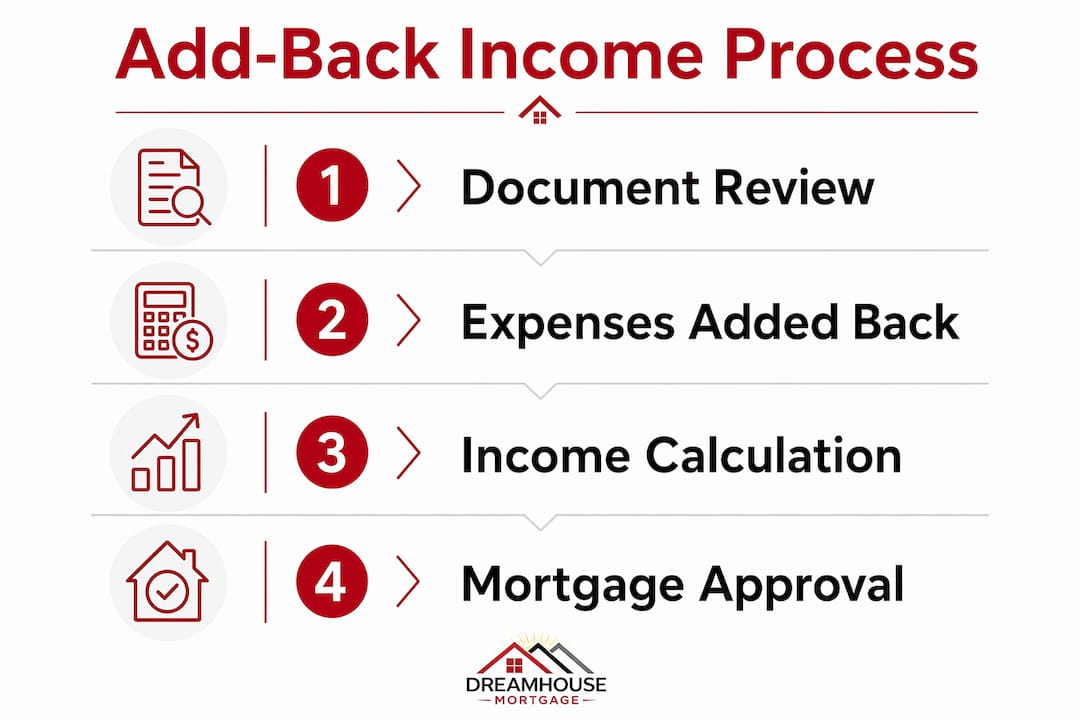
Proper documentation is non-negotiable. Tax returns, profit and loss statements, invoices, and bank statements are all required to substantiate each add-back item. A claim without supporting paperwork will not survive underwriting.
How do lenders calculate qualifying income using add-backs?
Lenders perform a cash flow analysis starting with your net business income, then add back non-cash expenses and subtract non-recurring income to arrive at a normalized qualifying figure. This process is more involved than reviewing a T4 slip, and the methodology varies meaningfully across lender types in Alberta.
The general underwriting sequence works like this:
- Start with net business income from your Notice of Assessment or business financial statements. This is the baseline figure before any adjustments.
- Add back non-cash deductions such as depreciation, amortization, and depletion. These restore paper losses that did not affect your cash position.
- Add back one-time expenses that are clearly documented as non-recurring. Legal fees from a resolved dispute or a one-time equipment write-off qualify here.
- Subtract non-recurring income such as a one-time contract payment or an insurance settlement. Lenders want income that will continue, not windfalls.
- Average the result over two years. Most lenders require two full years of business income history and use the average of both years as the qualifying figure.
Income volatility is a critical factor. Year-over-year declines greater than 20% can negatively affect eligibility even after add-backs are applied. A lender who sees your adjusted income rise in year one and fall sharply in year two will use the lower figure or decline the application outright. Add-backs improve your income profile, but they do not override a pattern of instability.
“Mortgage approval focuses on sustainable forward cash flow, not just reported net income. Adding back depreciation and amortization aligns income closer to actual cash flow but does not override income volatility or business losses.” — Homebuyer.com
Lender type also matters significantly. Banks and federally regulated lenders in Canada apply strict add-back criteria with limited flexibility. Credit unions operating under provincial regulation in Alberta often apply more judgment-based underwriting. Private lenders apply more flexible criteria and may accept a broader range of documented add-backs to increase qualifying income, though their rates reflect that flexibility. Understanding which lender type fits your income profile is a core part of the mortgage planning process. Dreamhouse Mortgage works with all of these lender categories, which is a meaningful advantage when your income does not fit a standard template.
For a detailed comparison of how each lender type treats self-employed income, the self-employed mortgage lender types guide from Dreamhouse Mortgage is a practical starting point.
What are alternative mortgage options beyond add-back income?
Self-employed borrowers unable to qualify using tax-return income alone may use alternative documentation methods such as bank statement loans or CPA-verified profit and loss statements. These options exist specifically for situations where the add-back calculation still does not produce enough qualifying income.
The table below compares the four main alternative qualification methods available to self-employed borrowers in Alberta:
| Method | How Income Is Calculated | Best For | Key Limitation |
|---|---|---|---|
| Add-back adjusted tax return | Net income plus documented non-cash and one-time expenses | Borrowers with stable, growing income and clean returns | Requires two years of filed returns |
| Bank statement loan | Average monthly deposits over 12–24 months, less an expense factor | Borrowers with strong deposit history but heavy deductions | Lender applies a blanket expense ratio that may understate income |
| CPA-prepared P&L statement | Accountant-certified profit and loss without tax return | High-profit businesses with inconsistent deposit patterns | Lender scrutiny is high; CPA must be licensed and credible |
| Debt-Service Coverage Ratio (DSCR) loan | Rental income covers the mortgage payment | Real estate investors with income-producing properties | Does not apply to owner-occupied primary residences |
Bank statement loans average deposits over 12–24 months and apply an expense factor to estimate net income. This works well for borrowers who deposit consistently but claim heavy deductions. The trade-off is that the lender’s expense factor may not reflect your actual cost structure, which can cut qualifying income.
P&L-only loans can yield significantly more qualifying income for businesses with high profits but inconsistent deposits. A Calgary contractor who invoices large commercial clients quarterly may show irregular deposits but strong profitability. A CPA-prepared statement captures that reality better than a bank statement average.
DSCR loans are a separate category entirely, designed for investment property mortgage applicants. The lender evaluates whether the property’s rental income covers the mortgage payment, with minimal focus on your personal income. This is particularly relevant for Alberta investors in Calgary, Chestermere, or Red Deer who hold or are acquiring rental properties.
Pro Tip: Do not assume one method is always superior. Run the numbers on your actual tax returns, bank statements, and P&L before choosing a qualification path. A mortgage broker with access to multiple lender types can model all three scenarios and show you which produces the highest qualifying income for your specific situation.
For a broader look at non-traditional mortgage options, including how lenders evaluate alternative income documentation, that resource covers the current landscape in useful detail.
How should self-employed borrowers prepare add-back income documentation?
Self-employed borrowers in Alberta should begin organizing add-back income documentation at least 12–24 months before applying for a mortgage. Mortgage qualification focuses on reliable forward income, and lenders need to see a consistent, well-documented income history before they approve a file.
The preparation process covers several distinct areas:
- Complete tax returns with all schedules: Lenders require two years of personal and business tax returns, including all supporting schedules. Missing pages or incomplete filings create delays and raise underwriting flags.
- Notices of Assessment from the Canada Revenue Agency: These confirm your filed income and that no taxes are outstanding. Outstanding CRA balances are a serious qualification obstacle.
- Detailed profit and loss statements: These should be prepared or reviewed by a licensed accountant and should clearly separate recurring operating expenses from one-time or non-cash items.
- Bank statements for 12–24 months: Both personal and business accounts. Lenders use these to verify that deposits align with reported income and to identify any large unexplained transfers.
- Invoices and contracts supporting add-back claims: If you are claiming a one-time legal fee or an extraordinary repair as a non-recurring expense, you need the invoice and a brief written explanation of why it will not recur.
Working with both an accountant and a mortgage broker before filing your taxes is the most effective strategy available to self-employed borrowers. Add-backs require careful documentation and timing, and a tax strategy that minimizes your CRA bill may simultaneously reduce your qualifying income to a level that blocks mortgage approval. These two goals require coordination, not separate conversations.
Add-back treatment varies widely across lender policies, so confirming which items your target lender accepts before you apply prevents surprises during underwriting. Mortgage professionals advise confirming eligible add-back items with lenders early, including whether dollar caps apply and whether income averaging is used after adjustments.

The mortgage checklist for Calgary from Dreamhouse Mortgage is a practical document-by-document guide that self-employed borrowers across Alberta have used to organize their files before submission.
Pro Tip: If your income declined in the most recent tax year, file your application before the new year’s return is required. Lenders using a two-year average will include the stronger prior year, which can meaningfully improve your qualifying income.
Key takeaways
Add-back income is the most direct tool self-employed borrowers have to close the gap between taxable income and actual cash flow when qualifying for a mortgage in Alberta.
| Point | Details |
|---|---|
| Add-backs restore non-cash expenses | Depreciation, amortization, and business-use-of-home deductions are added back to increase qualifying income. |
| Two-year averaging is standard | Most lenders average two years of adjusted income; a sharp decline in year two reduces the qualifying figure. |
| Lender policies vary significantly | Banks, credit unions, and private lenders apply different add-back rules. Confirm eligibility before applying. |
| Alternative methods exist | Bank statement loans and CPA-prepared P&L statements can produce higher qualifying income when tax returns fall short. |
| Early preparation is critical | Start organizing documentation 12–24 months before applying and coordinate tax strategy with mortgage planning. |
What i have learned working with self-employed borrowers in alberta
The most consistent pattern I see with self-employed clients in Calgary, Edmonton, Airdrie, and Cochrane is this: they come to me after a bank has already declined them, and the reason is almost always the same. Their accountant did an excellent job reducing their tax bill, and their mortgage application paid the price for it.
Add-back income is a legitimate and powerful tool, but it is not automatic. I have reviewed files where a borrower had $40,000 in depreciation and amortization that a lender would have added back, but the borrower never mentioned it because they assumed the lender would find it. Lenders do not hunt for add-backs on your behalf. You and your broker need to identify them, document them, and present them clearly.
The other misunderstanding I encounter regularly is the belief that add-backs alone can rescue a declining income trend. They cannot. If your business earned $120,000 adjusted in year one and $85,000 adjusted in year two, the lender sees a business under pressure. No amount of add-back documentation changes that narrative. In those cases, I redirect clients toward bank statement loans or CPA-prepared P&L options, or I recommend waiting six months and rebuilding the income picture before applying.
What actually works is planning. The self-employed borrowers who get approved on their first application are the ones who sat down with their accountant and their mortgage broker at the same time, 18 months before they wanted to buy. They made deliberate choices about which deductions to claim and which to defer. They kept their CRA account current. They maintained clean, organized bank statements. That level of preparation is not complicated. It just requires starting early.
My honest advice: do not treat your mortgage application as a separate event from your tax filing. They are connected, and the decisions you make in April affect what you can borrow in October.
— Guriqbal Chahal, MBA, PMP
Work with dreamhouse mortgage on your self-employed mortgage strategy
Self-employed mortgage qualification in Alberta requires a broker who understands how add-back income works across multiple lender types, not just one bank’s policy. Dreamhouse Mortgage, led by Guriqbal Chahal, MBA, PMP, works with banks, credit unions, alternative lenders, and private lenders across Calgary, Edmonton, Airdrie, Cochrane, Chestermere, Okotoks, Red Deer, and surrounding communities. The team specializes in building mortgage files that present add-back income clearly and match each application to the lender most likely to approve it.

Whether you are buying your first home, upgrading, or refinancing, Dreamhouse Mortgage provides a personalized review of your income documentation and identifies every eligible add-back before your file goes to a lender. Visit the Calgary mortgage broker profile to learn more, or explore self-employed mortgage options in Alberta to understand the full range of products available to you.
Contact Guriqbal Chahal, MBA, PMP, Mortgage Broker, Dreamhouse Mortgage at 403-966-6072.
Find Dreamhouse Mortgage on Google
FAQ
What is add-back income in a self-employed mortgage?
Add-back income is the process lenders use to restore non-cash or one-time business deductions to your net income, producing a higher qualifying income figure. Common add-backs include depreciation, amortization, and business-use-of-home expenses.
Which lenders in alberta accept add-back income for self-employed borrowers?
Banks, credit unions, alternative lenders, and private lenders in Alberta all consider add-backs, but their policies differ significantly. Add-back treatment varies widely across lenders, so confirming eligibility with your broker before applying is the most reliable approach.
How many years of income do lenders require for self-employed mortgage qualification?
Most lenders require two full years of business income history and calculate qualifying income as the average of both years. A significant income decline in the most recent year reduces the qualifying average even after add-backs are applied.
Can i qualify for a mortgage if my tax return shows low net income?
Yes. If your tax return understates your cash flow due to legitimate deductions, add-backs can increase your qualifying income. If the adjusted figure is still insufficient, alternative documentation methods such as bank statement loans or CPA-prepared profit and loss statements may produce a higher qualifying income.
How far in advance should i prepare my add-back income documentation?
Start preparing at least 12–24 months before your planned mortgage application. Mortgage readiness planning that far in advance allows you to coordinate your tax strategy with your mortgage goals and build the income history lenders require.