To add a spouse to your mortgage, the lender has to approve them as a joint borrower, and that means a full joint application: both incomes, both debts, both credit histories. Adding them to your home’s title is a separate step. In Alberta it is done with a Transfer of Land, usually through a lawyer. Many Calgary, Airdrie and Cochrane couples assume one step covers both. It does not, and the order you do things in affects your cost, your qualification and your legal position.
This guide explains how the process works under Canadian rules, what a lender looks at, which costs can appear, and where to get legal advice. It also covers the reverse question, removing a co-borrower, because the same logic applies.
TL;DR
- Adding a spouse to the mortgage (the debt) and to the title (ownership) are two different tasks, handled by different parties: the lender or broker, and an Alberta real estate lawyer.
- A joint borrower becomes equally responsible for repaying the unpaid balance, so this is a shared liability and not just permission to make payments.
- Your spouse’s income can improve qualification, but their debts, credit and unverifiable income can lower the amount you are approved for.
- Depending on the lender and the structure, the change may be a simple amendment or may be treated as a refinance or lender switch, which brings extra costs. Ask which one it is before you sign.
- Call Guriqbal Chahal at 403-966-6072 before you contact your current lender. We can compare how several lenders would treat the change.
Table of Contents
- Mortgage, title and spouse: three things people mix up
- Why couples add a spouse in the first place
- What joint liability really means
- How lenders assess the new application
- The process, step by step
- Adding a spouse to title in Alberta
- What it can cost
- Insured mortgages and first-time buyer rules
- Your right to written disclosure
- Removing a co-borrower
- Our perspective: treat it as a household decision
- Work with a Calgary mortgage broker before you apply
- Frequently asked questions
- Sources
Mortgage, title and spouse: three things people mix up
Before you start, separate the three questions couples usually blur together.
- Who owes the money? This is the mortgage. Anyone who signs the mortgage agreement as a borrower is liable for the debt.
- Who owns the home? This is the title, the record at Alberta Land Titles of the registered owners and how they hold the property.
- Who has legal rights in the home? This is where marriage, cohabitation agreements and Alberta’s dower framework come in.
A spouse can be on title without being on the mortgage, and a spouse can be on the mortgage without being on title. Lenders often prefer that anyone on title also signs the mortgage, because it keeps the security simple. But that is a lender policy, not a law of nature. The right structure depends on your situation.
As the Alberta guidance on land registration shows, the mortgage secures the debt, while the Transfer of Land and the dower framework govern title and certain spousal rights. That is why mortgage advice alone is not enough when ownership is changing. You need your broker and a lawyer working from the same facts.
Why couples add a spouse in the first place
The most common reasons we see in Calgary and the surrounding communities:
- Qualifying for the purchase. One partner’s income is not enough for the home you want in Beltline, Marda Loop, Airdrie’s Windsong or Cochrane’s Heartland, so both apply together from the start.
- Marriage or a new partnership. One person owned the home before the relationship and wants to share ownership and responsibility.
- Renewal or refinance. The mortgage is coming up for renewal and it is a natural moment to restructure.
- Self-employment income changes. One spouse’s income is easier to document than the other’s, and the couple wants the strongest combined file.
- Estate and family planning. Joint ownership affects what happens if one partner dies, which is a question for your lawyer.
If you are still before purchase, this is simply a joint application, and the process in our Calgary first-time homebuyer guide applies. The rest of this article focuses on adding a spouse to an existing mortgage or an existing home.
What joint liability really means
When your spouse signs as a joint borrower, they take on the same obligation you have. The Financial Consumer Agency of Canada (FCAC) states that a joint borrower is equally responsible for repaying the unpaid balance. It also notes that joint borrowers generally have rights to the same disclosure information and ongoing statements from a federally regulated lender.
In practice:
- If one of you stops paying, the lender can look to either of you for the full balance.
- The mortgage appears on both credit reports, so late payments hurt both scores.
- Your spouse’s existing debts will be counted when you apply for other credit, and the mortgage will be counted against them too.
FCAC’s guidance on managing money as a couple says the same thing in plain terms: if you borrow together, know your responsibilities as a joint borrower. Agree before applying how payments will be shared, who can draw on any attached credit, and what happens if one income drops.
Pro Tip: Have the payment-sharing conversation before the application, not after approval. If a home equity line of credit is attached to the property, decide whether the new borrower will have access to it. Joint access means joint liability for every dollar drawn.
How lenders assess the new application
A lender or broker cannot simply insert a name. According to Canada.ca’s guidance on getting preapproved for a mortgage, the application is reassessed using both borrowers’ income, debts, credit history, identification, employment information, assets and down-payment or equity evidence. The lender may then approve a lower amount, ask for a larger down payment, charge a higher rate, or require a co-signer.
That means your spouse can help or hurt the file.
When a spouse helps
- They have stable, verifiable employment income.
- They carry low debt relative to income.
- Their credit history is clean and long enough to score well.
When a spouse can reduce what you qualify for
- They carry large credit card, car loan, student loan or line of credit balances. Canada.ca lists these as debts lenders consider.
- Their credit report shows missed payments or collections.
- Their income cannot be documented under the lender’s rules, which is common with new businesses or commission-heavy roles.
If one of you is self-employed, the way income is calculated differs from lender to lender, and our guide on add-back income for self-employed borrowers explains how some lenders treat business write-offs. If a credit issue is the obstacle, read how a credit bureau is used in a mortgage application before anyone applies, because every hard inquiry matters.
The stress test still applies
The application is also tested against qualifying rules, not just your current rate. Our Canadian mortgage qualification rules guide walks through how the qualifying rate and debt ratios work for Alberta buyers. A joint application is tested on the combined figures.
The process, step by step
Canada.ca does not set one universal timeline or fee for this, because lender policies and transaction structures differ. The sequence below reflects the steps that apply in nearly every case.
- Decide what you actually want. Mortgage only, title only, or both. Write down the answer, because it determines who you call.
- Talk to a mortgage broker or your existing lender. Ask whether the change can be done as an amendment to the current mortgage, or whether it would be treated as a refinance, an equity transaction, a lender switch or a discharge.
- Submit a complete joint application. Both spouses provide identification, employment and income proof, asset statements, debt details, and equity or down-payment documentation.
- Complete underwriting. The lender reviews both credit files and applies stress-test and debt-ratio requirements. If the mortgage is insured, the insurer may also review the file.
- Retain an Alberta real estate lawyer if title is changing. The lawyer prepares the Transfer of Land and registers it, and coordinates with the lender.
- Review and sign the amended documents. Check names, legal land description and ownership structure line by line.
- Keep the paper trail. Save the amended commitment, the signed agreement and the registration confirmation.
Pro Tip: Ask for a written list of costs before you authorize any change: lender fees, appraisal, legal, registration, discharge and any penalty. A clear list prevents surprises at signing.
Documents to gather for the joint file
- Government photo ID for both spouses
- Recent pay stubs, a letter of employment, and the last two years of Notices of Assessment from the Canada Revenue Agency
- For self-employed spouses, business financials and the documents your lender requires
- Current mortgage statement and property tax assessment
- Statements for debts, lines of credit and savings
- If a gift or transfer of funds is involved, the paperwork showing where the money came from
Adding a spouse to title in Alberta
Changing registered ownership of an Alberta property generally requires a Transfer of Land. According to the province’s Land Titles guidance, the form records the new owners and the intended type of tenancy, such as joint tenancy or tenancy in common, and may require dower-related documentation where applicable.
The Alberta Land Registry’s page on completing the Transfer of Land form specifically addresses the case where there is one current owner. It lists a statement in the Affidavit Re Value of Land that the transfer is from a married person to that person and their spouse, for the dower requirement when adding a spouse to title.
Joint tenancy or tenancy in common
This choice is a legal one, not a mortgage one, and it affects what happens to each person’s share. Ask your Alberta lawyer to explain the consequences for your family, especially if you have children from a previous relationship, a cohabitation agreement or a marriage contract. We do not give legal advice on ownership, and neither should anyone who is not your lawyer.
Avoid document mismatches
Alberta’s Land Titles guidance on submitting documents for registration identifies mismatched names, land identifiers and tenancy details between the transfer and mortgage documents as common problems. Before signing, confirm three items on every document:
- The exact legal names of both spouses, as they appear on ID
- The legal land description and title number
- The tenancy type you intend
If you are also buying, our guide to Alberta land transfer fees explains how registration fees work in this province, where there is no land transfer tax as there is in some others.
What it can cost
No single number applies to every couple, and we will not invent one. The cost depends on how the lender classifies the change.
| Structure | What can be involved |
|---|---|
| Simple amendment with current lender | Lender administration fee (if any), legal fees for title transfer, Land Titles registration |
| Refinance with current lender | Appraisal, legal fees, possible early repayment charge depending on contract, new terms and rate |
| Switch to a new lender | Appraisal, title search, title insurance, legal fees, discharge fee from old lender, possible early repayment charge |
| Insured mortgage re-underwriting | Possible new mortgage-insurance premium, plus the items above |
Canada.ca lists these possible costs in its guidance on discharging a mortgage: appraisal, title search, title insurance, legal fees, administrative fees, a new insurance premium and an early repayment or discharge fee. The same page says discharge fees may range from no charge up to $400 where not otherwise regulated, and professional discharge fees are typically $400 to $2,500. Those figures apply to discharge transactions and are not a guaranteed price for adding a spouse.
If your lender calls the change a refinance, our breakdown of Calgary refinance closing costs shows what to budget, and mortgage penalty types in Canada lists the payout inputs to request from any lender. If you want broader reading on how borrowers sometimes recover money from lender charges, this explainer on how mortgage overcharge settlements work is a useful reference, though it does not change what you owe on your own file.
Pro Tip: The cheapest time to add a spouse is often at renewal, when you can change the borrower line without an early repayment charge. Mark your renewal date and start the conversation four to six months ahead. Our mortgage renewal rate guide explains why that window matters.
Insured mortgages and first-time buyer rules
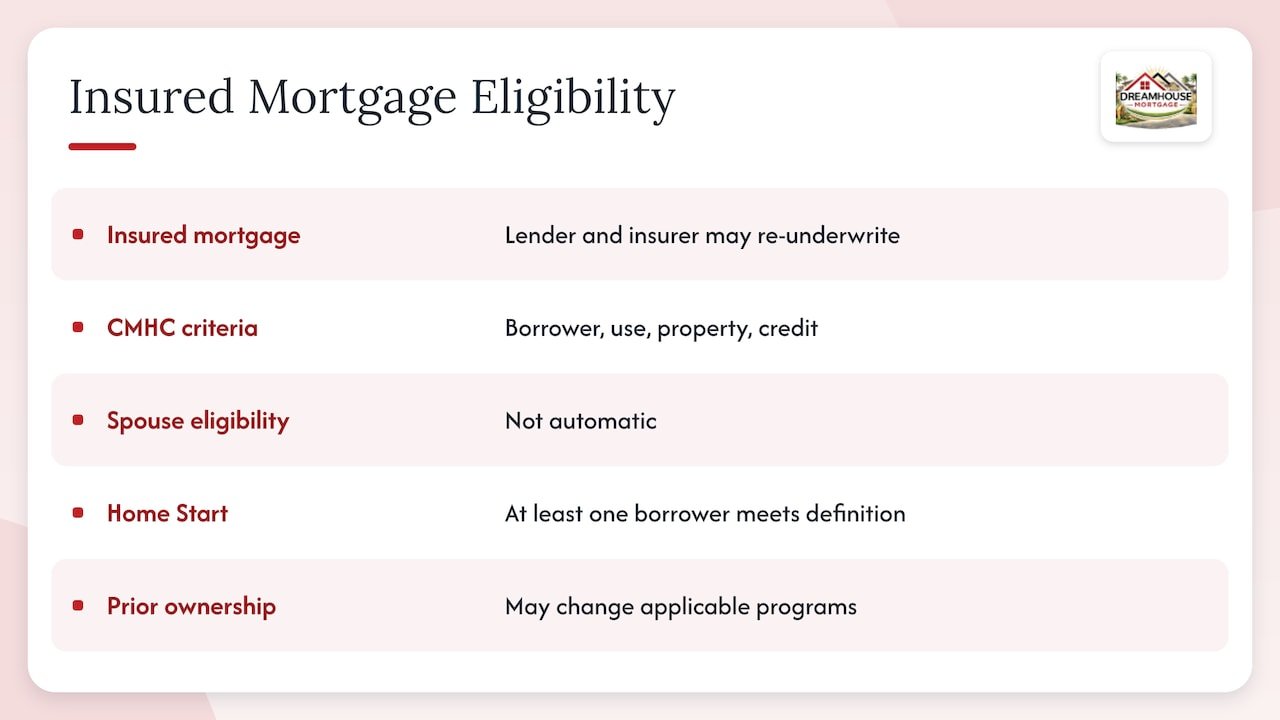
If your mortgage is insured (typically when the down payment is under 20%), adding a spouse may require the lender and the insurer to re-underwrite the file. CMHC’s published requirements distinguish eligible borrowers, owner-occupied use, property requirements, creditworthiness and borrower and co-borrower rules, so eligibility is not automatic just because the person is a spouse.
First-time buyer status is a related trap. For CMHC’s Home Start product, at least one borrower must meet its first-time homebuyer definition. Adding a spouse does not turn every borrower into a first-time buyer, and a spouse who has owned before can change which programs apply. Before you add someone, review our first-time home buyer benefits guide so you do not give up a benefit by accident.
Your right to written disclosure
When a federally regulated lender changes the original mortgage agreement, it must provide written disclosure of the change no later than 30 days after making it, according to Canada.ca’s mortgage rights guidance. That rule applies to federally regulated banks and federal credit unions. Other lenders, including provincially regulated credit unions, may follow different frameworks and contractual procedures.
The practical safeguard is simple: ask for the amended commitment or agreement before you sign, and keep it with your records.
Removing a co-borrower
Many people reading about adding a spouse are really asking the opposite question: how do we take a name off? The principles are the same, and the lender’s consent is the central issue.
- Removing someone from the title is a Transfer of Land handled by a lawyer, but the lender must still agree if a mortgage is registered.
- Removing someone from the mortgage means the remaining borrower must qualify alone on income, debts and credit. The lender will not release a borrower just because the couple agrees.
- If the remaining borrower cannot qualify alone, options include a co-signer, a different lender with different policies, or a sale.
After a separation, you will also need legal advice on property division, which is outside the mortgage conversation. A family lawyer in Alberta is the right professional for that part. Once the legal terms are settled, a broker can test which lenders will accept the new structure. For people carrying other debts at the same time, our debt consolidation mortgage page explains when rolling debts into the mortgage may help the single-income math.
Our perspective: treat it as a household decision
At DreamHouse Mortgage, we look at adding a spouse the same way we look at any financing decision: what does the household need, and which lender policy fits it best? Because we work with banks, credit unions, monoline lenders, alternative lenders and private lenders, we are not limited to one lender’s rules about joint borrowers, income types or credit. That matters here. Two lenders can reach different answers on the same couple.
We also want couples to understand what they are signing. A joint mortgage is a shared promise. If your spouse’s income helps you buy or keep a home in Calgary, Airdrie or Cochrane, that is a good reason to add them. If the main reason is to satisfy a lender’s request, pause and ask whether another lender or structure would let you keep the arrangement you actually want.
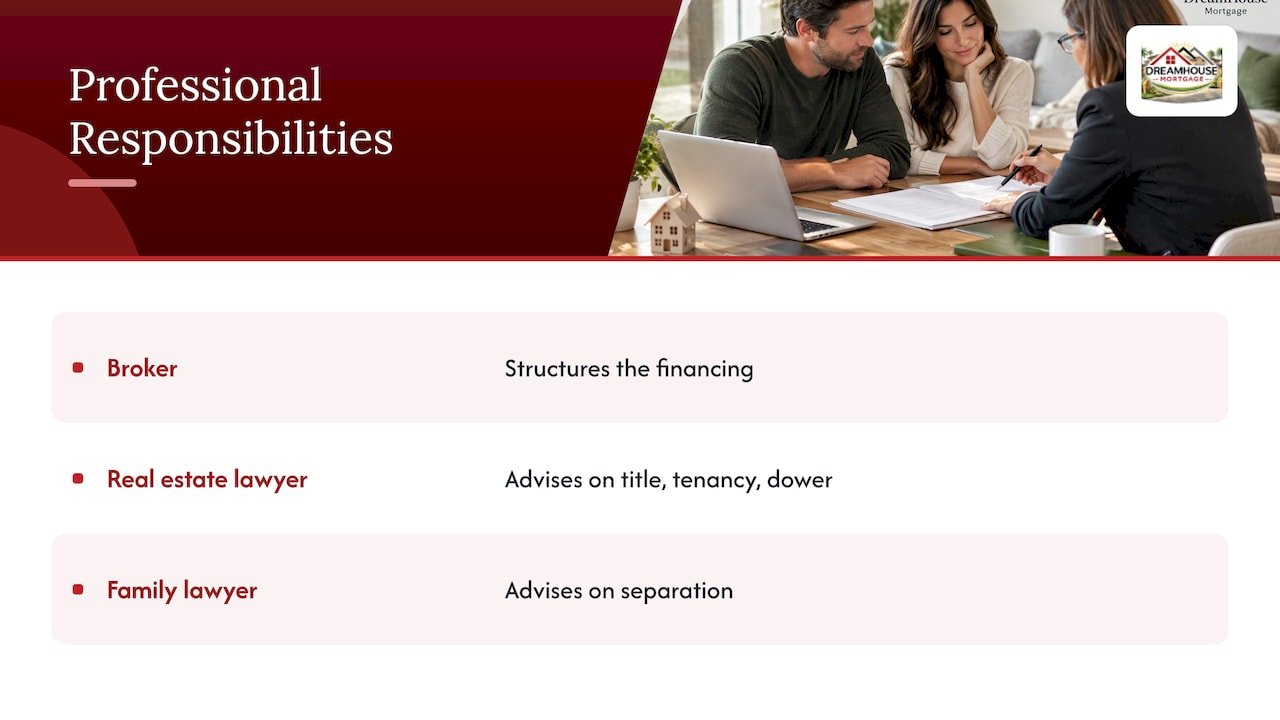
Finally, we stay in our lane. We structure the financing. Your Alberta real estate lawyer advises on title, tenancy and dower, and a family lawyer advises on separation. When those professionals and your broker share the same facts early, the closing is smoother and the documents match.
— Guriqbal Chahal, MBA, PMP
Work with a Calgary mortgage broker before you apply
If you are adding a spouse as part of a purchase, a renewal or a refinance, we can compare how lenders would treat the joint application before anything is submitted. That protects your credit file from unnecessary inquiries and shows you the likely cost of each route. Whether you are a first-time buyer in Calgary, a family in Airdrie, or a couple in Cochrane, start with our first-time buyer mortgage services or see everything we offer.
Call Guriqbal Chahal, MBA, PMP, Mortgage Broker, at 403-966-6072. You can also find us on our Google Business Profile.
Frequently asked questions
Can I add my spouse to my mortgage without refinancing?
Sometimes. Some lenders allow a borrower to be added by amendment, while others treat the change as a refinance or require a new mortgage. Ask your lender or broker to classify the transaction in writing before you compare costs.
Does adding my spouse to the mortgage put them on title?
No. In Alberta, ownership changes through a Transfer of Land registered at Land Titles, which is separate from the lender’s approval. You may need a lawyer for the title change even after the lender has approved your spouse as a borrower.
Will adding my spouse lower my interest rate?
Not automatically. A second income can improve qualification, but the lender may also approve a lower amount, ask for a larger down payment or charge a higher rate if the spouse has heavy debts or weak credit. A broker can test the file with several lenders.
What happens to a joint mortgage if one spouse dies?
The answer depends on how title is held and on the mortgage contract, so ask an Alberta real estate lawyer and, for estate questions, an estate lawyer. In general, the lender’s agreement stays in force and the remaining parties should notify the lender promptly.
Sources
- Disclosure of information to joint borrowers: know your rights, Canada.ca
- Managing your money as a couple, Canada.ca
- Getting preapproved for a mortgage, Canada.ca
- Preparing to get a mortgage, Canada.ca
- Discharging a mortgage, Canada.ca
- Mortgage rights when applying, Canada.ca
- Land titles overview, Alberta.ca
- Transfer of land, Alberta Land Registry
- Alberta land registration publication, Open Alberta
- Pending Registration Queue: Tips for Submission, Open Alberta
- CMHC Home Start