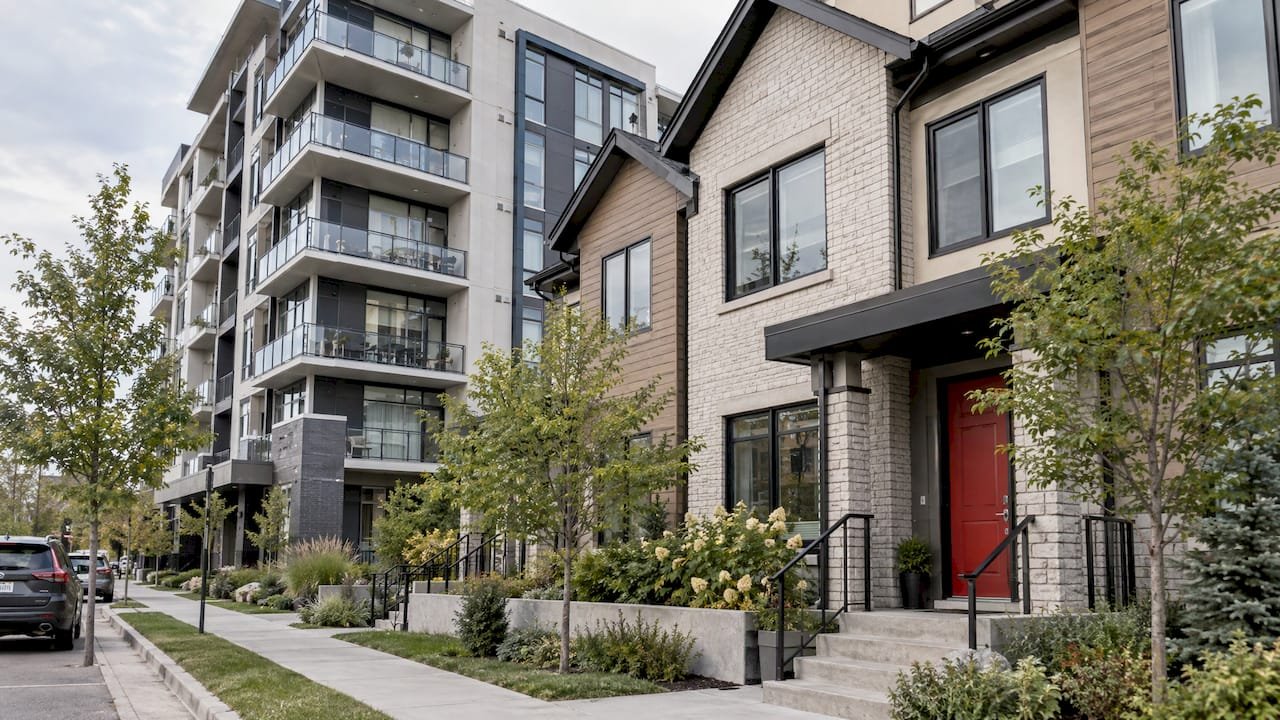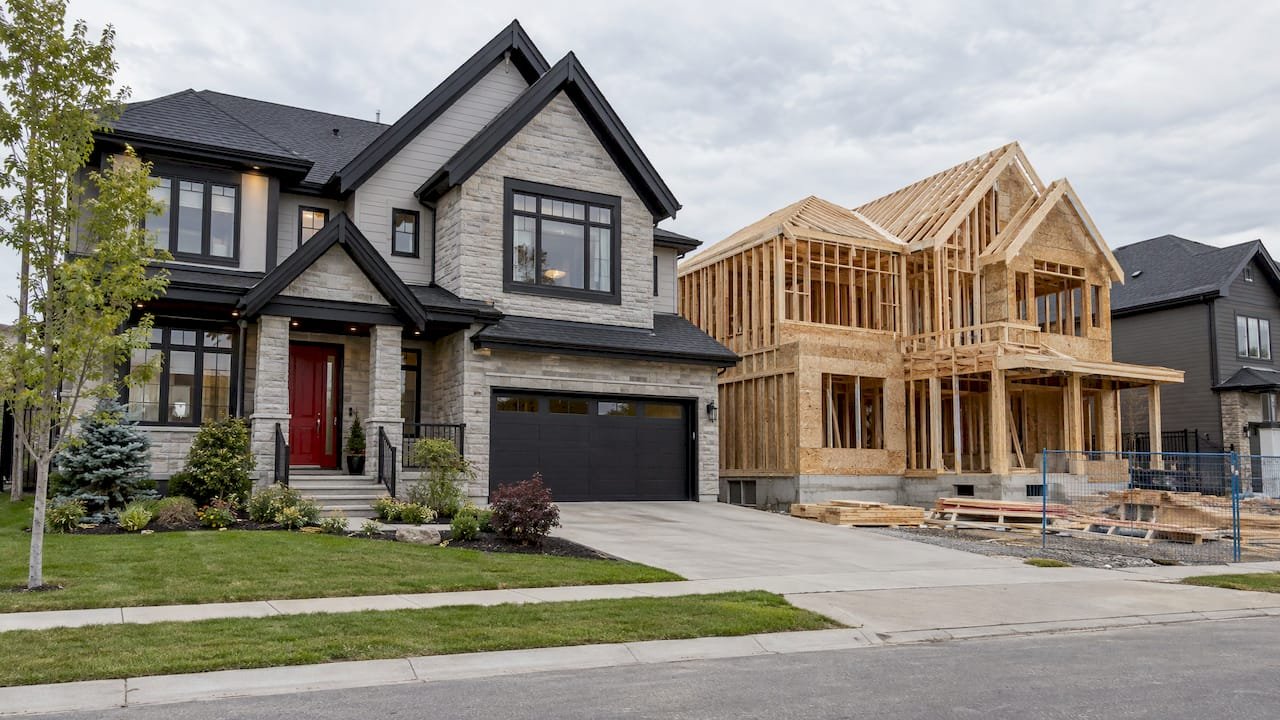
A condo and a townhouse are not opposites. “Condo” describes how you own a home, and “townhouse” describes how it is built, so a townhouse can be a condo. For a first-time buyer in Calgary, Airdrie or Cochrane, the real decision is what you own, what you maintain and what you pay each month, because those three things change what a lender will approve. Before you fall for a unit, get your numbers checked. You can call Guriqbal Chahal at DreamHouse Mortgage on 403-966-6072 and we will run both scenarios for you.
TL;DR
- A condo is a form of legal ownership (you own your unit and share common property). A townhouse is a building style. Many Calgary townhouses are condos, and some are freehold.
- Freehold townhouse: you own the house and the lot and pay for the roof, exterior and snow yourself. Condo townhouse: you pay monthly fees and the corporation handles shared property.
- Compare the full monthly cost, not the price tag. Condo fees count in mortgage qualification, and a weak reserve fund can mean special assessments.
- Duplexes and condo apartments follow different down payment rules than a one-unit home, so confirm the property type before you make an offer.
- A pre-approval with the right property type in mind keeps your offer realistic.
Table of Contents
- What Is the Difference Between a Condo and a Townhouse?
- Condo Townhouse vs Freehold Townhouse
- What Do Condo Fees Actually Cover?
- What Does It Cost Each Month in Calgary?
- Which Townhouse Drawbacks Should You Plan For?
- Condo vs House for a First-Time Buyer
- Duplex vs Townhouse
- How the Property Type Affects Your Mortgage
- A Checklist Before You Choose
- Get the Numbers Before You Make an Offer
- Our Perspective
- FAQ
- Sources
What Is the Difference Between a Condo and a Townhouse?
CMHC, Canada’s national housing agency, explains that a condominium is a form of legal ownership, not a style of construction. Condos can be apartment-style buildings, townhouse or rowhouse complexes, stacked townhouses, duplexes and even detached houses.
A townhouse, by contrast, describes the shape: a home attached side by side to others, each with its own outside entrance and a shared wall. CMHC’s guide to buying a first home describes it that way.
That is why a search for “condo vs townhouse” can mislead. Two row homes on the same Calgary street can look identical and be owned in two different ways. CMHC’s Homebuying Step by Step guide names the main forms:
- Freehold: you own the building and the land, and you carry the full cost of maintenance.
- Condominium: you own your unit and share ownership of common areas, and the condo corporation is responsible for repair and maintenance of common property.
- Leasehold: you own the building but lease the land.
- Co-operative: you buy a share in the building. No mortgage loan insurance is available, so a minimum 20% down payment is required.
Most first-time buyers choose between the first two.
Condo Townhouse vs Freehold Townhouse
This is the comparison that matters most when the listing says “townhouse”.
In a regular townhouse condominium, CMHC explains that the unit typically consists of the interior, while the exterior and land are common elements whose repair may be the corporation’s responsibility. In a freehold condominium you own the plot and the structure and are normally responsible for the whole house, including exterior walls, roof, lawn and driveway.
One Canadian explainer on condo versus freehold townhouses puts the cost question well: the fair comparison is not a fee versus nothing, but a fee versus the same costs paid directly. A freehold owner buys their own building insurance, replaces their own roof and arranges their own snow clearing. A condo owner’s fee bundles those items and spreads big costs across owners and years through the reserve fund. Freehold is usually cheaper in most months and more expensive in the month the roof is due. A condo costs more, but steadier.
| Condo townhouse | Freehold townhouse | |
|---|---|---|
| What you own | Your unit plus a share of common property | The home and the lot |
| Monthly fee | Yes, set by the corporation | Usually none |
| Roof, exterior, snow | Handled through the corporation | Your responsibility |
| Rules | Bylaws on pets, rentals, parking, exterior changes | Municipal rules and any caveats on title |
| Insurance | Your own unit-owner policy | Full home insurance |
| Big repair bills | Spread through fees and the reserve fund | Land on you in one hit |
Some properties sit in between. A shared driveway, a party wall agreement or a private lane can come with a fee even on a freehold-style title, so ask for the title type in writing before you make an offer.
What Do Condo Fees Actually Cover?
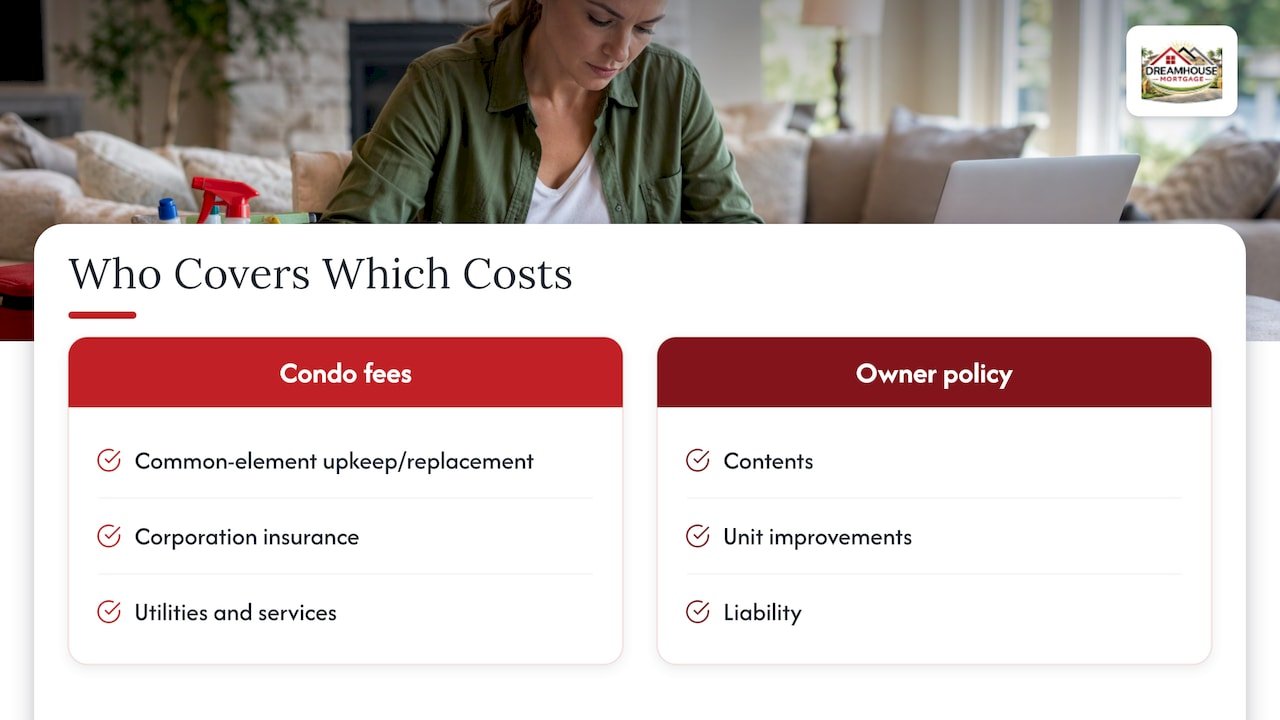
CMHC says condo fees cover upkeep and replacement of common elements, the corporation’s insurance, utilities and services. The corporation’s policy does not replace yours. Unit owners need their own policy for contents, improvements to the unit and liability.
In Alberta, corporations must keep a reserve fund for major repairs, and a reserve fund study is required every five years, according to the province’s condo law resource. That study is the document to read before you buy. It tells you whether the roof, heating system and doors have been planned for.
Calgary.com suggests a healthy reserve fund holds at least three to six months of operating costs, so repairs do not trigger special assessments. CMHC advises condo buyers to review the corporation’s financial and technical audits and to understand how it makes decisions on finances, common property and rules.
Pro Tip: Ask your realtor for the bylaws, the reserve fund study, the budget and the last few years of minutes before the condition period ends. A fee that looks low can be low because the reserve fund is thin.
What Does It Cost Each Month in Calgary?
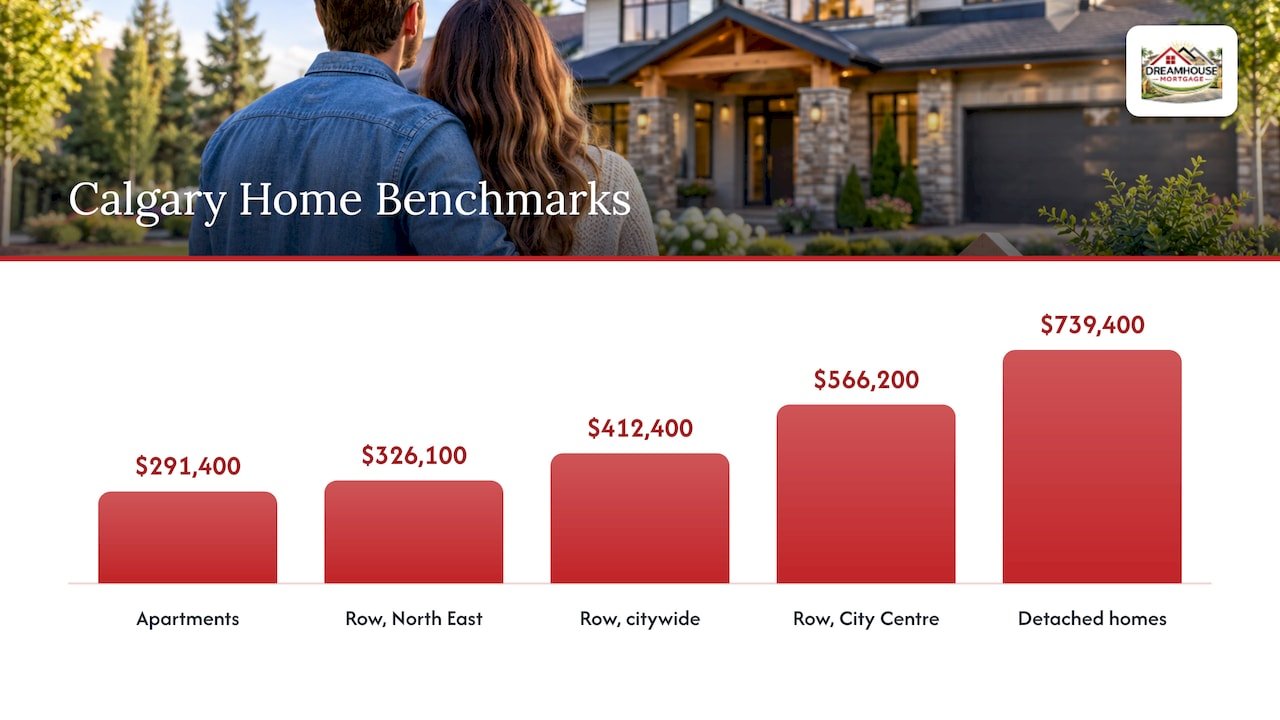
Calgary’s detached, row and apartment prices differ widely, and they move every month. CREB’s September 2026 benchmark for row homes was $412,400 citywide, against $291,400 for apartments and $739,400 for detached homes. CREB publishes updated figures every month, and the row-home benchmark varies by district, from $326,100 in the North East to $566,200 in City Centre.
For a worked monthly picture, a Calgary cost guide used December 2024 benchmark prices with 20% down and a 5.2% five-year fixed rate. It estimated total monthly ownership cost at about $3,270 for a row home and $2,600 for a condo. The same guide gives condo fees of $250 to $450 for townhouse complexes and $300 to $700 for condos, and suggests maintenance reserves of $150 to $250 per month for a townhouse and $50 to $100 for a condo. Treat these as an illustration from one period, not a quote. Your mortgage rate, down payment and fee will change the result.
There are two practical lessons:
- A lower price does not always mean a lower payment. A condo with a $600 fee can cost more per month than a freehold row home with a higher price and no fee.
- Fees count against you at approval. Lenders include condo fees in the debt service ratios used to calculate how much you can borrow. One Canadian guide notes lenders treat these fees as part of the GDS and TDS calculation, which lowers the maximum qualifying amount. Our guide to Canadian mortgage qualification rules explains those ratios.
Which Townhouse Drawbacks Should You Plan For?
Calgary.com lists the common trade-offs of townhouse living: monthly fees that can rise as buildings age, shared walls, rules on exterior changes and limited private outdoor space. It also notes transfer fees to the association at purchase and that end units are usually more desirable and more expensive.
Here is how to turn those points into decisions:
- Noise: visit at different times, on a weekday evening and on a weekend.
- Yard: if you have a dog, check the pet bylaw and the size of the outdoor space.
- Renovations: condo corporations can require approval even for interior work.
- Rentals: if you may rent the home out later, read the rental bylaw first.
Condo vs House for a First-Time Buyer
A detached house gives space, privacy and fewer restrictions on renovating, but you pay every maintenance bill and carry the highest purchase price. A condo usually has a lower purchase price, lower maintenance and insurance costs and amenities, with fees and less space in return. This summary comes from a first-time buyer guide, which also recommends budgeting for property tax and maintenance.
A townhouse sits between the two. In Calgary communities such as those in the south-east or north-west, or in commuter towns like Airdrie and Cochrane, a freehold row home can give you a front door, a small yard and a garage without a detached-house price. Whether that works depends on your monthly budget more than on the label.
Duplex vs Townhouse
A duplex is a single building divided into two homes. CMHC describes a duplex or triplex as a home reconfigured into multiple units, typically owned by one person who rents out the extra units. A townhouse is one home in a row. Like townhouses, duplexes can also be condos, so check title.
The financing rules differ by unit count. Under the federal insured mortgage rules, a one- or two-unit owner-occupied property can be insured with 5% down on the first $500,000 and 10% on the portion above, up to the $1.5 million cap in effect since December 15, 2024. Three- to four-unit properties require 10% down with at least one unit owner-occupied, and a purely rental property needs 20% down.
A duplex with a rental suite can help carry the mortgage. Lenders treat rental income differently: some count 50% of gross rent, some 80%, and some require a lease plus two years of tax returns. If you plan to rent out part of the property, see our guides on investment property mortgages in Calgary and second home vs investment property rules.
How the Property Type Affects Your Mortgage
Your down payment depends on the purchase price and on whether the property is owner-occupied. The minimum rules above apply to a Calgary condo or townhouse alike, but the property type still affects the file:
- Condo fees reduce the amount you qualify for.
- Reserve fund and building health can matter to the lender and the appraiser.
- Freehold properties carry no corporation fee, so more of your qualifying room goes toward the mortgage itself.
- Insured or insurable status depends on the price and down payment. Read our explanation of insured vs insurable mortgages and the minimum down payment in Calgary.
If you are borrowing part of your down payment, check how a borrowed down payment can shrink your approval before you shop. For the full first-time process, start with our Calgary first-time homebuyer mortgage guide.
A Checklist Before You Choose
- Confirm the title type in writing: freehold, condominium or a hybrid with a fee.
- Set a monthly ceiling, including mortgage, property tax, condo fee, insurance and a maintenance reserve.
- Request condo documents: bylaws, budget, reserve fund study, minutes and insurance details.
- Test the fee against your approval: a higher fee lowers the amount you can borrow.
- Match the property to your plans: pets, renting out a room, a growing family, or a move in five years.
- Get pre-approved first, with the property type you are considering. Our pre-approval requirements checklist for Alberta lists the documents to gather.
Get the Numbers Before You Make an Offer
We help Calgary, Airdrie, Cochrane and Chestermere buyers compare a condo, a townhouse and a house on the same payment basis. As a mortgage brokerage, we have access to banks, credit unions, monoline, alternative and private lenders, and we handle pre-approvals, lender selection and document collection. You can see our mortgage pre-approval service or our first-time buyer page.

Call Guriqbal Chahal, MBA, PMP, Mortgage Broker at 403-966-6072, or find us on our Google Business Profile.
Our Perspective
When a first-time buyer asks us whether to buy a condo or a townhouse, we start with the monthly payment and the approval, not the floor plan. The label on the listing tells you very little. The title, the fee and the reserve fund tell you a lot.
Our approach is to price both options side by side: the mortgage, the property tax, the fee or the maintenance reserve, and the insurance. Because we work with multiple lenders, we can look for the product that fits the property type you choose, and we explain each step so you know what is being approved.
A pre-approval is the right first move. It shows you a realistic price range across Calgary communities and commuter towns, before you fall for a home you cannot finance.
Guriqbal Chahal, MBA, PMP
FAQ
Is a condo better than a townhouse?
Neither is better in general. A condo suits buyers who want lower maintenance and a lower entry price, and a townhouse suits those who want more space and their own entrance. Because a townhouse can itself be a condo, compare the title type, fee and reserve fund rather than the label.
Is it better to buy a condo or a house in Canada?
It depends on your budget, how long you plan to stay and how much upkeep you want. A house gives more space and control but puts every repair on you, while a condo spreads major repairs through fees. Run both through a pre-approval so you can compare the payment you would actually qualify for.
What makes a house a condo?
The legal registration, not the building. CMHC states that a condominium is a form of ownership, so a detached house can be a condo. In a freehold condominium your unit may be the entire house, including exterior walls, roof and lawn, with fees going toward common elements.
What is the difference between a duplex and a townhouse?
A townhouse is one home in a row of attached homes. A duplex is one building with two homes, often owned by one person who rents out the second unit. Down payment rules depend on the number of units and whether you live in one of them.
Do I need a larger down payment for a condo or townhouse?
Not for the type alone. The federal minimum depends on the purchase price and owner-occupancy: 5% on the first $500,000 and 10% on the portion above, for a one- or two-unit home you will live in. Co-operative apartments are the exception and need 20% down.
Sources
- CMHC: Condominium Buyer’s Guide, Condo Basics
- CMHC: Condominium Buyer’s Guide, FAQs
- CMHC: Homebuying Step by Step
- CMHC: Buying your first home in Canada
- Condo Law Alberta: Reserve Fund
- Calgary.com: Should I Buy a Townhouse?
- Calgary Home Selling: True Monthly Cost of Owning a Home in Calgary
- JD Real Estate Calgary: Townhomes for Sale in Calgary
- HomesFound: Freehold vs Condo Townhouse
- WealthNorth: Types of Homes in Canada
- REMIC: Property Types
- Square One: The Ultimate First-Time Home Buyer’s Guide
Recommended
- Rent vs Buy Calgary 2026: Full Guide | Is It Worth It?
- Best Calgary Neighbourhoods for First‑Time Buyers in 2026: A Smart, Confident Guide to Buying Your First Home
- New Build vs Resale Calgary Mortgage: The Smart Winner for Buyers in 2026
- First Time Home Buyer in Calgary Alberta: How Much Income Do You Really Need?